
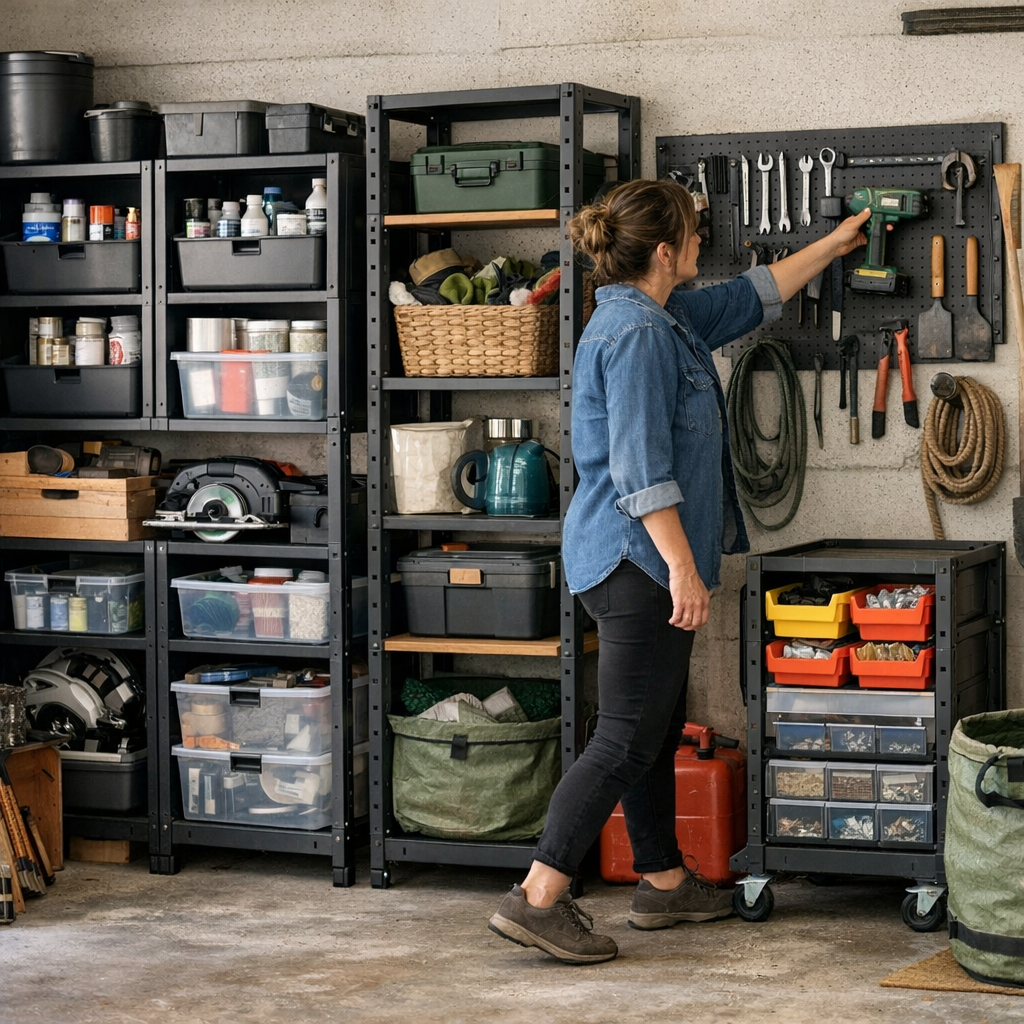
There’s a rush that comes with a freshly arranged garage or workshop. Racks finally bolted level, every bin matched and snapped in place, the floor swept and tools lined up in satisfying symmetry—for a moment, it feels like you’ve unlocked a new system, one that will keep chaos at bay. But then Monday turns up. You’re halfway into a fix, lugging in supplies or cleaning up after a project, and the honeymoon is over. Suddenly, that pristine arrangement starts showing where it truly holds up—and where it quietly slows you down.
When Storage Looks Tidy But Movement Stalls
The biggest trap for any organized garage or workshop is this: storage that solves “the mess” but creates frustration beneath the surface. On the outside, rows of identical bins and matching cabinets promise order. But come cleanup time, you find yourself hesitating. Did you stash those screws in this bin, or the next? Now you’re prying open lids, swapping trays, and replaying last week’s logic. The uniform look is clean, but your actual movements are anything but efficient.
Worse, when items are sorted simply by what fits—rather than what actually belongs together—things get muddled. The shovel sits next to a lug wrench. Extension cords end up jumbled with socket sets. And the solution? You shift a cart just to get to a shelf (again), or find yourself stretching awkwardly around a cabinet edge for something you need with one hand full. The wall might be lined, but it’s not working with you. And the floor—meant to be clear—becomes a holding pen for whatever doesn’t click neatly into your “system.” Every small stumble—overflow piles, blocked shelves—chips away at the smooth routine you set out to build.
Where Uniform Storage Breaks Down in Everyday Use
It’s under real, repeated use that most storage setups reveal their cracks. Sure, the matched system looks pristine and resets easily on a slow Sunday. But fast-forward to the next urgent repair or inventory restock, and you’re guessing which bin holds what, or which shelf silently shifted since last week’s cleanup. The ‘organized’ impression disappears as soon as you realize the rolling tool chest always sits in front of the one shelf you keep needing, but moving it means clearing a new cascade of piles every time.
The friction isn’t dramatic, but it’s relentless. Over time, corners collect tools in limbo, shelves absorb loose bits that defy your labels, and one stray item—“just for now”—snowballs into an entire shelf of miscellaneous. An arrangement that started tidy drives micro-resets with every use: reshuffling, retagging, and backtracking. You don’t get obvious mess, but you lose easy flow—resetting the space becomes a sequence of small corrections instead of one satisfying action.
Why Zones With a Single Mission Keep Work Flowing
The real breakthrough comes from trading showy uniformity for zones with one job each. It’s about function that fits the way you work, not just the way your hardware store display looked. Assigning a clear role to every section changes the pace. One wall becomes the tool area—shears, trowels, hand tools together, nowhere near the paints or power tools. A sturdy cart turns into the fastener hub: every screw, bolt, nail sorted by size, not just tucked away “somewhere.” Suddenly, movement gets automatic—returning an item means you already know exactly where it belongs. No more flipping labels or opening every bin to guess. The system works at the speed of your memory, not its appearance.
This doesn’t demand elaborate label schemes or color codes. Sometimes the fix is the opposite: let the rows get asymmetric if it means categories stay sharp. Painting supplies isolated on their own high shelf. Garden hoses in a rolling bin that migrates with the seasons: near the door for summer, stashed out of the way by winter. Purpose-based zoning does more than tidy up—it warns you before overflow happens and keeps your everyday reset as simple as a single, deliberate motion.
Spotting Early Warning Signs Before Zones Blur
Pay attention to hesitation—when you reach for storage and stop because the “right” spot is suddenly unclear. One week it’s a drill that lands with the brushes, next it’s sandpaper blending into a drawer of old tape. These small slips signal a zone beginning to blur. The fixes don’t have to be big: shift a shelf’s contents, toss up a clear label, or roll in an extra bin for short-term spillover. These micro-adjustments keep things from devolving into another corner of confusion and save you the giant reorganizational weekend you’d rather never do again.
Real Scenes: How Zones Outperform Shelf Symmetry
After the dust settles from a busy weekend project, you can spot the pain points at a glance. The floor cart holds an odd array—old hose clamps, garden wire, December’s windshield scraper, and a roll of painter’s tape from last night. The cart’s side, never meant for storage, starts acting as a drop-off zone—slowing every attempt to put something back. The wall rack hides the wrench you need behind two backup hammers and a pry bar set you never actually use. That clear front of “organization” is now just a veneer over awkward reacharounds and missed cues.
That’s when the difference becomes impossible to ignore. Systems that actually work are not the showy ones, but the ones where returning something is as natural as grabbing it in the first place. Even as new projects shift what you need or the seasons change the supplies in rotation, a clear, purpose-based setup lets the rhythm stay unbroken. It’s not about filling every inch, but about minimizing excuses for stray piles and repeat reshuffling.
Making the Area Work With You—Not Against You
The real test of any setup isn’t an empty, photo-ready workspace—it’s how unfussy it stays after weeks of real-world use. If every zone leads you instantly to the right move—no guessing, no side-stepping extra piles—then the routine clicks, especially on the busiest days. But if uniform setups hide all logic or demand daily dance steps to avoid overlap, most of your time goes to constant minor resets and workaround habits that never feel natural.
The setups worth keeping are the ones you barely have to think about—the ones that allow you to work, clean up, and reset with barely a pause. The reward isn’t perfect looks; it’s real, persistent clarity. That’s why the simplest shift—ditching generic storage walls for clear, category-led zones—pays off well after the novelty wears off.
Find practical storage and organization options for workshops, garages, and utility spaces at StackNest.