
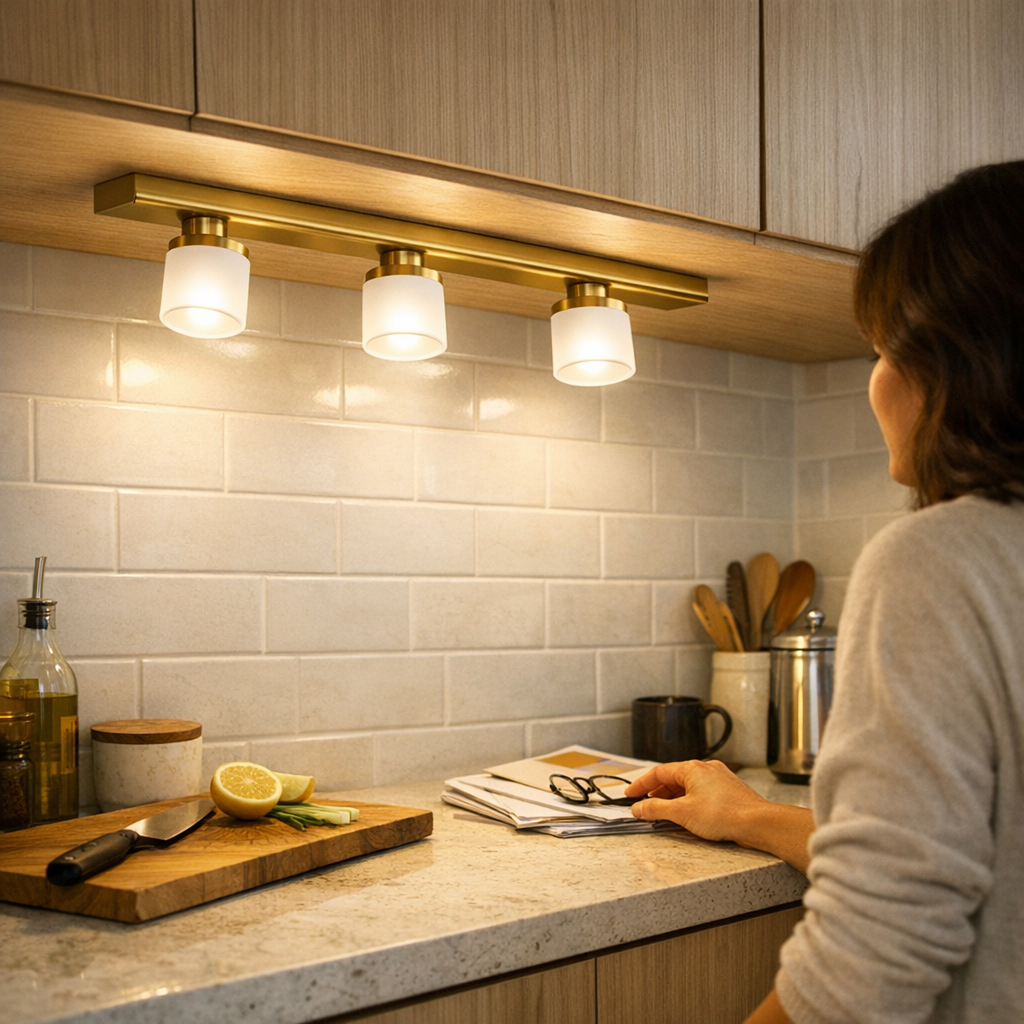
Dim edges turn any “finished” under-cabinet or shelf lighting setup into an everyday compromise—fast. Even with cables hidden and the surface newly bright, the reality sets in during week one: you start avoiding the ends, shifting meal prep or paperwork to the safe, central glow. Things migrate—chopping boards, chargers, the “good” utensils—always toward the brightest spot, leaving the corners in dim neglect. Suddenly, the newly installed light isn’t extending the usable area. It’s narrowing your habits, and every day, a so-called upgrade slowly becomes a limitation you plan around.
When the Glow Stays Central—and Corners Fade Away
After days with standard under-cabinet lighting, clutter collects in the lit zone, not by accident but out of necessity. Bowls, documents, and small tools pile up in the center because the edges slide into shadow. Even at midday, you might catch yourself squinting for a dropped cable or that farthest spice tin. As evening falls, the border between usable and unused becomes sharp: the full width of your counter, shelf, or desk reads as available, but the only area you actually reach for is the zone the light fully covers.
This is more than personal preference—it’s strain built directly into the layout. Shared kitchens and office nooks become cramped as everyone clusters at the lone truly visible spot. Underused edges aren’t decorative; they’re a daily friction. Each sidestep or detour around a dull patch is time and comfort lost, even if you only notice when your routine pulls toward the middle yet again.
The False Comfort of a Minimal Install
Most setups start with the lure of visual order: a slim LED strip flush against the cabinet, hardware neatly hidden. But if the light beam falls short—too centered, too shallow—the “minimal” install turns cosmetic. Impeccable lines spell out the problem even faster: darkness crowds every edge. Every day, the setup looks resolved but works incomplete.
Workarounds multiply: you inch cutting boards away from the wall, shift devices toward safer zones, constantly nudge everyday items from one patch of light to another. Sooner or later, you’re using just two-thirds of a full run. That’s not a subtle tradeoff—it’s wasted space built into your routine, not because of a technical gap, but because coverage got sacrificed for appearance.
Glare vs. Shadow: Getting the Light Out Far Enough—But Not Too Far
Slide the fixture forward to erase those dim edges, and you trade one annoyance for another: glare. Light spears out under the cabinet or shelf, bouncing directly into your eyes or splashing onto countertops at the wrong angle. That supposed sweet spot—broad coverage, glare-free lines—never lands by chance. It demands bracket tweaks and an honest look at shelf depth versus beam spread, not a guess from the spec sheet.
If you’ve found yourself fidgeting with fixture position, or pivoting to escape hard glare during a late-night task, you’ve run into the real balancing act. It’s not technical specs that matter, but lived awkwardness: broad, low-glare light that actually fits your real working habits. There’s no universal answer—only patient adjustment, right until both the edge and the line of sight finally make sense for your own space.
The Cable Conundrum: Neat, Calm, and Out of Sight
Even the best lighting plan falls apart if one cable snakes down the wall or flickers into view at eye level. It’s not just visual mess—it’s a split-second distraction, pulling attention from the work surface before you even realize what’s different. Every “almost right” install seems to leave at least a few inches of white line climbing out from a shelf, or a black adapter hanging from an outlet with nowhere to hide.
Small, decisive hardware wins here: adhesive channels or rear-edge guides route lines so tightly you forget they exist. When cable runs follow the fixture, hugging the underside contour or ducking sharply out of sight, both the room and your attention feel clearer. It’s a minor detail with outsized impact—especially during a rushed morning or group meal, when even small distractions add up fast.
Everyday Use Reveals the Gaps: Real Scenes, Real Friction
The first days after a lighting upgrade often sell the installation short. As routines settle in, new limitations surface, including:
- Reaching for a canister at the shelf edge, but having to double-check the label where light failed to reach.
- Pushing paperwork to the middle of a wide desk, though the ends “should” be usable—and telling yourself you’ll sort the rest later.
- Watching everyone cluster in the same bright spot at a communal counter, while shaded ends gather untouched clutter.
- Retrieving a dropped pencil or cable from a dim bin at the edge, hours later than you needed it.
Each act builds a pattern: the visible area sets the real limit for use, and you quietly train yourself to ignore everything beyond the comfort zone of proper lighting.
Small Shifts That Restore Real Utility
Most fixes aren’t dramatic. Sometimes, moving the light fixture outward even an inch, or tucking the cable path above the cabinet lip, changes the entire feel of the space. Suddenly, the outer “catch-all” zones—once shadowy, awkward, or ignored—come back into use. Plates, keys, and chargers stop drifting toward the center. The whole surface earns its keep, not just the spotlighted sliver.
Use a diffuser or custom cover if supplied. It’s not an accessory—it prevents raw glare while letting light reach out into those corners. Check the lateral spread; don’t settle until the entire usable width is comfortably, softly visible, but the beam itself doesn’t shine straight at your face. For dense or changing setups, don’t be shy about chunkier brackets or adhesive mounts: the last inch of cable or fixture length can be the dividing line between a half-measured fix and a truly usable solution that adapts over time.
True Comfort Means Every Edge Works—Not Just the Center
A lighting run that looks perfect but leaves half the shelf in shadow is a daily chore in disguise. Real comfort comes not from minimal aesthetics, but from making every inch function—edges lit, cables low-profile, traffic flow maintained, and bright spots distributed where activity actually happens. If you’re sidestepping the ends or if a group keeps crowding toward the one clear patch, your setup isn’t supporting you yet. There’s no reason to settle for surface-level neatness when small, hands-on changes can unlock the whole area’s potential.
Purposeful under-cabinet and shelf lighting isn’t about aesthetics as much as about reliable routine. Once you strip away unused dim sections and stray cables, what remains isn’t just clarity—it’s daily usefulness that matches how you and others actually work. That difference is felt, not just seen. Small adjustments in position, angle, and support can turn your installation from “presentable” to a surface that finally does its job.