
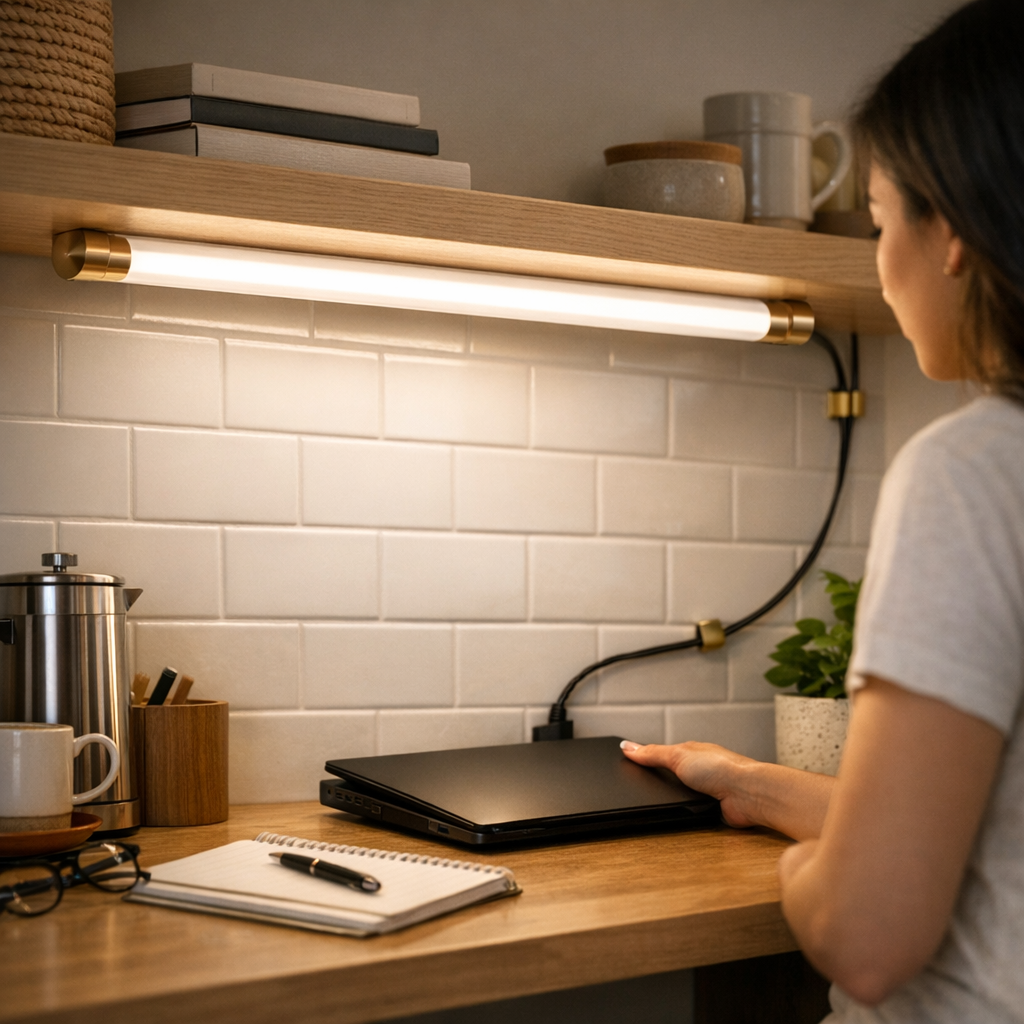
Even the sleekest indoor lighting setup can start to unravel within days of use. That flush-mounted LED? It creeps askew after the second desk shuffle. Cables that vanished at install reappear, catching the eye—or a sleeve—every time someone plugs in a device. One week in, you’re not admiring a crisp workspace; you’re nudging lights back into line, pushing cords aside, and wondering why all that supposed “minimalism” now feels like a recurring maintenance job instead of a solved problem.
The False Security of a Finished Look
Minimal cable clips and slim brackets promise calm surfaces but rarely outlast a real week in a shared or flexed room. If support fails, convenience collapses—no matter how neat it looked initially.
Picture a desk: On day one, the linear LED disappears under the shelf, cable hidden. By Friday, the bar leans just off-parallel, leaving one edge in shadow. Cable clamps loosen as laptops come and go, until an exposed wire cuts across that “clean” line. Suddenly it’s not just the look that suffers; it’s the way you use the space—constantly realigning, tucking, re-routeing. The sense of “done” dissolves as you fight the same annoyances, one interruption at a time.
- A fixture that sags a few millimeters throws glare onto the work surface or leaves half the desk in murky light
- A cord, at first tamed by a discreet clamp, slips forward and becomes the obstacle you move around every morning
- Daily use turns a “solved” setup into a slow cycle of repeated, forgettable corrections
This is more than cosmetic. In high-traffic kitchens, compact shared desks, and shallow shelves, every flex or bump makes minor weaknesses obvious and unignorable.
Where Most Lighting Setups Start to Unravel
The illusion ends after you clean, plug in, or adjust—usually by the third interaction. Weak points consistently emerge, including:
- Brackets that flex, so an edge droops and uneven light spills onto backsplashes or out toward the user—making small tasks harder and reintroducing glare
- Cable management designed to hide, but not to hold, slips near high-tension spots—think of where power strips meet desk legs, or where a cable rounds a corner that sees constant movement
- Single-point supports, which rotate or slide with a brief nudge, especially on floating shelves or flexible wall panels
These failures rarely announce themselves. Instead, they erode visibility, inject glare, or leave once-lit corners in a new dimness. An under-shelf LED brightens a counter until a bump leaves a dull shadow. In every shared workspace, the hidden cord migrates—first off-stage, then snaking visibly, then snagging as soon as a chair is rolled back.
How Subtle Drift Becomes Everyday Friction
Lighting drift and visible cable creep aren’t dramatic. They build subtly, with the next realigned light, jostled wire, or minor tilt. The test: Do you fix the same little thing every few days?
- A student’s under-shelf lamp, mounted with a center bracket, demanded near-daily nudging. Switching to a dual-lock bracket and clamp kept it set—the “finished” feeling finally lasted through a month of use.
- Two side-by-side kitchen LED bars: one secured on both ends stayed even, giving full counter light; the other, clipped at one point only, slouched until a prep area faded half into shadow and made chopping awkward.
Fixes That Actually Last Beyond Day One
The difference between constant fixes and true clarity isn’t surface-level minimalism but real support matched to repeated movement.
- Double-bracket supports, especially with locking tabs, stop dips across longer LED bars or heavy shelves; single brackets rarely survive repeated shelf flexes or hands brushing past.
- Cable clamps belong where force happens most, not just where wires are visible—usually at transition points, plug-ins, or the edge within arm’s reach, not halfway along a hidden run.
- Early, intentional retightening during the first week makes a visible difference—pressing a clip or adjusting a bracket after the room settles can prolong the setup’s clean look and real use.
It’s not about over-accessorizing. The right choices, placed by habit patterns, make the clutter disappear—and stay gone—despite hands, chairs, and plugged-in chaos.
Small Setup Tweaks: From Daily Fix to Seamless Use
Still fighting alignment drift? Move your anchor point closer to where hands interact with the surface—often just a few centimeters is enough to keep things steady under real-world traffic.
Cables inching back toward visibility? A clamp or adhesive guide placed right at the main trouble spot (entry edge, wall drop, plug socket) can lock the cable’s path. When supports anticipate the room’s daily behavior, maintenance falls away—you notice the light, not the setup.
Questions That Come Up Again and Again
Why does my light fixture keep drifting out of place?
The most common reason: brackets are undersized or fixed only at one end. Every shelf flex or accidental bump nudges the bar, and edge droop accumulates. Secure two-point brackets and periodically check for slip in real use—not just after install.
How do I stop cables from becoming visible, even with cable management?
Clamps often fail because they’re not placed where movement happens. Install them at transition spots—corners, plug zones, or emerging from behind desks—to prevent creeping wires from reappearing with every user adjustment.
What’s the most frequent mistake people make in lighting setup?
Choosing accessories based on visual neatness instead of how the space is actually used. “Invisible” brackets or once-tucked cables turn into visible distractions if real-world motion, tension, or flex isn’t addressed at the setup stage.
Recognizing What Really Lasts in Lighting Setup
The value of a lighting support setup shows up weeks later. If you’re still straightening, untangling, or nudging month after month, the solution failed silent stress-testing. Areas that truly feel “finished” let you walk in, use the space, and never think about the hardware—because every contact point, wire path, and bracket was judged for how you really move, plug, or clean, not just how it looked in photos.
For practical, lasting solutions in indoor lighting support and cable management, visit LightSupport.