
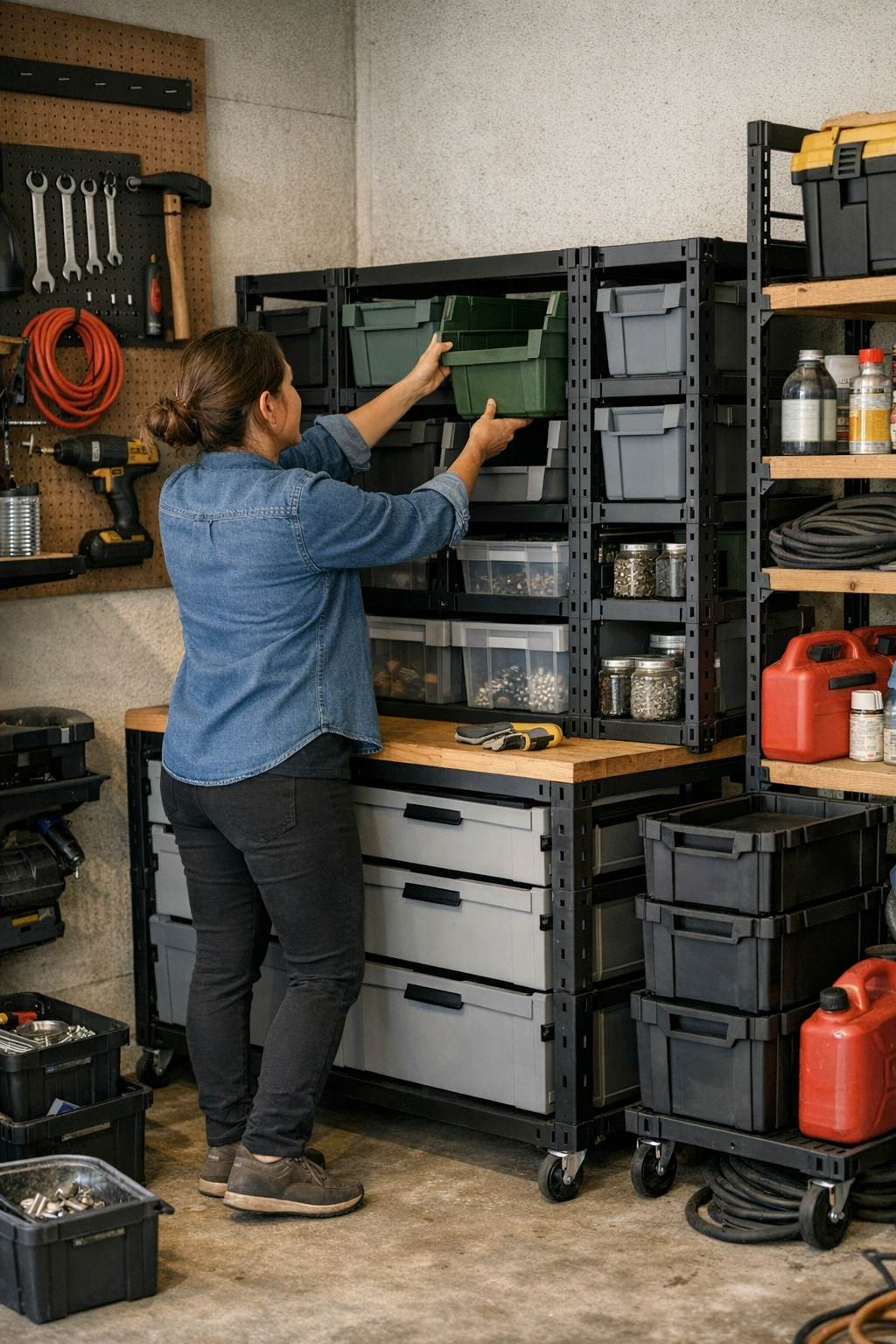
Every garage and workspace looks perfect for exactly one day—until real life sets in. Shelves are lined up, bins are labeled, every tool has a place. The next morning, it’s still holding up. But by the end of the week, the system that once looked “done” is already fighting you: bins too narrow for what you really grab, a rolling cart that jams beside the door, shelves sagging under the “overflow” pile that’s already back. That finished look? It’s masking a new, daily battle—for every tool, every return, every bit of the path you have to clear just to work.
When Order Is an Obstacle, Not a Solution
It’s easy to mistake neatness for usability. The diagrams say “modular,” but actual routines reveal the gaps: a bin too snug, a shelf too tall, just enough friction that you hesitate to bother returning something the right way. Imagine it: mid-project, you walk in, keys drop on the bench, you reach for a screwdriver—except two bins have to move first, and there’s nowhere obvious left to put it back. Pretty soon, things pile up: stacked where they don’t belong, set “for now” atop a container, crowding out the system one shortcut at a time.
This isn’t disorganization—it’s a mismatch between setup and real use. Every grumbled return or “temporary” stack is a tiny tax, and each adds up. A space that looks full of potential quietly drains momentum, until you’re choosing between a long cleanup or just working around the clutter.
Spotting Friction Before the Reset Fatigue
Most problems don’t announce themselves. They show up in habits you didn’t mean to form:
- The rolling cart you planned to move freely now blocks the only walkway—and it rarely finds its way back.
- The backup drill perches on a shelf edge because the “dedicated” bin is wedged tight and always full.
- Cleanup keeps getting slower, every project leaving a wake of items to reshuffle or step over.
- The back wall, loaded with hooks, ends up with the same heap collecting underneath—an “organized” pile you sidestep each time.
What starts as a single overstuffed bin is suddenly a weekly headache: shifting stacks to clear the workbench, hunting for the missing wrench, and convincing yourself “I’ll fix this next weekend.” Resetting feels like starting over, and the old order never quite returns.
“Boring” Placement: Why It’s the Only Shortcut That Works
The setups that last often aren’t flashy. They’re the ones where every wrench, fastener, or pack of batteries gets a single, dedicated, boring spot. No doubled-up containers, no “overflow” tray that swallows half a dozen odd items—just a spot where you can return things in seconds and walk away.
This isn’t about matching bins for show. It’s about shaping your storage around the rhythms you can’t escape: grabbing, using, and returning, without having to shuffle something else first. Over time, any spot that asks you to move two things just to put one away quietly falls apart. The “boring” approach—predictable, familiar, and frictionless—keeps projects moving, even when you’re tired or distracted. It removes every last excuse for letting something go “just for now.”
Real Adjustments: Shifting from Display to Daily Flow
The turning point is when you ignore what looks uniform and start shaping around what you use most. One corner might be lined with matching bins—until you realize none actually fit your primary hand tools. Returning a wrench means moving three containers left, getting the wrench in, then sliding them back, and ultimately skipping the step entirely. Within days, that spotless shelf evolves into a jumble of displaced tools and abandoned best intentions.
The fix is never dramatic but always practical. Swap in a single wide bin for daily-use tools. Pull two inflexible containers, close the gap for low-use stuff, and deliberately leave a “quick return” space that’s open. Suddenly, you aren’t fighting your storage—you’re moving through it. Grab. Use. Return. Done. No domino effect, no backup, no creeping mess to undo at week’s end.
How “Maximizing Space” Can Work Against You
Garages and utility spaces are filled to their supposed limits: cabinets squeezed behind doors, shelves flush to the ceiling, bins crammed along the floor. But every “tightly packed” setup comes with hidden costs:
- Rolling carts always in the way. There’s no true home for the cart once it leaves its spot—it collects clutter until someone finally digs it out.
- Bins underfoot. Floor-level storage blocks the natural walking routes, making you sidestep or shuffle every trip.
- Lost corners. Boxes fill dead spaces, nothing is ever truly accessible, and retrieval always requires extra steps—or gets ignored entirely.
- Overloaded wall hooks. Each peg becomes a stacking zone until tools overlap, and the one you want is always at the back.
A setup that fits the room can still sabotage your routine. The moment the fit is off, every project runs slower, every reset grows into a half-day job, and the promise of order becomes another to-do list.
Function Wins: Spotting What Really Works in Daily Use
It’s easy to impress guests with tidy rows of storage, but it’s the repeated use that tells you what works. The proof is in the daily dance: nudging the cart yet again to open a cabinet, fishing behind the same overhanging bin for the tape measure you always use, conceding that the “main” shelf is now just a dumping ground for whatever won’t fit somewhere else.
The best systems don’t make you think twice. Every tool with real reach gets its own, instantly accessible spot—no second moves, no overlapping, no shuffling. You finish a project, tidy up in seconds, and never feel like you need to “reset” before starting the next round. The space finally works around your habits, not against them.
Real-World Solution: The Staging Bin
Not everything goes neatly back every time—sometimes you’re done for the night, a guest brings something back, or you’re between tasks. That’s why a single “staging” bin or shelf works as a pressure valve. It’s not a dumping ground; it’s a buffer that keeps your core system from bogging down when life happens. With it, your main setup never unravels over one stray item: mess stays contained, the rest stays easy.
Setup That Follows Routine—Not Just Geometry
The real test isn’t if things fit the floor plan—it’s if you’re gliding through the routine, not stepping around it. If you catch yourself shifting, squeezing, or hesitating around a spot, it’s the wrong fit. Storage should echo your rhythm: fast access, clean returns, no trail of “almost put away” tools or supplies. When the layout matches your flow, resets fade into the background. Cleanup isn’t a chore. You finish, you return, and the system is already ready for the next run.
The best setup disappears into your habits—you don’t notice it, because nothing slows you down. Sessions end without chaos, and the system stays “reset” by default. There’s no going back to working around your own storage.
Find modular storage, workshop shelving, mobile carts, wall systems, and more practical solutions for real spaces at StackNest.