
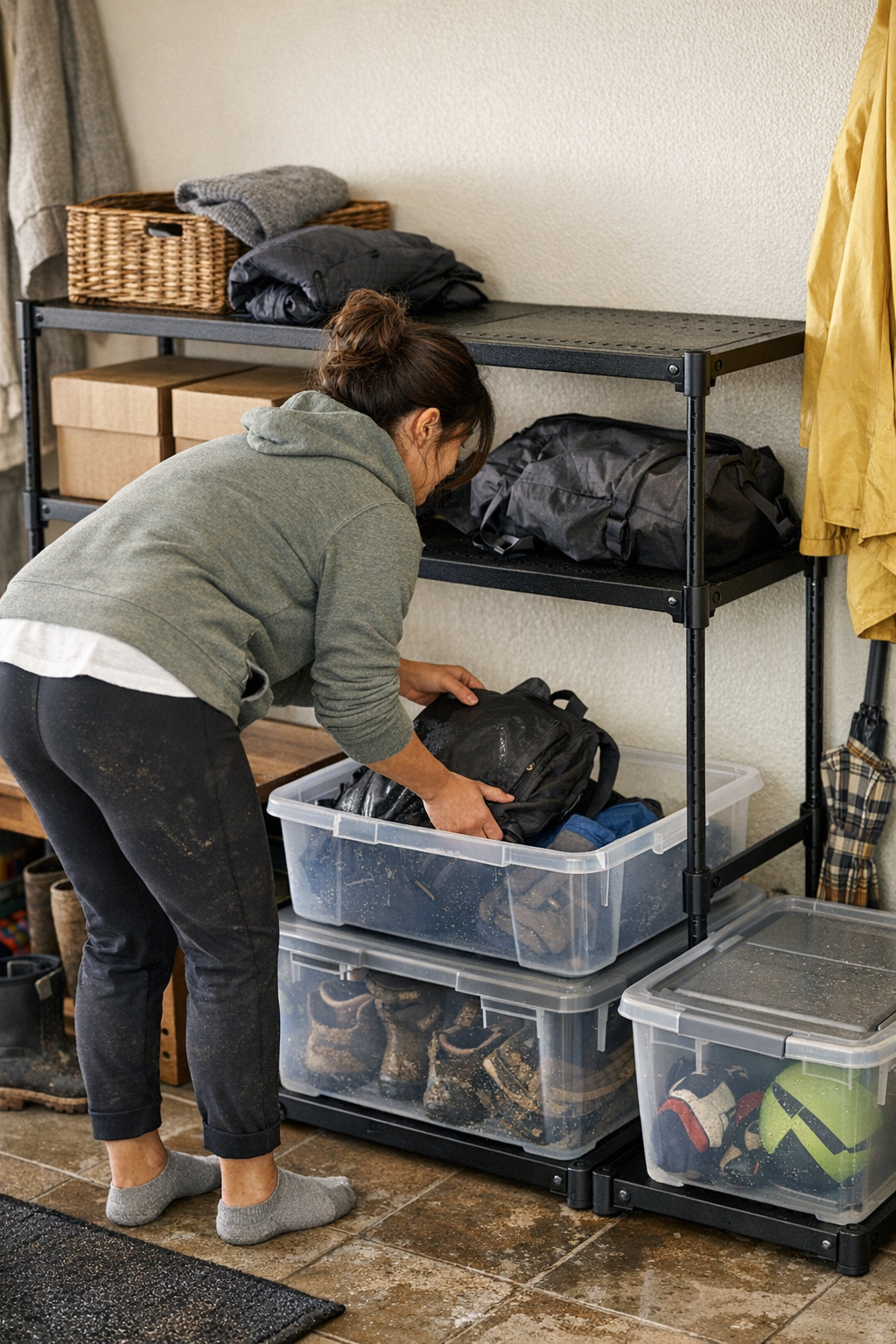
Cardboard boxes and plastic bins are not interchangeable once your entryway enters real use. Stack a cardboard box under a bench or line a few up along a wall, and they look organized for maybe a day—until the first week of wet shoes, dripping coats, and off-schedule resets. Suddenly the edges of those boxes sag, corners slump, and what started as a tidy drop zone turns into a damp obstacle course. Instead of storing away clutter, you’re now sidestepping a soggy pile and prying stuck boxes off the floor just to keep the path open.
When Cardboard Boxes Collapse under Repeated Entryway Pressure
Cardboard seems fine at first—holds shape, fits shelves, takes labels. But entryways are not static rooms: shoes come in muddy, bags drop heavy, and one rainy Saturday is enough to warp what you thought could last a season. By the end of week two, lids don’t close, boxes lean and spread, and one damp base can glue two boxes together. What started as a reset-friendly system now slows you down. The bin meant to collect quick returns blocks the walkway; instead of quick drop-and-go, you’re forced to pause and untangle stuck storage on your way through.
Every time a cardboard edge curls or a corner gives, movement through the space gets clumsier. Shoes that should stay contained slide out of a sagging box and start a slow creep along the wall. A routine—come in, drop gear, move on—gets punctuated with detours and hands-full recovery runs. The setup looks organized only until the first predictable failure point. After that, your storage becomes an extra obstacle in the threshold instead of keeping the path clear.
What Entryway Friction Really Looks Like
- Dropping a wet bag onto a box and feeling the whole stack shift or edges bow, making it harder to use next time.
- Shoes that start in line, then slowly sprawl as sagging bins can’t hold a shape—turning a tidy row into a constant widening that blocks the bench.
- Sitting down at the bench and setting something aside, only to realize there’s no clear space because a collapsed bin base has migrated inward.
- Trying to return one item to its “spot,” but now that bin is half-folded, soggy, or fused to its neighbor, slowing access and pushing everything outward.
Each of these failures doesn’t just make things look messier—they add seconds and slowdowns to every pass. Resets become rescue operations. Instead of supporting your routine, cardboard ends up giving you more work with every rainstorm or rushed morning.
Plastic Bins: Rigid Boundaries and Reliable Flow
Plastic bins hold up and hold boundaries when water, mud, and frequent shuffling hit your entryway. Where cardboard absorbs every drip and warp, plastic stays rigid. Floor-level bins see the worst—mud, snow, stray granules from shoes—but a good plastic bin shrugs it off. Slide it out, wipe it down, reset instantly. No warping, no edge collapse; one hand is enough to move, and you’re not worried about the bottom smearing across the tiles.
The difference becomes obvious in three days of normal use:
- Plastic slides and resets fast, never sticking or swelling shut.
- Muddy shoes go in; the bin cleans up with a quick towel—no softened seams, no corner melt.
- Bins keep a true inside/outside divide. What’s dropped stays contained, walkway stays clear.
- Returning bulky gear is a repeat move, not a negotiation with torn sides or stuck bottoms.
Structure Reshapes Reset—Not Just Storage
Place cardboard too close to daily action—main floor, under the bench, or near the door—and it absorbs the consequences: runoff, constant movement, mixed-weight returns. As the sides give, categories blur and spill, making every reset another project. Plastic reestablishes the edge: even if shoes and coats rotate all season, the bin itself never becomes a variable. You don’t have to do a full re-sort every week; you just return items once, and the zone remains defined and usable.
Clear Bins vs. Opaque: Finding Items in Motion
Visibility is another friction point most people notice only after the third or fourth reset. Transparent plastic bins make it easy to spot what’s left behind—no more guessing which stack holds the missing glove or leash. If your drop zone serves a busy household, or you swap categories by season, the extra seconds saved add up. Opaque bins look tidier but often slow you down: you have to open, rummage, and relabel, especially when categories drift and multiple people use the space. Choose transparency to track change, or go opaque if you prioritize a calm, fixed look—just understand the real-world trade-off in retrieval and reset time.
Right-Sizing: The Early Warning for Friction Creep
Entryway bins should fit both the shelf depth and real-use pressure. Overstuffing a bin—one extra boot, one extra scarf—quickly turns order into friction. Lids won’t close, bins bulge outward, and just trying to push something in can jam the return flow for everyone. When bins bulge, the whole drop zone loses clarity, bumps against walkways, and requires twice as much correction with every pass-by. Stop loading before bins press against their own limits: that’s the boundary between support and slow breakdown.
Transition Space Fixes That Actually Work
- Place plastic bins at high-pressure points: Directly under benches or beside doors—where mud, drips, and returns collide most often. These absorb the worst and deliver the biggest payoff in function.
- Pick clear bins when categories shift or entryway traffic is high: Faster resets, no guessing, fewer items lost in the shuffle.
- Reset the base first: Fixing just the lowest, most-used bin sets a strong edge and instantly tightens up the rest of the space.
From “Organized Once” to Consistently Usable—Across Real Use
Every system works on day one, but transition spaces live and die by what happens during a downpour, after a week of rushes, or when the pile at the door doubles overnight. Cardboard’s orderly look collapses under repeated pressure, while structured plastic keeps daily clutter from becoming permanent blockage. Resets take seconds, not minutes. Categories hold. Drop zones remain open to use, not just open to look at—so coming home late or carrying a week’s worth of stuff doesn’t wreck your whole flow.
If your entryway now feels like a semi-permanent pile—slow access, shut-down reset energy, drop zone boundaries failing at the floor—switching even just the main bins to rigid, moisture-proof plastic won’t make things perfect, but it will restore a clear, usable edge. Not a magic solution, but a practical, visible difference you’ll see every time the threshold pressure returns.