
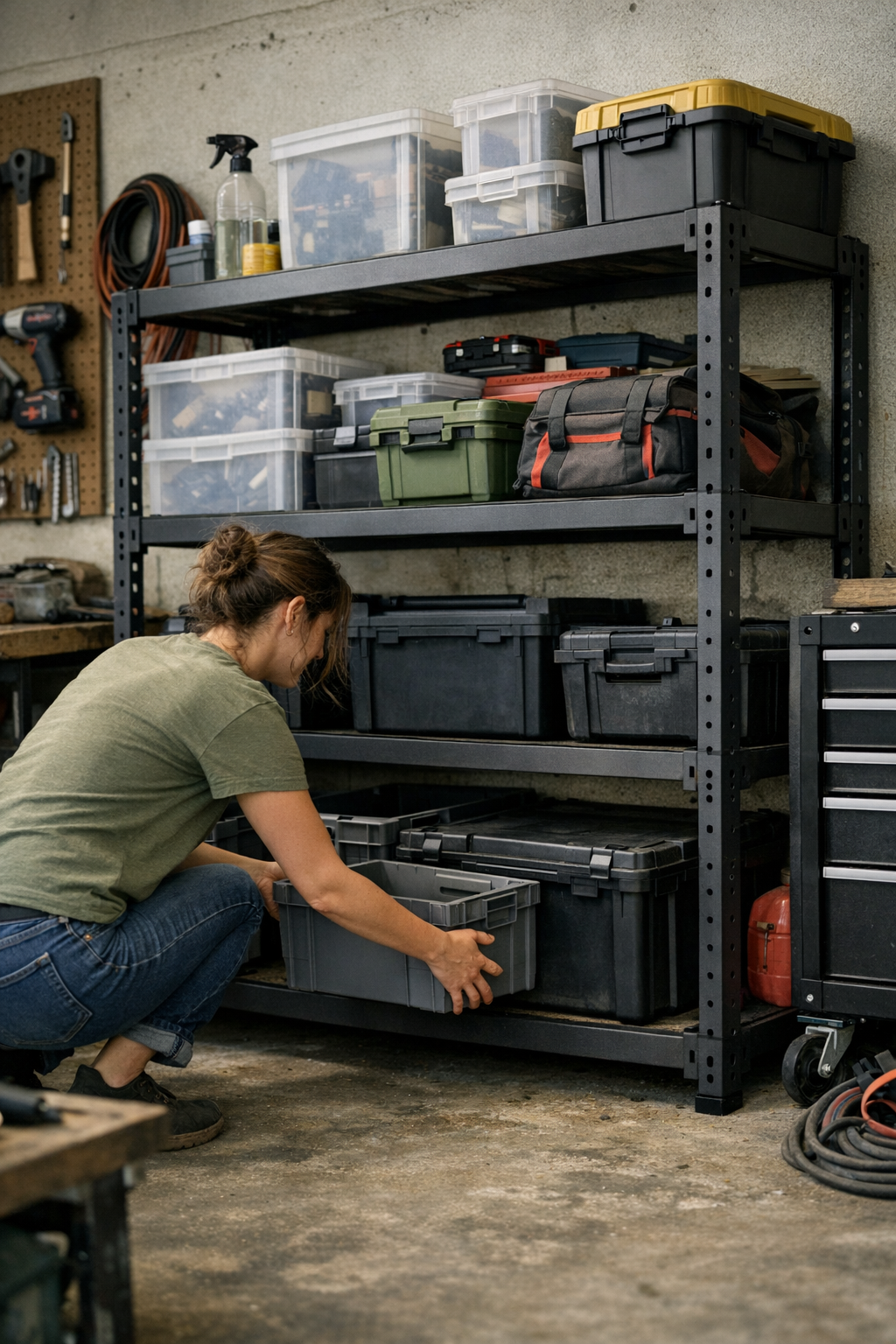
The problem isn’t that your garage storage looks bad—it’s that it keeps letting you down when it matters most. That flawless shelf line, that “organized” corner, the wall rack showing off all the right bins: at 7am, you feel set up. By 7:10, reality bites. Grab the heavy cooler from up top and the entire shelf shimmies. Wheel out the rolling cart and every nearby box shifts just enough to block your way. What looked tidy yesterday now turns into a stealth obstacle course. In the garage, the shed, or any unforgiving utility zone, it’s not being organized that matters—it’s whether your setup actually works under real, everyday pressure.
The Daily Sabotage: When Storage Fights Back
That modular shelf you built out with perfectly spaced bins and neat open space? It only behaves for the photo. In the friction of daily use—swapping a tool, grabbing the salt mid-storm, wrestling out the awkward floor jack—it starts slipping. You finish one clean reset only to face a new pile inching closer to the door by the next morning. That rolling cabinet you used to slide out with one hand now sticks, blocked by bins that never get put back up top. The walking lane you count on shrinks, narrowed by the gravity of “just for now” overflows. Fitting things in was easy; keeping them clear and accessible isn’t.
Top-Heavy Trouble: Where Setups Tip from Order to Chaos
Here’s the trap: heavy stuff stacked high doesn’t just create a risk—it breaks the entire flow of your zone. You meant for those upper bins to hold just seasonal gear, but soon the big toolbox is up there too. Each time you reach, the unit rocks or you steady it with a hip. Move a mobile rack and—wait for it—the tilt makes you cringe a little, so you wheel it less and leave it half blocking everything. That once-logical arrangement hides a quiet instability. The more you reach, rearrange, and adjust, the wobblier it gets—and the more likely you are to dump overflow on the floor or stuff “temporarily” into whatever corner hasn’t been blocked yet.
Where “Organized” Means Blocked Paths and Slowdowns
Before the mess even registers, you’ve lost flow. Instead of quick access and smooth resets, you find yourself detouring carts just to get through, squeezing around that always-in-the-way bin, or bracing racks every time you touch something heavy. Wall space looks full but isn’t truly useful; the best walking path gets parceled out to boxes waiting for a real home. Good storage on paper often devolves into bad movement and slow, awkward routines. A setup meant to solve chaos quietly becomes another part of the clutter cycle—never really letting you move, restock, or reset without stopping to fix something first.
The Shift that Fixes More Than You Expect
There’s one reliable move: always anchor your heaviest loads low, no matter how inconvenient it seems at first. Resetting means more than making the frame happy—it completely changes your daily routine. Drop those stubborn bins of winter salt or auto parts down to the lowest shelf. The structure stiffens. The swaying, that instinct to brace things before pulling, simply disappears. Mobility returns; the cart stops snagging. You stop doing small acrobatics every time you try to get something out or put it back. Light gear up top, heavy gear in the base—suddenly, the system doesn’t nag you for attention. It just works, quietly, for the fiftieth time as well as the first.
If your reflex is to grab a shelf for balance before removing something, it’s a red flag you’re living with top-heavy tension. Even shifting a few dense bins to the ground shelf breaks the feedback loop of wobble, blocked paths, and slow resets. Setups aren’t just about “where things go”—they’re about how you move.
Real Use, Real Difference: See It in Movement
Dragging weight down on paper doesn’t change your garage’s footprint. What it does is strip away all those unconscious little workarounds—pushing carts sideways to open a lane, stashing things in dead corners, taking two trips to avoid a teetering bin. With the heaviest supplies grounded, your flow kicks back in. Lighter stuff up high? No more shelf shivers or surprise avalanches. Even if bending for winter tires means a few squats, trading that for a clean access lane is a win.
The value creeps up every time you walk in for a fresh round of sorting or find yourself reaching for that tool cabinet at speed. The routine—use, return, reset—runs smooth again. No last-minute shuffling to uncover a handle. No backing out bins just to reclaim the floor. The right anchor points let the storage fade into the background and the work take center stage, instead of the other way around.
Spot Check: Forget “Pretty,” Aim for Stable
If you’re reaching out to steady a shelf, stop. It doesn’t matter how sharp the setup looks. Stability is the test that counts. Put the heaviest, most stubborn objects at the lowest point. Judge the system by how it stands up to daily resets, not how it stands still for a photo. Aligned shelves stay put, quick returns stay quick, and your lanes keep open—even as seasons (and storage demands) change. No more re-stacking your best intentions every weekend.
Stability Is the Single Upgrade That Outlasts Effort
“Good enough” storage fades fast under real use. The difference between a barely-functioning setup and a truly reliable one is how steadily it protects your flow after dozens of uses, not just at setup. That’s why heavy-down, light-up isn’t a minor tweak—it’s the backbone for movement, access, and clean restarts. Make the swap one time, and watch as the rest of your area—previously a tangle of slowdowns—quietly, believably, stays available for work.
You can browse modular options and zone-specific solutions at StackNest.