
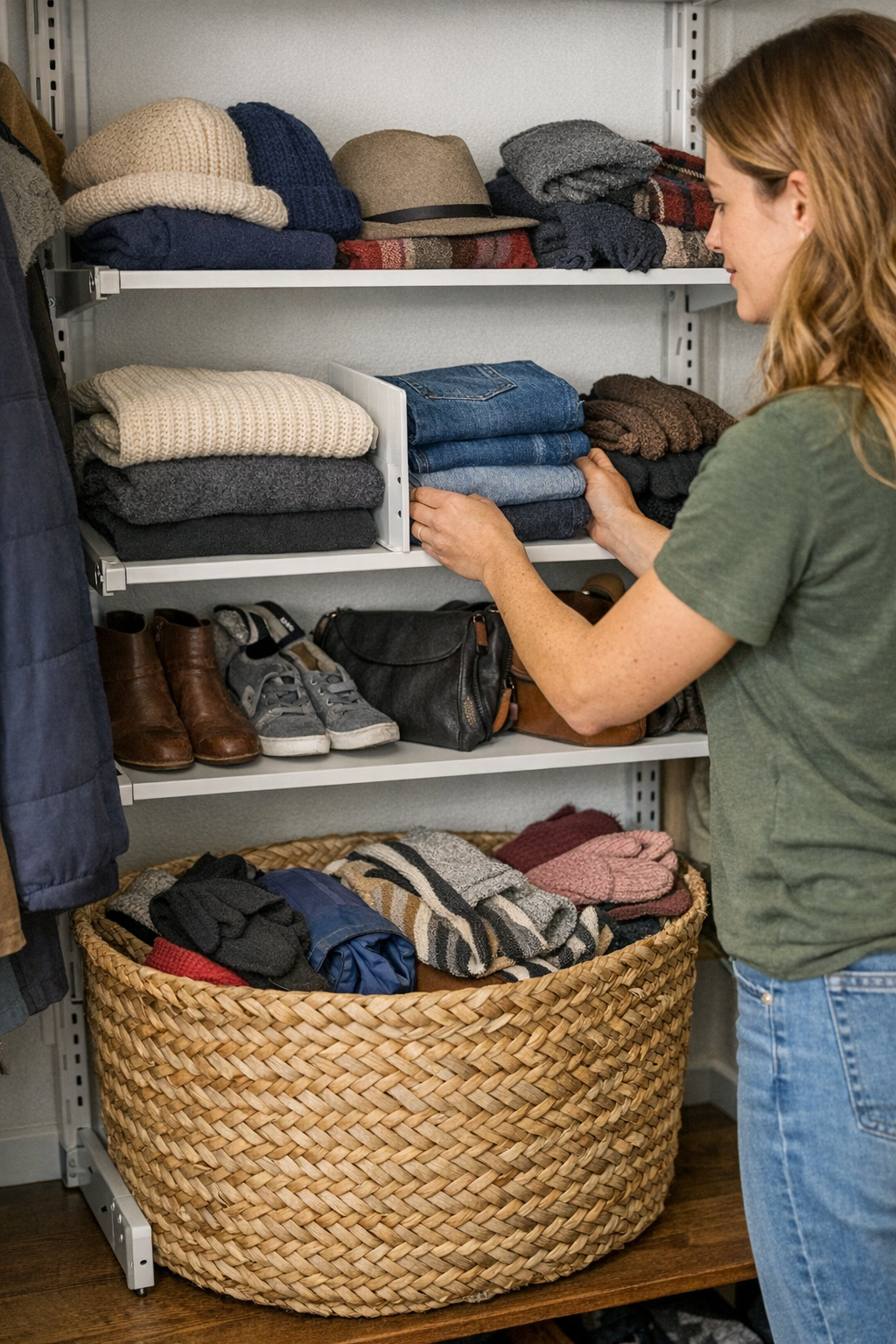
If you’ve ever organized a closet, only to watch it fall apart in days, this will sound painfully familiar: You spend a weekend turning chaos into order—stacks of folded jeans, sorted sweaters, shoes lined up, bags and scarves each with their own spot. For a moment, it works. But almost instantly, daily life starts to unravel it. A single reach for a shirt tips an entire pile. Shoes drift from their line. Scarves collapse into the bags’ territory. By next week, your careful categories are a vague, blended mess—slower to use, harder to reset, and quietly, endlessly annoying. Why does every “fresh start” slide back into friction so easily?
Invisible Boundaries—The Silent Saboteur
Every storage space without real, physical boundaries becomes vulnerable to the way we actually live. Open shelves tempt items to blend, especially when multiple people share them. Without defined edges or barriers, clothing and accessories naturally drift across lines, nudged by each quick grab or hurried put-back. Pulling a sweater out from the bottom row? Odds are you shift the jeans stack, lean a shoe, or send a scarf sliding. Days later, what once looked clear is now a teetering, shapeless mix that’s harder to sort—and slower to fix—each time you need something.
The same pattern echoes in bedrooms and entryways. That tidy sweater stack on an open shelf? Rummage for one shirt and the pile slumps, spreading sideways. Two days of normal use, and what began as separate zones is now a jumble to dig through. The effort builds: you need two hands just to retrieve a shirt without toppling everything, and “resetting” means starting from scratch, not simply straightening what’s there.
Scenes from the Mudroom: Where Organizing Tricks Fail
Picture the busy mudroom shelf: hats on the left, gloves in the middle, scarves on the right, maybe a catch-all basket beneath. In the haste of a weekday morning, someone grabs a hat and nudges the neighboring scarves. On Wednesday, gloves blend into the scarf zone; by Friday, stray items spill off shelves or bury themselves in the floor basket. What started as an orderly system is now a mixed pile. The frustration isn’t the stray mittens—it’s the slow creep from “each item in its place” to “everything everywhere,” just from living normally.
It’s never a dramatic collapse, just a steady erosion: Each reach shifts lines a little farther. By the weekend, any sense of roles or sections is erased. Resetting feels like a full reorganization, not a tidy-up—so it gets put off, and function lapses until the next major overhaul.
What Lasts: Real Boundaries, Not Just Space
If the problem is items seeping across invisible lines, the solution is giving each group true, physical boundaries that hold up to real use. Not more shelf inches, not another giant basket—just clearer, more visible separation.
Something as basic as a three-inch shelf divider works wonders. Stacks hit a wall and stop; sweaters and shoes can finally share a shelf without blending after every retrieval. When you reach for a shirt or slide out a bag, you don’t spill into another zone. Shelves recover quickly from everyday use—the “reset” is a ten-second adjustment, not a five-minute excavation. The gain isn’t perfect order, it’s simple stability and obvious zones you don’t have to think about.
When Bins Become Black Holes
Don’t assume every container brings order. Oversized bins and deep catch-alls actually invite chaos if left open inside—especially in mudrooms and closets. Shoes and scarves begin as neighbors but end up mixed, small gloves vanish beneath boots, and finding anything means digging through the whole jumble. Even decorative baskets become mini-chaos zones if they lack sub-dividers or interior trays. The rule: If you can’t instantly see and name what’s inside—that space is primed for clutter to spread.
Simple Tests and Smarter Boundaries
1. Do you lose track of “where things go” by Friday?
If your setup only makes sense in that after-clean snapshot, but you’re mentally guessing by week’s end, boundaries are missing. A closet, entryway, or shelf should “announce” what belongs where—without a label or a moment’s pause.
2. Why does empty space get cluttered faster?
Uncontained shelves invite items to drift, expand, and spill. It’s separation—not size—that matters. Each reach, if unchecked, blurs categories until every reset feels like starting from scratch all over again.
3. Can you have too many dividers?
Definitely. Micro-compartments or fiddly inserts just create new headaches. Efficient storage means clear, broad boundaries—“a section for hats,” not “slots for every color.” If you dread putting things away, or resets feel slower, you’ve over-divided. Test by living with your new boundaries; good ones will speed up resets and reduce daily friction, not create more steps.
Making Organization Stick in Daily Life
Design for quick resets, not showroom moments. True order survives the hectic mornings, not just the Instagram “after” photo. Dividers, trays, and sectioned bins let everyone—kids included—restore order in seconds. No instructions needed, no searching for the “right” spot, and no hesitation.
If you keep seeing sections blur, drop in a divider. Even lightweight barriers—a vertical insert, a low-sided bin, a clear acrylic tray—stop migration and pay off fast. Check where your setup sags the most after a regular week: That’s your best place for a small, strategic upgrade.
Beyond the Look—Holding Onto Function
Spaces that merely “look” organized rarely hold up. The real drain is not the mess itself but the frustration of fighting entropy every week—the shirts spreading sideways, the gloves sinking to the bottom, the mystery socks on the floor again. Room doesn’t fail; boundaries do. Every time you catch yourself reshuffling categories or doing a mini-reset just to reach what you need, that’s a nudge to rethink separation, not space.
Truly functional organization is built for the cycle of use: grab, return, repeat. A few minutes spent installing shelf dividers or sizing tray sections can save you dozens of half-hearted resets—and keep every zone more visible, accessible, and fast to fix for good. The goal is not frozen perfection, but a closet or entryway that rebounds from real life, day after day.
Find real-world storage solutions that make a difference at ClosetWorks.