
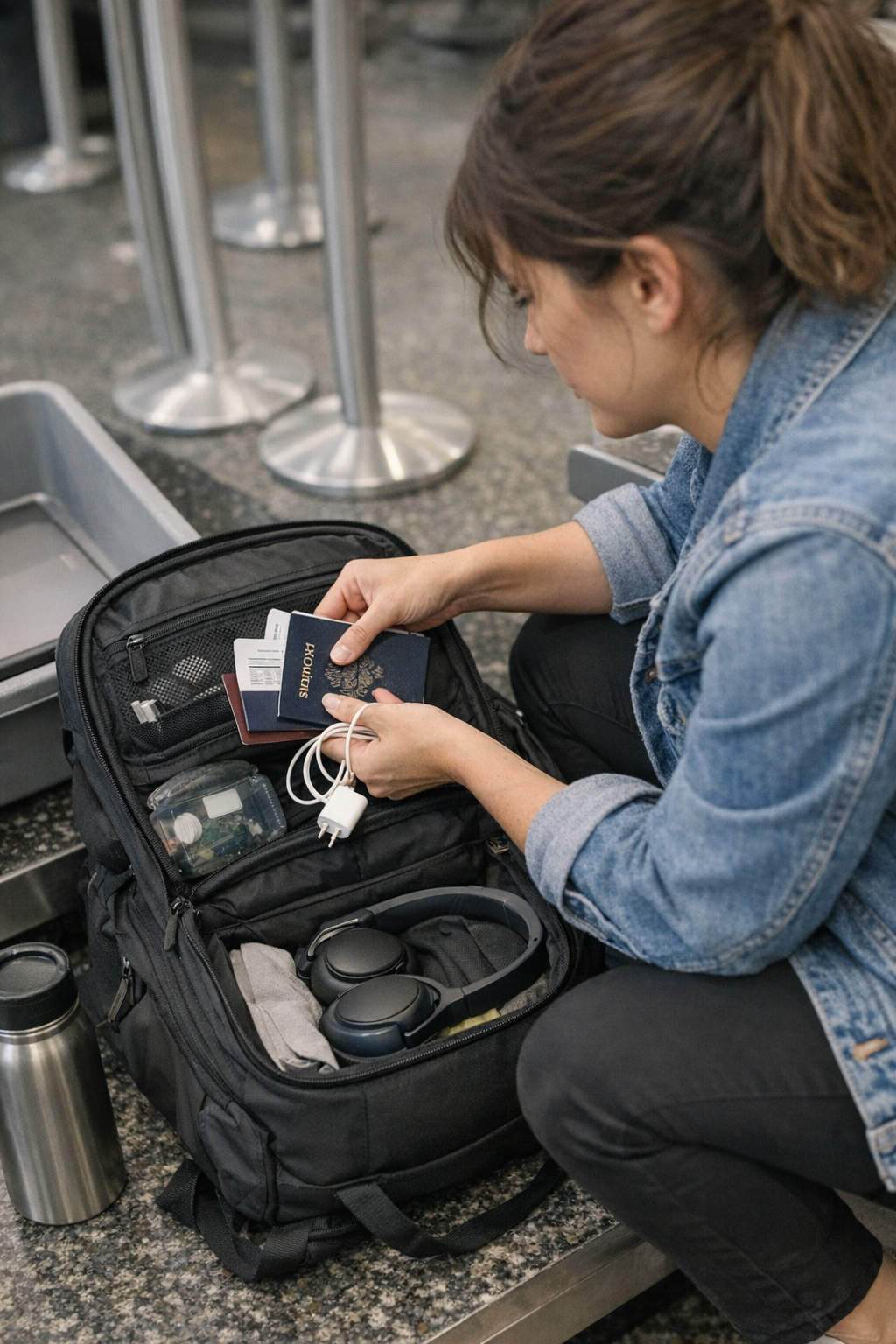
The bag that looks “perfect” at home rarely keeps up inside an airport. Neatly stacked organizers, tucked-in document pouches, and zipped pockets all promise control—until you hit your first security line or need your passport in a hurry. It’s only after a few real-world retrievals that minor packing choices start turning into real slowdowns: multiple zippers to open for one boarding pass, a charger tangled under layers, or your bag suddenly splayed open across a checkpoint tray while others nudge forward and you dig for what you thought was accessible.
When “Organized” Turns Into “Hard to Use”
Tidy packing—cables rolled, toiletries locked away, documents slotted in labeled organizers—can fool you into feeling ready. But as soon as your feet hit busy airport concrete, appearance and function diverge fast. The structure that looked sharp at the kitchen table now requires you to unzip two or three compartments for a simple passport pull. At your first tray-transfer, you’re hesitating, pulling apart organizers, and stacking mesh pouches on the fly, with every delay amplified by the pressure of the line. Each time you repack after security, the “order” you built slips further out of reach.
This isn’t just bad luck—it’s a side effect of setups made for storage, not movement. Things you reach for repeatedly—boarding pass, headphones, ID—end up buried under zipped pouches or behind layers built for visual neatness. That first access might feel smooth, but each repeated retrieval multiplies the problem: friction mounts and the original packing logic collapses through constant interruption.
Repeated Access Reveals the True Structure
The real test of any carry-on isn’t the first grab. By the third or fourth document check, access patterns start to show their weaknesses. A passport that’s slickly hidden behind organizers, a charger jammed below a mesh pouch, or an earbud case always at the bottom—they all slow you down at the worst moments. Each re-pack gets messier. A charger never quite goes back in its slot, a mesh pouch bulges after you pull just one cable, and what looked organized now refuses to cooperate. At home, none of these frictions exist; but in line, or on the move, every missed detail compounds. Flow is interrupted. Small messes accumulate.
Recognizing the Cost: Slowdowns in Real Transit Moments
Security Checks That Expose Every Flaw
Airport security rarely cares how “clean” your packing looked before you left. One call for a laptop, another for liquids, and now your planned layout is scattering open on a hard tray. Mesh pouches catch, stacked organizers need to be transferred and restacked, and there’s no time to gingerly relayer everything. Your hand keeps darting into the bag just to find things that seemed obvious hours ago. Jam something back hastily, and it will slow you down again at your next checkpoint.
Boarding and the Seat-Entry Struggle
Breezing through security only trades one challenge for another. In the boarding line, your passport is lodged under the in-flight tech pouch—meaning you now have to balance your bag on one knee while you unpack in public. At your row, grabbing a tablet or headphones mid-aisle forces another round of loosening compartments, disrupting the fragile stacking order that looked so clever at home but now unravels into a juggling act.
Overhead Bin Realities and In-Transit Retrievals
Eagerly lifting your bag into the overhead bin? You’ll likely be pulling it back out within minutes if you miss a needed item. What was “on top” shifts and sinks, pouches slide, and suddenly a passport or boarding document is embedded in the middle instead of on hand. Each retrieval tugs at clashing layers—zippers catch, compartments sag, and a bag that looked organized when zipped now trips you up with every attempt to move quickly. The cost isn’t a visible mess—it’s the drag on your routine and confidence.
Packing for Movement, Not Just Order
Real airport cycles prove it over and over: storage-only setups get in your way, but packing for movement reduces friction. Every item you need more than once—passport, boarding documents, earbuds, a single charging cable—belongs in a spot you can reach in a single motion, with no layered pouches or secondary zippers in your path. Gear you won’t touch until landing? Bury it deep—out of reach, out of mind.
Small structural tweaks quickly separate bags that slow you down from those that move with you:
- Consolidate travel documents and top-use tech into one quick-access compartment, not scattered across pouches.
- Keep separate organizers for cords and other low-frequency items, but out of your main retrieval zone.
- Treat “organize everything” methods as checked-bag logic—not for your in-motion carry-on.
After even a single trip, the change stands out. Instead of opening three zippers at every checkpoint, you’re making one move for high-frequency items. A laptop drops onto the tray without disturbing a dozen pouches. You can grab and stow your passport without losing the thread on airport flow. The bag looks less pristine—pouches and pockets might be a little looser—but it works with you, not against you, every time the routine repeats.
Where “Less Orderly” Means More Useful
The biggest concern many travelers have—“won’t my bag devolve into chaos?”—almost never matches reality. Allowing a little looseness in your main compartment gives you flexibility to adapt: this morning it’s your phone, this afternoon it’s your charger, every checkpoint your passport. Nothing ends up buried for long, and no retrieval feels like a teardown. The day’s rhythm gets smoother, not messier: fewer stops, fewer course corrections, less time untangling gear for a five-second ID check. The real improvement is cumulative—your movement gets easier, the small stresses fade, and you stop dreading every pause in the airport gauntlet.
Small Adjustments That Deliver Lasting Relief
The best setup isn’t the one that looks best right after packing, but the one that survives repeated in-transit use. Every multi-step retrieval—passport trapped under three layers, charger caught behind a sleeve, toiletries wedged deep—costs you seconds and patience each time. Changing the home for even one repeated-use item can make you the person breezing through security instead of the one rifling through pouches at every stop.
So before you reach for another travel organizer, pause: think about which items you’ll want instantly, and whether your setup keeps them on hand when it really counts. The best systems aren’t just tidy—they keep up when your routine is exposed to real travel pressure, letting you move, reach, and reset with less drag at every step.
See travel tools and organizers designed to make real movement easier at CarryOnSupply.