
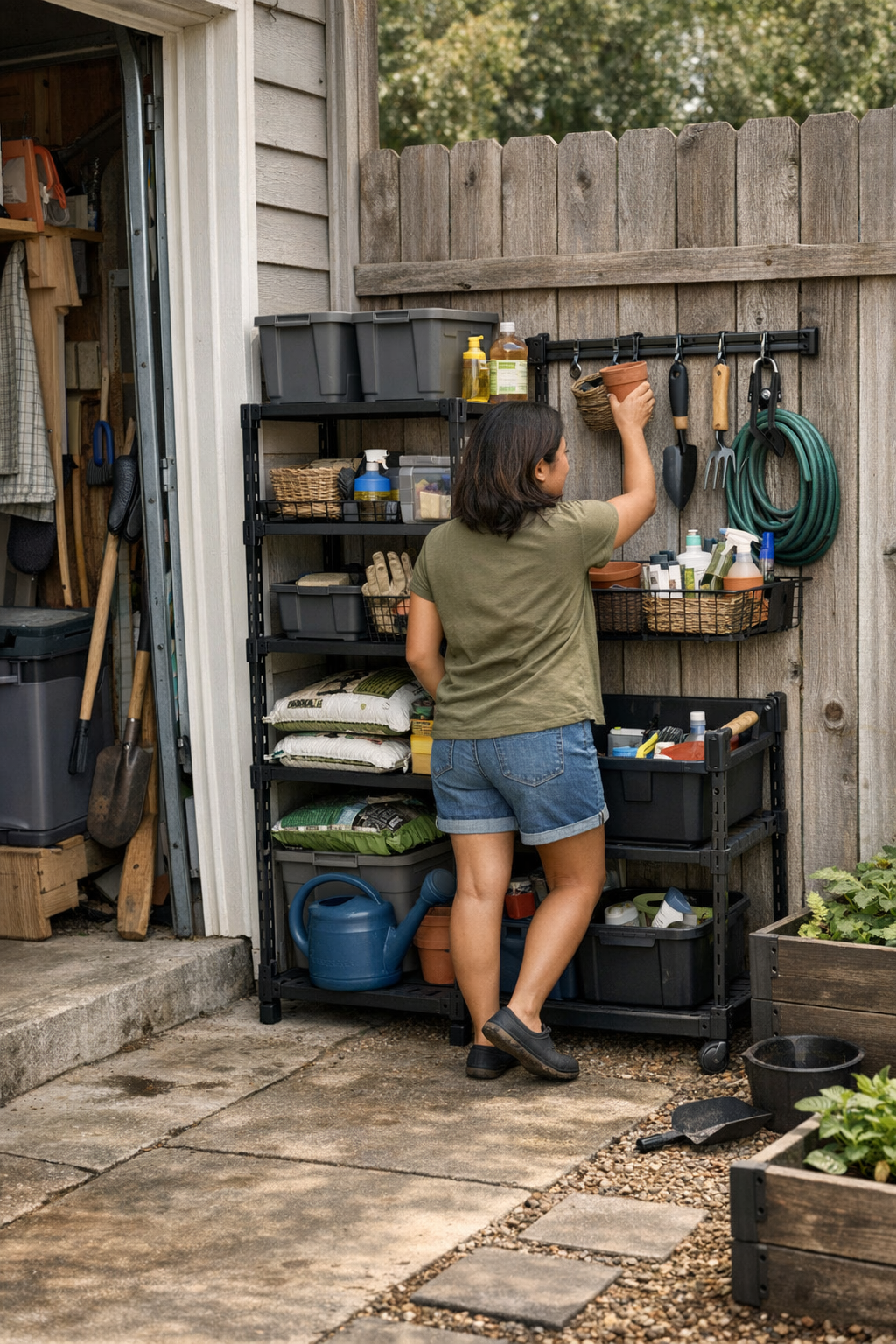
Most outdoor storage feels solved until you actually start using it, week after week. At first, the side yard or patio-edge looks squared away—lidded bins snapped shut, lawn chairs stacked, rakes out of sight. But reach for a shovel after a rainstorm, or try to put away muddy boots when your hands are full, and the setup shows its cracks. That clean, organized surface quickly demands shuffling, stacking, and constant quick fixes. There’s a real difference between a backyard that looks tidy and one that actually lets you move, work, and reset without interruption.
Clutter Moves Into Your Path, Not Just Your Pile
The drive for a minimal fence-line or neat shed pushes everything into bins and boxes. Gloves wedged in totes, secateurs buried under hoses, soccer balls smothered by lawn bags: it’s organized until you need the third item down. One gardening session, and suddenly you’re peeling open heavy lids just for a misplaced trowel, or moving bins so you can grab the rake without knocking over the hose cart. That crisp, stacked look doesn’t last past the second or third use—friction creeps back in with every task.
The mess rarely explodes all at once. Instead, you get walkways filling up with “just for now” piles—boots left near the shed door, garden bags dropped at the fence, tools that never quite make it home because their “home” is too buried. Every small detour signals it: the system isn’t out of space, it’s set up for surface calm and hidden hassle. The smooth footprint is an illusion; the more you use it, the more awkward the flow becomes.
Where Tidy Setups Break Down—In Actual Motion
Think about a typical setup: storage bins stacked along a garage wall or tucked into a side-yard cabinet. Leaving gear out of sight keeps the yard pretty, but only until you hit a wet stretch or a week of projects. That’s when the bottom container needs unloading, or the last-used tool ends up exiled somewhere in the stack. It takes just a couple of hurried drop-offs before the original “system” turns into a tangle—lidless containers, tools sprawled at the cabinet base, boots abandoned at the threshold, blocking the rest of the walkway.
These are the choke points that shrink what should be open routes. Suddenly you’re shifting lawn chairs just to free the path for the mower, or nudging camping tables aside to clear access to the hose. Once piles gather along a wall, every quick return—“just leave it here for a minute”—invites more overflow. Days later, the area officially “organized” feels as clogged as before.
The Modularity Shift: Open Use Beats Hidden Clutter
Stacked bins try to keep order by hiding gear. Modular wall strips, open rails, or shelves shift order into motion: everything sits uncluttered, visible, ready to grab. At first, the wall rack full of shovels or pegs lined with gloves can seem busy—less visually tidy than matching tubs. But once outdoor tasks ramp up, the setup doesn’t unravel. You use one item, you return one item—no reshuffling, no leftover pileups.
After a round of planting, you drop the trowel right onto its peg, hang up the gloves, and move on. Even with dirty hands or arms full, you can reset the area in seconds. The system doesn’t just look organized; it actually stays that way. Shared spaces suddenly work for everyone: no more decoding which bin holds what, no more “I’ll fix it later” dumps in the path, no more depending on whoever set the system up in the first place.
Real-World Reset: Garage Edge Revisited
This shift only feels real after you’ve lived the before-and-after. My patio cabinet, once packed with lidded tubs, lasted a few weeks before weather and routine opened the floodgates. Each trip meant digging through the bottom bin just to grab one bag of soil. Rain turned the ground around the cabinet into a catch-all: garden tools, boots, and empty planters crowding up the path. By May, my supposedly space-saving stack had doubled its footprint—but made moving through the zone a headache.
Switching to an open rail and shelf, easy to reach and no stacking involved, changed the reset entirely. I could shove boots back onto an open rack and hang trowels straight from the door—no bins to open, nothing to move out of the way first. Even on wet days or with the pace of group cleanup, returns never clogged the entry. There wasn’t more storage; there was just less buildup, fewer obstacles, and an ease that stuck through the season. No more shifting two bins just to put one tool away—and no more micro-clutter dragging down every routine.
Small Changes, Big Difference to Movement
The worst blockages start right by the access points. Whenever you need to step around a bin, unstack a tub, or sidestep a jammed-in chair just to return one tool, clutter wins. Corners meant for easy passage quietly transform into overflow zones—the hidden graveyard of “temporarily” stranded boots and project leftovers. Even the least-used spot can become a dead space, a magnet for mess as soon as normal routines speed up.
Modular wall systems or visible shelf zones flip that routine. Movement through the area stays clean; putting items back doesn’t trigger a domino effect of tidying. The next person in doesn’t face a mess from yesterday. Instead of warning kids, guests, or partners to “watch the pile by the door,” the area handles itself—a frictionless reset instead of a reluctant chore.
From Dead Corners to Real Utility
Some trouble zones never look “messy” until you see how they work. The side of the garage or a fence-line often collects stray gear: sports balls rolling into the open, tools set aside for “later,” garden supplies after a busy weekend. Closed bins claim to solve the problem, but the minute someone needs the lone basketball or hedge clipper, it resurfaces—forgets to get put away—and starts blocking the path. That one spot becomes a vortex for overflow, and the awkwardness spreads to every other border zone.
The simplest fix is to make these corners accessible for real use: hang a low wall rail, mount a pegboard, or install a one-row shelf—just high enough for anyone to grab and to return what they need without ever stacking. Small layout tweaks—dropping a pegboard by six inches, adding a ledge by the backdoor—change how quickly gear comes and goes. Every step toward open movement is time gained for actual yard work, not just cleaning up last week’s clutter.
Stop Hiding: Choose What Actually Works
Shoving everything out of sight is the most tempting version of order, but relief comes from never having to move three things just to use the fourth. It’s not about perfect optics—it’s about not being interrupted by your own storage system. If you can return a rake, tuck a chair, or put back boots without a chain reaction of shifting, your space works. If you need to unbury bins or stack lids after every use, it’s time for a reset.
See where your setup stalls, what triggers overflow, and which corners become the unofficial dumping ground. Lean into open, modular options that match how your yard gets used—not just what fits the space at rest. The right storage zones clear movement, cut down on daily reshuffling, and keep your outdoor area ready, no matter how many hands use it or how often the routines shift.
See setups and outdoor storage solutions focused on real utility at TidyYard.