
Every outdoor storage setup looks clever for about a week—until daily routines start grinding it down. That first afternoon arranging your backyard, garage wall, or utility corner is almost effortless: new cabinets fit, the deck box swallows the mess, and for a brief span, all your tools and gear march into place as if the system was custom-built. Then the rain comes, or you rush out for garden work, and it only takes a few muddy drop-offs before things unravel. With real use, order starts to slip: one corner jams up with “for now” piles, the cabinet lid catches on your shoulder every time, and you’re suddenly shuffling boxes or carts just to reach what you need. The friction builds—and so does the sense of wasted effort.
When “Organized” Doesn’t Mean Easy
Clean lines and storage bins promise control. At first. You line up matching cabinets, stack everything inside: hoses, rakes, trimmers, gloves—no stray clutter in sight. But it doesn’t last. The deck box turns into a jumble after just a few returns. Heavy tools sink beneath lighter clutter. Quick drop-offs become layered stacks—each one making the next retrieval messier.
It’s worse on the wall. You mount hooks, shelves, clever racks—clear floor, instant efficiency. But as you start using them, the faults show. One shovel never quite sits right, blocking the next hook; gloves pile up on what was meant to be a “spare” shelf. A dead corner quietly fills with overflow: bent handles, bags of seed, coils of wire. The illusion of order fades with each routine reset.
Where Storage Friction Builds Up
The pain points aren’t obvious until you’re deep into daily use. It’s that familiar bend-and-stuff as you wedge a wet hose into a narrow cabinet, balancing muddy gloves on the edge because the shelves are filled—or worse, knocking something loose every time you reach for a hand tool. Rolling carts seem like a flexible fix until you realize you’re always nudging one aside to open a door, move down the path, or avoid blocking the walkway altogether.
Organization shouldn’t mean working around your storage. Yet, too many setups do: fixed shelves demand awkward angles when you try to put away muddy gear, or you find yourself juggling three boxes just to return a single item. By mid-season, the whole storage zone slows you down with every reset. What started off as “order” now requires constant maintenance to keep from grinding to a halt.
Prioritizing Return Flow Over Initial Order
Durable, low-friction storage isn’t built on category—it’s built on actual movement. The most practical change is almost invisible: organize for how things come back dirty, wet, or in a hurry, not just for how they fit neatly on day one.
Think of a typical storage zone post-rainstorm. Hoses, pronged tools, muddy shoes—everything comes in messy and at once. The designated “all-purpose” cabinet soon becomes layered and damp, and every clean handoff means digging through a grimy stack. Cabinet doors swing into bottleneck spots by the fence or walkway, halting traffic just as you’re trying to put something away quickly. Alone, none of these moments feels huge, but as a pattern, they slow you down and push mess elsewhere.
A Real-World Adjustment: Letting “Messy” Gear Avoid the Main Storage
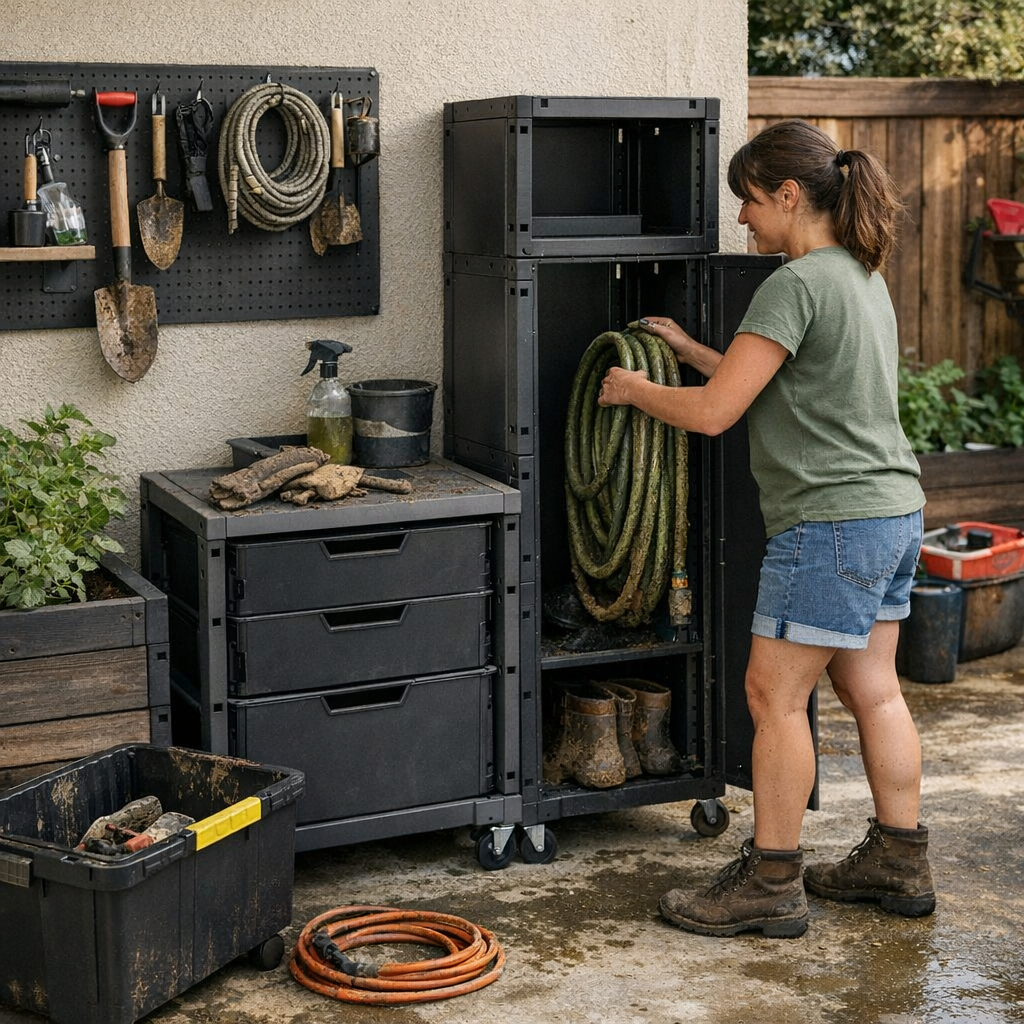
Here’s a fix that actually sticks: split storage by likely mess, not just by item. Place a modular, weather-resistant cabinet right by the spigot—dedicating it solely to wet or dirty returns. Yank a shelf out and you’re left with a tall bay, perfectly sized to drop hoses, sodden trowels, or filthy gloves upright—no stacking, no digging. The dirty stuff goes direct, sparing the main area from gradual buildup and keeping cleaner tools cleaner.
The impact is immediate. No more forced bending to squeeze gear where it doesn’t fit. No more blocking your own path to dump a muddy shovel. Instead, fast drop-offs go straight where they belong—so by the end of the week, you haven’t spent half your energy reshuffling the same tools. The whole setup is easier to reset, and far less cluttered, even after heavy use.
Spot Trouble by Watching for Repeat Choke Points
If you’re tiptoeing around loose gear, shuffling the same tools day after day, or dreading the reset after a busy weekend, those are your clues: storage isn’t keeping up with your routine. Watch for repeat offenders—the spot where piles start forming, the tool that’s always stuck out, the awkward reach you keep making each time you return something. These are signals the setup is working against you, not with you.
Solutions can be direct, and you’ll feel the relief quickly:
• Swap bulky cabinets for wall mounts where walkways are tight.
• Remove shelves and design vertical slots for long or awkward-handled items.
• Separate messy, wet gear from dry storage to stop grime spreading everywhere.
Systems That Move With You, Not Against You
The best outdoor storage setups anticipate your steps, not just your inventory. Think: slipping out in boots, trying to unhook a hose with one hand, or dropping shears on an easy shelf instead of hiding them under a stack. Modular units stay flexible—they adapt as you swap out gear through the season, or as one side of the system starts collecting too much overflow.
But even the cleverest modular system fails if it ignores movement. A wall system is only as good as its depth—if tools stick out, you’re always dodging them. Floor cabinets save space until they clog a tight path. Rolling carts seem effortless, until you realize there’s no spot that doesn’t turn them into an obstacle after every use. The real test is after a dozen cycles of use, not after one photogenic reset.
Make Outdoor Storage Work Harder Than You Do
At the end of the day, storage that can’t handle muddy hands, surprise downpours, or hurried drop-offs is just aesthetic. What works week after week is a system that lets you move—no detours, no double-backs, no balancing acts. The real value is in setups that match how you actually use the space, not just how it looks after you clean it up.
If you find yourself thinking, “Why do I have to keep fixing this?”—that’s your cue to rethink the flow, not just the footprint. A few small shifts in layout or zone rules can turn daily frustration into a space that works for you, not against you.
Find modular systems and practical setups that adapt to your actual routines at StackNest.