
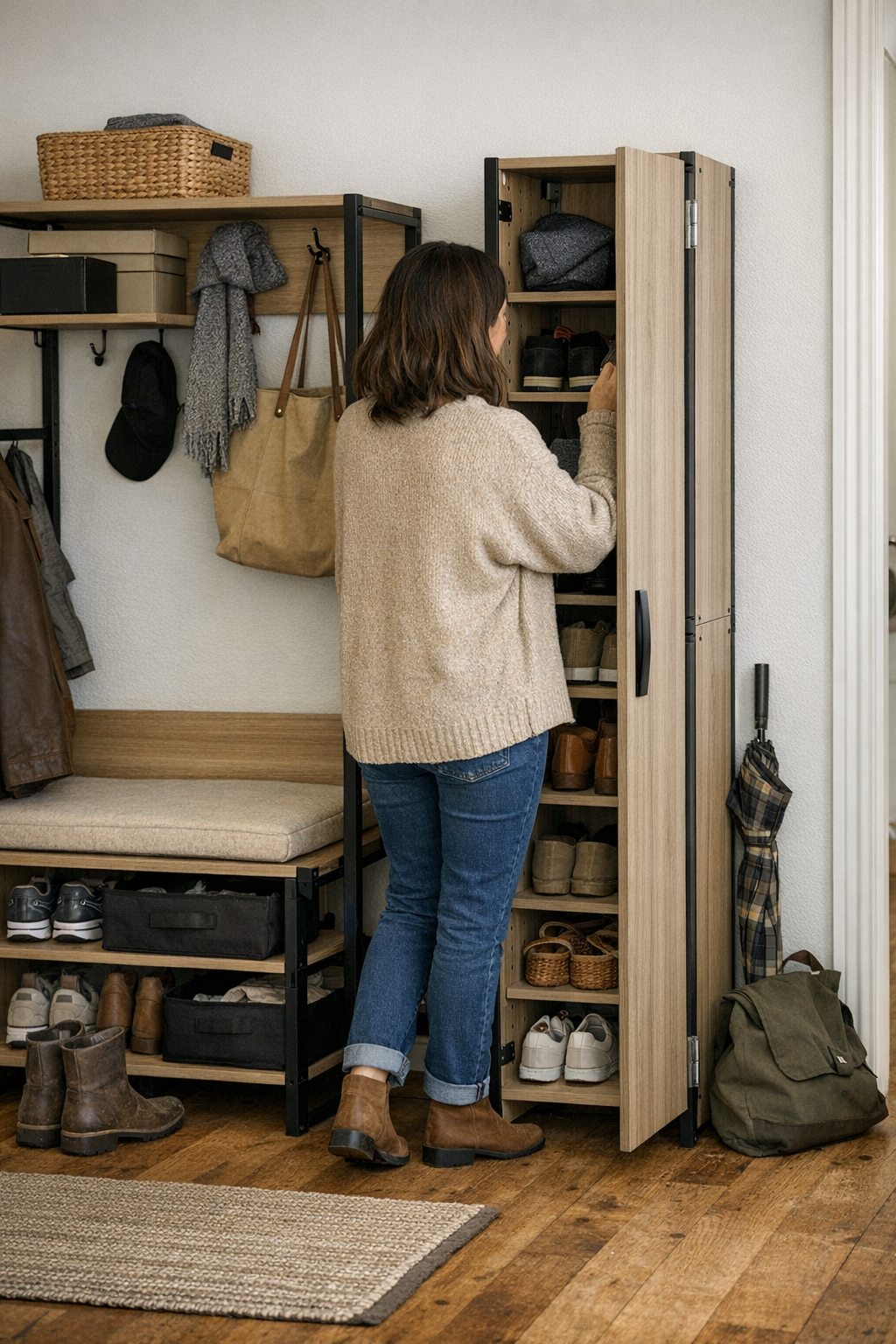
If your entryway makes you stop to clear a path just to open a cabinet—or if dropped bags and creeping shoe rows keep turning “organized” into blocked and awkward—your storage setup isn’t helping, it’s fighting you. In high-traffic thresholds, the swing and footprint of a cabinet decide whether your daily routines flow or jam up. That’s where the real difference between wide-swing and narrow storage doors appears: not in showroom images, but in the grind of everyday use as items pile, shift, and the so-called tidy zone keeps falling apart under real movement.
How Wide-Swing Cabinets Turn Flow Into Friction
On paper, a wide-swing entry cabinet looks like it makes things easy—open the door, see everything, grab what you want. But this only works as long as the floor in front stays empty, which almost never happens. The moment routine kicks in—a rainy drop-off, arms juggling bags, someone else squeezing by—the wide door’s oversized arc bulldozes shoes out of line, catches on bag straps, and demands a cleared strip of floor every time you need to get inside. The “open access” quickly turns into a moving blockade right at your chokepoint.
This isn’t random clutter—it’s predictable: Shoes left even slightly forward get swept out or tripped over. Bags stacked near the hinge get toppled or pinched when you open up. Jackets hung near the action lose sleeves to the swinging door. Each trip starts a mini reset, copying yesterday’s cleanup. You don’t see the cost at first, but after a few days, your “organized” entry is just a new obstacle course—slowed, crowded, and demanding extra steps you barely notice but always feel.
The Cumulative Effect of a Wide Arc
These little interruptions stack up fast. Step back to open the cabinet, put something away, and that tidy walk line you made yesterday instantly fills with today’s shoes and bags. The reset never holds. If your square footage is tight or your entry gets heavy use from several people, a wide-swing cabinet makes the space feel like it’s set up to resist you—not support you.
Narrow Storage Doors Make Space Behave
Now compare a cabinet with a narrow pivoting door—one that opens close to the cabinet face and claims no more than 12–15 inches into the room. Suddenly, shoes and bags can accumulate near the front without blocking storage at all. You can walk in, kick off shoes, drop a bag, and still open the cabinet freely. The threshold stays passable, resets are faster, and you don’t have to rearrange everything just to grab a coat or stash wet boots.
Slim doors, easier routines. Slim vertical storage uses wall space, not walkway, so it rarely forces you to step around a giant moving door. You get access along the side margins—the zones where overflow usually starts to sprawl—rather than needing a clear, empty rectangle for a door arc. Items get put away with less chance of triggering a domino effect of shuffled piles or misplaced gear.
When Real Life Crowds the Threshold
You feel the difference on any standard morning: one person wrestling with shoes, another squeezing through with a bag, someone else dropping their stuff halfway inside. Wide-swing cabinets force people to wait, back up, or shuffle around the door. A narrow-door unit lets movement continue; you’re less likely to block the flow or trap yourself and others between piles and swinging edges. Even when piles form, they aren’t automatically in the way.
Everyday Scenarios: Where Design Collides With Routine
Real entryway setups show their true behavior in ordinary moments:
- The “Quick Reset” That Stalls: Putting away one pair of shoes should take seconds. But when a wide-swing door needs room, a simple reset becomes a full-shuffle event—move shoes, shift bags, maybe even slide the bench—just to open the cabinet fully and finish the task.
- Drifting Overflow: Shoes neatly aligned by a bench edge stay that way only until a door swings through—then the row spreads wider, the bench collects items, and your walk zone eats clutter instead of containing it.
- Bag Drop Problems: If your storage needs a “safe zone” to function, there’s nowhere good for bags except in the walkway or in corners where they become trip hazards—or get dragged by the next opening.
- The One-By-One Backup: Rainy days and family entries expose the flaw: every person waits for the giant door to clear before moving through—when the goal should be quick movement, not staged procession.
Each repeated friction point—tripping over bags, shifting shoes, apologizing for blocking the way—chips away at any entryway system’s claim to be organized. Good storage doesn’t just look neat on moving day; it lets you move and reset with minimal hassle when the week is in full swing.
What Actually Changes With a Slim Vertical Storage Unit?
Switching from a wide-swing to a slim, wall-hugging vertical cabinet resets the threshold for real. With a swing limited to about 15 inches, shoes and bags now pile near the door without blocking access. Instead of stopping to clear a landing zone or nudge shoes aside, you open, stash, grab, and step through—no pivot, retreat, or tactical sidestep needed. No one waits in the hall. No one has to step back. Movement stays continuous—even as piles appear and disappear through the day.
The result is everyday pass-through—not just first-day tidiness. Over a few weeks, the difference is quietly but visibly real: the bench is for sitting, not overflow. Shoes go back on shelves, not back into traffic. Less drama at the threshold, fewer end-of-day resets. Problems don’t vanish, but they stop piling up right in your movement path.
Does a Narrow Door Limit Storage?
This is often the big question. In use, vertical units trade extra swing space for height and adjustability. For most mixes—shoes, hats, backpacks, or a rotating set of seasonal gear—capacity holds up if you set the shelves to match your highest-traffic items. Unless you’re parking winter boots for six people or storing large sports equipment, nearly all entryway needs fit. If the area is still crammed, it’s often the overflow of “just-in-case” items, not a storage pattern flaw.
Points to Watch: Not Every Narrow Door Is Equal
One repeated headache with narrow doors: weak hardware. Cheap hinges or flimsier doors can’t keep up; they flex, slam, or drift out of alignment after just a few weeks of hurried use. When considering a change, check hinge strength and door stability, or upgrade hardware so the door survives the cycle of slammed, pulled, and leaned-on use it’ll see at real thresholds. A narrow swing only helps if the door stays squared up after 100 daily grabs and drops.
When and Where Wide-Swing Still Makes Sense
There are spaces and routines where wide-swing cabinets can work—mainly when you control every variable. If you have a guaranteed clear floor in front (at least two feet, reliably), and your entry routine is smooth, timed, and never involves piles or sudden drop-offs, a wide-swing door won’t punish you. But for most lived-in homes—where entry space shifts from gear landing pad to hurried reset zone—each wide door is an invitation for daily pileups and extra steps.
One visible rule: If you’re regularly sliding items aside to open your cabinet, the door is eating up your movement zone. Any bag, shoe, or bench edge within about 24–30 inches of the hinge is at risk—and will get swept, blocked, or stranded in daily use.
The Big Difference: How Entry Storage Shapes Daily Life
This isn’t about looks or matching covers—it’s about function when things get messy. Every time a pile forms, the wrong door turns a small hassle into a blocked threshold. Wide arcs demand wide lanes and daily vigilance. Slim pivot or sliding setups trim that demand, letting your routine—including the inevitable drift of shoes, bags, and wet things—play out with fewer slowdowns. “More storage” isn’t the answer; storage that respects your real movement is.
Find transition-space storage that adapts to your routine at Betweenry.