
The ceiling fixture you installed looks bright enough at first glance. But a week later, you slow your step at the stair landing, sensing the drop-off just outside the light’s reach, or you find yourself craning forward at the bathroom mirror to escape a slice of shadow that never seems to move. Rooms lit with a single flush or semi-flush mount might pass the “does this look bright?” test—but in daily use, uneven distribution, shadow lines, and sudden glare start to interfere with actual tasks. These aren’t dramatic failures; they’re the minor, repeated obstacles that quietly build up when lighting gets picked for the wrong reason—appearance, spec sheet, or quick installation—while real movement and sightlines go ignored.
The Everyday Cost of “Easy” Lighting Installs
The biggest lighting mistakes reveal themselves through routine—walking the same hallway after sunset, reaching for the edge of a work surface, or glancing at the mirror and seeing one half of your face almost vanish. That soft shadow by the stair edge or muddled corner in the laundry isn’t an accident of bad luck or “cheap fixtures”—it’s what happens when the fixture type and placement never matched what you actually do. Hallways and stairwells, in particular, seem fine until you reach for a handrail or turn a corner and realize you’re moving slower, feeling for edges the light doesn’t quite reach.
Hallways nearly always reveal the shortcut. The typical flush-mount ceiling light offers broad, central brightness—but only from certain angles. Stand at a corridor turn or pause before the stairs: the center zone is lit, but the side walls melt into gray, and the floor’s edge feels half-guessed. It’s in these subtle moments—turning sideways to see where the hallway bends or catching your foot on a barely-visible tread—that the gap between “enough light” and “usable light” becomes hard to ignore.
Where Light Lands: The Real Test Isn’t on Paper
Brightness specs and catalog mockups fade as soon as real conditions step in. The width of a corridor, open doorways, or a row of backpack hooks instantly redirect, block, or cast new shadows across a space. The central fixture, perfectly balanced in an empty room, starts to falter when a shelf or closet interrupts its spread. Suddenly, crossing that hallway means one side of your body is well-lit and the other fades into obscurity, especially in the evening or when the sun shifts. The supposed “bright fix” leaves you moving more carefully—side-stepping shadow pools, glancing down for missed steps, or hesitating at the far end of a poorly-lit run.
Bathrooms and Mirrors: Shadow Problems That Don’t Leave
An overhead bathroom fixture lights the room but rarely helps at the mirror. Half your reflection slips under a shadow line, and rotating the fitting or swapping bulbs never quite fixes it. Every morning, you lean or twist—one shoulder in glare, the other in murk—just to get even lighting for shaving or checking details. That imbalance becomes habit. You stop expecting clarity until you try another bathroom set up right—vanity lighting flanking the mirror, shadows neutralized, every feature visible. The upgrade isn’t “extra”—it’s what’s actually needed for the space to work, every day.
Pairing Placement with Purpose
Strong lighting setups are never just about wattage or appearance—they hinge on whether each routine action is actually visible and comfortable from every angle that gets regular use. For a corridor, sticking with just a flush mount creates a tunnel with lit and unlit zones. Adding a wall sconce or two at walking height, even halfway down the hallway, breaks up the darkness, defines the stair edges, and smooths the transition between rooms. Suddenly, movement is steady, corners are mapped at a glance, and you stop inching along once the sun sets or you cross from a brighter zone into these in-between spaces.
Task Zones: Lighting That Keeps Up With What You Actually Do
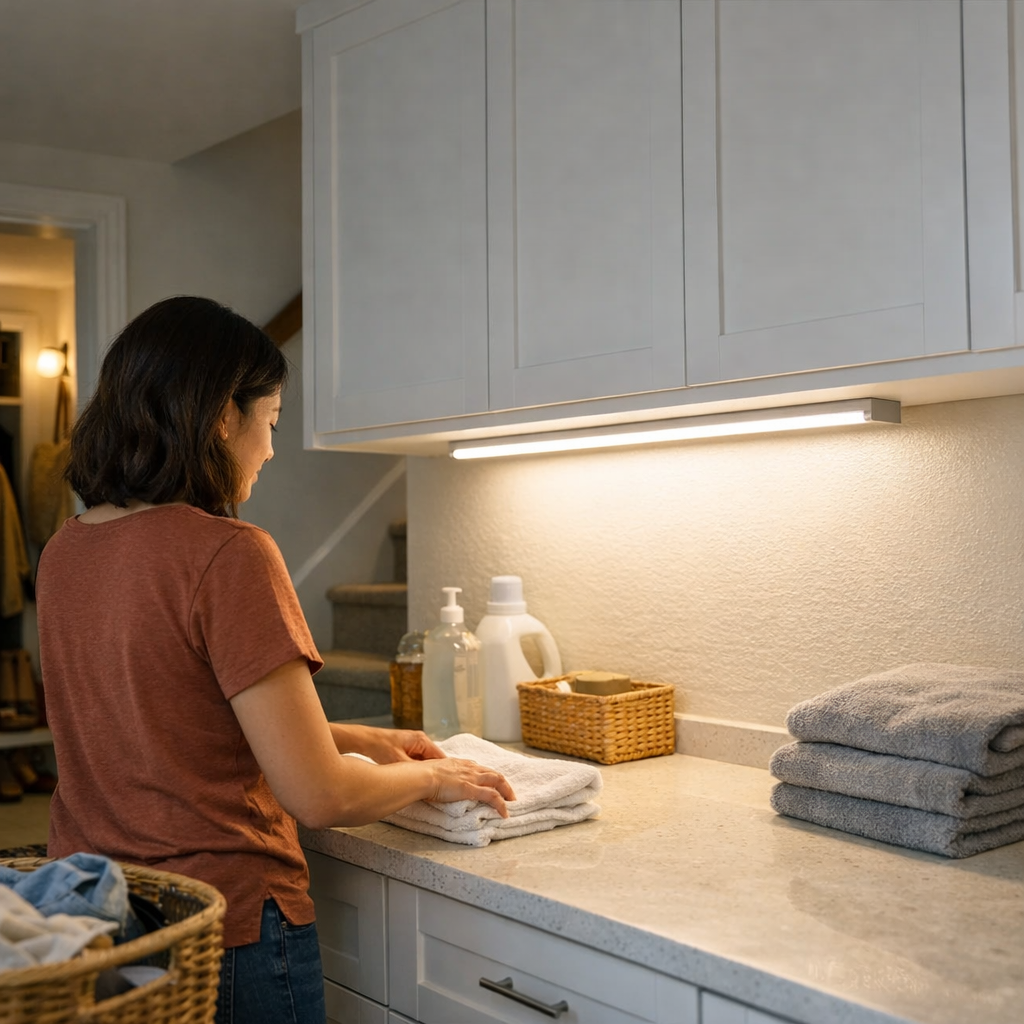
In laundry rooms, mudrooms, and utility spaces, these differences stand out fastest. A single fixture in the center can never fully cover counters, nooks, or the spot where you always sort clothes. Try folding laundry during a cloudy afternoon: the far edge of the counter blurs, detergent bottles hide in a persistent shadow, and you find yourself shifting the wash basket into the limited beam—over and over. Or, stepping from laundry into a mudroom, you lose track of the landing as light falls off before your foot finds the threshold. Each time you reach for more light without thinking, the inadequacy of the setup becomes unavoidable.
Improvement isn’t about dumping more brightness in. Mounting a damp-rated, low-profile LED strip beneath an upper cabinet or along the back edge of a work surface wipes out the stubborn dead zone instantly—no extra fixture clutter, just precision. Every part of the counter lights up, lost corners reappear, and moving quickly between tasks means fewer stumbles or missed spots, especially when daylight is weak or nonexistent. The change is practical and ongoing, not decorative: visibility meets the shape of what you actually do.
Why the Wrong Fixture Feels Good—Until It Doesn’t
Poor lighting rarely fails all at once—its cost accumulates invisibly, through small repeated inconveniences. One fixture in the ceiling ignores blocked sightlines, problem corners, or areas where your routine piles up. Over weeks, you unconsciously brace yourself: squinting at the same dark counter, nudging a basket for better visibility, memorizing a shadowed stair edge where you keep slowing down. The “done” look wears thin, and the feeling of a truly finished, usable room never arrives.
Lighting wants to be a one-and-done job. But living spaces evolve: furniture shifts, routines change, sightlines get blocked that weren’t an issue when you unpacked the fixtures. The result isn’t total darkness—it’s the quieter frustration of moving and working around persistent, avoidable blind spots.
Targeted Lighting: Small Shifts, Large Relief
You don’t always have to start over. The fix is usually targeted—placing light where struggle repeats, not where it’s easiest to wire or where bare bulbs make the gallery shot. One wall sconce at hallway height breaks up the gloom that a flush mount leaves untouched. A single under-cabinet damp-rated strip turns “search and fumble” into obvious, visible order in a laundry room or next to a utility sink. The right solution doesn’t chase brightness—it follows the path of actual movement and use, shaping the light around the routines that expose friction every day.
Real-World Lighting Checks Worth Trying
1. Walk your entire route—after dark. Before picking placements, take each main path—across the hall, up the stairs, over to the laundry—at night. Wherever you slow down, stretch your stride, or lean for clarity, that’s a sign the lighting shape needs changing, whether by adding a sconce at eye-height or placing a strip along a work edge. These points aren’t decoration—they’re navigation cues built into the structure of the space.
2. In work areas, always pick damp-rated fixtures. Utility rooms and near-sink counters collect invisible moisture from splashes, washing machines, and steam. Regular fixtures corrode or dim sooner—while a damp-rated LED keeps its steady spread. The difference isn’t theoretical: it’s fixtures that keep lighting your routine instead of failing quietly after months of use.
Lighting That Follows Your Routine—Not Just the Floor Plan
The best lighting setups don’t compete with how you actually use the room—they adapt to it. “Easy” isn’t just a fast ceiling mount or the most “modern” surface cluster: it’s installing lighting that tracks each movement path, exposes every edge, and never leaves you working around shadow traps or squinting across uneven surfaces. A flush mount matches a low ceiling; a sconce adds definition along a wall run; a hardwired task strip clears the blind spots beneath cabinets. Over time, it’s these decisions—tied to layout, routine, and repeated friction—that turn stubborn inconvenience into seamless, safe use. Not once, but every single day.
Lighting that respects the lived-in structure of your home clears up the small, costly annoyances that never make it to the punch list but undermine every routine. The fix isn’t more light—it’s targeted clarity, placed where you need it, lasting as long as you need. Practical, every-angle visibility always wins over empty wattage.