
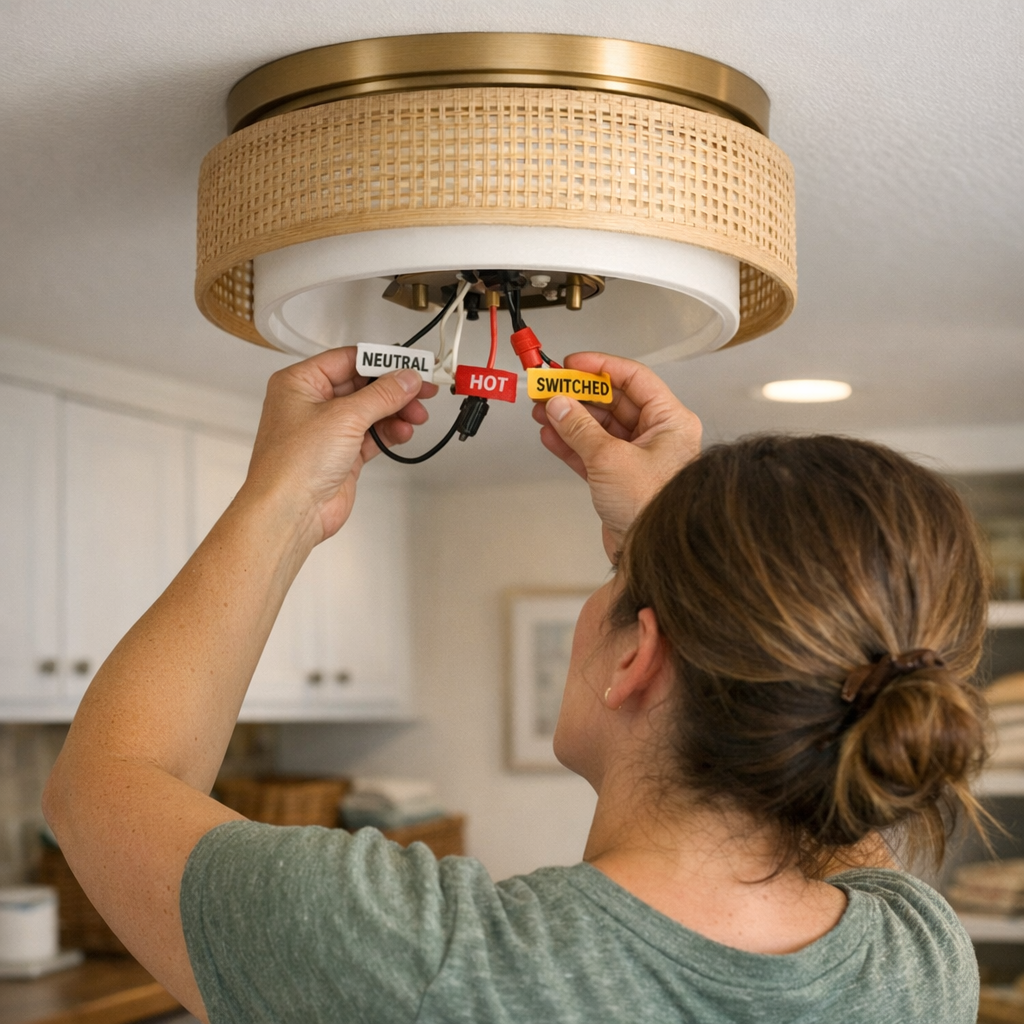
Indoor lighting rewires your routine—not just the room. In high-traffic areas like hallways, stair turns, and tight laundry work zones, a poorly labeled ceiling or wall fixture doesn’t just create a mess behind a cover plate. It leaves you guessing in every upgrade, repair, or late-night fix: which wire controls the stairway turn? Why is the mirror zone still shadowed, even after swapping a “brighter” vanity light? That quick bulb change or sconce replacement turns into a drawn-out process of trial and doubt—disrupting daily flow long after you’ve closed up the fixture.
When “Looks Fine” Stops Working: Where Wire Confusion Begins
Frustration surfaces at the worst moments: a hallway flush mount winks out just before guests arrive, and pulling it down reveals an unmarked jumble of wires. You try to upgrade laundry or under-cabinet lighting, but four indistinguishable leads appear—opacity, not clarity, hidden in the ceiling. What seemed handled years ago resurfaces:
- Rush hour repair: The bathroom sconce is dead. You confront a blend of black and white wires with no hints—forced into slow deduction while time vanishes.
- Mid-task frustration: Folding laundry in weak light, you pop open the fixture only to face a tangle that offers zero guidance. One wrong guess, and the whole room stays dim.
- Stairway lighting mystery: Multi-switch setups mask “silent” wires. Changing a stair fixture unearths a surprise: the replacement throws shadow where safety used to be, undermining your confident routine at every step.
The problem is invisible until it breaks your flow—forcing hesitation where you need clarity. “Looks fine” on install quickly becomes “why isn’t this working?” the next time real use exposes the missing logic.
Labeling: The Small Habit That Pays Off Later (and Again… and Again)
Wire labeling feels unnecessary during the first install—especially when colors look obvious, and new fixtures (like a utility-room flush mount or a stairway wall sconce) appear foolproof. In reality, even the most logical setup turns confusing once you can’t see behind the ceiling plate, especially years later or after a renovation shifts the wiring layout.
Every high-use space develops its own quirks. A guest bathroom’s vent and light might share a hidden circuit, or a utility zone inherits mismatched splices. Skip labeling, and every revisit becomes a slow rediscovery, stalling basic fixes and injecting uncertainty into tasks you should finish in minutes.
The difference is immediate for those who label wires at every open fixture—using durable tape and fading-proof ink before anything goes back in place:
- Changing a mirror light isn’t a puzzle; it’s direct—no time wasted tracing invisible lines.
- Under-cabinet task lighting upgrades finish fast, not in staggered sessions triple-checking connections by flashlight.
- Stairway bulbs get replaced with confidence, never with a lingering doubt about which side controls the landing and which might leave a shadow at 2 a.m.
Why Wire Mix-Ups Repeat—And Multiply
The risk is cumulative: each guess at an unlabeled wire is a shortcut that compounds trouble. Color alone won’t save you—especially with past repairs, odd add-ons, or houses where codes changed mid-stream. Shared neutrals, recoded wires, and creative “fixes” lead to mismatched results, from stubborn shadows that won’t lift to flickering edges that make nighttime movement uncertain. It’s not only a technical problem—the visual toll persists for months: dim work surfaces, uneven mirror light, or a stair turn you cross with less certainty every time.
When high-traffic corners—stairways, tight laundry tables, passageways—get locked into these compromises, routines shift: you fold clothes in shadow, move mirrors to chase clarity, or delay basic fixes out of wire confusion. Each missed match increases stress, not just maintenance.
Labeling in Practice: Small Steps, Big Impact
One label at every connection flips the scenario: put the certainty at the wire, not in unreliable memory. Use robust tape with a permanent marker—write directly, “hot,” “neutral,” “switch leg,” or precise roles suited to the spot. Make tags easy to spot right by the connector so they survive both mounting and the next unscheduled repair.
- Apply labels close to each join—don’t let them disappear behind plates or brackets where future-you won’t see them.
- Mark clear abbreviations, fixture locations, or circuit hints if needed—short and unmistakable, not elaborate.
- With fixtures upgraded often (like LED panels, bathroom sconces, stair lighting), check that labels remain visible—not just after install, but at every revisit, years later.
This habit turns routine fixes—mirror swaps, under-cabinet improvements, bulb changes at the stair landing—into fast, confident tasks, not slow, risky evenings. Every zone that sees high use benefits: hesitation drops away, and maintenance fits into regular flow again.
Lighting That’s Easier to Live With
“Bright” isn’t the same as usable. Your home’s lighting lives and fails in everyday moves: missing labels mean shadows persist at the folding table, the hallway can’t be trusted for safe steps at night, or the bathroom mirror always needs adjustment for clarity. Real improvement comes not from dazzling lumens but from friction-free upkeep—every upgrade, replacement, or fix handled with certainty because the structure behind the fixture is clear.
Labeling isn’t about technical perfection. It’s a basic step that keeps ordinary lighting frustrations from building up, especially in your most-used corners: laundry nooks, stair turns, hallways, baths. The payoff is visible—clarity and ease, right where routines depend on it.
Find lighting made for real, repeatable use at LightHelper.