
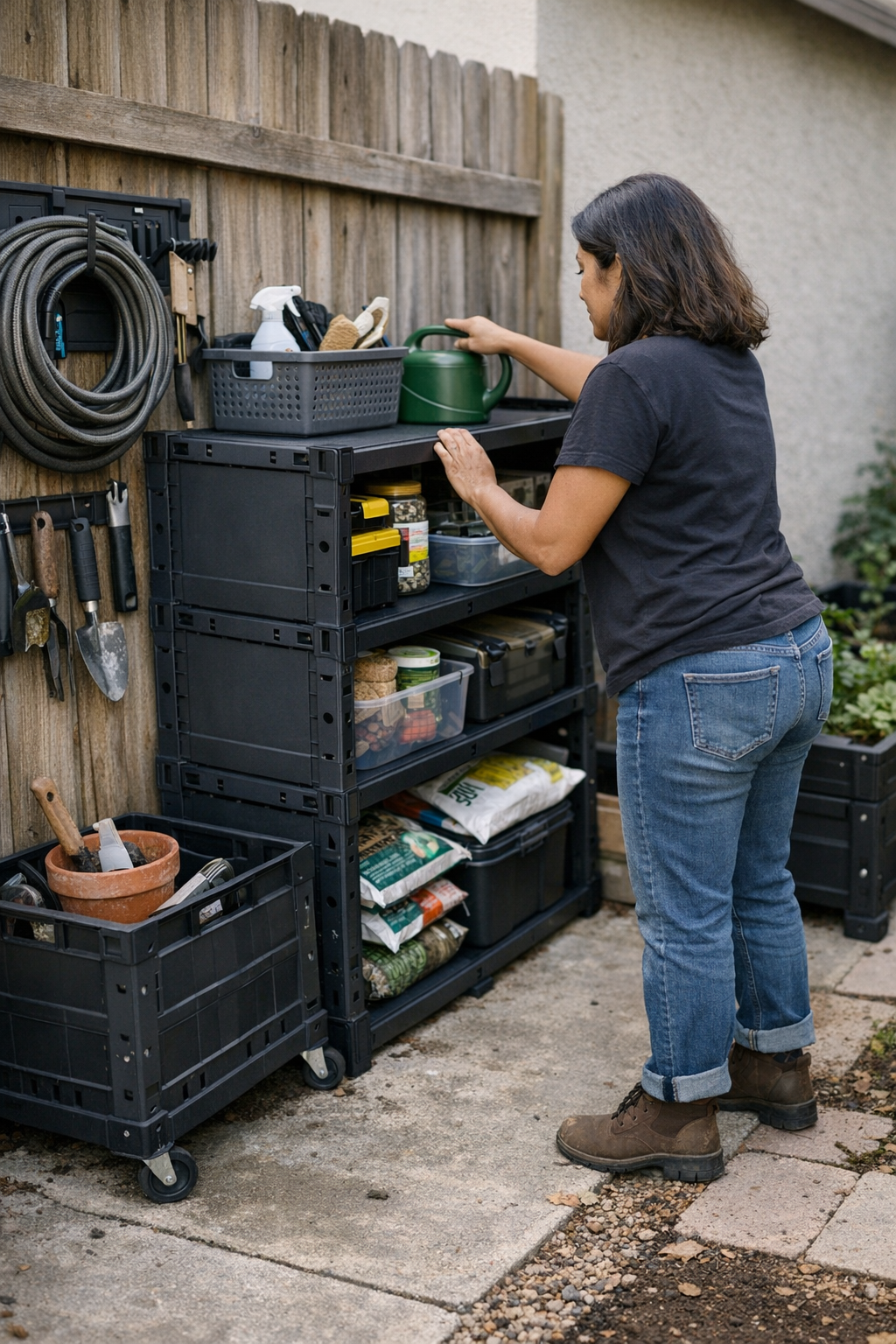
Most outdoor storage starts with hope: a strong shelf, a bin for boots, maybe a wall hook for the rogue shovel. But in real backyards, side-yard strips, and garage edges, the chaos always overruns the plan. You don’t curse at the shelf lines—you curse when you can’t make it three steps before tripping on what didn’t fit. If you’ve ever dragged a cart through a narrow path only to nudge aside bags of mulch or played hopscotch over boots swimming in puddles, you already know the truth: it’s the floor that fails first, and everything else just distracts you from it.
Why Perimeter Order Can’t Save the Center
It’s easy to get fooled by the edges—neatly lined bins tucked against the fence, precision racks along the garage, a system that flexes around the patio. Stack high, clear the way, and the space looks almost under control. Until real life walks through. One tool left 18 inches from its hook turns into a slalom obstacle. A bag that won’t fit because yesterday’s load never got sorted sits tight in the only gap left. Someone races in from the garden, drops muddy boots dead center, and the tidy edge becomes irrelevant—a setup that stores but stalls you every time you return.
It’s rarely the unreachable corners or ceiling-level racks that cause the reset spiral. It’s the cluster of what can’t find a home, scattered at shin-level, collecting on the ground right where wheelbarrows, bikes, and people collide—all in the name of “maximizing” space.
When Storage Backfires—Spillover Hits the Center
Organization promises relief from chaos, but the transition point—the path itself—is usually where systems fail. The cycle is sharp and familiar: after a rainstorm or a DIY weekend, all containers and hooks max out, so boots and bags drift into the worn walkway. No one comes back to re-stack when their hands are full: the bike gets nudged through, the rake handle swings wide, a muddy trowel is dropped “temporarily” on the first dry slab. The overflow doesn’t go up, it goes down—right underfoot. The next trip means kicking things aside, nudging a bin that lost its corner, or detouring around one-too-many abandoned items. No shelf label helps when you can’t see the floor.
“High-density” only works in diagrams. As soon as return traffic gets real, movement splinters. Wheelbarrows stick on stray garden shoes, bikes must be lifted sideways, and that one forgotten bucket becomes a landmine. You spend three times as long resetting, the routine turns into a scavenger hunt, and suddenly all that impressive storage makes the space harder—not easier—to use. The real performance test isn’t shelf capacity but whether traffic—even rushed, distracted, or dirty—flows clean through, not around or over.
The Rapid Shrinking of Clear Zones
Picture any narrow side-yard or the classic garage threshold: storage “lives” on each side, while the middle lane is sacred for movement… for maybe three dry days. Then the weather shifts. A kid’s bike is parked halfway in after a shortcut. Gardening stuff comes back muddy and is left to dry—right where you walk. By Tuesday, the red bin is jutting into the walkway, a rake is wedged under a pile, and the space intended for traffic morphs into a sorting zone. Moving a barbecue means first shifting shoes, bins, and whatever else snuck onto the floor.
Anyone with a utility corner, patio edge, or garage supply zone has watched it happen: what’s stored on the edge stays unused, while the items everyone grabs get abandoned in whatever “neutral ground” remains. The true measure isn’t shelf height or container count—it’s how long the main route stays open without a reset war every week.
Why Every Inch of Floor Matters Most
The urge to line every wall and swallow every spare foot is strong. Convenient in theory, but every organizer shoved along the edge risks leeching just enough space to stall movement mid-project. The center lane—roughly 28 to 32 inches—becomes untouchable if you ever want more than single-file passage. Fill that with cube bins or mount hooks just low enough, and yardwork devolves into a sidestep puzzle. Tools get dropped mid-route, slowdowns happen, and your storage zone starts to feel tight, whether or not it passes a visual inspection.
Even clever modular racks only improve things if they leave that middle strip sacred. The moment a shelf noses into open floor, it turns into a magnet for orphaned tools, so-called “temporary” drop-offs, and “it doesn’t fit” overflow. The “bonus” hook at arm’s reach? It’s fine for one shovel—until you have three muddy tools and a bucket trying to hang off it. All those small compromises add up fast, suffocating the main flow line.
Fixing Footprint Friction—Not Just Adding More Storage
Sometimes the breakthrough isn’t another shelf, but a shift in orientation. A real side-yard setup: one blocky storage cube—supposedly “out of the way”—ran perpendicular to the fence. On paper, nothing jutted into the walkway. In reality, it pinched the traffic enough to create a bottleneck. The fix: pulling the unit back by just 16 inches and resetting it parallel to the fence. Suddenly, trash carts rolled through without bumping, wet boots found a safe landing at the side, and the headache of “where do I put this?” vanished for both adults and kids. Resets dropped off; overflow items actually landed where they belonged instead of the path’s center stripe. Nobody had to stop and reshuffle after each use because the movement matched the routine.
This isn’t some aspirational downsizing—just a clear rebalancing: keep every inch for flow, not just for storage numbers. A less crowded footprint looks lighter but ends up working twice as hard. Stress vanishes from the routine. The payoff is obvious after one busy week—less shuffling, less “just for now” clutter, and a space everyone actually wants to use again.
Quick Tip: Carve out a “drop buffer” zone right past your main entry—an 18-inch patch that stays empty, even on messy days. That single chunk gives everyone a guilt-free bailout zone for boots or stray tools, so the center lane doesn’t get sacrificed in the name of speed or convenience.
How Over-Organization Quietly Breaks the Flow
The more obsessively you fill the margins, the faster the walkway turns into overflow parking. Every new cube “just to make it fit” is a bet against movement. In a shared yard, this gets brutal: your five-minute cleanup becomes someone else’s half-hour detour. The more steps it takes to access or return an item, the greater the odds it finds its way onto the traffic line, waiting for “later”—which usually means “never.”
The real difference between a superficially organized but jammed area and a setup that survives weather, chaos, and family routines is always the same: not perfection against the wall, but unblocked space in the middle. Upgrade layouts with enough slack for real, repeat use—room for gear to travel in both directions without drama or resentment. Give up the last shelf or bin if you must, but never the clear path. After all, the only system that stands up to the everyday mess is one that keeps moving with you, not against you.