
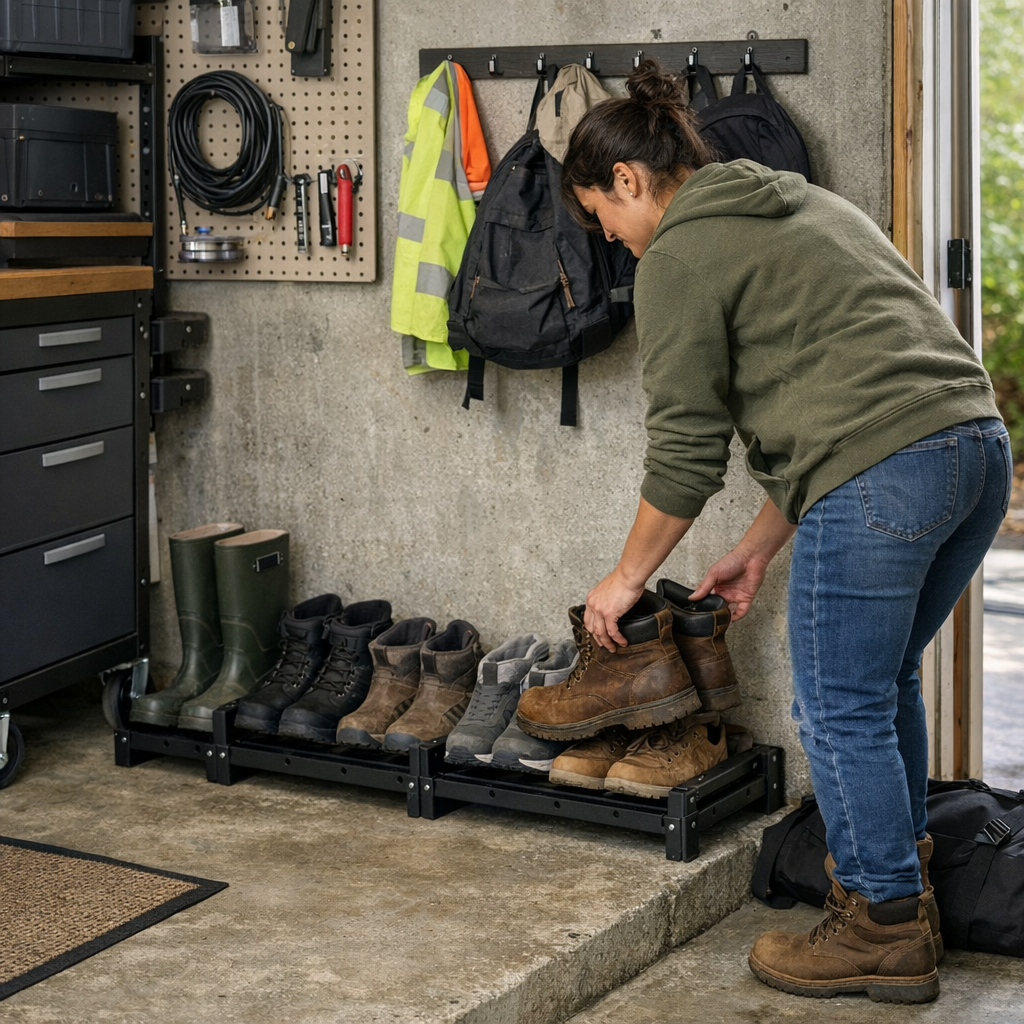
Every garage entry or mudroom starts out with the promise of order—shoes off the floor, traffic flowing, everything in its place. By day three, that promise is already cracking. You’re sidestepping bins to wedge the door open, pausing to shove a runaway boot out of the walkway, looping around a storage rack that seemed “space-saving” on paper but shrinks your path in real life. Look closely, and it’s the difference between a setup that photographs as organized and one that actually lets a family move, pause, and repeat—all week, not just on a tidy Sunday.
Where Storage Collides with Everyday Movement
Shoe storage fails aren’t about clutter—they’re about collision. That rack near the door: does it quietly disappear, or are you bumping it every time you walk through with groceries? Does a bin keep shoes contained, or does it create a pile you have to shuffle just to pull out your bag? The issues surface fast: a wall bin hogs elbow room near the key hooks, a floor rack eats up the landing zone, or an “organizer” turns one easy trip into a circuit of interruptions and awkward pivots.
It’s the repeated, barely-noticed obstacles that build up frustration. Those nudges to keep shoes aligned, the bending to re-catch a pair kicked aside, and the shoulder-turn to squeeze past—these are the signs your storage clashes with your routine, not fits it. And the longer a setup requires manual resets, the less it’s actually working.
Wall-Mounted Storage: Out of Sight, In Your Flow
Wall-mounted racks look neat until you live with them. Suspend the shoes: yes, less on the floor. But every inch they protrude matters when space is short. In reality, a “slim” rack can belly out into vital walkway. It stubs carts, snags bags, and narrows the spot where two people would otherwise pass side-by-side. Over time, marks and bumps appear exactly where you grip the doorframe or fumble for a tote.
And when you’re under pressure—school rush, arms full—one stray pair topples right into the crossing. Storms just move the mess upward: now drips and mud drop directly into the stretch you want to keep clean. “Off the floor” is no help if it’s always in the line of fire.
Floor Racks and Bins: Control or Clog?
Set storage on the floor and you dodge some pitfalls, but you invite others. Bins that bulge just past the corner slow every pass. A big “catchall” tub looks clean on Monday and turns messy by Wednesday, shoes layered and spilling because nothing guides them back. Walkways shrink as overflow piles up until someone’s tripping, or—worse—skipping the bin entirely to toss shoes anywhere the path is clear.
Here’s how setups reveal themselves: the area stops resetting itself. Pairs linger off to the side, left halfway in the bin or banked at weird angles. Cleaning gets skipped because of another step—moving the whole container, untangling laces, clearing mud from a traffic path now twice as dirty. If you’re ducking around the same obstacle more than once a day, the system has started to work against you.
What Lasts: Layouts for Real-Life Use
The setups that make it through a week mostly unscathed aren’t the showpieces—they’re the ones you barely notice. They create invisible lanes that accommodate the real choreography: carrying bags in, pushing the stroller out, getting multiple people past each other without stops or sidesteps.
Take a floor rack dropped parallel against the wall, set back far enough—not right up at the door, not jutting into the cold zone. In one honest test, switching from a wall unit to a slanted, low rack granted a full 22-inch clear lane. That’s not a number for a product tag; it’s enough for two kids to run by or to carry a week’s worth of groceries without a hip bump or a second glance. That angle meant shoes lined up on their own again, not stacked or turned awkwardly. Mud collected on the mat, not on the bags, and re-entry meant shoes landed where they belonged—no extra cleanup loop.
Small Shifts, Real Impact
It’s rarely a complete overhaul. Sometimes just pulling a unit four inches away from the bottleneck lets the zone breathe. Splitting one oversized bin into two shorter rows brings a sense of order—everyone finds their own spot, overflows stop, and the “always-in-the-way” area becomes a footnote instead of a daily headache. The best layouts don’t max out capacity at the cost of simplicity. With nothing blocking the obvious through-line, shoes move in and out naturally, and traffic no longer staggers or doubles back.
Good Storage Lets Good Habits Settle
Choke points spawn mess and apologies. Wall pegs stick out right where the sports bag hangs; a bin blocks the spot you pause to tie laces. These collection spots are magnets for unfinished resets, and the more often you have to apologize (“I’ll move this in a second”), the more the system is failing the routine. What works? Floor solutions so discreet they’re almost invisible—low, zone-conscious, never crowding the critical inches that make one space passable for all sizes and speeds.
Quick Real-World Fixes
- Do a real-life walkthrough: Carry laundry, wheel a cart, move through with kids or groceries. If a setup slows you down more than once, reposition or resize it.
- Stop building upward: Tall bins and high racks encourage overstuffing and block sightlines. Priority is always width and clear access, never more vertical stacking.
- Guard a clear lane (20–24 inches minimum): Never let racks or bins intrude here. This path isn’t for shoes—it’s for movement. Defend it, and even the smallest entry stays workable.
The real win isn’t just a tidy floor—it’s frictionless movement. Shoe storage that respects the natural ways people move will always quietly outperform any system that only looks good in a product shot. The right setup isn’t what organizes the most—it’s what disappears from your daily routine almost entirely, every time you walk in or out.