
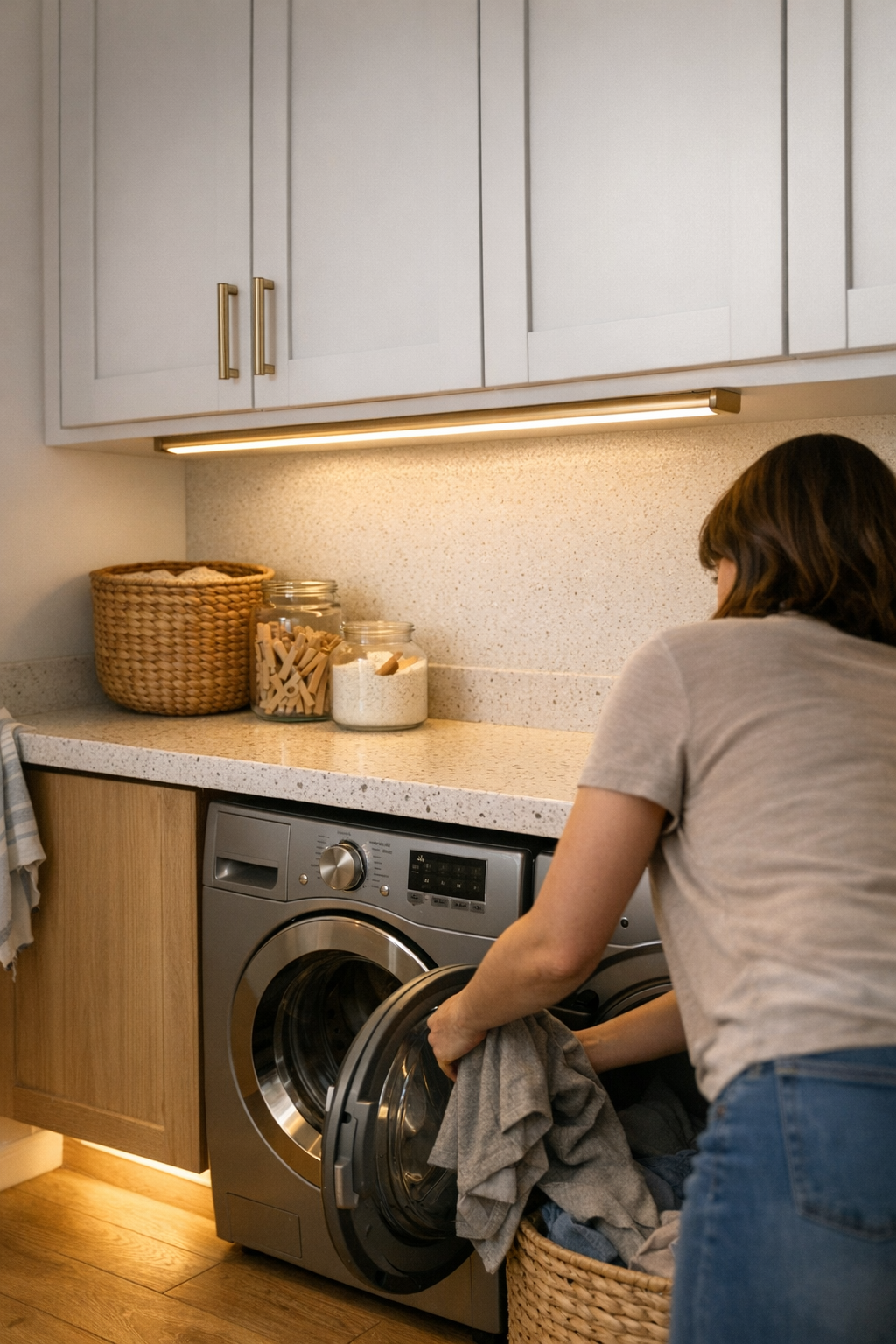
A room can look bright on day one and still work against you a week later. Ceilings fixtures easily trick the eye: hallways seem clear, but each sweep for dropped keys or lost socks exposes dark corners. Stair treads dissolve at the edges; a shallow step blends into the landing, and routine becomes uncertain. In laundry rooms, new overhead lights still leave machine bases and cabinet edges shadowed—so you end up scanning on hands and knees, searching by feel instead of sight. The most common indoor-lighting flaw isn’t “not enough light,” but misdirected light—overhead pools where you don’t need them and shadow wherever you do.
Why “Grounding” Your Lighting Matters Most
In every real routine—reaching for towels, carrying baskets up stairs, crossing a corridor in bare feet—lighting either reinforces your confidence or subtracts from it. Relying solely on ceiling fixtures, even with plenty of wattage, builds a false sense of visibility. Overhead pools leave sides and edges in darkness, so floors turn uncertain as your eye hunts for boundaries it can’t read. The most persistent mistake? Ignoring ground-level and work-surface lighting. Over days, these missing layers turn a room from “looks fine” to “missed step, squint, lost earring—again.”
Daily Friction: When Visibility Lags Behind Looks
Repeated friction is both small and constant. You hesitate at a stair turn. You watch a cap or sock fall, only to realize it’s vanished under the cabinet edge. You clean along baseboards you don’t fully see, trusting touch over light. Laundry work slows as you retrieve random buttons from floor shadows. Hallway crossings turn into quick glances over your shoulder as one half of the passage disappears into murk, despite a confident glow overhead. Friction adds up: every micro-delay or small risk is a direct result of missing, poorly directed light.
Catching the Invisible Corners: Real Scenes in Everyday Spaces
Stairways and Landings: Where Shadows Catch You
Stair setups betray their gaps in the rhythm of use. Near the bottom, steps flatten together as dusk falls, and that ankle-pause becomes unconscious—especially with arms full. At turns and landings, you half-guess the newel post or edge, moving slower than the space “should” require. This isn’t a style issue: mounts at low wall height or discreet LEDs at stair bases “set the line” clearly. One glance, even in a rush, and your footing is sure. You notice the absence of this clarity most when hurried—when one dim stair nearly undoes the whole routine.
Vanity and Mirror Zones: The Glare/Squint Cycle
Mirror lighting is often chosen for appearance, but placement rules the outcome. Fixtures set high or chosen for shape, not spread, throw harsh stripes across your face. You lean closer, chasing usable reflection, but the work surface below still sinks into shadow. Every early morning brings the same glare-squint-repeat; your jawline vanishes behind bright patches, and counter edges blur. Lower, better-aimed task or wall lighting slices through this pattern—stopping the squint and bringing detail back. Weeks later, you realize forgotten habits have faded: no more leaning in, no more hunting for stray objects in the dark.
Laundry and Utility: When Small Lights Solve Large Problems
The usual laundry nook “upgrade”—a flush or semi-flush ceiling mount—creates even, central light but allows every edge to sink into shadow. The difference comes with one targeted change: an under-cabinet LED strip, maybe 18 inches, set at toe-kick height. Suddenly the base of every appliance is plain, the floor stays readable, and socks can’t vanish into gloom. Instead of unnecessary detours and dropped items, the routine tightens up—movement feels direct, and cleanup doesn’t miss anything hidden.
How Lighting Setups Fall Short During Real Use
The letdown isn’t visible during install. After a ceiling fixture goes up, or a builder’s allowance of layers is ticked off, spaces look “lit” for photos. But as the week plays out, familiar strains return:
- Patches of glare make you shield your eyes and change direction.
- Mismatched vanity or mirror light leaves stray hairs and lost outlines.
- Fuzzy baseboards, stair treads, and storage edges mean more scanning, slower steps, and constant retrievals.
These aren’t abstract defects—they point directly at light that lands wrong, or simply never lands where your routine actually happens.
It’s Not Just About Output—It’s Where the Light Lands
Brighter isn’t always better—just more misleading. Increasing ceiling wattage pumps up overhead glare and deepens floor shadows. Most “visibility” gains here are illusory. A single small wall sconce or under-cabinet run often delivers more movement confidence than a full upgrade to the primary fixture. The key: place light where you look, step, and use your hands, not just where the wiring is easiest. “Grounding” means visible, workable light in the lanes and surfaces you actually touch—nothing more technical, just that direct.
Quick Real-World Tips: Lighting That Grows More Useful With Time
Choose Task Over Decoration—At Least First
If you find yourself pausing, hunting for objects at floor or counter level, or stepping wide to avoid darker zones, you need fixtures designed for direct, usable output. Start with task and directional lighting; add decorative or accent pieces only when your movement routes feel obvious and clear.
Don’t Ignore the Edges
Persistent dimness along stair edges, hall corners, or cabinet bases is a clear signal: the perimeter needs its own layer. Cheap or compact toe-kick LEDs, wall-wash strips, or nearly invisible sconces do what overhead lights never can—break up edge shadows and provide side-to-side visibility you feel with every step.
Bathroom and Laundry: Pick the Right Rating for Dampness
Laundry alcoves, near showers, or basement halls attract moisture, which quietly breaks or stains ordinary lighting over time. Always look for “damp-rated” fixtures for these spots—one swap now saves you from corrosion, dimming, and slow fixture failure later, and keeps the routine uninterrupted.
When a Room Looks Ready, But Still Fights Routine
A room is “done”—until real use exposes the cracks. If the first week after install includes:
- Missing or hesitating on stair treads—especially in a rush
- Squinting at edge details or at the vanity
- Constantly losing objects to low dark corners
- Your own footfalls feeling uncertain before dawn or after dusk
—your foundational lighting wasn’t built for movement, search, and use. Adding a toe-kick LED, a wall sconce near the floor, or a true task fixture near work points often undoes years of annoyance. The change is immediate and practical; “finish” becomes about function, not appearance.
The Real Impact: Routines Become Smoother, Safer, Less Frustrating
Lighting isn’t done when a space looks bright—it’s only done when routine movement feels unforced and everything you touch, step on, or search for looks exactly as visible as needed. Lighting that’s grounded—layered to match your real paths and points of use—removes awkward corners from daily life. Fewer dropped objects go missing. Movement feels direct, not interrupted. There’s no generic template: the right fixture always fits your space’s structure and your routine’s friction points, not a decorator’s scheme.
For more practical ideas and proven lighting options, visit LightHelper.