
Every gift wrap closet promises order—until real use turns it upside down. Upright rolls might look sorted on day one, but repeated use brings mess fast: tubes topple, lighter wraps get wedged behind heavier ones, and “grab-and-go” becomes shuffle and dig. Each birthday, holiday, or last-minute rush chips away at that early neatness. Instead of quick access, you’re met by shifting stacks, loose ends underfoot, and bent paper every time you need to wrap. The tidy vertical lineup only stays tidy if you barely touch it—which defeats the point of dedicated storage in a busy home.
Why Upright Bins Fail Under Real Pressure
Upright bins give instant visual order. On a closet shelf, rows of tall tubes signal control—at first glance. But every retrieval destabilizes the lineup. Pull one roll and others sag into gaps or crash sideways. Return a tube, and lighter paper leans, slides, or sinks beneath heavier rolls. Within a month, straight edges degenerate into a jumble of crooked heights and pinched ends. One torn sheet signals the system’s weakness: upright bins can’t hold up to repeated rummaging and quick returns.
Real use always pushes the limits. Need a roll from the back? You’re removing the front ones, risking scuffed edges or ripped designs along the way. Any rush—wrapping two gifts before heading out—means working against a shifting maze. You wouldn’t stack plates on edge and expect them to stay sorted. Yet upright bins expect paper tubes to behave as if they weren’t moved. Every session leaves the closet a little more scrambled, a little closer to a full reset. Even light use becomes friction: each return is an instant invitation to future clutter.
Flat Underbed Storage: Eliminating Return Friction
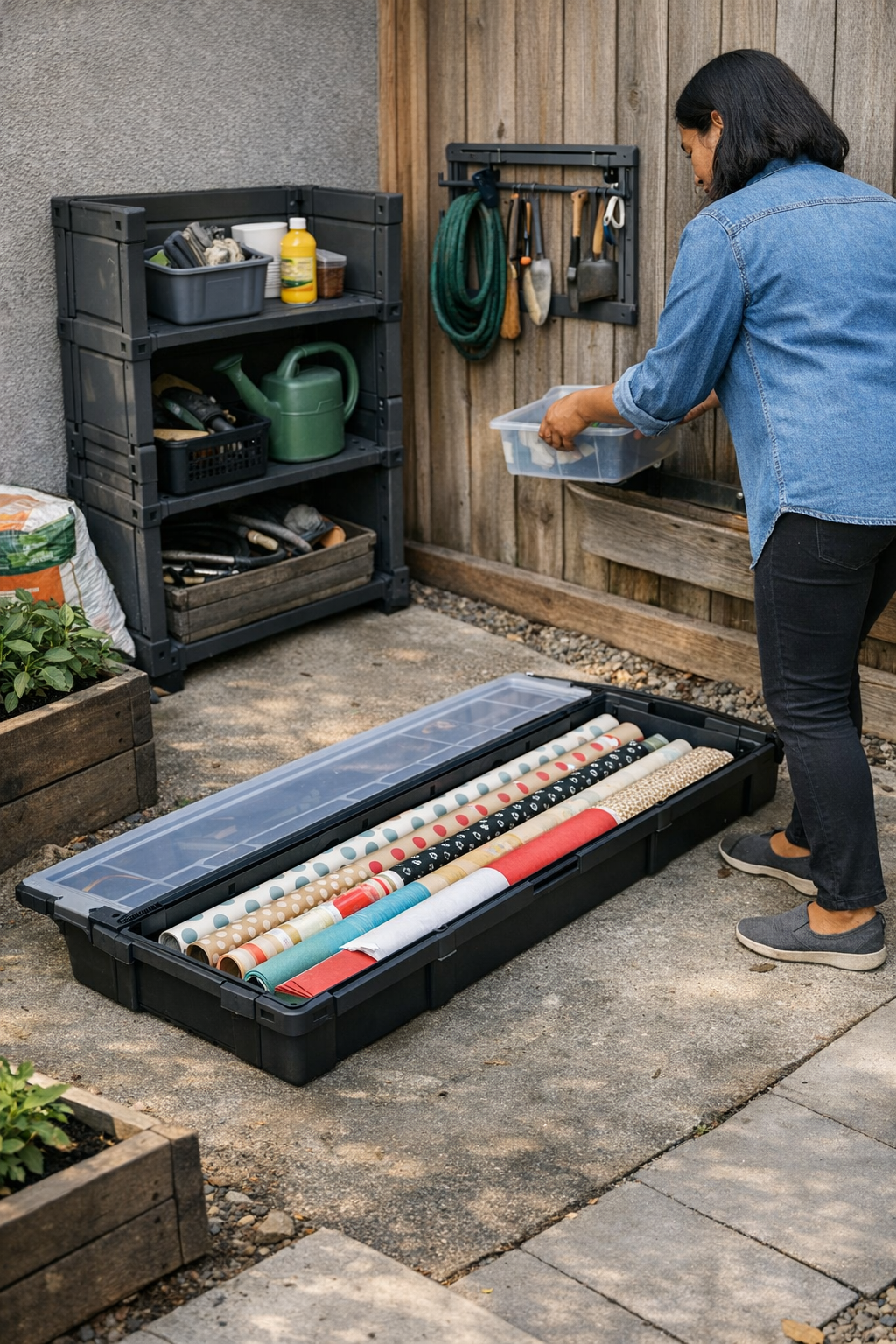
Switching to a long, flat underbed box moves storage traffic laterally, not vertically. Instead of balancing rolls, you lay them side by side: easy viewing, zero tipping, and no weight fighting for prime position. Retrieval is direct—slide the box out, every design visible, nothing buried. There’s no forced reshuffling; rolls lie still, and paper survives unscathed. Access finally matches intention: quick, predictable, without resetting every single time.
This setup also cuts silent waste. Edges stay crisp for months, not weeks, since the paper isn’t crammed or tugged past obstacles. You don’t have to restore order after every use. Even in holiday crunch time, the box holds its logic: grab what you need, lay it back, shut the container. Footprints stay contained under the bed instead of creeping into closet floor space or blocking walkways. Flat storage adapts to busy seasons without making “reset” its own chore category.
Floor Space and Route Clearance
The underbed solution comes with its own boundary: you need clear space beneath the bed, and a box that actually fits (most max out around 36 inches for wrap rolls). But the payoff is more valuable zones elsewhere. Closet shelves stay free from spills and rollovers; access paths open up. Zone discipline returns—not just visual order but real, ongoing usability for everyone in the household.
The Real Test: Crises, Crowding, and Repeated Hands
Nothing spotlights a system’s weakness like a rush job: reaching twice for a buried pattern, chasing a roll that rolled under shoes, pausing a busy morning to stand all the collapsed tubes upright—again. These aren’t isolated slip-ups but recurring failures baked into vertical setups. Minutes get lost smoothing bent edges or playing catch-up after each session. The breakdown becomes predictable: more users, more frequent wrapping, more mess to untangle each time.
With a flat underbed box, the entire pattern shifts. A typical weekday: someone slides out the box, scans the lineup, picks a roll, and leaves everything else perfectly undisturbed. No domino effect, no emergency tidying. Reset happens by default. And when multiple family members share gift duty, the benefit grows: nobody has to decipher someone else’s attempts to restore vertical order. The system tolerates impatience without getting unsorted.
Preserving Usability Amid Daily Cross-Traffic
Left unchecked, every wrap station attracts category drift—bows tossed into the box, tape jammed between rolls, ribbons tangled with paper. If you mix everything, your “organized” solution dissolves into another bin to unload before use. Flat boxes support clarity only if you maintain category boundaries. Rolls get their box. Accessories go elsewhere: a shallow drawer, a shelf caddy, or even a tray on the wall. This split isn’t fussy; it’s structural. It makes presets possible: holiday wraps on one side, everyday patterns on another, all visible and retrievable without mixing.
Small Adjustments for Real Storage Flow
Prevent sideways drift with a few habits: set gift wrap sheets flat under the rolls and weigh them with cardboard so they don’t migrate. Use a quick divider—even a cut-down plastic folder—between delicate prints and heavy-duty paper. When the flat box starts to bulge, don’t squeeze in more: purge what you never reach for. The pressure of real use always shows up at the edge—so let that edge signal what belongs and what should exit.
The Shift: From “Looks Organized” to “Refuses to Fall Apart”
The biggest gap between upright bins and flat underbed storage isn’t just looks; it’s the difference between a system that survives being used and one that demands constant maintenance. Vertical bins present order once. In daily life, they slide toward disorder with every grab and return. Flat underbed setups focus on unbroken flow—you access, use, and reset without extra steps or secret clutter zones creeping in behind a neat facade. The box takes the hidden wear, not your schedule.
Real improvements in storage aren’t about appearances; they’re about removing friction from the routine itself. If your system still interrupts you—forcing resets, bottlenecking access, or inviting clutter overflow—it’s camouflaging the real cost. Choose something that stays usable even when the pace picks up, family hands multiply, and the gift-giving season crowds your routine. The days of reconstructing order after each use are over—storage should solve problems, not simply delay them.
Find more practical storage solutions for inside spaces at Gridry.