
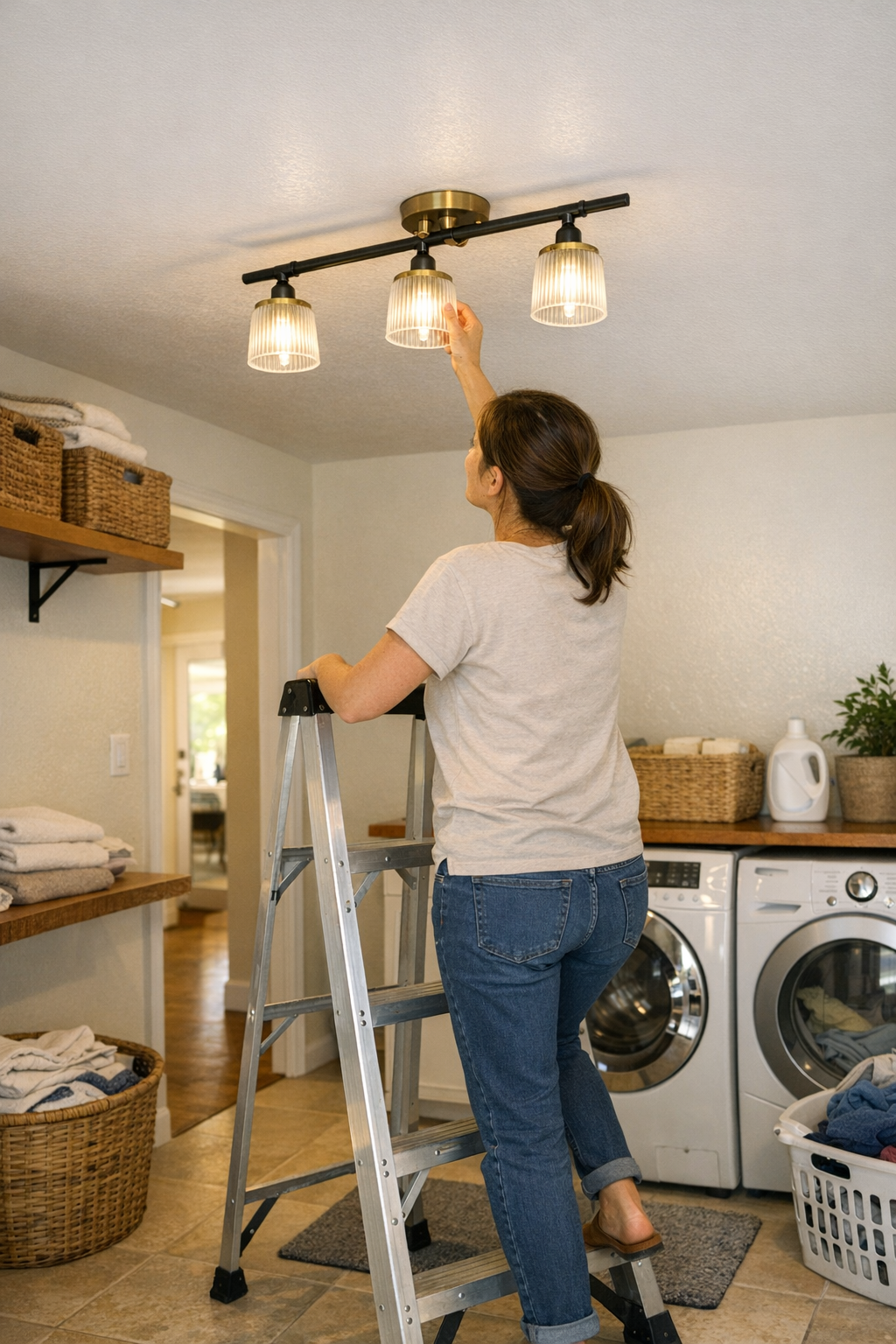
The real weakness in home lighting is rarely about brightness—it’s about what happens the third, tenth, or twentieth time you need to get up and replace a bulb or clean a lens. A ceiling fixture that looked efficient on install day can quietly become a maintenance trap: access gets awkward, especially in tight corridors, over slick laundry room floors, or where storage creeps into the only clear patch of ground. If every trip up the ladder means bracing on shifting mats or squeezing past baskets, the setup chips away at your confidence and routine—no matter how good the lighting looks after dark.
Why Maintenance Access Becomes the Real Weak Point
Lighting placement isn’t purely visual—it decides whether care and upkeep fit into real life or turn routine tasks into calculated risks. The design flaw doesn’t announce itself at first, but it gets sharper every time you edge a ladder across wet vinyl, wedge it between stacked bins, or balance in the corner just to reach the light. That low-simmering friction—never quite dangerous enough to force a fix, but always enough to discourage maintenance—stays hidden until it becomes part of your routine, not just a single hassle.
Hallways and Laundry Rooms: Repeated Risk, Not Just Routine
Spaces like laundry rooms and hallways seem straightforward—until you try to maintain their lighting. Laundry setups are rarely dry, with mats slipping as floors collect stray water, and pathways narrowing between ever-present baskets. A fixture directly above the busiest zone means you clear clutter or risk a bad footing every time. In a hallway, even with even illumination, shuffle room disappears behind boots, coats, or storage, so maintenance means fighting not just height, but your own belongings. These aren’t dramatic accidents; they’re slow-drip limitations that make quick fixes anything but quick.
The Subtle Threat of “Looks Good Enough” Placement
Fixtures centered in a room or designed for symmetry often miss the mark for daily use when the real conditions aren’t considered. A bright light placed over a chronically damp or narrow patch may look perfect—until you have to stretch, reach, and lose solid footing again and again just to change a bulb. The anticipation starts to feel like a silent burden—hesitating at the doorway, knowing what’s ahead before the ladder is even out.
How Floor Conditions Undermine Confidence
When you finally tackle maintenance, can you set both feet of the ladder on solid, non-slip ground? If not, even a small spill or uneven grout line makes the job feel unstable. Needing to pause and dry the floor or shift half the room’s contents just for safe footing is a clue: a lighting choice made for appearance is quietly eroding your willingness to follow through with basic care.
Everyday Reality—Not the Spec Sheet—Defines Good Lighting Setup
The real test of a fixture isn’t on install day, but after months of use. Shift a hallway light by eighteen inches to land it over reliably dry, textured floor, and the routine transforms: maintenance happens in seconds, no more dragging mats or working around baskets, no more double-checking for slip hazards every time. The visual change is almost invisible, but the reward is real and permanent—safe, routine upkeep becomes background, not a source of nervous calculation. Changes like these show their value only with the daily repetition others overlook.
Field-Tested Tips: Making Maintenance Safe and Repeatable
- Always dry the floor right before setting your ladder, and use non-slip pads or a rubber mat under each foot—even in rooms that don’t usually seem wet. Routine laundry or bathroom moisture is persistent and often underestimated.
- Check for creeping clutter or new obstacles on the way to your fixture. If storage, laundry, or bins are routinely in the way, the fixture placement is already clashing with real life. Move it closer to the open area—even if the result is slightly off-center—and you’ll feel it every time you need access.
- When jobs require awkward tricks—propping ladders, stacking towels underfoot, reaching at odd angles—it’s a visible sign: this light needs a better setup or a new position.
Listening to Friction: When to Rethink Fixture Placement
If upkeep means hesitation, tiptoeing, or hyping yourself up, your fixture’s placement is silently working against you. Symmetry and centered light may satisfy the eye, but it’s reliable access that lets you actually keep the space functional without dreading routine care. Move a fixture toward a stable, dry patch—even at the cost of pure alignment—and the reward is immediate: maintenance becomes uneventful, not a carefully managed risk.
Recognizing When It’s Time to Act
If every routine repair means shifting furniture, clearing debris, or inventing a workaround, that’s a clear prompt—your setup isn’t matching the way you live. Any fixture that turns basic maintenance into a stressful project is out of sync with its room. There’s no reason to accept a design that triggers new tension every time a bulb burns out.
The Quiet Value of Access-Aware Lighting Decisions
Lighting that works in real life isn’t just bright or stylish—it’s easy to reach, simple to clean, and feels safe and obvious to maintain. The payoff is the difference between worrying about a ladder on soapy floors and just getting the job done without a second thought. Every shift that minimizes risk and maximizes movement turns the fixture from a worry-source to a quiet background strength. The best setup is the one that disappears into your routine by never forcing you to work around its limitations.