
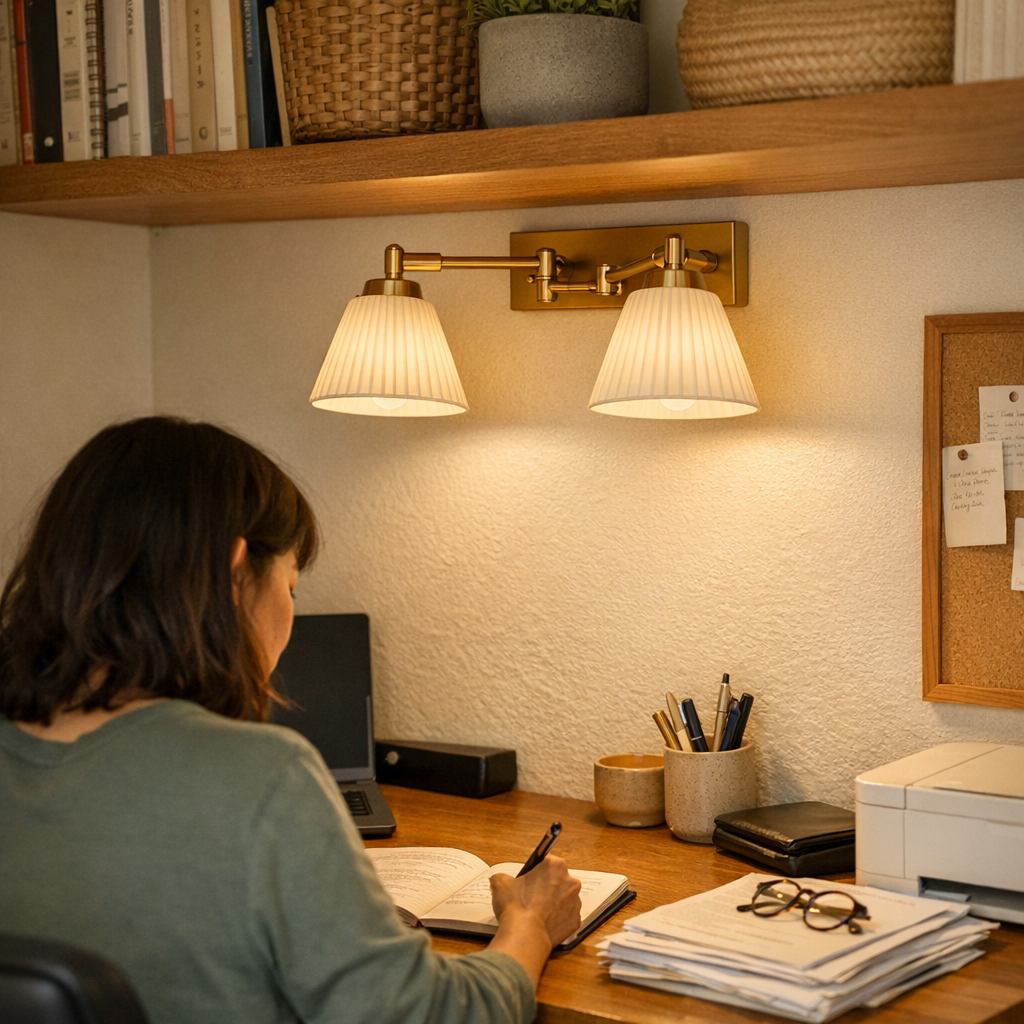
The problem with small office corners isn’t that they start out dark—it’s how quickly their lighting breaks down when you actually work there. A ceiling fixture can make the room seem bright, but the second you lean over paperwork, swipe a file from under a shelf, or catch the edge of your monitor, the weak spots snap into view: shadows you can’t outmaneuver, glare slicing across screens, surfaces that refuse to stay consistently lit no matter how many times you angle a desk lamp. Most home offices with a corner setup—wedged beside bookcases, jammed against storage, or half-blocked by equipment—reveal the same stress: what passes for general illumination is uneven, unreliable, and quietly draining every time you sit down to work.
The Hidden Friction of Small Office Corners
You flip on the overhead light, expecting the whole office to function. But most “well-lit” corners unravel once you start using them. Your keyboard is half in shadow by late afternoon; your planner disappears under the permanent dusk cast by a high monitor. Move a stack of papers, push your chair, or adjust for a Zoom call—every shift exposes new gaps. Instead of the workspace serving you, you’re forced to hunt and compromise for usable light, second by second.
Closely-packed storage, tall bookshelves, printers, and even the shape of your desk conspire against most ceiling fixtures. Their supposedly wide beams collapse into cluttered corners, leaving your tasks split between pools of visibility and dead zones of shadow. This isn’t a harmless inconvenience. Over time, the small drag of bad light adds up to genuine strain: mistyped notes, weary eyes, misplaced documents, and the underlying fatigue of adapting to a setup that works against itself.
Why Room Lighting Alone Fails These Spaces
Standard room lighting—a flush mount or semi-flush on the ceiling—throws a broad wash of light, but that spread is blunt. The more surfaces and edges your work area has, from raised shelves to deep desktop gear, the more the fixture’s light fractures. The ceiling solution that looked even at first glance can’t handle the real geometry of a cornered workspace. Monitor glare shifts with each hour and task surfaces stay patchily bright in exactly the wrong spots. Each piece of equipment you add multiplies the problem—not just briefly, but with predictable, routine friction every single day.
This difference becomes painfully clear in late afternoons, during cloudy days, or any stretch when daylight shifts. The central area stays visible, sure, but the edges—the parts you use most for detail work—become unreliable. You end up angling your chair, dragging your laptop toward the middle, or reflexively sliding paperwork into the only area that “feels right” to see. These constant micro-adjustments interrupt not just comfort, but your momentum—adding invisible hurdles to every standard workflow.
Real-Life Example: The Elusive, Usable Light Zone
Picture a home office corner boxed in by shelves and a bulging filing cabinet. Overhead, a single flush mount: all looks set. But as your routine shifts from typing to reading, then to marking up printouts, the ceiling fixture’s limits close in. A shelf edge throws a line of shadow right where you annotate. The leftmost part of your desk disappears into dimness. Extend your arm, and you block what little light escapes. Tasks drag out as you chase a moving patch of visibility—constantly repositioning notes, chasing the “good” angle—while large portions of your surface slip into murk.
Even a fast routine, like double-checking an invoice or updating a calendar, turns sluggish and odd. Small interruptions become habit; slow strain turns invisible but cumulative. The cost isn’t just time—it’s the depletion of focus, accuracy, and willingness to stay at the desk.
The Task Lighting Difference: Targeted Clarity Where It Counts
Fixed task lighting changes this equation entirely by anchoring clear, reliable light right where the work happens. Instead of asking a ceiling fixture to reach around corners and under shelves, an under-cabinet LED strip or hardwired wall sconce targets the actual problem zone. Mounted, for instance, 60 centimeters above the desk lip or shelf underside, these lights erase persistent shadow lines and carve a steady, usable surface no matter the hour or desk load.
This isn’t just generic “brightness”—it’s a stable, focused field of light that doesn’t shift with every object you move. Your keyboard, notepad, and current project stay evenly visible whether the sun is up, down, or behind clouds. Where ambient-only setups cause glare, task lighting settles quietly, keeping outlines crisp and fine details legible. The directness ensures you never have to “find” your light; it’s always exactly where your hands, eyes, and tools need it—consistently reducing squinting, desk shuffling, and accidental shadow-casting.
Routine Use: How Fixed Task Lighting Shifts Your Workflow
Add a fixed under-shelf light to a formerly shadow-ridden desk and the change is immediate: that stubborn afternoon dimness across the center of your workspace just stops showing up. You’re no longer inching papers toward the cheapest patch of brightness, no longer twisting awkwardly for better angles. The entire usable zone stays predictable from morning to night, whether you’re editing, reading, drafting, or switching between monitors and hard copies. The difference? Each repeated task now unfolds on your terms, in constant clarity, rather than at the whim of your fixture’s coverage.
Recognizing Lighting Weakness Before It Wears You Down
Don’t trust a room’s overall glow—watch for the signals that lighting is quietly failing your workflow:
- Lopsided desk brightness, where one half stays stubbornly dim even with lights fully on.
- Shifting glare on monitors that creeps larger as daylight fades or as you change tasks.
- The need to physically move objects, or yourself, to rescue documents from shadow or glare zones.
- Rising eye strain or headache, especially tied to certain desks, times of day, or activities.
These red flags are the early warnings: repeated annoyance isn’t normal wear-and-tear—it’s the product of a setup that isn’t supporting you, visually or practically.
Tips for Achieving Reliable, Repeated Task Visibility
1. Track where your hands and eyes are most active. Identify the physical zones—keyboard, reading nook, reference shelf—that see the most use. Test in real time; don’t assume a plan matches your routines.
2. Target fixed task lighting to those weak spots. Just one well-placed under-shelf light or wall sconce over your crowded desk can outperform any ceiling fixture when the light actually needs to reach around objects and corners. Prioritize direct coverage over the actual work surface.
3. Skip just adding more ambient light. Raising overall room brightness rarely solves shadow; it often just multiplies glare and wastes power. Layered lighting—balancing task and ambient—delivers control and reduces visual discomfort.
4. Treat persistent eye discomfort as a setup failure, not an annoyance. When you catch yourself squinting at the same spot or reaching for tasks in unreliable light, it’s a sign to adjust the fixture, not just soldier through.
The Lasting Impact: From Chasing Light to Predictable Comfort
If you’re working daily in a tight office corner, lighting is not an upgrade—it’s the foundation for every task that requires accuracy and endurance. Ceiling fixtures perform for open rooms, but corner-heavy routines quickly show their gaps. Fixed task lighting, tuned for your real-world setup, banishes the constant distraction of “not enough” light and delivers the kind of usable clarity you stop having to think about.
The shift isn’t cosmetic. It’s practical: no more rearranging papers for a sweet spot, no more squinting at half-lit forms, no more compounding fatigue that sneaks up day after day. A small upgrade to targeted lighting resets the baseline of your office—from an endless, interrupted hunt for the right light, to a routine that always runs on steady, reliable visibility. Find fixtures that solve these practical frustrations at LightHelper.