
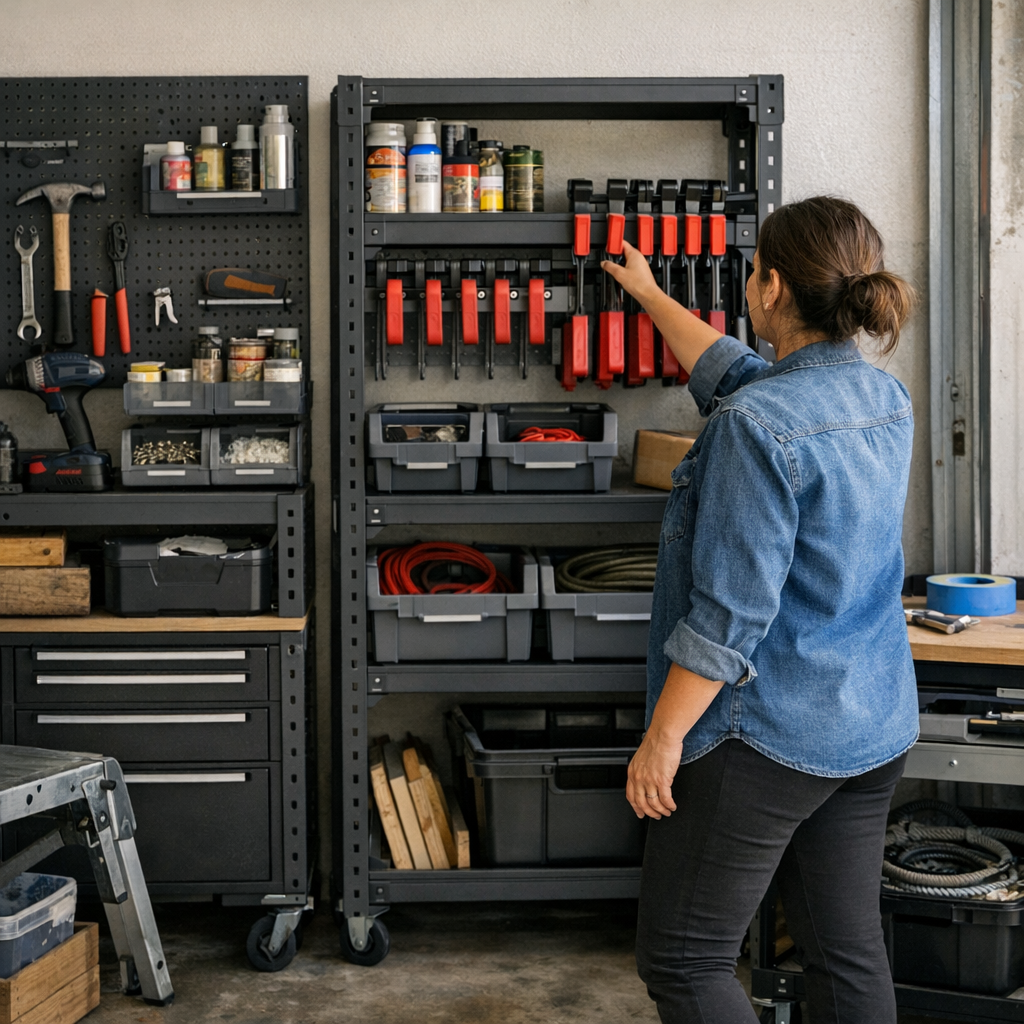
Every new garage or workshop setup feels full of potential: bins neatly mounted, pegboards bristling with promise, carts gliding smoothly into empty corners. For a brief stretch, the whole area looks engineered for speed and efficiency. But then real work starts—pulling a few tools, stashing supplies in a rush, reaching for the cart you rolled aside last night. Almost overnight, that “modular flexibility” turns sideways. Quick grabs turn into mini scavenger hunts. Carts block the path you meant to keep clear. The system that looked right on day one quietly starts working against you when the pressure’s on and your hands are full.
Where “Flexible” Turns Frustrating
Walk into a freshly arranged space: open bins everywhere, a cart you can roll “wherever you need it,” peg hooks waiting to be reassigned. For a moment, it’s perfect. But stick around through a few project swaps, and the cracks appear. That mobile cart? Now wedged halfway across the room because you needed the work surface, blocking every pass to the other side. The bin for “miscellaneous” screws? Overflowing and stacked beneath a toolbox, impossible to sift through quickly. Every quick change or small reset means pausing, nudging, peeking, and second-guessing. The flexibility that sounded so empowering now soaks up your momentum in tiny, annoying ways.
At the root of it all: When every slot and shelf is open to “whatever fits,” the mental load creeps up. Tools don’t flow naturally back to their homes—they just end up wherever’s easiest in the moment. You bend, detour, and hesitate—until a five-minute project leaves the space a little less sorted than before. The pattern keeps repeating: more time spent shuffling, less time actually working.
Fixed Homes vs. Free-For-All: Where Real Use Draws the Line
Flexible storage seems like the antidote to clutter. It promises adaptability, the power to change with your workflow. But spend a week in a garage or shop actually living with all that flexibility, and you start to see why it falls short when pressure mounts:
- Overflow zones multiply. That empty shelf becomes a dumping ground for random fasteners, paint cans, or half-finished side projects. You lose sight of what’s intentional and what’s just “sitting there for now.”
- Mobile pieces get in the way. The cart that started out neatly nested becomes a speed bump. Instead of freeing up space, it blocks the path between workbench and door.
- The hunt extends. Favorite tools drift farther from their “usual” resting places after every session. You scan pegboards, move bins aside, crouch to check under the bench, all for one lost driver.
Compare this to a fixed-role setup. Assign a wall rack—no exceptions—for drivers. Carve out a shelf labeled clamps, and never let anything else creep onto it. Suddenly, every end-of-task reset is quick, almost automatic. Tools land exactly where they belong, so next time you reach, they’re already within arm’s distance. Your workspace returns to “ready” with nothing to untangle or explain.
Looking Organized vs. Working Smoothly
This is the honest frustration: a garage can look orderly—bins lined up, hooks filled, no loose clutter in sight—but still work against you. Watch for a week and you’ll spot the cracks: a tape measure buried in a parts drawer, clamps scattered across three zones, the hardware bin absorbing loose washers, wire, and shims. Visual tidiness hides growing confusion, and every reset gets a little slower, a little less certain, as the lines between categories blur.
Scene in Motion: The Anatomy of Setup Drift
Imagine a real workbench routine: you’re sanding a frame, fixing an outdoor chair, sorting hardware for a quick fence repair—all in the same week. By Friday, the shelf for abrasives is half-filled with glue bottles. That dedicated spot for pliers now hosts a soldering iron. The rolling cart—meant to follow you—sits stuck by the back door, blocking the path because you wanted it “out of the way” yesterday. Overflow stacks up on the edges, brushes drift to the floor, and every time you reset, you have to scan the whole wall just to find the basics.
This isn’t messy—yet—but it’s slow, awkward, and full of little workarounds. Each misplaced item means a pause, a rethink, or a detour. Over a month, it steals hours. More often, it chips away at your willingness to start a new project—who wants to spend fifteen minutes reshuffling just to clear a spot?
Assigning Roles: Small Shifts, Real Relief
The breakthrough often comes with a tiny change: labels on shelves, one definite hook per tool group, a strict “clamps go here, nothing else” rule. In real use, these fixed markers do what flexibility never can—reset routines turn mindless, tools flow predictably, and overflow stops collecting where it shouldn’t. Even after a flurry of repairs or a long build, clamps end up on their own shelf. Drills hang right back on the pegboard, no questions. There’s no guessing, no scanning the whole space—just a smooth, fast return before you head out the door.
You haven’t added square footage. You haven’t covered every inch of wall. But the system works better, because your usual movements—grab, use, return—actually fit the setup instead of fighting it.
Spotting Friction Points: Signs Your System is Slipping
Keep an eye on your own space for a few days. Odds are you’ll spot these problem zones:
- Carts stranded awkwardly in passageways, moved just because it’s easier than rethinking where they belong
- One shelf or wall nook quietly ballooning with overflow—paints, gloves, mystery hardware—all “just for now” but never truly reset
- Every tool return forcing you to scan three surfaces instead of going straight to one spot
- Dead corners where bins gather dust and nothing you need is ever close at hand
Each one signals a system out of sync with your actual habits. The space looks logical when empty, but it slows you down, nudges you off balance, and builds up silent inefficiencies you feel with every pass through the shop.
Fixed Where It Matters—Flexible Where It Doesn’t
Here’s the secret rhythm of a space that stays truly usable: high-use tools—drills, drivers, clamps—get unchanging homes, always visible and always accessible. That saves not just seconds but energy, making resets fast and return flow nearly automatic. Meanwhile, seasonal or low-frequency items—odd hardware, paint trays, rags—can float in open bins or flexible drawers. You don’t need perfection, just the critical routines anchored down so nothing slows you when you’re mid-project.
Quick experiment: Instead of remaking every inch, just pick your most-used tool group. Assign it a fixed, unmistakable home and watch a week’s worth of routines. Most of the “Where did I…?” moments disappear overnight—and so does the creeping frustration that chokes off momentum.
The Hidden Power of Stable Roles
It feels counterintuitive to lock in floor or wall space for dedicated tools when you crave adaptability. But dependable setups win in the long run: the system quietly boosts clarity, the awkward dead zones disappear, and every tool is right where you expect, every single time. The penalty for blurring roles is clear—more piles, more blocked paths, more head-scratching, and less actual building or fixing.
The setups that last—year in, year out—aren’t just tidy on install day. They stay smooth because routines have priority. Your movements rule the layout, not the other way around. Fixed roles for your core tools preserve zone clarity, harness every square inch, and make expansion or reconfiguration painless instead of overwhelming. The best spaces mix security where it counts with flexibility where it’s earned—leaving you free to get to work, not get bogged down by reset after reset.
You can explore tools and modular systems designed to solve these everyday setup problems at StackNest.