
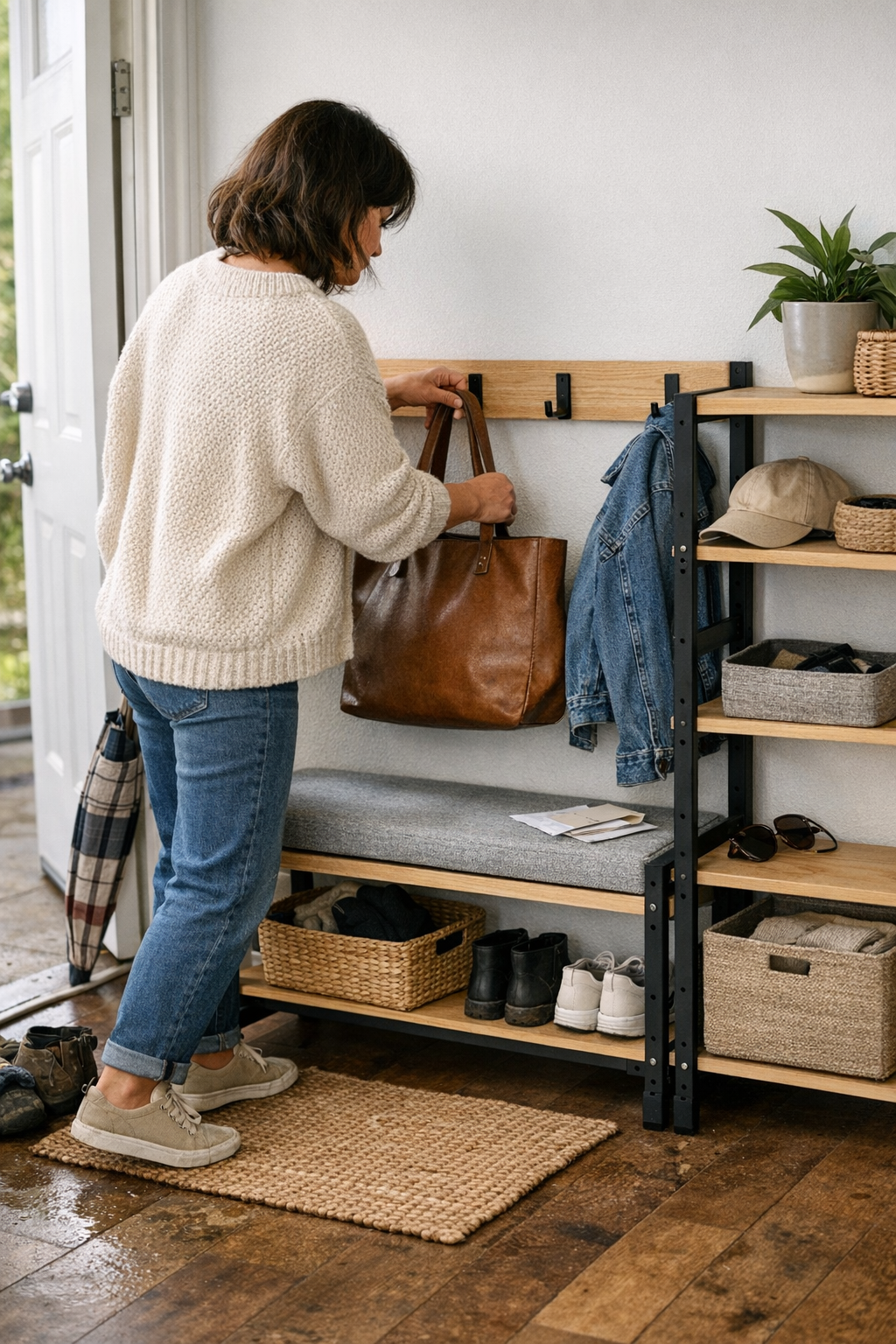
Every entryway reveals the same pattern within days: shoes pile up by the threshold, bags drift out of immediate reach, and “temporary” piles tighten the very path meant to stay clear. The promise of entryway storage is control—but the reality depends on where your key storage actually lands. If your shoe rack or bench sits even a step or two too far from the actual flow, the chaos returns, fast. The wrong setup quietly overloads the edge zone, forces awkward detours, and turns simple routines into repeat obstacles you never planned for.
When Storage Lives Too Far from the Action
The instinct is classic: keep the entry picturesque by pushing storage deeper—stacking racks, benches, or cabinets beyond immediate sight, lining up hooks on walls past the landing zone. For a day, maybe two, the front feels open. But as soon as daily life resumes—a fast in-and-out, arms full, kids darting through—the separation breaks. Here’s where friction gets real:
- Shoes stall right beside the mat, never making it back to the distant rack.
- Bags cluster around the path “for now,” waiting for a reset that gets bumped by the next arrival.
- Mail lands on the nearest surface, rarely migrating beyond the entry until habit or schedule allows.
What starts as rare slippage turns quickly permanent. Those extra few feet kill the reset. Instead of order, you inherit a rolling obstacle course no one claims, but everyone works around. The myth of a tidy, far-off storage zone dissolves the second repeated use exposes the drift.
A System that Breaks Down Under Real Traffic
Peak hours reveal the cost. Mornings mean frantic exits; evenings bring tired arms, wet boots, and the familiar traffic snarl. Here’s what actually happens in homes that push storage too far away:
- Overflow squeezes the threshold where room is tightest, not in the controlled “storage” area.
- The bench lost by the far wall sits empty as shoes erupt around the door.
- Bags and jackets drape over chairs, pile up at corners, or hang awkwardly from door handles—visible stopgaps, not systems.
Instead of fixing clutter, remote setups move the overflow to the worst spot. The entryway clogs. “I’ll clear it later” becomes a nervous refrain. The cleanup backlog grows—and with each reset deferred, the clutter forms a semi-permanent blockade at the only space that can’t afford it.
Near vs. Far: It’s Not About Looks—It’s About Routine
Compare these two setups:
- A wall-mounted bench anchored just inside the threshold.
- A slim vertical rack further down, out of the initial path—neater in photos, harder to reach.
Both seem neat on day one. By week’s end, the contrast is sharp. The distant rack collects only what someone bothers to carry; the bench by the door becomes the actual reset point. Shoes, bags, coats—everything lands on the closest available surface. Reaching deep for storage turns into an exception, not a habit. The result? The “for now” pile stakes its claim right at the boundary, growing with every return.
The near-bench option does something crucial: it makes reset almost automatic. Entry storage only works if it’s impossible to miss in real-life flows. Too much distance, and the micro-reset collapses. Annoyance trumps intention, and clutter wins by default.
The Reality of Clutter Creep
Small moments expose the system. Picture three people coming home on a wet day:
- Boots too soaked for the rug get abandoned at the door—forming a ragged wall after just two arrivals.
- Grocery bags demand an immediate drop, turning the nearest open floor into a clutter magnet.
- Backpacks, gym gear, and jackets cluster at the pinch point, forcing each newcomer tighter into the pass-through.
This isn’t about laziness; it’s about friction at the margin. When the most-used storage isn’t right at hand, “temporary” fixes repeat until the path jams up and resets feel punishing. Entryways built for clean lines but not real behavior trade functional flow for short-lived appearances.
What Actually Changes When You Move Storage Close
Shift your core storage—bench, hooks, shoe rack—just inside the threshold and the effect is immediate:
- Shoes and bags drop naturally during entry, not after a forced trek past the action.
- Small resets—straightening shoes, sweeping grit, restoring order—become near-automatic because they’re on the way, not out of the routine.
- Overflow shrinks. It’s easier to return things right where habit forms, so piles don’t take over.
The simplest diagnostic: for one week, watch where things actually end up. The “official” storage zone is whatever surface captures daily use—not the one that looks best when staged. Every unintended cluster tells you where the friction lives. If dealing with shoes, bags, or coats is still awkward, the storage is too far.
Using Far Docks Wisely
Remote cabinets, large vertical racks, corner benches—they have a job: off-season boots, extra gear, overflow for items you rarely touch. But for everyday shoes, coats, and bags, the only zone that works is the one you walk through with full hands and zero patience. If it’s not within the path of entry, reset never becomes routine.
Put distance to work by reserving the farthest spots for rarely-used items. Force daily essentials to live on the front line—so returning them is easier than avoiding the reset. Storage should help your default, not add steps to every start and finish.
Recognizing When Your Setup Isn’t Working
Watch for the signals: stepping over repeat piles, promising “I’ll sort it tonight,” or fighting with a buildup that undermines your open space. If your storage makes you work around stuff instead of with it, you’re resetting the wrong problem. The cost isn’t just mess—it’s everyday drag, path congestion, and the steady stress of never quite catching up.
Choose storage just one stride too far and frustration compounds. The zone stays tidy in theory but fails in daily practice—a universal hurdle, not a personal flaw. Most layouts are built for how a transition looks, not how it holds up under repeated, untidy use. Routine, not appearance, is the axis that matters.
Entry Storage That Works With You, Not Against You
Every transition-space setup fails or succeeds by how it handles imperfect, repeated entries—not by the order captured in a single tidy moment. Storage that sits where the pressure is sharpest—within reach as you come through the door—carries the flip: resets happen by default, not effort. Even a small shift—a bench moved closer, a wall rack added at the edge—can break the cycle between intention and overflow for good.
If you’re caught in a loop of constant reacquisition, reset, and never-quite-clear passage, don’t just clean harder—move your storage to where your habits insist on landing. The right setup isn’t invisible: it works because it puts the fix in your way, not out of it.