
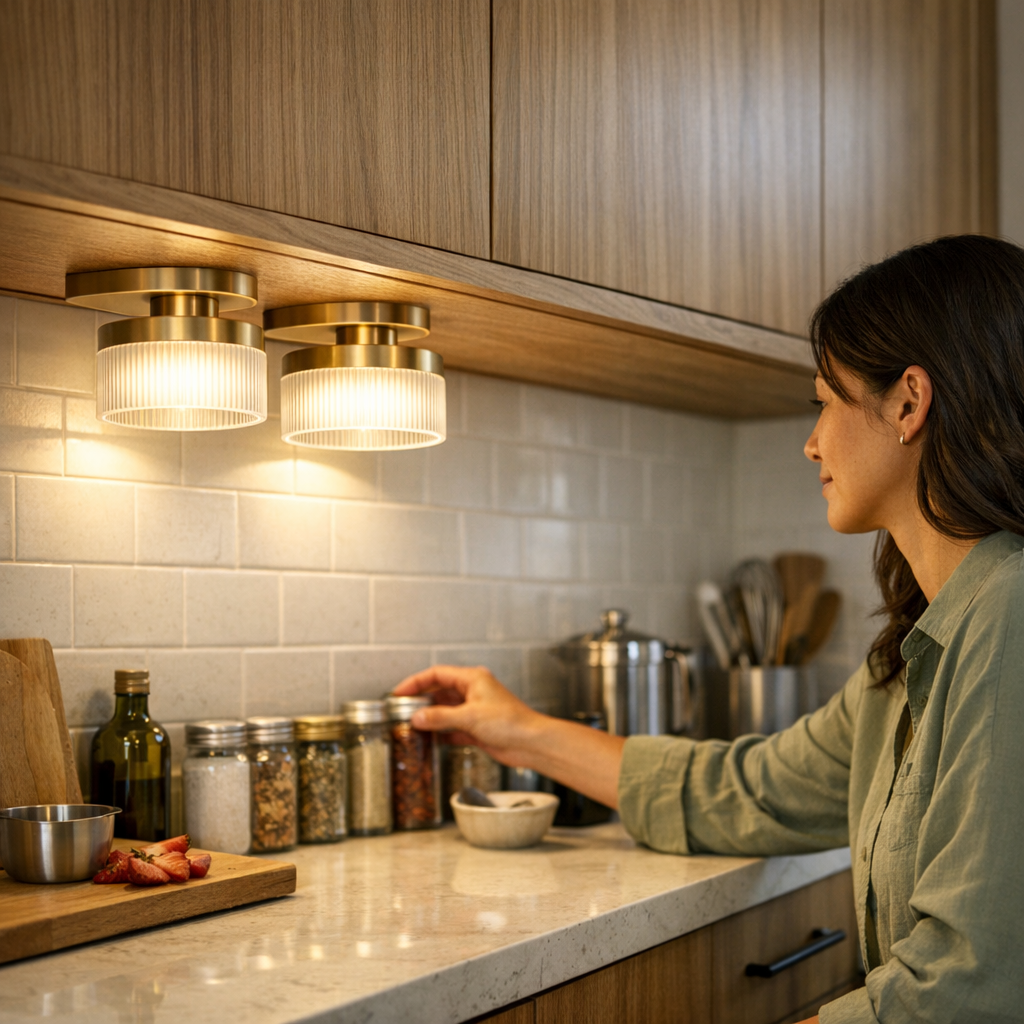
The quick win of “minimal” under-cabinet or shelf lighting always looks best in photos—until it starts sabotaging daily routines. The gap isn’t about brightness in the first hour, but about what fades or fails after real use kicks in. Shadowed edges creep into meal prep and cleanup; you slow down to find a label or brush crumbs out of blind corners. You reach and the shiny new fixture stays out of reach—light stuck in the middle, while your working edges stay just out of sight. Instead of solving friction, the setup creates small, persistent interruptions that repeat every time you work along the counter, shelf, or desk.
How Shadowed Edges Become Daily Friction
After only a few days, the missed spots start costing time. Under-cabinet or shelf lighting that stops short of the edges—or leaves the far wall in the dark—brings back old problems, just with neater lines:
- Corners collect dust and crumbs because you simply can’t see what’s settled there, only what’s in the light.
- Packets, measuring cups, or craft tools slide into shadow and disappear from view until you dig through a pile or move everything around.
- Everyday motions—scooping flour, sorting folders, sweeping a work surface—feel jagged, not smooth, because half of the surface stays hidden.
Visual discomfort is only part of it. Loose cables, flimsy mounts, or brackets that shift during cleaning break the illusion of a finished space. The routine stalls: you reach, adjust, glance for a control button or loose plug, then resume. Small hiccups add up, making a “clean look” begin to feel half-baked.
The Problem with “Clean” Single Fixtures
Clean lines invite the shortcut—just one slim bar or panel mounted for maximum stealth. It feels finished during install; functional problems surface later. Most single fixtures do not cover the full area actually in use: the front edge, the ends by the walls, the gap below a shelf where items actually move in and out.
- If you mount too far back, the front zone stays in shadow. Items closest to you—cutting boards, stacks of mail, onions mid-chop—are always less visible.
- Even a “strong” central light leaves darkness at the edges. Add more objects, more shadow creeps forward. Corners fill up with unlit clutter.
- Minimal cable runs and flush mounts shift after real handling or cleaning. Power cords start slipping into view, switches end up behind canisters or under piles, breaking both the look and the workflow.
This isn’t just a detail—week after week, the same interruptions keep breaking the pace of ordinary use.
Scenes from Real Setups: When Edges Don’t Get Their Light
Kitchen routines that reveal missed spots
Supposedly “sleek” under-cabinet strips almost always leave shadows along the backsplash or counter edge. Strawberry tops and coffee grounds lurk in the unlit perimeter; you find yourself bending for a label, tilting jars, or brushing debris blind. Cleaning becomes guesswork—one quick swipe, then a second, just in case the darkness is hiding something sticky. The space seems sorted, but every prep runs up against a limit you can only feel, not fully see.
The home office shelf where folders disappear
With one tidy panel dead center, folders and cables banish themselves to the front lip or far side. A flash drive missing for days turns up wedged in the narrow shadow under a loose bracket. You stretch, guess, or scan with your hand—not because you’re disorganized, but because the lighting stays anchored to the “display zone” rather than the working zone.
Laundry zones where shadows hide what matters
Above the washer, under-shelf lighting might read as “bright” on install—and yet, try tracking down a detergent cap or cleaning wipe jammed against the back wall. The edge is always dim. Cleaning supplies hide in a shadow line even after straightening up. A cable, knocked loose in a hurry, sags into the field of view with the light itself barely reaching the places you actually grab and move things.
Why Solid Support and Full Coverage Matter
Good lighting depends on more than just fixture design: it’s the support and reach that shape every use. One fixture with a loose bracket can create as many hazards, irritations, and “where’s the cable go now?” moments as leaving a space unlit. Lasting improvement means setups designed for how the space is actually used, not just photographed:
- Brackets and clips that grip through cleaning, stacking, and accidental bumps—so alignment survives more than the first install.
- Cable management that locks in place, preventing cords from working their way into sight or getting tangled across your workspace.
- Fixtures that extend to active edges—even if you need two short lights at each end rather than one continuous strip with dead zones.
These tweaks might seem like extra effort up front, but over time, they end up saving more energy than they cost. When the support pieces survive real movement, and coverage reaches the working edge, you stop noticing the lighting—which is the point. The space finally works without compensations or detours.
Small Adjustments, Big Improvements: A Simple Example
One shared kitchen counter, haunted by dim edges under a single slim strip, changed immediately with two tight-run fixtures at the ends—plus a few nearly invisible cord clips pinning wires flat and out of sight. Suddenly:
- Every corner caught the light. Cleaning was quick and certain, not tentative.
- Labels, tools, and stray food didn’t vanish into gloom—every position was visible without extra reaching.
- No cord betrayed the setup or distracted your vision, because nothing drifted out of place after the third wipe-down.
More than just “brighter,” the upgrade erased all the usual ways a neat setup gets less useful with time. The surface wasn’t just organized—it stayed that way in use.
Tips for Stronger, Edge-to-Edge Light
- Test beyond the first-day install. After setup, use the surface normally for a few days. Are you adjusting your habits to chase usable light, or does every inch stay visible?
- Support matters as much as aesthetics. Use brackets and clips made for tight, repeated handling. If anything wobbles or the cord drifts forward, adjust or lock it down again.
- Add or move fixtures without apology. If an edge stays dim, bring in a second small light or shift the main one. Actual use beats abstract minimalism—light what you need, not just what looks cleanest from a distance.
If your under-cabinet or shelf light looks finished but keeps slowing you down, check the far edges, see where cables have started to slide, and watch how the beam really behaves when in motion. Good lighting—matched by solid mounting—doesn’t just solve appearance. It removes the friction that keeps pace with your routine.
For practical indoor lighting, mounting, cable management, and support setups that help every inch of your space stay usable, see what’s available at LightSupport.