
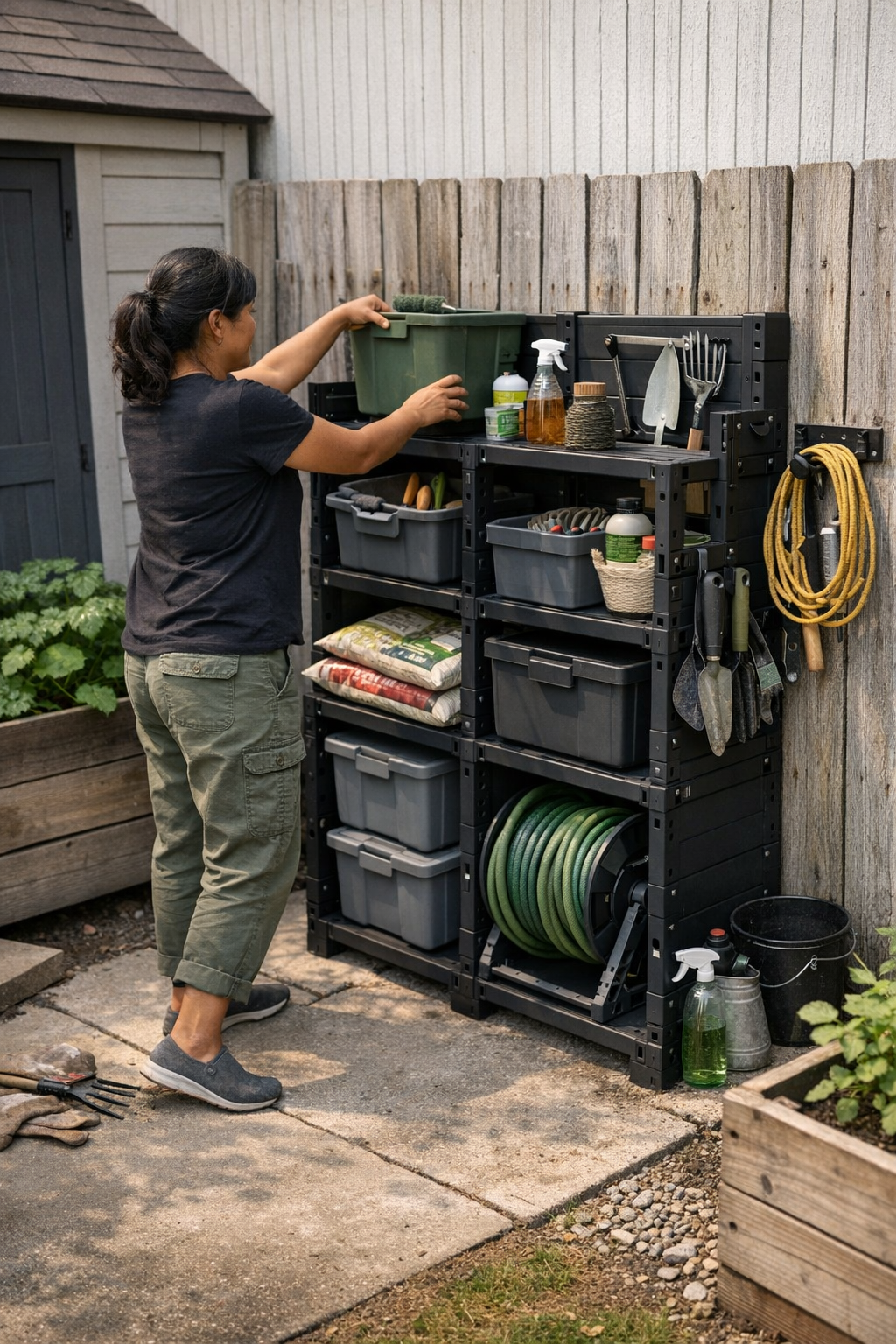
If you have a tight outdoor space, every storage choice either smooths—or complicates—your entire routine. Drop a shed, a storage bench, or even a single rack in the wrong spot, and suddenly movement slows, piles form, and your yard feels smaller every time you try to use it. The difference between “it fits here” and “it actually works here” becomes painfully obvious after just a few days of normal living.
The Subtle Creep of Center-Heavy Storage
It’s tempting to drop a big storage bin right in the center of your patio or yard. It looks organized, seems reachable from all sides, and promises convenience on paper. At first, it delivers: grab a cushion on your way out, toss in a tool after you prune—simple.
But as soon as you stack two or three real-life activities—garden Saturday, impromptu soccer, a neighborhood BBQ—the “convenient” center quickly turns into a traffic jam. Storage planted in the middle stops being helpful and starts blocking everything else. You end up weaving around it with muddy boots or armfuls of toys, setting one thing down just to move another. By the end of the week, you’re not grabbing what you need—you’re shuffling, detouring, and stacking temporary piles, just to make room for the next task.
A Real Scenario: The Never-Ending Reset
Picture this: It’s Saturday. You drag out hoses and trowels, dodge a bin set dead center, and start gardening. Halfway through, bags pile up in your “easy access” pathway. The wheelbarrow’s route turns diagonal to avoid the chest. Shoes and tools cluster wherever you hesitate. By midday, your path is strangled by overflow, not order. Finish up, tidy what you can, and it still takes too long to reclaim space for dinner—the “mini-reset” never really leaves things clear. Day by day, your yard gets harder to put back together, not easier.
Choosing Where Storage Belongs—Why It Makes or Breaks a Small Space
This isn’t just about cramming things wherever they’ll fit. It’s about how bodies move around those things, every single day. Center-stage storage may look efficient, but in small yards, it steals breathing room and cuts up your natural walking lanes. Movement slows. Every reset gets heavier.
Edge and wall storage flips the whole equation. Install wall racks or slim lockers along the fence, and suddenly your yard develops an actual “lane”—a clear, unbroken route for push carts, soccer games, wheelbarrow runs, or just refilling the bird feeder. Instead of stepping over an obstacle or dragging bins to reclaim space, you stay in flow. The center opens up. You stop playing traffic cop and start using the yard the way you meant to.
Repeated Friction: When Storage Fights the Way You Move
The trap is visible in almost every rushed setup: a central bench or box looks tidy but only works when nobody else is around. The moment two people need something from it, you’re queuing up, pausing for lids, or making awkward workarounds—one person digging while another waits, or stashing wet gloves on top because there’s no space to hand things off. By evening, temporary drops—balls, hoses, backpacks—start filling what little open floor was left. Resetting gets slower, and instead of containing clutter, your storage setup creates it.
Edge and Wall Storage: Actually Use-Focused
The best outdoor storage earns its keep during the mess, not just in empty moments. Hanging racks along a fence or tucking modular cubbies against an out-of-the-way wall means the gear and overflow stay out of the movement zone. The useful space stays in the center, not the sides—and that lets you stage, work, host, or play without pushing a bin or detouring around the aftermath of “being organized.”
Real Use: The Difference After One Change
Mount a weatherproof wall rack along the back fence and you feel the result instantly. You can push the mower, drag that unwieldy garbage can, or run alongside your kid without zigzagging around a stubborn box. Reset after a muddy project? You hook up tools in seconds. Nothing’s in the path. The difference isn’t extra storage volume. It’s that you never have to move one thing to get to another—or spend five minutes making the path clear again simply to use the space.
The Hidden Pitfalls of Floor and Corner Storage
It’s a classic error: see an empty corner and drop in a bulky tote “out of the way.” But real use reveals how fast corners swallow up everything—boots, bags, stashed hoses—until overflow blocks the path or half-buries the gate. Fill every floor inch, and routine tasks become dodging missions. The storage fits, but the movement never does.
Wall setups aren’t immune to failure. Hooks placed just out of reach, shallow shelves too short for real tools, or racks never used except as a holding zone for that one thing—the result is always the same. Clutter returns. If you keep dropping things on the ground, your wall setup isn’t solving the problem. It’s just shifting it around, and the real reset still demands more bending, lifting, or temporary piles than it should.
Real-World Fix: One Adjusted Zone
Installing a vertical tool rack by the garage door instantly rerouted how weekend cleanups happened. No more hedge trimmers sliding around the patio table, or gloves wedged behind a central chest. Instead, everything lands in its own spot—no crossing the yard or working around obstacles to put things back. The path stays open. Ends of task and beginnings of the next connect more naturally, because less is blocked in between.
Tips to Dodge Classic Outdoor Storage Traps
- Initial order doesn’t guarantee easy resets. If reclaiming clear space always means moving the same box twice, rethink your zones.
- Edges and boundaries should direct, not just store. Let walls and fences control foot traffic—not collect rejected clutter.
- Test the return flow at the end of a full day. Does clean-up happen in one natural sweep, or do you chase piles from zone to zone?
- Watch for overflow magnets. If a single area hoards stray shoes, hoses, or toys, it’s not about adding bins—it’s about redefining that space’s job.
- Don’t ignore gear weight and weather. Wall systems only help if they can handle real use—reinforce where needed, or support with slim floor units.
Setup That Matches Your Actual Routine
An outdoor setup should make movement automatic—not force you to pause, arbitrage floor space, or repeat the same slow reset after every use. Open flow beats empty floor every time—storage only serves if it lets you glide through the daily pattern without circling barriers or nudging overflow out of the way.
Real difference happens in small things: the two extra minutes you save not shifting boxes, the trip you skip because tools have a clear return spot, the weekend that doesn’t end with you re-choreographing the same old piles. Ignore flow, and even a perfectly staged space turns cramped. Organize by the way you actually use your yard—not just by what looks neat for a day—and you get a space that feels bigger, moves quicker, and resets itself faster, even when life is messy.
For outdoor storage systems designed to keep edges working, circulation clear, and resets short, visit TidyYard.