
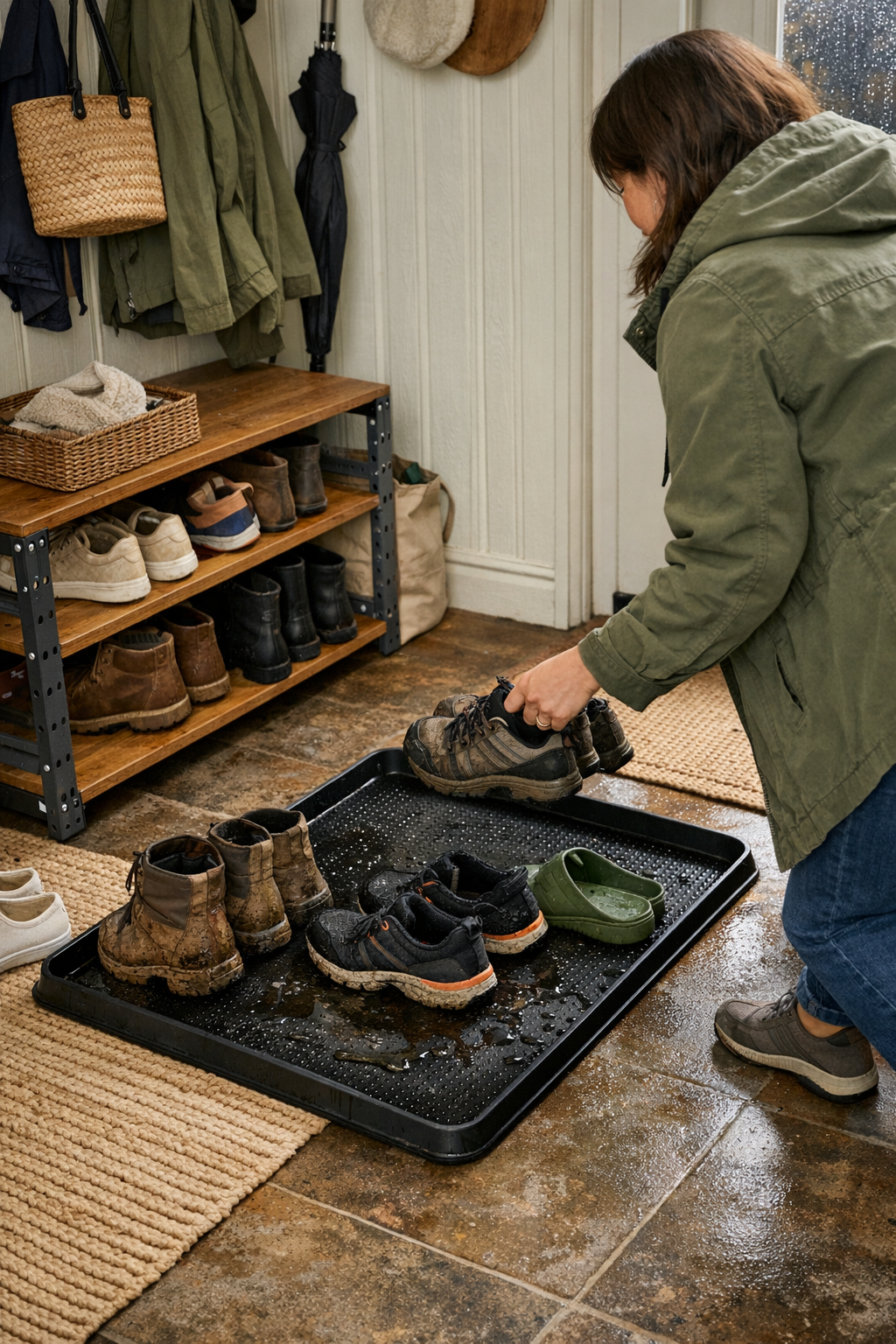
Every busy entryway hits the same bottleneck fast: the drop zone that’s supposed to keep things tidy instead becomes a daily hazard—especially when rain, mud, or snow slice through your routine. The real issue isn’t pretty: wet footprints fan out, shoes dump grit and moisture, bags migrate closer to the path, and what started as a clear threshold turns into a slow reset spiral. In these lived-in transition spaces, details like what sits under the main shoe row or where bags actually land make or break how long it takes to reclaim order, or how often you just give up and step around the mess. Ignore the problem, and the “reset” goes from a thirty-second fix to an afterthought that never fully restores the zone.
When Rugs Can’t Keep Up With the Mess
Walk in after a storm: the shoe line immediately splinters, the bench is loaded with yesterday’s scarves, and bags land wherever there’s half a square foot left by the door. At first, a woven rug might look like it soaks up the worst—until water seeps under and the fibers hold onto every bit of grit and moisture. Edges curl. A dark stain radiates from where boots overlap. By lunchtime, everyone’s quietly stepping wide, the musty smell spreads, and nobody volunteers to deal with the rug that’s started working against you instead of for you.
Every new trip in—drop-off, lunch run, school return—pushes the zone further out of control. Wet spots become navigational hazards. Shoes drift outward and the boundary between clean floor and soaked zone dissolves. Sit on the bench, and you feel the soggy edge under your feet. Instead of guiding routine, the rug demands more and more time, making every return a little slower and messier.
Why the Drip Mat Makes the Difference
Containment beats absorption, every time weather returns. A drip mat doesn’t pretend to clean; it just collects runoff, trapping moisture and grit until you’re ready to lift, dump, and reset. The value doesn’t show much on a dry day—but hit your second downpour or a week of unpredictable weather and a rug’s slow decay becomes obvious: creeping odor, spreading stains, unseen damage under benches. Meanwhile, with a drip mat, the repair cycle is clear—pick up the mat, dump the water, maybe swipe a towel. Back to zero, without mystery damp creeping out of sight or lingering under heavy rugs.
The Cycle of “Quick Fix” That Makes More Work
It happens without you planning it. By midweek, entry drift has taken over. Nobody actually deep-cleans a saturated rug; they push it aside or hope it dries. The zone’s wet edge spreads, stains slide under the bench or along the wall, and temporary drops become semi-permanent clutter as bags, shoes, and coats expand into every inch of passable floor. What’s meant to be a fast threshold turns into a tricky detour—one that slows everyone and multiplies the amount of “later” clean-up still coming.
Real-World Reset: Scenes From Repeated Use
Reset speed shows what works. After a heavy-use morning—three pairs of boots, extra bags, a last-minute coffee spill—the difference hits fast. With a drip mat, you scoop and dump; the floor clears itself. There’s no debate over who scrubs a rug this time or whether something is rotting under the bench. The mat leaves the zone dry within an hour. Shoes and clutter stay put, the routine risks less spillover, and you avoid stains building up week after week. Absorbent rugs get heavier, stickier, and more impossible to reset with every cycle; too many storms, and “fresh start” means shopping for another rug or even patching up the flooring underneath.
If the day spins off-track—unexpected guests, muddy sports bags, a dog with soaked paws—the mat shrugs it off. The area doesn’t stall in catch-up mode. Old setups force you to tiptoe around cold wet patches and ignore slow, hidden damage that quietly raises the reset cost until you notice too late.
Where Clutter Hides: Entry Zones That Drift
Setup neatness never survives the week. Shoes edge apart and form a wider, unwieldy row. Bags inch into the threshold, blocking the main route. The bench mutates into an overflow parking spot. Without a visible split between wet and dry zones—a drip mat to corral water and a specific area for bags or overflow—moisture, clutter, and traffic collide into an indistinct zone. Movement gets tighter; resetting means first relocating the pile, then sorting out what’s damp and what’s drifting. Containment creates clarity. Without it, the entry becomes a slow-moving tangle of unpredictable drops and invisible damp that violates every planned order.
Tip: Give Shoes and Bags Their Own Zones
Doors invite drop-offs, but drawing a hard line helps. Keep the drip mat as a shoe and boot zone only; send bags and dry gear to a separate rug, cubby, or bench area. This keeps wet prints from spreading, makes moisture patterns easy to spot, and prevents overflow from claiming floor you need for a clear return. The small boundary sharpens retrieval when you’re in a rush and reduces the accidental migration of grime onto whatever bag or coat lands within reach.
Why Resets Shouldn’t Take All Day
Rugs trap everything—moisture, grit, slow stains that don’t dry out by morning. The heavier the use, the more the “clean-up” turns into a drawn-out, low-priority fight against soaking, must, and sticky grit. Drip mats don’t absorb; they contain, making the return to order an actual reset instead of a new maintenance problem baked into the entry’s routine. No rug rotation, no expensive replacement, no surprise damp lurking below the bench. The consequence is a shorter, more reliable fix each cycle—and a zone that actually recovers between rush hours.
Setups That Actually Match the Routine
The real test isn’t how symmetrical a setup looks—it’s whether movement stays fluid after days of real use. Shoe rows widen beyond intent. Bags and kids’ gear reclaim high-traffic corners. The bench doesn’t just seat; it collects overflow, testing the existing boundary every time schedules collide. Drop the wrong item in the wrong spot, and reset delays snowball. Containment strategies—a drip mat under foot-traffic, weather-resistant storage for repeated wet returns, a slim secondary rug for bags—create a threshold that bends with the routine instead of blocking it. Instead of stopping to sort out damp chaos, the area stays ready for the next rush and actually reflects how people move through day to day.
For dependable transition-space storage and more resilient entry routines, see Betweenry.