
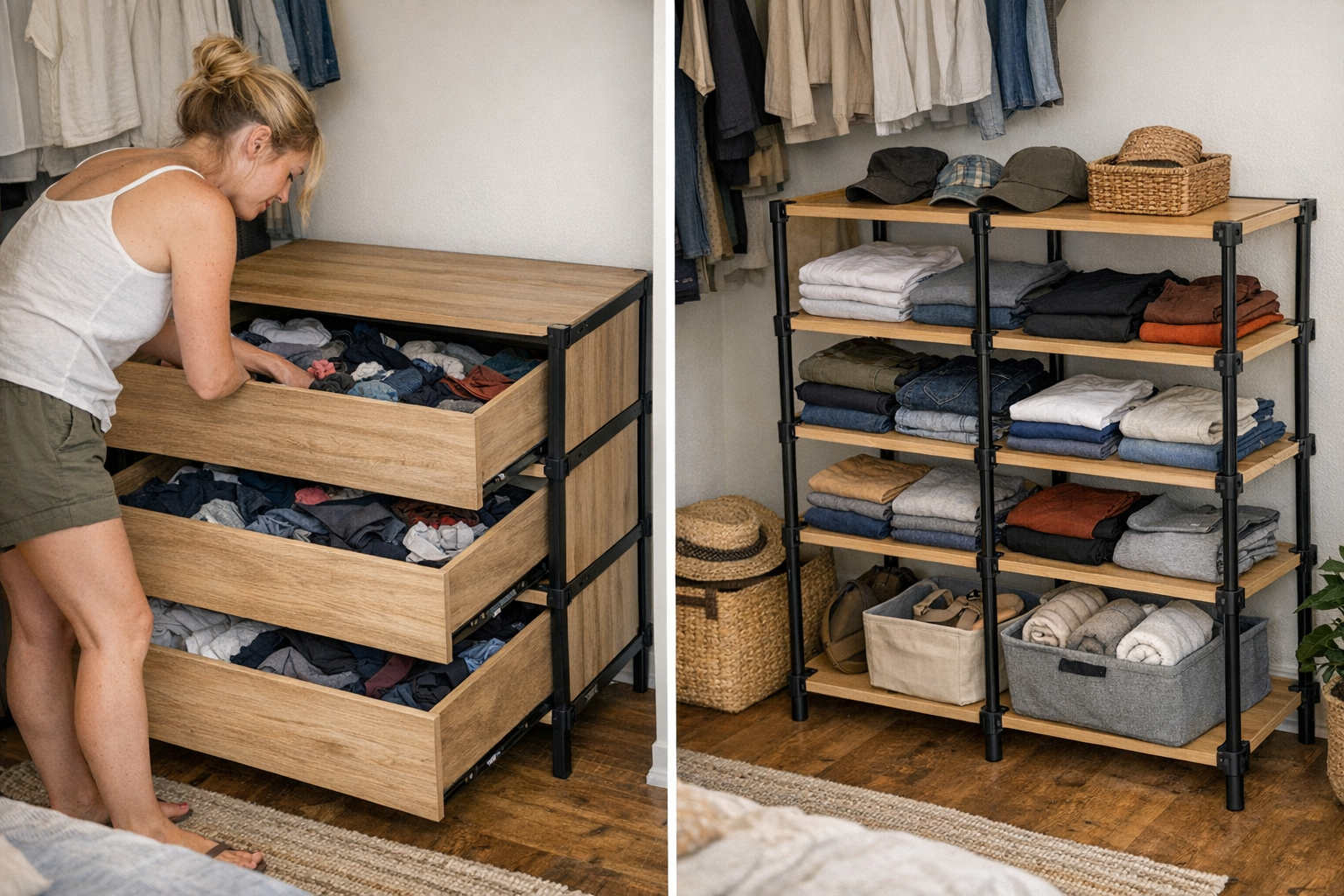
Drawers or open shelves: both look tidy at first glance, but the real test comes at 7:23 on a rushed Thursday morning. That’s when you’re elbow-deep in a drawer, searching for the socks you know you put there, and you realize—your storage solution isn’t actually helping you. It just looked good for a day or two. The difference between a closet that photographs well and one that keeps up with real, everyday routines comes down to less visible details: friction, category drift, and how smoothly you can reset at the end of a busy week.
Drawers: Neat on the Surface, Chaos Beneath
Imagine the lower half of your closet lined with deep drawers—everything sorted, folded, hidden from view after a weekend reset. By midweek, though, that illusion starts to slip. You can’t put your hands on what you need without disrupting layers: socks disappear under t-shirts, sports bras slide to the back, athletic tops get lost. The sense of order you worked for quietly comes undone, one hurried grab at a time.
Deep drawers make it far too easy for categories to blur with each rush. They swallow poorly folded stacks, and items shift and topple before you notice. What starts as minimalist calm turns into a churned-up mix just below the surface.
The Drag of Reaching, Shuffling, and Searching
This friction adds up in the routine details. Every morning, reaching for one specific shirt means touching—if not actively moving—three others. Socks stuck at the bottom force a half-unfold of everything on top. Untangling a pile to find a single missing gym short slows you down and leaves folded stacks looking punched-in. Drawer resets take longer each time, and what once felt efficient slips into maintenance mode—constant process, barely keeping pace.
The trouble is mostly hidden. Drawers fool you with surface order, but every repeated reach disturbs the balance. Eventually, it’s easier to stop resetting entirely and just live with low-level chaos.
Shelves: Full Visibility, Fast Access, Real Limits
Shelves, by contrast, refuse to let items hide. Every piece—pants, towels, folded knits—competes for visible space. With no deep layers, you pull what you need without dislodging the rest. Each category is exposed, so mixing is obvious and retrieving is quick. You lose less time to searching or reshuffling. Shelves tell on you: overstuff them or neglect a row, and chaos is instantly on display.
But shelves can crowd up fast. Too many stacks become hard to control, and soft items spill into each other nearly overnight. One oversized sweater can push an entire row toward collapse. The neat line up front quietly grows into a jumble when no one’s looking. Still, you always know where things are—and if you use bins or baskets, they force you to define what goes where, at least until overflow starts again.
Scene: Mudroom Entryway Shelves in Practice
Picture the honesty of a mudroom shelf lined with baskets. There’s a tray for keys, a bin for hats, boots set out in their spot. Categories stay clear because each is visible and easy to access. But if shoes start landing outside their bin, or baskets overflow, clutter spreads instantly from shelf surface to floor. Even then, finding the right scarf or gloves is a glance and grab—fast, but risking visual clutter and the need for constant pulse-checks.
Dividers: Small Fix, Big Relief
Back to the bedroom closet: add removable dividers and watch the tone shift. Each divider becomes a miniature boundary—shirts here, leggings there, socks corralled to one side. Suddenly, the drawer you’d grown to dread opens to clear, persistent zones. The scramble for a specific item is gone; instead, you can nab what you want with a single reach. Stacks hold shape. Crumpling slows down. The difference isn’t always dramatic, but it’s real—you’ll feel it when resets become near automatic instead of a weekend project.
Dividers quietly prevent category sprawl and reduce the subtle mess that builds from little misplacements. Implementation is simple, but the payoff comes in every rushed morning and low-stress reset.
Quick Check: How Deep Is Too Deep?
If grabbing your favorite workout tee means moving two or more layers, your drawer is working against you. Too much vertical space invites chaos. Shallow drawers or strategic dividers force a single layer—everything visible, nothing buried, so mornings flow and clean-up is fast.
Reset Anxiety: Signs Your Storage Isn’t Working
When storage works, even hectic routines don’t unravel it. If you’re hesitating to reset a space because it seems overwhelming, your system needs tweaking—not just more discipline. Drawers devolve without boundaries. Shelves overflow without limits. True storage success shows not just in how easily you can tidy up, but in how little there is to fix each evening or weekend.
The best setups don’t rely on constant vigilance—they quietly keep things organized day after day. Whether that means confining socks to a single slot or making towels easy to grab off a shelf, the difference is functional, not just visual.
Beyond the Closet: Where Storage Friction Sneaks In
This tension shows up in every high-use zone:
- Kitchen drawers without flatware dividers devolve into utensil grab-bags.
- Bathroom cabinets with deep baskets let bottles vanish at the back and half-used products multiply.
- Garage workbenches lose all order when one tool gets wedged behind another inside a deep drawer.
The cycle is the same: each time you have to move the wrong thing to find the right one, friction accumulates. Each small fix—dividers, bins, clear visibility—reduces the reset grind and keeps daily routines smoother.
What Works: Everyday Storage Tactics
If you find yourself wasting time searching or resetting, try this:
- Root out hidden layers—deep drawers and bins love to hide clutter. Add dividers or split a single deep drawer into two shallow ones if possible.
- Track how often you have to move one thing to get what you really want. If it’s frequent, reorganize for single-layer or single-category access.
- For shelves or busy drawers, reduce categories: one type of thing per shelf (or per bin) lets you see when clutter is creeping in.
- Move your most-used items to open storage or top-access spots—control friction, then customize boundaries where chaos appears most often.
The lowest-friction storage setups are the ones you barely have to think about. Small changes like a simple divider or a swap to open shelving can transform how a space functions in real, messy, repeatable life. If your system feels like it’s always on the edge of chaos, it isn’t you—it’s the setup. Good storage adapts to your rhythm and helps declutter as you live, not just after a big reset.
Discover practical options and smarter routines at ClosetWorks.