
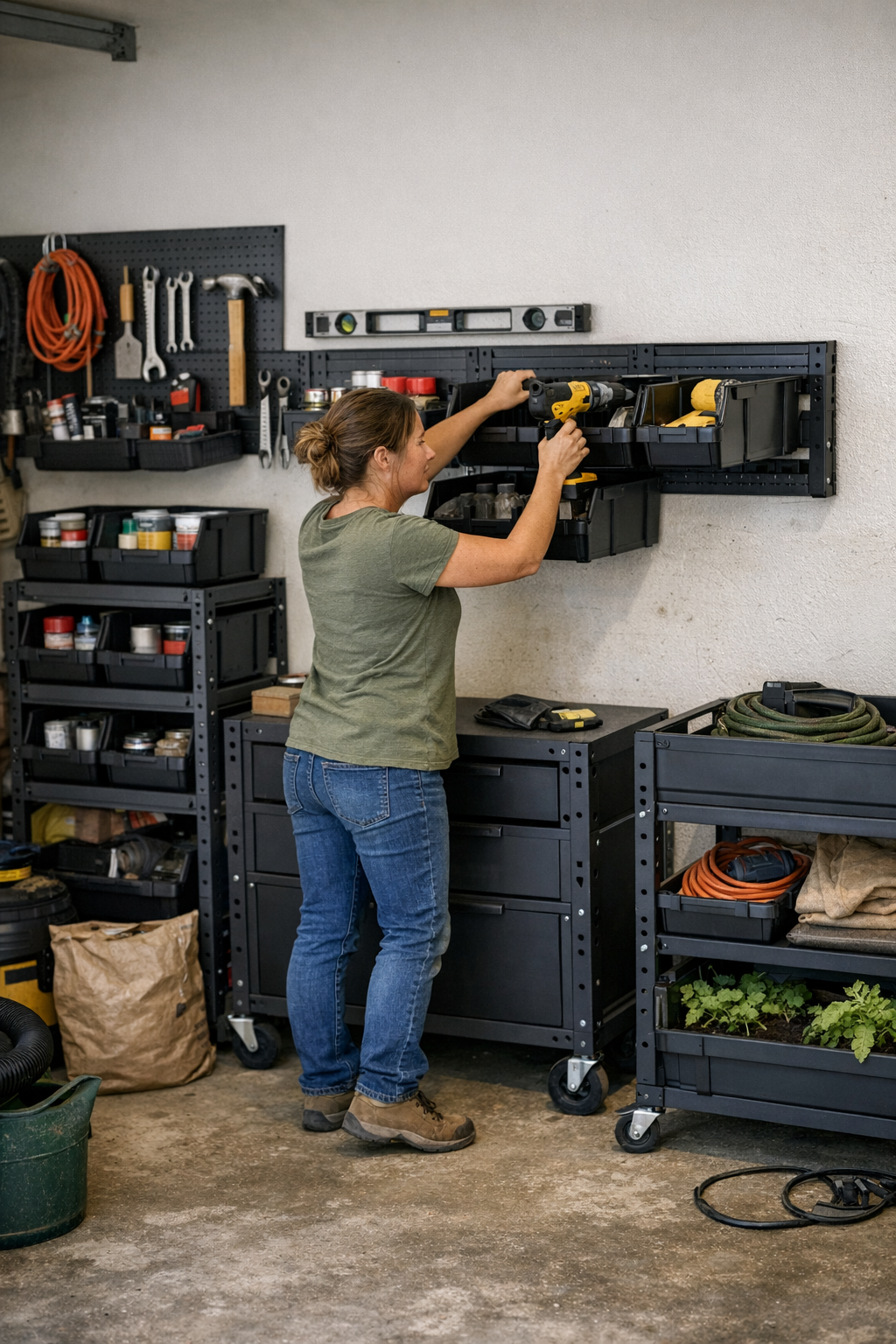
The urge to finally “get organized” in a garage, workshop, or shed always starts out hopeful: a Saturday trip down the organizer aisle, ready to conquer clutter for good. You buy the matching bins, sturdy racks, and stackable trays, load them onto every shelf and pegboard, and for a brief moment, it looks like real progress. But then you try to use the space—the real way you use it. That’s when things start to slide. The order looks convincing, but friction creeps in: bins block each other, wall racks swallow what you need, a rolling cart lodges itself in your main route for the third time this week. The space seems sorted but everyday tasks get messier, not simpler. Practical setups rarely need more containers—they need better flow.
How “Organized” Can Still Mean Awkward—And Why It Keeps Happening
It’s easy to feel done once everything looks uniform. But looks don’t fix the underlying problems. A stack of trays might line up on the bench, but by midweek you’re digging through the wrong one to find your favorite screwdriver. Hooks meant for tools turn into tangled parking for garden hoses, always at the wrong height. The rolling cart’s wheels jam in the only walkway that actually gets used, so you push it aside, rerouting yourself around obstacles you only created last weekend.
This is the everyday cycle: a space that photographs neatly, but disrupts your routine. The problems never show up at setup. They show up later—on the third time you twist through a blocked path or move stacks just to access what’s hiding at the back. Everything technically fits, but nothing moves smoothly. You end up shoving containers an inch this way, a box that way, trying to make the arrangement adapt to your habits, instead of the other way around.
Real Routine Interrupts: How Setup Creates Unexpected Barriers
Working in smaller areas makes these gaps painfully clear. You mount a pegboard and sort bins by category, but soon you’re playing Tetris: always shifting something to get what you really need. The most-used tray ends up four feet away because it looked better there, not because you ever grab it from that angle. Unused wall space turns into a dumping ground for random cords, while the floor’s corners gather overflow—a bag of nuts and bolts, a grime-streaked tarp. These slowdowns are subtle, but constant—especially with dirty hands, a time crunch, or a chilly garage where one extra step is one too many.
The friction is cumulative. In the evening, cleanup turns into awkward shuffling: stacking mismatched bins that don’t nest, sliding gloves onto any open surface, piling odds and ends onto a cart you have to relocate for the third time. Week after week, what started as order quietly morphs into constant mini-resets that steal your time and block smooth movement.
Why Looking the Part Doesn’t Make a Space Work
The visual payoff of a coordinated setup disappears the first time you need to unhook three things to access one. Trays that nestle perfectly together are a headache once you realize the items you use most are buried or blocked. Every reach-around or awkward maneuver is a reminder: organizers chosen for the sake of looking “tidy” often get in the way of real, repeated use.
There’s a real cost here. Bad wall layout means tools drip onto the floor, oversized racks gobble up working space, and neglected corners fill with overflow that slows every task. The more you shuffle and shift, the less satisfying the “system” becomes—if it even counts as a system at all.
The Hidden Gaps Routine Always Exposes
The weaknesses surface during rushed mornings, sudden weather, or whenever your hands are full. That narrow storage path in the shed? Always blocked by a rolling cart you have to drag aside just to access drawers. Baskets tucked under benches? Great until you need one fast, crouching and re-sorting in an awkward huddle. What works in a catalog photo collapses under repeated, real-life cycles—the ones you didn’t plan for, but repeat every week.
Shift Your Mindset: Design the System, Not Just the Storage
The real fix doesn’t come from more containers. It comes from stepping back and mapping how you actually use the space. Walk the whole area. Where do your hands land first? Which path does your body naturally take? Where is movement always interrupted, and which stretch of wall or bench inevitably collects overflow?
Building a system means prioritizing effortless reach and uncluttered movement. That could mean a wall rail at standing height, holding trays that slide out without blocking anything else. Or modular panels that shift as your needs evolve—freeing you from a fixed rack that always pinches the same high-traffic spot. Instead of containers dictating your routine, the system adapts to you. The right layout clears paths, zones, and corners that would otherwise turn into storage purgatory.
Practical Upgrades: What “System-First” Actually Changes
When each organizer is chosen to slot into a bigger blueprint, the difference is immediately obvious. Tools you use weekly have their own tray, at a height you can reach in one motion—no reshuffling required. The wall system keeps overflow off the floor and finally kills the pile in that always-messy corner. End-of-week reset stops feeling like an all-day battle; each tool and glove lands where it belongs without friction, so you can actually finish and move on.
It doesn’t look like a showroom. It feels like work goes faster and cleanup finally snaps into place. Nothing’s perfect, but the endless shuffling stops, replaced by a setup that lightens the load instead of building new obstacles.
Spotting a Layout That Still Needs Work
Does a cart block your walkway every time you open a cabinet? Does wall space look busy but nothing’s actually in reach? Do bins stack to awkward heights, or do categories keep bleeding together as you tidy?
These are the tells: when the “organization” keeps breaking down into weekly rituals of restacking, redirecting, and re-sorting, the underlying system just isn’t right. Only when you can move through the space cleanly, grab what you need instantly, and return things without inventing new routines, do you know the setup is working with you—not against you.
Turning Intentions Into Lasting Improvements
If you want a space that stays organized, stop letting organizers dictate the plan. Start with movement, daily reach, and the ability to reset quickly—choose solutions that serve those needs. Usually that means fewer containers, smarter wall systems, and layouts that don’t require acrobatics to keep in shape.
Organization stops being a battle the moment your setup feels frictionless—when trays draw out, carts park clear, and bins return to their spots without a second thought. That’s the shift: a workshop, garage, or shed that stores what matters, supports your real habits, and finally makes the whole project worth the effort.