
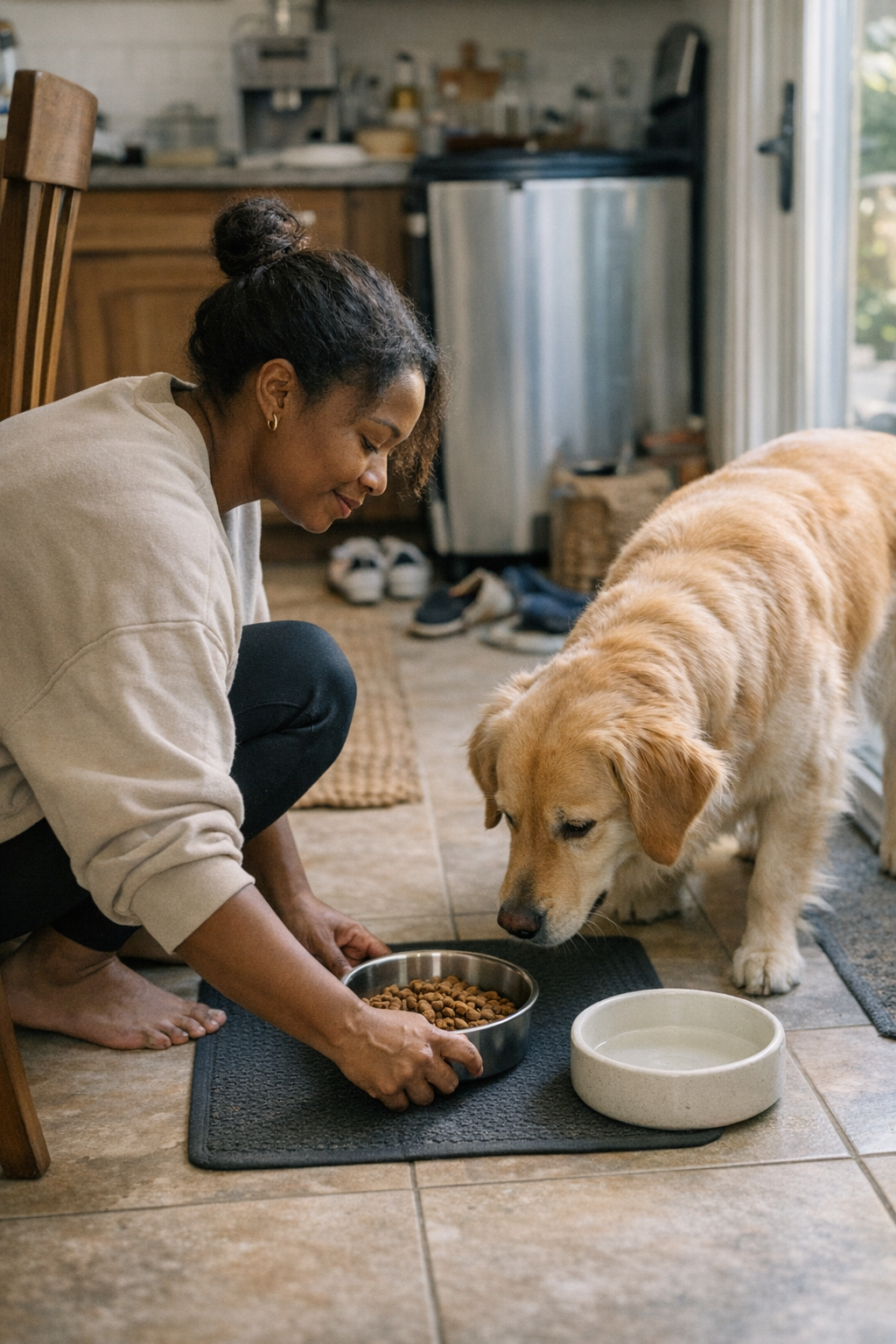
Every dog owner thinks the feeding spot is “set” — until the routine grinds. You notice it because you have to: the bowl is off the corner by three inches. The mat is nudged out from cleaning, just enough that your dog loses the usual quick walk-up. Maybe shoes slide into the zone, or the food bin drifts, or you’re sidestepping clutter every time you refill. It’s forgettable until you watch your dog slow down, hesitate, or circle before each meal — not because of appetite or mood, but because the “routine” is now a guessing game.
When Your Dog’s Routine Slows Down (and So Does Yours)
The breakdown doesn’t hit all at once. The feeding area is supposed to be reliable — bowl, mat, food nearby, done. But daily life pushes that “fixed” spot around. Mop under the table and the mat ends up off-angle. Shoes edge in, and you relocate the bowl for traffic — just for now. Each tiny shift adds up, and soon your dog’s “automatic” meal path is interrupted, causing her to pause, scan, or double back while you wait. That hesitation isn’t random; it’s the cost of the zone being a moving target.
Dogs aren’t overthinkers, but they recognize the difference between a bowl that’s always on the third tile from the fridge versus a bowl that’s wherever you last set it. Meals devolve from a direct approach to a minor search session — every pause multiplied across two meals a day, repeated endlessly. The friction is subtle, but it drags. Routines slow. Attention leaks away from everything else that matters — even for five seconds at a time.
Invisible Friction: What Actually Gets Interrupted?
A feeding area that only “looks” okay and one that actually functions well feel different every single day. Small, consistent signals give it away:
- Your dog waits at the “old” corner, ignoring the bowl inches from her nose, expecting continuity.
- You watch her navigate boots, shoes, laundry baskets — anything creeping into her path — turning meals into obstacle courses.
- Scattered kibble follows the bowl’s latest stop, now outside the usual mat, so cleanup is never automatic.
- You correct micro-errors over and over: nudging the bowl back, straightening the mat, promising to “get it right” next time — but forgetting, because life keeps shifting things again.
No crisis, just an endless string of minor holdups. They aren’t dramatic enough to demand a reset, but they quietly chip at your routine — until the friction becomes the norm.
The Drift: How Feeding Zones Quietly ‘Walk’ Across The Room
The drift starts with one “temporary” nudge. You want counter space clear, or a tidier look, or you’re mopping and push the bowl aside just for now. Problem solved for the mess, but every cleanup adjustment shifts the dog’s reference point. Soon, she’s walking circuits, searching the old spot even when the newest one sits in plain sight. What seems like a small placement tweak is, to your dog, a lost anchor. And as the bowl’s position drifts, so does the habit. The feeding area becomes wherever nothing’s blocking it — at least for that meal.
Most of the time you only notice when the tension stacks up: mornings crowd quick routines with stumbling, evenings crowd with cleanup that now takes twice as long because nothing lands in its expected chute. You see your dog pause, look up, and wait for your cue — not sure which setup to trust.
When the Routine Breaks Down: Real-Life Moments You’ll Recognize
Daily routines make the consequences obvious:
- Morning crush: The bowl is hidden under a table to make floor space, so while people dodge each other for coffee, the dog runs laps, looking lost. Patience runs thin, and the meal gets folded into the chaos.
- Freshly mopped floor: The mat has dried out of position. Your dog slows, eyeing every change, and you realize “clean” means less certainty for her. The setup wins visually but costs time and clarity.
- Shoes blocking the spot: The meal zone is now wedged next to a doorway. You’re stepping over gear, your dog is looping, and the feeding area now interrupts everyone’s flow — not just hers.
None of these require a full overhaul, but they turn “should be easy” into another small job. The space appears organized but doesn’t deliver on routine.
Why Dogs Rely on Predictable Feeding Spots
For dogs, habit forms around sameness. The bowl’s place on a particular tile becomes a signal — this is food, this is safe, this is certain. When the physical anchor moves, your dog’s built-in map breaks: searching, sniffing, stalling, checking the old spot, looking for permission to eat. These pauses aren’t quirks or pickiness. They’re side effects of a pattern that keeps changing — slower eating, less settled behavior, and you wasting mental energy making up for the weak point every time. Some dogs adapt, others hang onto the old spot longer, but the invisible cost is shared either way.
When you’re aware, you notice the feedback loop: bowl moves, dog pauses, you adjust, next time you forget, bowl moves again. The “routine” is now a series of corrections and compensations. You keep half an eye on the dog to see if she needs help — not because the system broke, but because the structure keeps shifting underfoot. What should run itself is now something you have to manage.
What Happens When the Routine Snaps Back to Center?
When the feeding spot actually stays fixed, ordinary friction drops away. Instantly visible changes: your dog heads straight in, no lost effort or missed steps. The meal begins as soon as it’s served, and there’s no stall-out waiting for clarification. Cleanup becomes a habit too: every crumb drops in the same, predictable spot. You stop looking for the bowl, and your attention moves to the next task. Other routines — door traffic, grocery runs, evening resets — flow around a known anchor, not a floating obstacle.
- Meals start and finish without mental reminders about placement or correction.
- Feed spills are reliably contained, making sweeps efficient, not aimless.
- The feeding area is a set part of your home’s traffic map; it doesn’t bounce in and out of your own movement path at random.
It’s not dramatic — just unmistakably easier. Your dog stops searching. Your hand doesn’t pause to double-check. The everyday pressure point is gone, and the zone holds steady even when the rest of life is shifting.
When Consistency is Hard: Trouble Signs and Simple Fixes
In many homes, a “permanent” feeding spot isn’t realistic — shared spaces, shifting furniture, narrow walkways. But certain misery signals stand out:
- Your dog paces at mealtime, fishing for the right spot before she’ll eat.
- Kibble turns up outside the usual mat — a not-so-subtle sign that the cleanup area keeps following the bowl.
- The bowl’s “home base” isn’t known — you or someone else has trouble remembering where to put it back, even once a week.
When this friction returns, try returning to the original anchor — same tile, same wall, after every meal, even on cleaning days. Improvement is often fast: your dog settles, you recover seconds or minutes, and meal routines slide back into place. The effect isn’t dramatic but it reduces a nagging, repeated inconvenience that only grows with time.
The Hidden Cost of a Wandering Bowl
A feeding setup that looks organized but floats between spots piles tiny costs on both you and your dog. The appearance is orderly, but the experience is unreliable: meal times get chopped up, your reach is awkward, cleanup is unpredictable, and your dog acts like each meal is a new puzzle. The real value of a fixed feeding spot isn’t perfection. It’s a daily structure you don’t have to fix in motion — so attention and patience are saved for things that actually change.
When the bowl’s location goes from “wherever” to “always here,” you reclaim a small piece of your routine — and those gains, minimal per instance, stack up every day. It’s about function, not just form: dog-life where resetting the basics never slows the rest of the house.
Every Meal, Easier to Trust
If your meal routine feels off, or your dog appears unsettled, check the bowl’s location history. Invisible drift has real impact — on your dog, your cleanup, and the speed of every reset between meals, walks, and home traffic. Lock in a fixed feeding zone, and the improvement is more than perceptible: it’s a daily reset that stops needing a second thought. DogPile’s practical everyday setups make that baseline easier to keep — because a calm feeding spot is more than tidy, it’s dependable.