
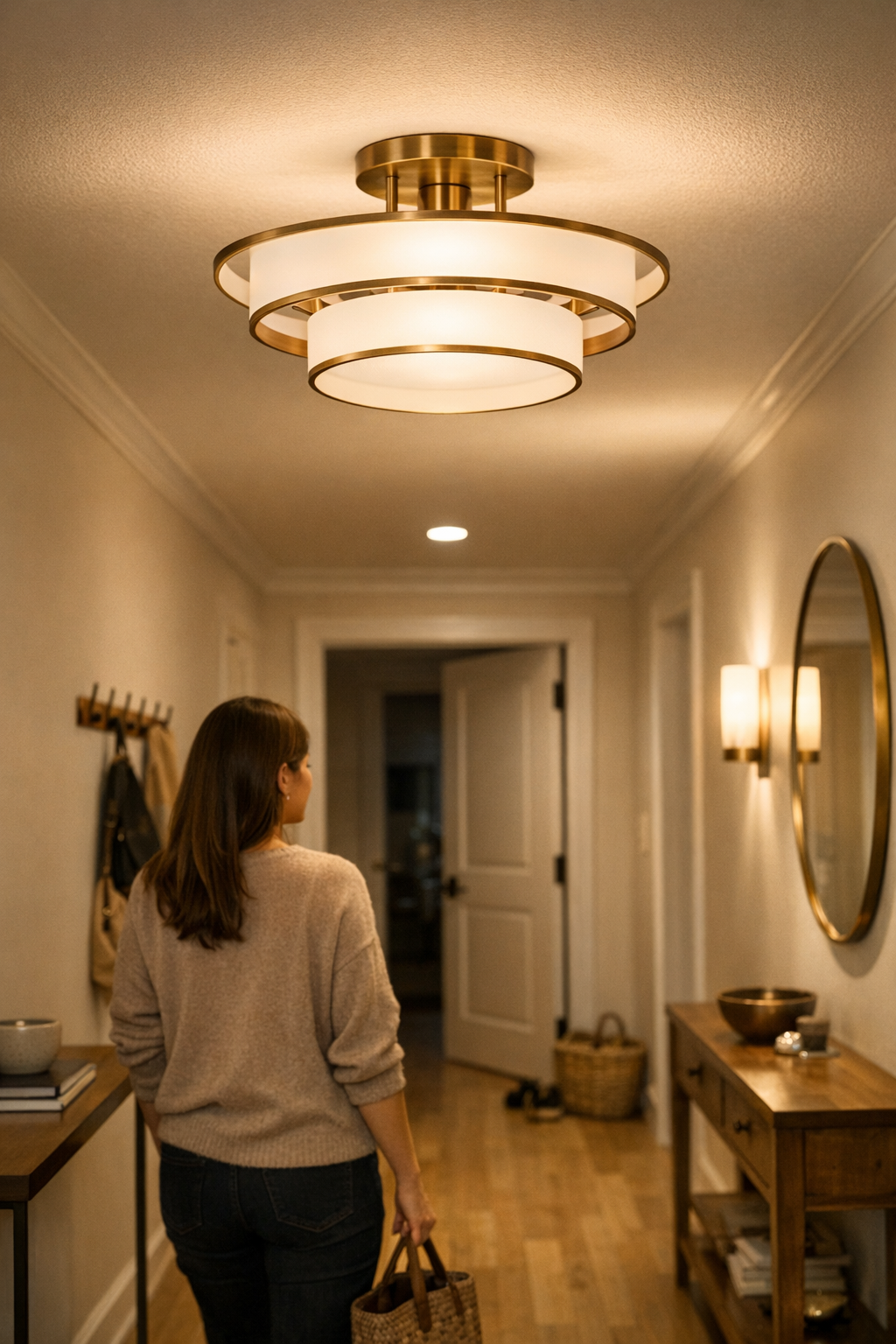
Corridor lighting doesn’t fail on installation day—it slowly undermines routine every time you pass through. The real problem shows up a week in, when the hallway just feels “off.” One step is bright white, the next is faded amber, and the last bulb in line casts a cold, uncomfortable tint. Glare shimmers above a coat hook; a dim stretch by the entry hides keys and shoes in the shadows. The corridor doesn’t link rooms; it slices itself into uneasy patches. Even small differences—bulbs swapped at different times, panels from mismatched batches—build up until every trip down the hall delivers a visible, nagging inconsistency. What looked seamless in daylight now feels distractingly unfinished at night, especially when movement stops being fluid and becomes a string of micro-hesitations.
When Light Tone Splits the Corridor
It only takes a subtle shift: one “neutral” bulb, another “soft white,” and suddenly the hallway betrays itself. Step from zone to zone and the color temperature dips or spikes, forcing your eyes to adjust inside the same supposed passage. Edges blur, corners bounce mismatched shadows, and fields of glare or dull spots show up exactly where daily movement happens. The shift is worst after sunset—no daylight to dilute the contrast—so corridors meant for quick, direct movement instead trigger side glances and slowed steps. Functional space fragments into interruptive mini-scenes, exposing every substitution or shortcut in the lighting plan.
The result is not just a different look but a drag on routine. It’s hunting for shoes in a yellowish bubble while the coat hook sits in a harsh beam. Pausing beside a glare-pool to let a guest pass, feeling shadows change as you cross threshold after threshold. Practice anything in that passage—putting on sneakers, hauling groceries, nudging the door open with a backpack—and the interrupted flow makes itself known over and over.
How Small Inconsistencies Creep In
Even deliberate planning can backfire. Matching fixtures is only as safe as their underlying batches. One missed detail—a replacement bulb pulled from the kitchen drawer, a panel strip reordered months later—sets off the chain. A “4000K” is not always a true match when the tint or batch has drifted. A corridor that looks aligned on install day drifts into patchwork reality: faint amber against cool white, haloes skipping from ceiling to wall, hotspots on tile or wood, awkward shadows down the baseboard. Under repeated use, the inconsistencies get easier—not harder—to spot.
Daytime hides, nighttime reveals
By day, mismatched tones fade behind other distractions. But at dusk, a corridor’s misalignments glare into view. Cold light bounces off one side of the wall, turning coats or pale surfaces blueish, while an opposite edge glows tired yellow. Pausing to check what’s underfoot, glancing back at a half-open door, you feel the disconnect more than see it outright—shadows that don’t line up, objects half-lit where you expected clarity. If you’ve caught yourself adjusting, squinting, or leaving something at the “better lit” end, you’ve run into the problem directly.
Movement Exposes the Weak Spots
Staying still can hide poor lighting, but hallways are built for movement. What seemed balanced across ceiling and wall breaks apart underfoot as you walk: floor shadows jump, glare streaks past hooks or shelves, depth flattens near doorways. Every change of step—especially when carrying something or rushing—makes the flaw obvious. Peripheral vision catches light shifts even faster: a misplaced panel, a too-cool surface, a streak of glare from an exposed LED strip that seemed fine on paper but disrupts repeated use.
Crossing a five-meter corridor after dark becomes a silent checklist of small corrections. You slow down at a dim patch, sidestep a coat dumped in the glare, try not to miss the pair of shoes you can’t quite see in the corner. The “straight line” between spaces becomes interrupted by light—so much that you catch yourself wondering if a simple route could be simpler still.
How Uniform Tone Transforms Corridor Use
The fix isn’t an architectural overhaul—it’s consistent tone and matching support. Align every bulb, panel, or strip to the same neutral output (usually 4000K) and the physical corridor becomes functionally continuous. No more abrupt edge shifts. Baseboard shadows hold their line; door frames stop throwing weird bands. Grabbing a tote from the hook no longer means pausing to adjust your eyes. Even piles of shoes, which once vanished into a dark corner, become clearly visible with no effort. The upgrade isn’t about a showy change, but about making the corridor work so smoothly that it fades into the background of daily movement.
Visibility you don’t need to think about
A corridor with true tone consistency operates quietly. Whether you’re carrying groceries, reaching for a scattered toy, or walking with a guest, your movement no longer “bounces” against the light. The visual field stops shifting. You stop scanning for missed objects or hunting for a switch that shouldn’t be needed. Instead, the space finally acts as the seamless connector it was meant to be, supporting real routines without extra pause or friction.
Common Misses and Field Lessons
- Don’t trust visual similarity in the shop. Always bring a sample bulb and confirm both Kelvin rating and maker—similar appearance is no proof of identical tone when installed.
- Never mix batches for panels or strips unless you’ve staged them side-by-side in your actual space. Factory drift—usually invisible in the box—can jump out once the lighting is installed down a linear passage.
- Test before going all-in on installation. Lay out panels or screw in bulbs temporarily, then walk the corridor at dusk. Subtle mismatches become glaring under real-night conditions that no daylight or phone test can reproduce.
Even a single inconsistent fixture unravels the intended flow. Narrow passageways punish poor alignment the hardest—side vision immediately picks up on odd tones and shadow breaks. Wide corridors disguise mistakes better, but in tight, high-use transitions, tone drift and panel mismatch pile up fast. The point isn’t to stage-perfect “design,” but to achieve comfortable utility quietly, so the corridor’s lighting supports, rather than interrupts, the routine it was meant for.
Making Simple Setups Actually Comfortable
If your corridor still draws attention after it’s “done,” something’s off. True lighting support isn’t about flash or fiddly options—it’s about resolving the basic sequence: clear sight, steady tone, smooth movement. When you can walk, reach, or check for essentials without thinking, the improvement feels invisible but real. Don’t add complexity; settle for a consistency that’s so natural you forget you ever needed to think about it. That’s when the corridor finally works.
For practical indoor lighting, lighting support, and accessories to help corridors (and every space you repeatedly use) feel easier and more comfortable, visit LightSupport.