
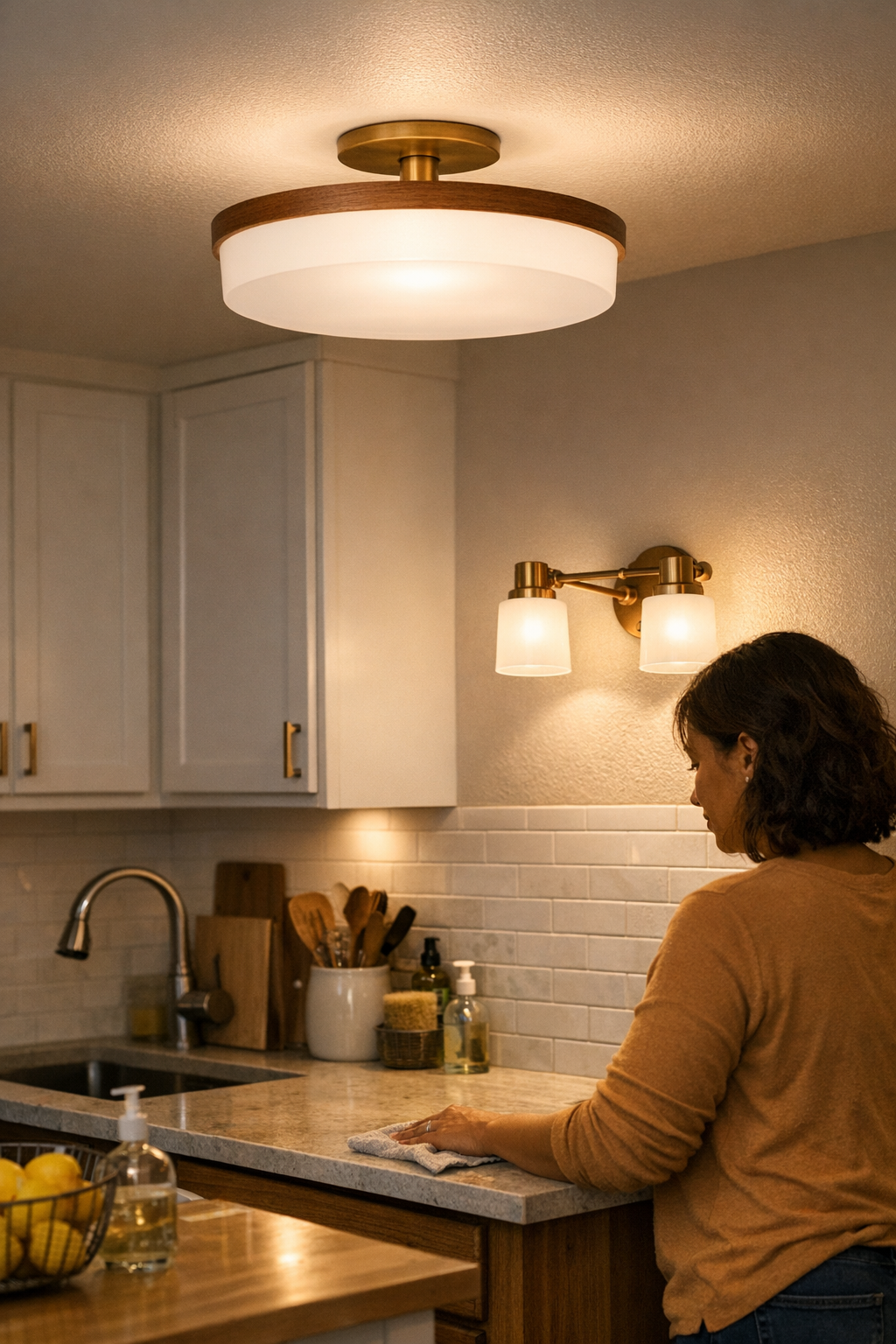
Everyday cleaning shouldn’t be a hunt for crumbs you can’t see. Yet, in most homes, basic overhead lighting creates glaring blind spots—surfaces “look” lit but force you to hunt in shadow for every last streak and crumb. If you’ve ever circled back to the same edge, leaning in just to catch what the main light misses, you’ve felt how badly the wrong setup steals time and turns quick cleanups into drawn-out, second-guessing routines. The repeated frustration isn’t just annoyance: it’s the cost of lighting that works in theory, not in use.
Why Standard Ceiling Lights Miss the Mark in Real-World Cleanups
The default option in most daily-use rooms is a single flush-mount ceiling light. On paper, the wattage covers everything. But stand anywhere but the exact center—scrubbing a counter, leaning over the sink, or shifting down a hallway—and the illusion breaks. The middle stays bright while edges fade, surfaces streak with shadow, and the very spots you touch disappear at odd angles.
The constant scenario: center glare, edge neglect. A counter’s working edge sits in dullness even if its middle gleams. Hallways have a pool of light that fades as you near the door, turning movement into hesitation. Mirrors betray you from the side, lighting one cheek and leaving the other ghosted in the dark. The payoff: missed grime, repeated swiping, and movement that’s slower and less confident—room after room.
Everyday Scenarios Where Lighting Friction Adds Up
1. Countertop Cleanups and Missed Edges
In the kitchen, you’re already tired, and you’re wiping down the counters at night. Shadows pool along the back edge and around the faucet. Leaning over to inspect your work, your head or elbow throws even darker shade. The overhead flush mount does little for the far side; you find yourself reaching and tilting, cleaning the same patch twice or more. Bit by bit, the cleanup drags, not because you missed a spot, but because your lighting did.
2. Hallways That “Look Bright” But Feel Dull to Move Through
You walk through a corridor lit by a central ceiling light. The floor ahead looks safe, but a step to the side and the wall loses definition. Turning the corner, a shoe rack or bag blend into shadowed edges. You end up either slowing your step or brushing the wall—never quite trusting your movement, even when, from a distance, the hallway “seems” lit well enough.
3. The Bathroom Test: Surfaces That Stay Uneven
In bathrooms, a single mid-room fixture dazzles the white sink center while leaving both mirror and faucet in patchy dimness. Grooming means shifting your angle to catch real detail, wiping means fighting both glare and shadow. Every motion turns into a recalculation—never just a single, confident pass.
From Showroom Brightness to Real, Usable Illumination
Apparent brightness from the threshold doesn’t guarantee usable light at eye level or work height. The true test: as you move through cleaning steps, does every surface reveal what’s left undone—or do you always have to adjust your angle, backtrack, or squint for confirmation? Overhead-only setups impress at first glance and fail during real routines, revealing the limits no catalog photo shows.
Solving these blind spots doesn’t require an overhaul—just layering the right types of light where they close routine gaps:
- Wall sconces by worktops erase shadow lines where dirt collects and overheads can’t reach.
- Under-cabinet strips, especially in kitchens or utility corners, push even, damp-safe light right down to the hands and backsplash—no missed crumbs, no long reach-around.
- Square-diffused flush mounts overhead, paired with low-glare wall fixtures, fill the entire room with usable illumination, not just broad, unfocused glow.
The Visible Shift: Faster Routines, Fewer Misses
Upgrade a single dome light to a square flush-mount plus a shallow wall sconce at the critical counter, and you see the change where it matters: hands stop flattening along backsplashes, no more circling the faucet, no more hunting a better angle. Glare drops. Side shadows flatten out. That nervous pause—“Did I actually get it all?”—just vanishes.
Routines tighten: kitchen, bath, or hallway, surfaces show dirt or water marks on the first pass; nobody’s looping around for another check. The goal isn’t decorative perfection—it’s clarity at every edge and comfort in fast, repeated movements, even if you’re hauling laundry or cleaning at an odd hour.
Do Small Rooms and Tight Corners Still Benefit?
In small, packed-in kitchens or cramped laundry alcoves, a single shadow means every mess is more obvious and movement is more awkward. Overhead-only setups amplify the annoyance: cleaning turns into squinting and triple-passing already-tight spaces. Targeted fixtures—under-cabinet bars, wall sconces placed at problem spots—erase these dark patches, turning dead corners into usable space without the constant mental second-guessing.
Damp-Rated Lights: Reliable Illumination Where It Matters Most
High-moisture zones like bathrooms and laundry rooms push ordinary fixtures past their limits. Steam, condensation, and humidity turn average lights hazy, and you’re left with uneven, unreliable spread—glare here, dim zone there. Damp-rated ceiling or wall fixtures keep output even and steady, no matter the weather or the routine. The upgrade isn’t glamour—it’s real-time confidence, less wiping blind, and one fewer source of nightly friction.
Choosing Lighting that Supports the Routine, Not Interrupts It
The best setup isn’t the prettiest—it’s the one that cuts through daily hassle. When ceiling and wall lights work together:
- Work surfaces are fully visible from first wipe—no leaning, no circling, no double-checking in the dark.
- Edges and corners finally stay found: even runs of cabinets, stair turns, and entry nooks reveal mess or trip hazards instantly.
- Movement flows without stop-and-start: you move at your real pace—not the pace forced by “almost bright enough” lighting.
- Cleanups shrink down to their real size. Most of all, the routine itself gets quieter, because light isn’t something you have to work around anymore.
In spaces defined by movement and detail, lighting that bridges the gap between “looks bright” and “actually clear” isn’t a design extra—it’s the difference between a routine that drags and one that just works.