
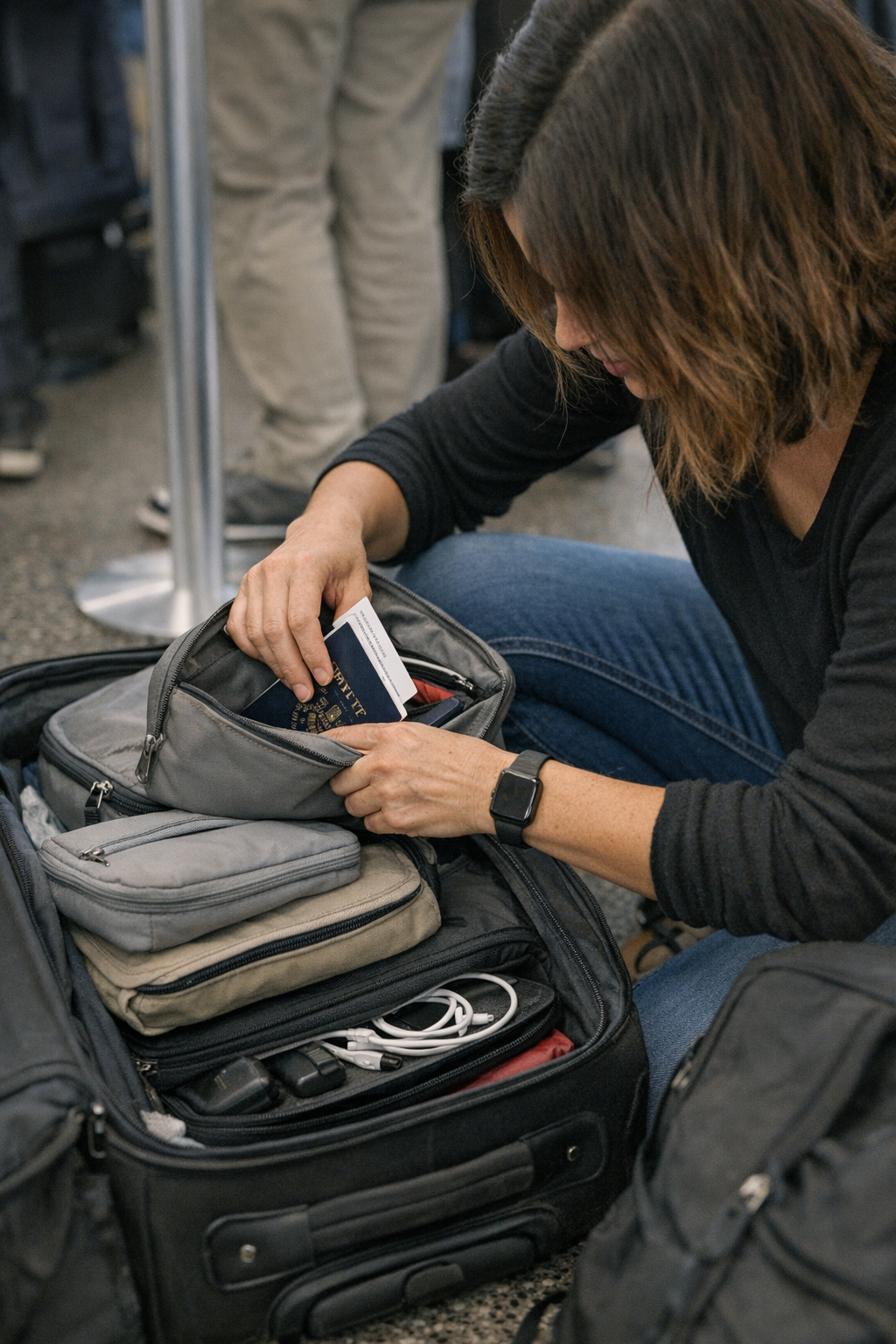
An organized carry-on can feel perfect—right until airport reality starts grinding away the illusion. At home, every pouch is zipped, chargers are coiled, and your passport slips easily into a slim organizer. Step into an airport, and the difference between “packed neatly” and “built for movement” appears almost instantly: reach for your ID at security, fumble for your boarding pass while others wait, or yank out a charger at a crowded gate—each motion caught in a web of compartments that seemed like an asset just hours earlier. A bag that looks sharply ordered on your kitchen counter turns slow, uncooperative, and awkwardly layered when actual travel puts pressure on the setup. That’s where friction starts to build, and why what works at home can work against you after the first real use.
Where Repeat Access Meets Real-World Friction
Airports expose weaknesses you barely notice until you’re in the churn of check-in, security, and boarding. Every travel checkpoint demands the same few essentials—ID, documents, chargers—over and over, often under time pressure. This is when a “neat system” starts working against you. By the third time you’ve yanked a pouch free, unzipped yet another layer, or set your tote awkwardly on the floor to retrieve your passport, you feel it: structure built for tidy packing turns into minor chaos under repeated retrieval. Worse, if your hands are repeating the same clumsy search with each checkpoint, the flaw isn’t your memory—it’s the bag’s structure slowing you down, step by invisible step.
The Quick-Access Trap: Organized but Not Usable
A visually flawless bag—chargers in tech pouches, documents nested, toiletries lined up—photographs well, but stumbles in real use. The moment you’re rushed, everything you need is gated behind layered steps. Boarding pass? Unclip one pouch, move another, unzip, dig. Earbuds? Blocked by a charger you packed “efficiently.” One clean, gridded packing job adds three or four micro-barriers every time you want something in motion. Each repeat retrieval is a reminder: tidy at rest, tangled under pressure. The harder it is to reach what you actually use, the more the system works against the flow of the airport and the speed of your own muscle memory.
Security: Where Organization Slows Down
The security tray is where these small inefficiencies become public. With staff watching and a line behind you, there’s no patience for methodical unpacking. You need electronics and fluids out—quick, all at once. Instead, you unzip tight compartments stacked for “efficiency,” dig through two pouches for one item, and end up juggling half-unpacked gear. Now your order has become a bottleneck. If a passport or phone slips deep between layers, you feel it in sideways glances or the extra seconds spent shuffling items while the trays pile up. What helped you feel “organized” at home now slows everyone, including you, at the worst possible moment.
Repacking Burden: A Cycle that Doesn’t End
Every retrieval in transit comes at a cost. The first time you fish out a charger or ID, you promise yourself you’ll repack with care later. The second and third cycles? Reality sets in. Each round leaves essentials shuffled, pouches misplaced, cables loose. You find yourself kneeling awkwardly near a power outlet or at the gate, trying to restore the original order, but the “system” quickly becomes a pile you keep reorganizing. The friction becomes self-perpetuating: every access weakens the order, making the next access even slower, until the tidy setup that gave you peace at home produces real irritations with every flight segment.
How Access Frequency Should Define Your Layout
The key to a frictionless carry-on is prioritizing frequency over visual order. Anything you’ll reach for more than once—passport, boarding pass, headphones, main charger—deserves immediate, single-zipper access. If it has to move around or come out, it should never be behind another item, buried beneath a stack, or hidden under a pouch labeled “for order’s sake.” In a real-world setup, frequent-use items should dominate exterior or top-level sections, even if that means breaking your visual grid.
Minimizing Steps Beats Visual Perfection
This approach intentionally sacrifices some Instagram-worthy layout for speed you’ll actually feel—single-motion retrieval, fewer zip paths, less public scrabbling. The new benchmark: if you never have to move another pouch, unzip an extra layer, or disturb your secondary gear to get core essentials, your travel rhythm becomes smoother and your re-packing sprints disappear. Clean packing is worthless if every real use turns into a miniature unpacking ordeal. Layout designed by reach, not by look, proves itself by making you invisible in security and effortless at the gate.
Spotting the Weak Points Before They Compound
Most carry-on failures aren’t big—they’re slow-building and repetitive. Notice if you’re opening two compartments to get the same item at every stop, repeatedly searching a section for your phone, or re-zipping the same pouch after each document check. If the same access process clogs your flow in multiple airport segments, you’re staring at a structural issue, not a personal quirk. These small drag points don’t just waste time—they create a travel rhythm that’s more about fixing earlier disorder than actually making progress.
Example: From Home to Boarding
The night before, you build a “system”—tech in one spot, toiletries tightly arranged. By the time you reach security, retrieving electronics means unzipping three pockets. At boarding, your noise-cancelling headphones (packed deep for symmetry) slow you down once more, forcing you to hold up the aisle while you dig. When you hit your seat, your main charger is—again—at the bottom. Each interruption is nearly identical: too many layers, not enough access, and the same repacking motion repeated out of necessity, not choice. This isn’t “messy travel.” It’s misaligned structure: setup that works until you actually move.
When to Rethink Your Setup
Ask yourself:
- Am I shifting more than one pouch or pocket to reach my most-used item?
- Do I re-pack key essentials every time I touch them?
- Is “order” costing me valuable seconds or creating new bottlenecks at security, the gate, or during seat entry?
If the answer is yes, the solution isn’t more packing discipline—it’s a new structure. Promote high-frequency, high-stress items to instant-access compartments. Let the layout look “lived in” if it means you never stall at a checkpoint or block the aisle while re-zipping. The real payoff is fewer interruptions and a setup that doesn’t just survive three or four rounds of airport movement, but actively makes each round easier.
The best carry-on isn’t just tidy on the first use; it’s one that silently absorbs the wear of three, four, or five real-world cycles—each faster and less fussy than the last. When your system removes friction instead of adding it, you’ll feel the quiet difference on every trip.