
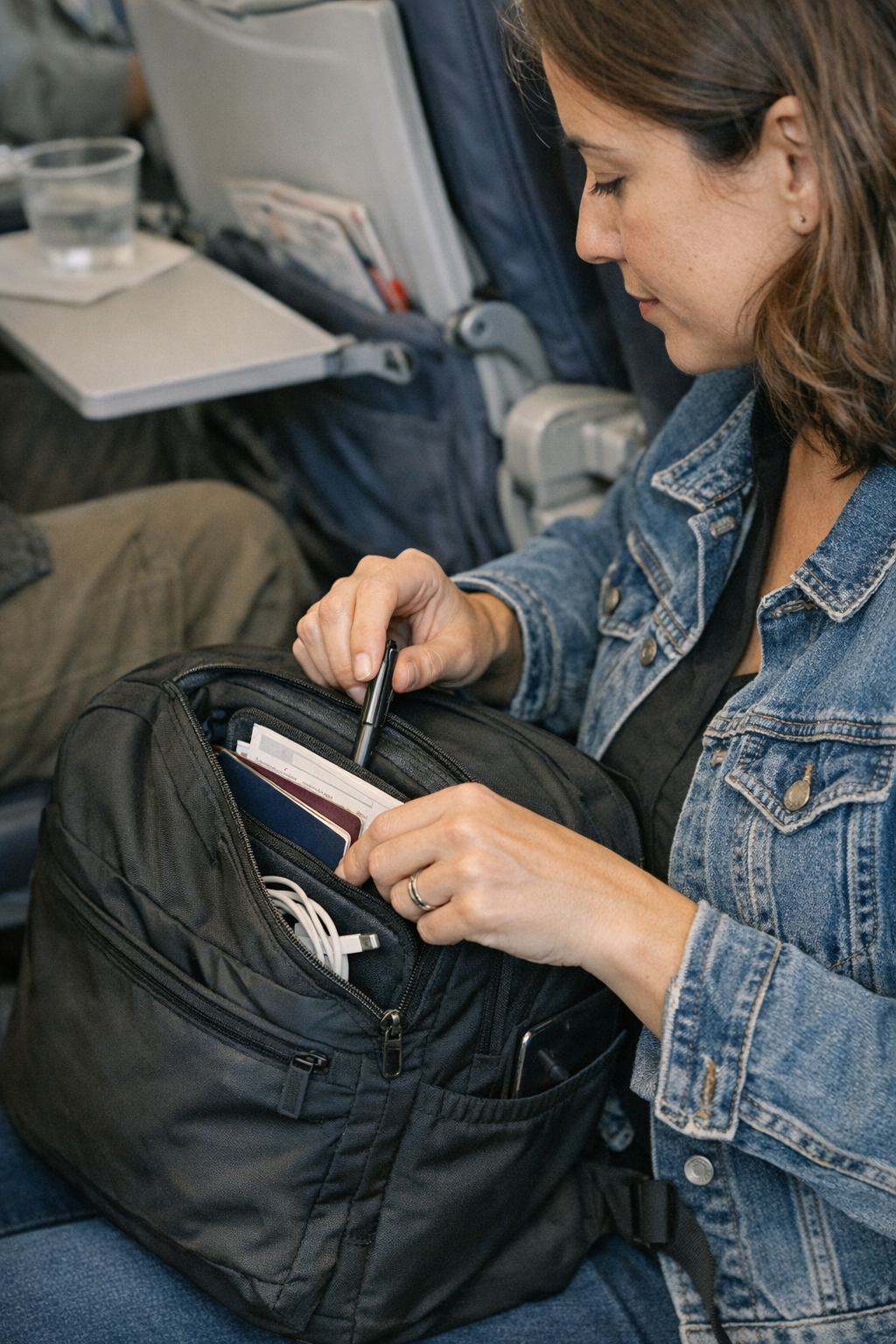
Every regular traveler recognizes the moment: crew announces descent, and your carry-on’s “organized” look evaporates into friction. What was a squared-away bag in the overhead now feels slow and clumsy under pressure—passport out of reach, charger knotted under layers, customs form buried deeper than you thought. Neat sorting at packing-time doesn’t protect you from the mess of actual travel: when retrieval means disturbing half your setup, organization isn’t working where it matters most—in the seat, in line, and on repeat.
The Calm of Packing Versus the Rush of Landing
Laying out pouches and cubes on a hotel bed feels precise—every item nested, zipped, decided. But the environment flips as soon as descent begins: trays up, elbows in, documents and devices due for stowage. Suddenly, you’re stuck balancing on a cramped seat, digging for the one item now needed first. Precision dissolves into a sequence of blocked zipper paths and awkward arm reaches. The “system” that looked impressive at rest jams under the real-time pressure of boarding announcements and tightening seatbelts.
This is where most packing logic collapses. A bag made to look sorted doesn’t translate to fast, one-handed access squeezed by neighbors and crew. If a passport is two layers down or a pen requires dislodging two pouches, your ideal setup is in the way. Organization that only works lying flat on a bed fails the test of in-transit reach, especially when the clock and aisle keep moving.
When Neat Packing Becomes Unusable Mid-Flight
On the outside, a carry-on stacked with cubes and pouches signals readiness. But repeat flights expose what actually breaks: essentials shuffled under low-priority gear, zippers that snag, or the creeping realization you’re spending too many seconds on a single retrieval. Patterns emerge: the same stress at each landing, documents misplaced, muscle-memory plans forgotten mid-air. Mystery pockets become wasted time as tactile shortcuts vanish in a pressurized cabin.
- Blocked Zippers: Overlapping or swollen pouches make smooth, single-handed pulls nearly impossible; you’re left twisting and tugging with little space.
- Buried Essentials: Each new addition pushes urgent items—boarding passes, cables—down the pile, demanding partial unpacking for every check.
- Partial Unpacking: A rush for a pen or form means extracting layers, balancing pouches on your knees, and hoping turbulence or a neighbor’s elbow doesn’t reset your whole stack.
- Confused Retrieval: Long flights bluff memory; labeling fails, and you open two, three, sometimes four pouches before finding the right slip of paper or charging cord.
These aren’t “bad luck.” They’re the result of setups built for visual order, not repeated, stressful access under movement and noise.
The Stress Loop: How Access Delays Multiply
Every snag inside a crowded aisle or during a customs line turns seconds into stress. Drop a form or tangle a charging cable, and you’re not just late; you’re holding up an impatient queue, re-packing with one eye on the clearing row, maybe nudging someone else’s bag to keep your own gear from spilling further. What looked like a minor hassle at the gate becomes a drag on your whole airport routine—especially after a long haul or tight connection, when even small interruptions compound into a habit of panicked checking and rushed repacking.
- One passport slip under stuffed organizers can mean your entire bag threatens collapse as you grope for the right pouch, risking an avalanche of gear on a stranger’s foot.
- Needing a single item urgently but finding it packed “for later” forces repeat overhead-bin lifts, crowding the aisle and spiking frustration on both sides.
- Returning a cable or form turns into a pouch shuffle that will have to be repeated again at the next security checkpoint.
Each struggle injects friction into your movements, turning orderly packing into a travel routine interrupted by its own design. The more steps each retrieval requires, the more likely the next one will be slower, messier, and more public.
Look Organized, Function Slow: Where Visual Order Fails
A setup that looks ready on Instagram often resists you in-flight. Stacked cubes and layered pouches keep a bag photo-tidy, but when the need for speed arrives, they block motion and stall quick checks. The gear praised for “order” often causes the slowest reach for the very items used most on planes: travel docs, pens, boarding passes, small tech.
As retrieval slows, repacking gets sloppier: the careful system breaks down, turning order into surface resemblance only. Missed items, lost pens, or scrambled forms become more likely with each rushed moment—especially in boarding and deplaning shuffles. The cycle is visible: packing order returns visually, but flow decays. The neat look intensifies the underlying dysfunction every time you need to move fast.
How Small Layout Tweaks Change the Landing Routine
One fix shifts everything: keep travel essentials in a slim, always-accessible outer pouch. Don’t store high-priority items (passport, pen, forms, quick-access cable) under deeper organizers. Instead, create a pocket—external, seatback-ready, or just outside the main compartment—so you never unpack for a routine check or crew request.
- Passport and travel documents should be reachable without disturbing anything else.
- Keep a pen visible and untangled.
- Place customs forms or medical cards where they slide out instantly with one hand.
- A single short cable or charger should be as accessible as a boarding pass, not layered inside gear cubes.
This adjustment removes forced unpacking and layered searches from boarding to arrival. The essentials pouch stands between you and a spiral of unpacking; it can hang in the seatback or ride the outer zip for easy, one-move retrieval—usually in 30 seconds or less. Old patterns—unlayering, digging, frenzied repacking—fall to the side, replaced by a sequence you actually control even when tired, crammed, or pressed by announcements.
Real-World Impact: The Difference After Dozens of Flights
No setup kills friction for good, but this structural change cuts out most of the repeated drag. Essentials in a slim, outermost pouch enable:
- Stowing devices, prepping customs forms, or flashing ID without turmoil, delays, or upending your packing.
- Moving smoothly through the aisle or staying clear of seat neighbors when demand for space spikes.
- Fewer missed items, abandoned pens, or customs delays even after brutal overnight legs or last-minute reboarding.
The biggest difference isn’t perfection—it’s in clearing away the interruptions that used to define the whole landing sequence. Instead of juggling or restarting every thirty minutes, you maintain a flow that keeps its shape across real-world travel. What once looked “organized” now acts organized, with less repeated stress and less time lost in every transition.
The Practical Takeaway: Movement Over Appearance
Most carry-on friction repeats because the wrong things are made easy and the right things are left buried. The best system isn’t necessarily the best-looking; it’s the one that lets you move, check, and stash with no forced resets in crowded, moving environments. Shifting high-frequency items into a quick-access zone does more to lower cumulative stress than any number of labeled cubes or extra pockets. Organization isn’t a goal for its own sake—it’s a tool for faster, smoother travel between security, seat, and arrival. If your bag keeps interrupting your movement, it’s showing you exactly where the next layout tweak should land.
See more practical carry-on solutions at CarryOnSupply.