
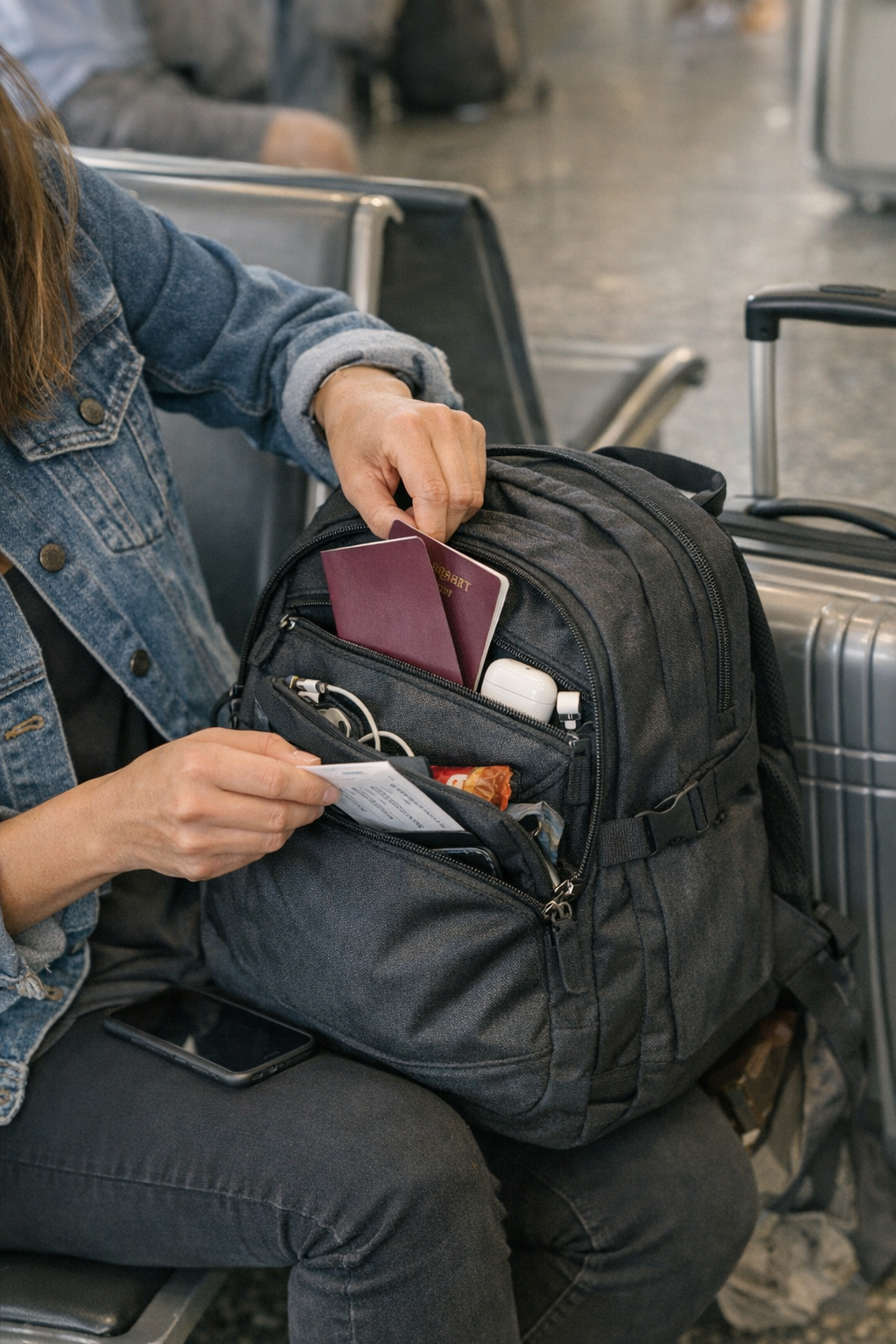
The real test for your carry-on comes when you’re halfway between flights—passport check, security line, boarding zone—moving fast and reaching for essentials that seemed perfectly placed at home but now feel buried under layers of “good organization.” A carry-on bag that looks tight and logical on the packing table quickly exposes its weak points during airport transfers. You reach for your boarding pass and end up unzipping three pockets. Your phone charger, once nested “efficiently,” is now lodged beneath snack wrappers and a toiletry pouch. The outside still looks neat, but inside, every access moment pulls the setup a step further from ready.
The Illusion of Order: When Neat Packing Doesn’t Hold Up
It’s easy to believe in the “stack and sleeve” method—each device, cable, and document tucked into its own pouch. But as soon as you’re moving between terminals, the logic starts breaking down. The problem isn’t overflow; it’s layered access. Waiting at security, you realize your charging cable is trapped below a divider, your passport is wedged with headphones, and your outer pocket—“reserved for quick stuff”—is now an overflow zone of half-used sanitizer and transit leftovers. Quickly, the meticulously packed interior starts forcing scattershot repacking with every checkpoint.
Access Gaps Between Packing Table and Gate
At home, every item has its slot. In line at the gate, the system collapses under real pressure. That wallet you tucked deep for “security” now means digging with people waiting. Your charger is easy to spot until you need it mid-transfer, only to realize it’s inside a zippered tech pouch wedged under a knit hat. Small retrieval delays stack up. One missed reach becomes a reset—every essential is now harder to extract and harder to return.
The Real Test: Multiple Transfers, One Bag
Switch planes twice and your bag’s structure gets exposed. The difference is sharp: you step off one flight, squeeze past crowds toward your connection, and scramble for documents and headphones—one hand full, the other occupied, nowhere to set the bag down. If your setup depends on deep stacking and nested organizers, this is where you lose efficiency. Boarding calls, ID checks, and snack runs demand single-move access, but instead, you’re left juggling and risk misplacing essentials just to stuff everything back before someone else edges you out in line.
Trapped by Your Own Neatness
This isn’t overnight chaos—it’s a visible drift. Every checkpoint leaves the inside less ordered than before. Snack wrappers slide into tech sleeves, a cable migrates to a deep corner, a passport gets sandwiched where it shouldn’t. Your bag looks composed but packs more confusion at every stop, and every new transfer makes the last attempt at order feel hollow.
Where Most Setups Break Down
Most “organized” carry-ons are built for static order, not moving travel. Multiple zippered dividers, stacked organizers, or pouches separated by logic at the kitchen table turn into practical obstacles at checkpoints. What you need most—passport, charger, boarding docs—ends up split, stacked, or hidden just when speed matters. Seat entries, overhead bin grabs, and quick gate checks? Every time the pressure is on, you’re blocked by your own layers, juggling or reordering the bag on the fly.
Why Layered Organizers Slow You Down
Organizer-heavy builds seem smart until the fifth reach in thirty minutes. It’s never “too much stuff”—it’s too many decisions, too deep a structure. Which pocket? Which sleeve? One wrong choice, and you’re forced into a partial unpack, sifting through pouches and stalling in the process. A tight, clever system at home becomes a drag every mile further from the packing table; essentials move further away just when you need them closer.
Spotting the Warning Signs: When Your Bag Adds Drag
Carry-on drag is hard to ignore once you know the cues:
- You end up with a handful of loose items after every tray pass or boarding call.
- A document or cable takes so long to extract that you need to stop, unpack, and re-pack in public.
- Key essentials repeatedly resettle into deep, inconvenient layers—forcing multiple re-reaches for the same thing.
- One quick retrieval sparks a full-on reset: what should be a five-second grab becomes a multi-step shuffle, every time.
Not dramatic failures—just constant, low-level interruption that saps pace and energy bit by bit, every transfer.
How a Quick-Access Setup Changes the Flow
The shift is simple but sharp: dedicate a flat, outer pocket—no overlap, no stacking, no double zippers—for high-frequency items only. The essentials you need through every phase—passport, charger, earpods, travel docs—live here, unburied. When tested in real airport movement, the difference is immediate:
- Security trays are prepped in seconds: one reach, all essentials out, zero digging in main compartments.
- Impromptu checks and seat entries no longer trigger a mini-repacking—credentials and gear come straight to hand.
- No more cascading resets—every access returns the inside to “ready,” not “almost together.”
After two transfers, the downgrade in visible order paid off in real movement: what looked less “packed” actually worked better. Traffic flows past instead of around you. The airport stops draining momentum over tiny, repeated friction.
Questions Frequent Travelers Ask (and the Real Answers)
Minimizing Disruption During Layovers
Q: How do you minimize disruption during layovers with a carry-on?
A: Only the things you reach for most go in the outer, unstacked zone—no hidden layers, no deep stacking. Priority is immediate, single-move access for the essentials, not locked pouches buried for the sake of neatness.
Organizer-Heavy Setups: Why They Falter
Q: Why do organizer-heavy setups become harder as the trip goes on?
A: The more you stack, the more every retrieval triggers partial unpacking. Each checkpoint introduces disorder as the “logical layers” shift, making repacking slower and essentials harder to track with every leg.
Seeing the Signal: When to Rethink Your Layout
Q: What’s one signal your current setup is slowing you down?
A: If you leave every checkpoint juggling or repacking in public—even after small access—you’re carrying a layout that resists movement instead of enabling it.
Packing to Move, Not Just to Look Neat
Perfect order at departure can’t keep pace with airport reality. Real travel flow comes from setups that anticipate repeated, on-the-move retrieval—not just clever storage. If your routine needs constant reset—always shifting, always re-layering—something needs to change. Prioritize single-motion access, reduce overlap, let a bit of mess show if it saves time and friction. In the end, workable beats Instagrammable, and your carry-on shows its strength not in how it looks when zipped up, but in how it lets you move and reach what matters after hours in transit.