
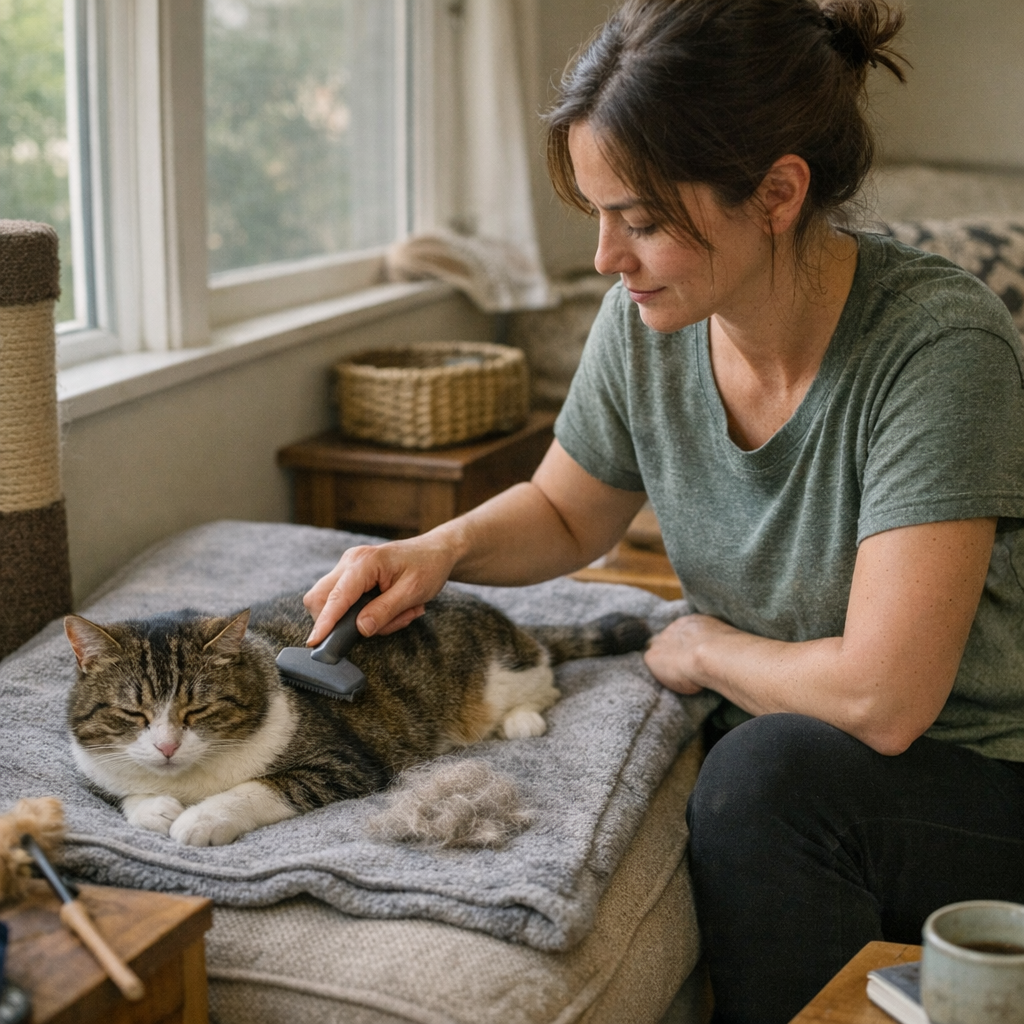
Every indoor-cat owner will recognize the pattern: you set out for a quick grooming session, only to realize fur has drifted under the dining chairs, the brush is missing again, and what looked like a two-minute job has become a scattered, ongoing mess. Brushing “whenever you remember”—in the middle of checking the water bowl, or right after you’ve tidied the food area—sounds practical but never simplifies the routine. Instead, the room keeps collecting stray hair, tools go wandering, and you find yourself repeating cleanups you thought you’d already handled. In daily home use, the invisible cost of sloppy timing and wandering tools isn’t just the visible fur—it’s the slow drag on your ability to reset, keep shared spaces usable, and avoid those corners of the room that keep turning up debris.
When Good Grooming Habits Go Wrong
The “just fit it in anywhere” mindset falls apart fast once friction begins stacking up. Brushing your cat on the move—by the kitchen counter, at the edge of a shared sofa, or while squeezing past their favorite resting chair—feels efficient until you realize:
- Fur has drifted beyond control: Hairs show up under tables, along hallway edges, behind the litter mat—forcing extra sweeps in areas you use most.
- Cleanup gets disjointed: That “fast” brush sparks a chase for the vacuum or dustpan, and fur escapes the original spot, triggering a string of unexpected wipes and resets.
- Tools keep vanishing: The brush is on the window ledge today, under a cushion tomorrow, or lost behind the TV by the weekend—wasting minutes each time you try to stick to a routine.
- Each session feels heavier: Mats slip, blankets need a full reset, surfaces catch more debris than expected, and the room never really stays “done.”
Over a few days, these small inefficiencies multiply. Instead of a single contained reset, you’re chasing the same mess through different rooms—never sure why it always returns, even when things seem under control. That’s when home order starts to feel fake: every area looks managed after each cleaning sprint, but hidden fur and stray tools quietly restart the cycle.
Why Post-Nap Brushing Shifts the Tone
Most indoor cats revert to favorite nap corners—sun patches on the couch, cushions by a window, or a tucked-away mat. After a nap, your cat’s energy drops, her urge to escape or dash off is muted, and she’s slow to transition. This post-nap pause is the short window when fur, tools, and containment finally line up—and you can shape the room’s mess boundaries without fighting the daily current.
The Daily Flow Change You Can Feel
After just a week of brushing only after naps, a new pattern sets in:
- Fur collects almost entirely on a dedicated mat, blanket, or patch—corralling hair into one spot rather than scattering it behind every chair leg.
- The surface you actually need to clean is predictable—no more awkward stretches under the fridge or food shelves.
- Your cat stays grounded—less likely to squirm, leap, or thread hair through a trail of toys, since she’s emerged groggy instead of wound up.
The difference isn’t perfection; it’s control. With the right timing and a single setup zone, cleanup shrinks to one shake-out or quick fold—rather than piecemeal retracing through the house, vacuum in hand.
The Cost of Brushing as Afterthought
Multitasking grooming—grabbing the brush during morning coffee, or while folding laundry in a busy room—feels clever in theory but breeds chaos in practice:
- Cats, in play-mode, eject fur far faster—twisting, wriggling, and tracking loose hair into food lanes, water mats, or even straight onto your lap.
- Loose fur now lands directly where it’s hardest to keep clean: around bowls and litter setups, in shared walking paths, or right at a room’s entrance.
- The “quick job” fragments: the brush loses its home, feeding setups need a full wipe, and what started as time-saving ends as double effort.
This invisible buildup isn’t just cosmetic: the next day, you’ll feel fur prick under bare feet, spot it beside the water bowl, or find your own mood turned sideways by yet another unfinished corner. Instead of routines clicking into place, they keep interrupting each other—and you retrace the same corrections on repeat.
Small Shifts, Noticeable Wins: Where, When, and How You Store the Tools
You don’t need a new gadget—just a focused setup. The biggest gains come not from what you brush with, but where you store the brush and when you use it.
Give Your Tools a Home, Not a Hiding Spot
Find your cat’s best-loved nap zone—the sunny corner, the window seat, the armchair fleece. Place the brush within arm’s reach of that spot, not banished to a drawer or floating across three rooms.
- If the napping surface has its own mat, fleece, or towel, use it as your fur boundary: it’s easier to shake one piece outdoors than to chase single hairs from every edge of the room.
- A tucked-away brush, slipped beneath a cushion or stowed behind a rest mat, stays findable—but only if you always return it here after use.
Boundaries Over Perfectionism
No setup eliminates shedding, but boundary brushing works sooner than endless sweeping. One soft mat, folded throw, or tucked towel—paired with immediate after-nap use—protects the shared spaces from overflow. Debris lands where you expect it, and a quick shake or swap resets the routine before it spreads. Even low-tech solutions gain power when they stop the problem’s path at the edge of the nap zone, not once it’s underfoot in every other room.
When Routine Shifts, What Really Gets Easier?
The win isn’t in skipping effort, but controlling it. When you pair brushing with your cat’s nap schedule—not a gap in your own—it means:
- There’s no stray fur leaping onto counters or into water bowls; no detour to vacuum a food mat after the fact.
- The brush isn’t lost to laundry baskets or bathroom shelves. It waits where you need it, not “somewhere” in the apartment.
- Resets shrink to seconds—a shake, a swipe, a folded-up throw—because mess never gets momentum.
- Your cat senses the pattern too: she tolerates brushing as a predictable, low-energy moment, rather than darting off with the first comb’s pass.
- The feeling of catching up overtakes the headache of always being slightly behind.
That said, friction still lingers. Mats still gather hair, laundry piles still come, and the occasional tuft escapes under the nearest chair. Every home has its blind spots: fur sticks to clothes, or clings between couch cushions. But the old pattern—resetting every space every day—gives way to a calmer pace, fewer corrections, and a room that feels as manageable as it looks.
Indoor Cat Life as It’s Actually Lived: Mess Boundaries and Relentless Return
Real routines aren’t polished. Tools wander, fur gathers, and the same pinch points resurface unless you reset the structure itself. If you manage work-from-home, tight shared rooms, or frequent movement between cat spaces and people spaces, you notice immediately when your system works—or quietly falls apart. The benefit of tying brushing to nap times and designating tool storage is measurable in shorter resets, less trailing debris, and a room that interrupts your day less often.
One Week In: A Room that Finally Holds Together
Midweek, with the brush stored under the window seat, improvement shows not in big change but in smaller interruptions: hair lifts easily with the blanket, fur doesn’t tumble out on every step, and refilling the water bowl or resetting a feeding mat skips the extra wipe. Instead of a home that looks staged but falls apart by the afternoon, your setup now stays one step ahead of the mess cycle.
Bringing It Home: Building Smarter Grooming Into the Routine
Storing the grooming tool within arm’s reach of your cat’s nap spot and brushing during low-energy wakeups is less about “doing it right” and more about dodging a chain of small, repeated inconveniences. Containing the mess early means the room becomes easier to reset, not just cleaner on the surface. Most indoor-cat setups are only as good as their weakest point—usually wherever tools wander or routines slip. Shifting storage and timing isn’t a cure-all, but it’s the quickest way to keep fur from taking over the rest of your week. For practical tools and boundary setups that fit