
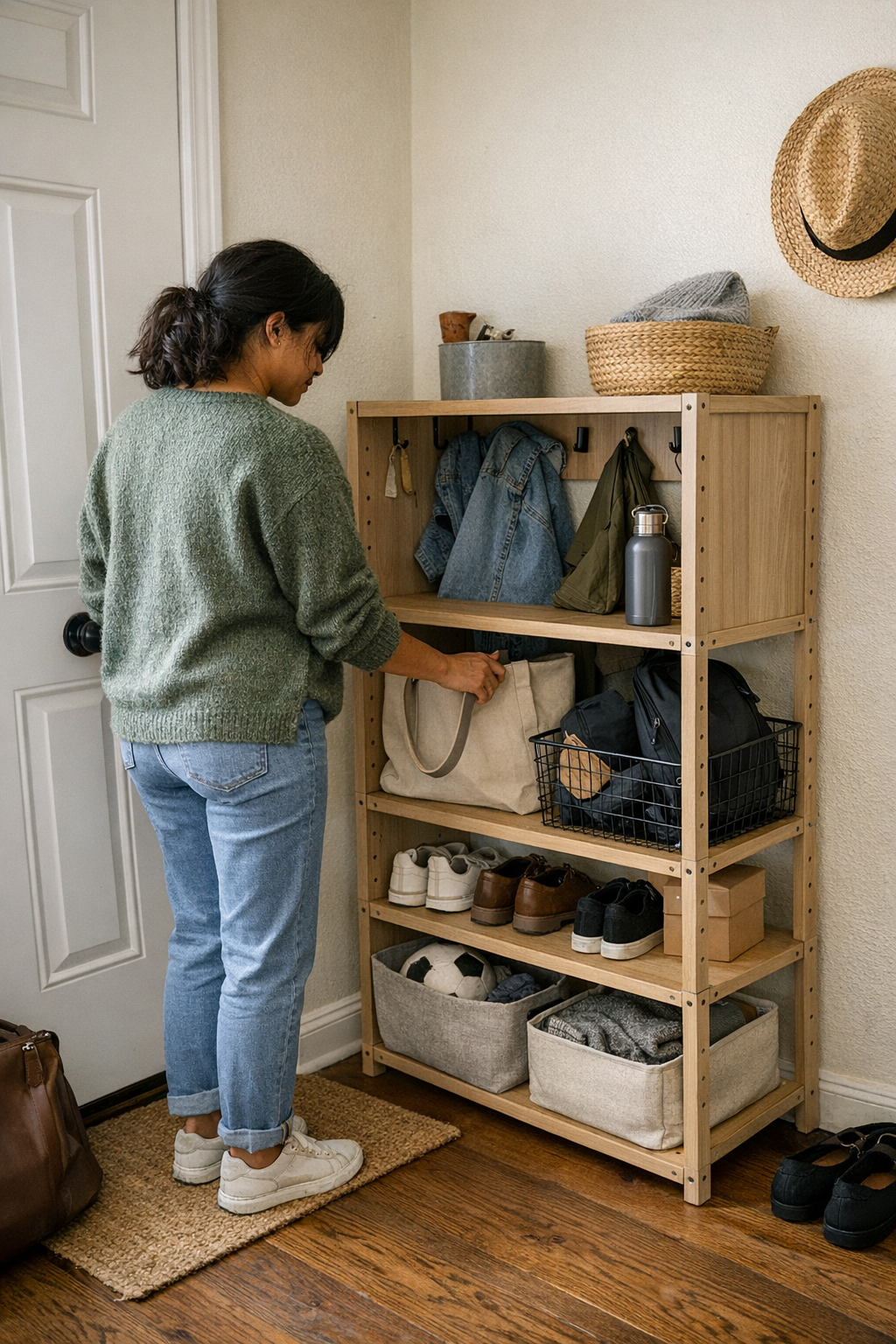
Threshold storage isn’t just about making clutter invisible—it’s about how fast you can reset the zone when the next entrance, drop-off, or handoff crashes through the door. In a cramped entryway, the promise of bi-fold door storage sounds unbeatable: panels fold away, walk space opens up, and for a brief spell, order is restored. But in the day-to-day grind—arms full, shoes drifting, bags multiplying—the cracks show up fast. The neat facade matters less when you’re stuck handling temperamental doors or stalled resets just to keep chaos at bay.
Why Bi-Fold Storage Seems Like the Answer—Until It Isn’t
Bi-fold cabinets catch attention for tight hallways because they sidestep the wide swing—no more doors banging into benches, bags, or bodies squeezing through the threshold. Early on, it feels like you’ve solved the passage puzzle: more space to move, mess zipped away in a tidy shell. For a few days, everything glides. But in a home that pulses with repeated comings and goings, that smoothness breaks down where you can least afford it.
Small compromises in daily use add up fast. Every folding panel becomes another moving part that can misalign, accumulate grit, or snag on a stray shoe. Instead of a quick return—grab, store, move—you’re juggling sticky hinges, nudging stubborn tracks, or dealing with panels that refuse to stay flush. A threshold that looked streamlined yesterday now bogs down today, just when you’re rushing to reset before the next round of arrivals.
When Small Friction Turns Into a Stalled Reset
Looking organized isn’t the same as working fast—especially at the entry where clutter pressure is constant. Picture the morning routine: shoes expand into the hallway, a backpack squats next to the cabinet, coats slip half in, half out. With bi-folds, a jammed panel or misaligned track means you’re stuck—groceries in one hand, fighting to coax the doors open with the other. If a panel pops loose or won’t stay shut, the “clean” look collapses and the reset backs up for everyone.
Real-world reset hurdles:
- Juggling two doors at once with one hand already busy
- Prying at a hinge or shuffling the track before the door will move
- A stuck fold blocking access to everything—no quick fix, no simple grab
This isn’t dramatic failure—it’s the kind of low-level hassle that piles up across every wet morning, hands-full entrance, or school-day rush. What starts as efficient storage trickles into repeated little interruptions. The system you trusted begins to stall you, one jam and one deferred reset at a time.
The Visual Order vs. True Usability Gap
Bi-fold doors conceal chaos—at least until the mechanism turns on you. The real cost appears not in the first week, but after dozens of rushed returns. A stuck panel or inch-intruding door breaks both flow and order. In morning traffic, someone dodges sideways for a half-folded panel, or gives up and dumps shoes outside the storage—restarting the hallway clutter all over again. In transition spaces, every slow reset shows on the floor, not in the design catalog.
Direct consequences you’ll notice:
- In a rush—one shoe in hand, the other hand on the lunchbox—the resistance leads to shoes abandoned beside the unit, not put away.
- Two people passing: a partially open bi-fold crowds the path, making each squeeze a stress test for space—and patience.
- With the door open, the next person waits, blocked by your incomplete reset; return flow stops until the panels are back in place.
- When tracks warp or hinges stick, “temporary” clutter becomes semi-permanent. The zone that was supposed to stay reset slips back into disorder after just a few days’ use.
What Actually Improves Daily Flow?
Switching from bi-fold doors to open-front storage in a tight alcove is less about aesthetics, more about reliability. When your entry gives you a foot-and-a-half at best (think 18 inches between the wall and the door), anything adding friction becomes an obstacle. With open storage, you see what needs resetting, toss shoes or bags in one-handed, and keep moving—no detours for adjusting hardware or matching panels. It’s honest: you trade away perfect concealment, but you get zero-delay returns.
Entry routines run better on:
- One-hand-or-no-hand drop-in—even if you’re juggling groceries and a toddler’s rain boots
- No alignment rituals—just grab, toss, or adjust on the fly
- Instant scan—what’s overflowing, what needs to be fixed before movement gets blocked
This is where function steps ahead of form—where looking “done” gives way to staying adaptable. If you’ve jammed your hand, tripped the reset, or watched clutter choke the path more than once, the problem isn’t your routine. It’s the setup slowing you down when you need speed the most.
The Real-World Payoff: Reliable, Low-Effort Reset
Entry zones take a daily beating—small faults grow bigger with every pass-through. A bi-fold that sticks or comes off-track once might be forgiven, but every extra micro-adjustment gets between you and a clean threshold. Each clog turns a five-second reset into a multi-step workaround. By contrast, open storage skips the risk: nothing to break, nothing to block, nothing to keep you from a quick, low-effort reset. It’s not about hiding the mess; it’s about preventing it from multiplying in the first place.
In real use, see where the simple setup wins:
- Bags dropped midstream: With open bays, you spot spillover right away—deal with it before it becomes wall-to-wall mess.
- Shoe lines drifting wide: Open units make it clear which pairs are out-of-bounds, so you can sweep the reset before anyone trips.
- Bench as landing zone: When every seat edge becomes overflow, open storage lets you rescue the bench for quick sitting without fighting panels for access.
- Return in motion: If closing a cabinet interrupts your momentum, that step gets skipped—leaving the system weaker each time. An open front keeps the reset part of the walk-through instead of a separate task you might skip.
Fast fix: For houses with the highest entry churn—kids, guests, recurring gear—leave at least one open bay for must-drop items. Visual clutter is a smaller problem than slow resets that let mess snowball.
Form vs. Function: The Entryway Reality Check
Catalog glamour fades fast if your storage slows the routine. If your entry isn’t constantly under traffic pressure, maybe a bi-fold shelf works out. But for most city apartments and crowded family homes, every extra hinge and track is another chance for trouble. Once a panel sticks, every return feels heavier. When things stall or snap off-track, maintenance and catch-up become regular chores—not rare issues.
The underlying logic: a threshold setup should turn your day smoother, not slower. The cost of chasing perfect visual order can spike each time a return gets blocked or postponed because the storage created one step too many. Simple setups—open benches, wall racks, drop zones you can reset in seconds—almost always outlast “clean look” systems in spots that see real, repeated use. If the trade-off is visible shoes but a pass-through that actually resets every day, most households find the “imperfect” system wins on reliability and real order, not just appearance.
Explore practical entryway storage solutions for real transition-space routines at Betweenry.