
Entryway Storage: Why Open Shelves Fail When Daily Life Moves In
On day one, open entryway shelves give the illusion of order—shoes arrayed in a tidy line, bags parked, every surface clear. Within a single week, that controlled image collapses under real use. Wet boots leave pools that stretch across the shelf; backpacks wedge awkwardly, blocking the path; loose mittens and keys start to edge off the surface. Every drop-and-go is a little reset failure, and soon the entry zone is less a pass-through and more a bottleneck—clutter stretches out, footpaths shrink, and it takes a full sweep just to make space for tomorrow’s commute.
The Drift: How Entryway Shelves Lose Control
Open shelves promise simplicity but rarely withstand weekday traffic. Small disruptions multiply: one shoe shifts out, another item hovers over the edge, a lunch box topples into the shoe row. By midweek, your threshold narrows—not because you intended clutter, but because every dropped item compromises the clearing you rely on. Without containers or clear boundaries, disorder spreads in slow motion: a puddle spreads across shoe soles, grit builds up in corners, and bags dangle half-on, half-off the shelf, daring anyone to restore order.
Routine movement adds friction every time. Bringing in groceries? That extra bag gets wedged, and the shelf collects clutter faster than it’s cleared. Rainy morning? One muddy shoe streaks the edge; by week two, the shelving is ringed with water stains and scattered gear. The initial quick-grab setup is lost—a grab-and-go zone becomes a site of delay and detours, and resetting the area requires a full-blown cleaning event, not the two-minute tidy you imagined.
Seeing Open Shelves Tested by Real Life
Direct comparison exposes the cracks: two entry zones, one with bare shelves, one with bins or dividers. Both look neat at first—shoes aligned, baskets for hats. But friction builds:
- A spill on an open shelf creeps, touching every nearby item. With trays or bins, the mess stays contained—the fix is to empty a tray, not scrub a whole shelf.
- Shoes spread: without clear edges, they migrate until you’re tripping over a splayed line instead of walking cleanly through.
- Small objects slide to the front, tip over, or disappear underfoot—what’s visible is never what’s actually reachable. Each missed recovery adds to the reset workload.
It’s not about how much room you have, but whether your setup holds the line against daily disorder—or simply stages it for a messier collapse in a week.
Crowded Days Expose Weak Spots
After a busy afternoon, the system’s flaws spike: Several people arrive—muddy boots, armfuls of gear, dripping grocery bags. Open shelves let water and grit spread unchecked; towels, meant to help, get left behind as soggy evidence. Every arrival pushes untidiness outward—eventually you stop even noticing the creep, and resetting feels less realistic every time.
One extra bag is often all it takes for shoes to block the threshold. Instead of a free pass-through, you’re now forced to reshuffle piles just to get inside. The clear traffic line dissolves into slow-motion clutter, and instead of a returned item, you inherit a new obstacle that lingers for days.
Containment Adds Boundaries—and Real Relief
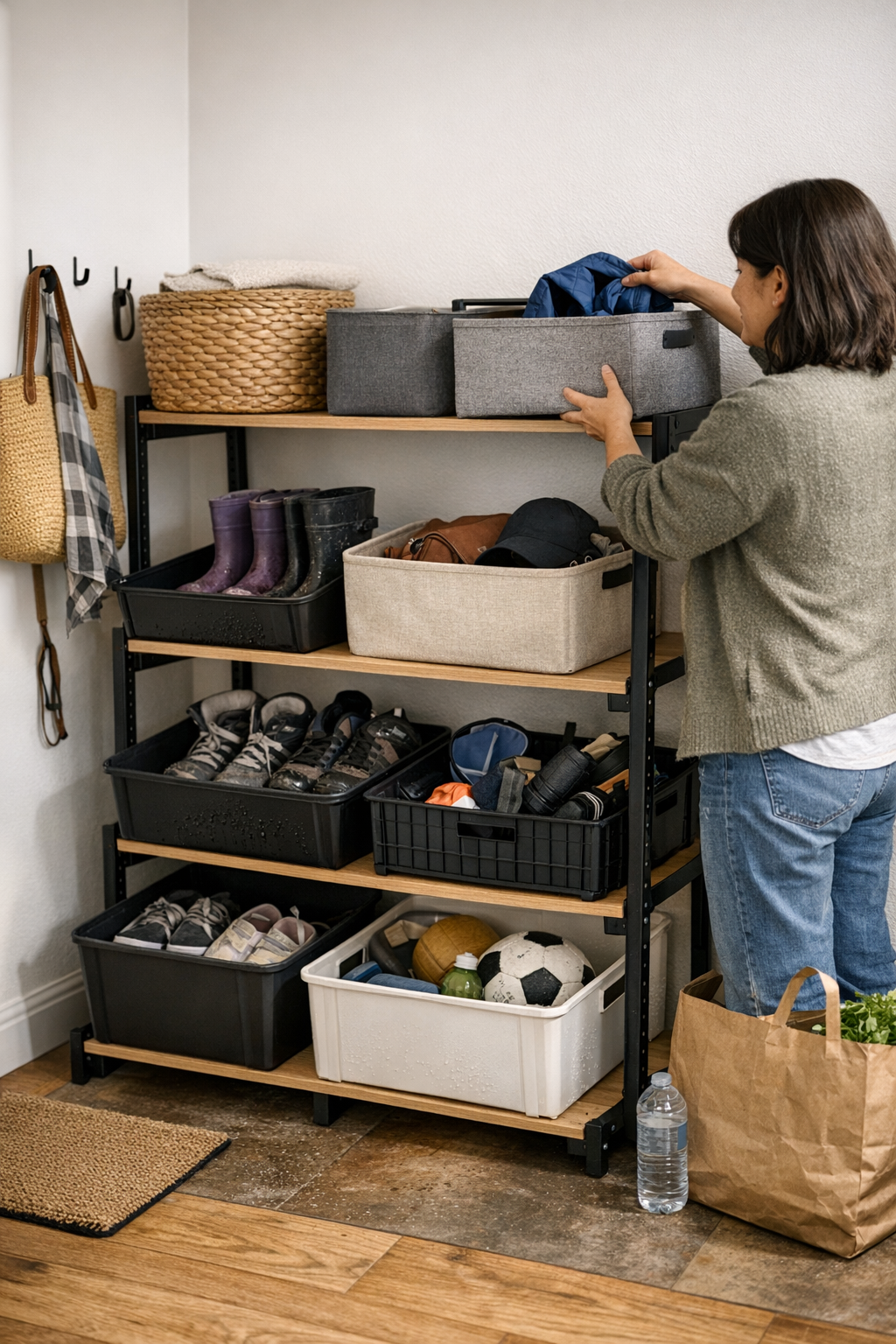
Adding deep bins, trays, or modular containment means a subtle but firm shift: now each item has a designated zone, messes don’t leak into each other’s territory, and recovery shrinks from a major task to a quick fix.
- Crumbs and debris are isolated in trays, not broadcast across an entire shelf.
- Shoes stay grouped—lift the tray, dump, done—rather than hunting single shoes around the room.
- Spills and dirt become localized cleanups, not silent, spreading backlogs.
The reset stops feeling impossible. Instead of staging a whole-area rescue, you empty a single bin, wipe a tray, and the entryway’s clear path is back. The storage now works with daily traffic rather than losing to it, making the zone a lasting entry—not just a day-one illusion.
Floor Space, Wall Storage, and the Illusion of Order
It’s tempting to believe that lifting clutter off the floor onto wall shelves cures the entryway chaos. And wall-mounted shelves do open up tight passageways and reduce tripping. But without hooks, baskets, or closed compartments, even eye-level storage collects all the same drift—bag straps tangled, hats stacked, misplaced gloves migrating shelf-to-shelf. During a rushed morning, top shelves go unused, and whatever’s awkward to reach simply lands wherever there’s open space. Mixed solution works better: wall bins handle hats and gloves, lower trays catch shoes and wet gear, hooks anchor always-moving jackets—so the threshold holds up under traffic, not just in photos.
Trouble Spots That Keep Coming Back
- Shoes drift and sprawl: The row starts neat, then edges wider until the walking route is squeezed to the wall or crowded entirely.
- Bench turns into overflow: The spot meant for sitting is lost under a pile of bags and coats left in passing. Now, tying shoes means balancing on one foot or clearing a mountain first.
- The corner of no return: Mail, keys, and “for later” items build up in the same dead zone, forgotten until the next reset marathon.
- Endless resetting: Every attempt to tidy up just pushes items from one zone to another—never really reclaiming openness for more than a few hours.
Containment doesn’t erase these cycles, but it shortens the reset window. With every drop, there’s now a real destination—so messes stop becoming permanent squatters, and recovery happens in evening passes, not weekend overhauls.
Quick Reference: Common Entryway Storage Questions
Wall-mounted storage wins space and clears the entry path—especially in narrow hallways—but without bins, hooks, or divided sections, clutter simply migrates upward. For cleaning speed and everyday reach, combine wall-mounted racks with baskets or hooks, then use floor bins below to capture overflow and wet gear.
Assign a watertight tray or deep bin directly for boots. This holds mud and water in one place, letting you dump or rinse the mess after storms instead of letting it reach the rest of the shelf. Make the habit: dump the tray regularly—otherwise, moisture still escapes the bin and spreads out again.
Closed cabinets hide clutter but slow retrieval, especially when multiple people use the space. Open shelves increase speed—but only if you prevent overflow with bins or trays. For mixed, repeated family use, pair open shelving with deep or modular containers, or position the most-used bins inside lower cabinets for a balance of speed and containment.
The Takeaway: Make the Reset Realistic
In real transition zones—the “Betweenry” of household life—minimalist arrangements dissolve under the pressure of actual routines. Every dropped item tests your setup’s boundaries. Choosing bins, trays, and smart dividers prevents that slow slide from controlled threshold to daily obstacle course. An entryway that rebounds quickly after a messy day—a setup that clears with a five-minute reset, not an hour—keeps the threshold functional for the next round of entries. Every solution that shrinks the reset burden brings the zone closer to something you actually use every day, not just on move-in day.