
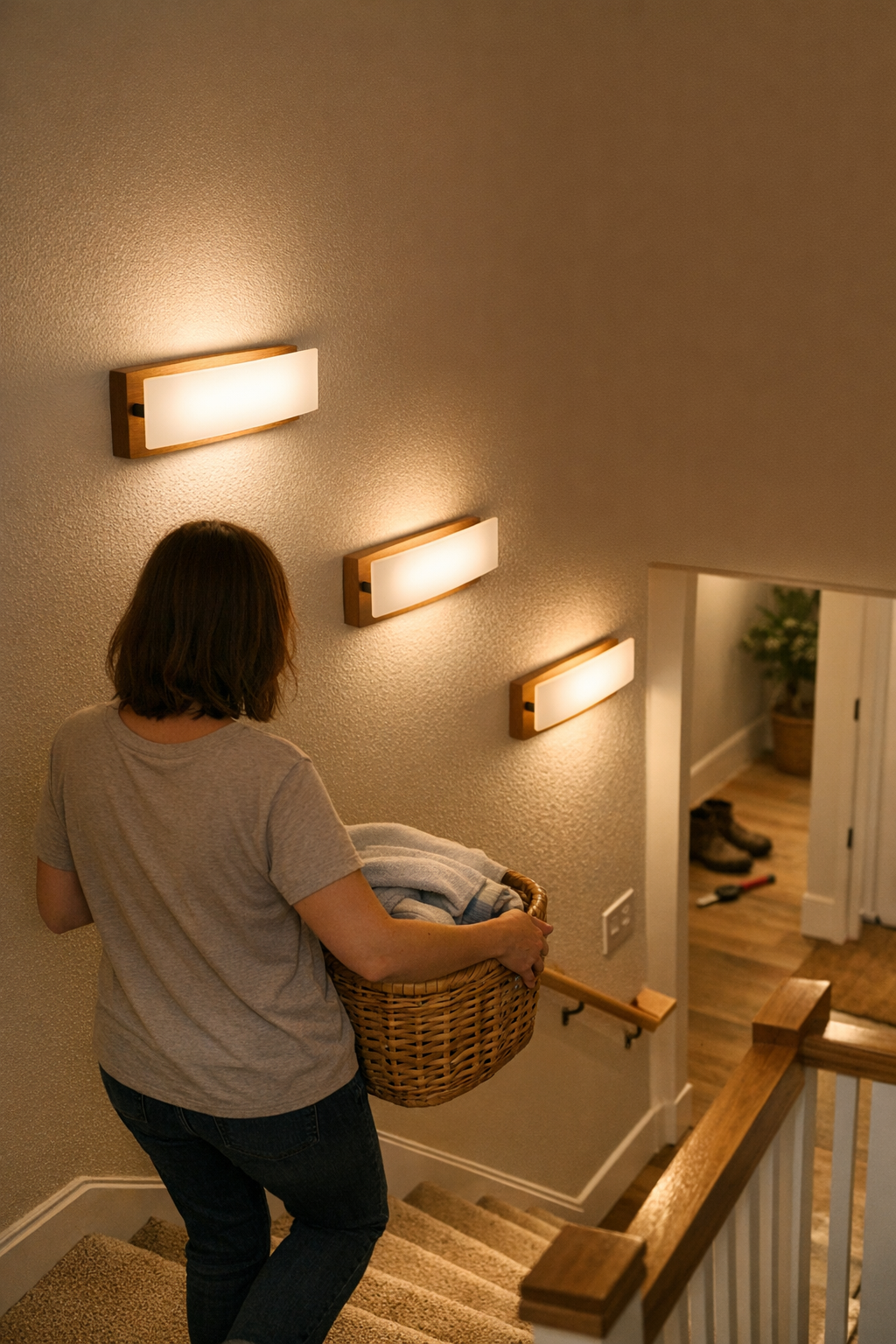
Most stairways look bright enough—until your routine exposes what the lighting misses. You’re halfway up, arms full with laundry or groceries, when a sharp shadow erases the landing edge. The ceiling fixture pours light over the general space, but the step in front of you blurs right where a stray shoe could hide. Every squint, pause, or foot that searches for a tread in the half-dark is a reminder: “well-lit” in theory can leave you guessing, especially at corners, top, or bottom steps. The real decision isn’t between bright and dim—it’s whether relying on just an overhead fixture lets unseen risks build up in your path, night after night.
Why Overhead Stair Lighting Doesn’t Tell the Whole Story
An overhead ceiling light covers the stairwell—but not the details that keep movement safe. Flush mount and semi-flush ceiling lights scatter a general glow across the steps, making the area look lit. On paper, it’s enough for routine traffic, especially during the day. But under real use, overlooked shadows and disappearing edges surface at the worst moments: the very spots where clutter gathers, or where a split-second glance can miss a tool, sock, or shifted tread. A bright zone overhead still leaves blind spots low on the stairs or at tight turns, regardless of bulb strength.
It’s not about total darkness. What shows up is an uneasy hesitation: your foot slows before a shaded step, or your eyes linger, uncertain if you’re seeing a trick of the light or something you should avoid. These are holes in coverage—quiet friction points—missed in daytime but stubborn after dusk. They’re why even “bright” staircases trip up real routines.
Everyday Routines Expose the Weak Points
The limits of ceiling lighting become obvious the moment daily movement challenges them. Hauling laundry or carrying groceries, you ask yourself: Are all treads clear—especially that corner, that dip, or the first and last steps? Half the trouble isn’t in finding your way, but in second-guessing whether a shadow means something’s there. If you regularly slow down at the same spot, it’s not just habit; it’s compensation for what the lighting fails to show.
The signal isn’t catastrophe, but irritation that builds every day: pausing at the landing, testing a toe before turning, peering into shadow for a dropped object. These micro-stalls don’t make headlines, but erode confidence in the space one hesitation at a time. Each routine stumble is less about clumsiness and more about fixture placement—not quite matching how people actually use stairs, especially as daylight drains or the house gets busier.
Where Single Fixtures Fall Short
On a straight, narrow set, a single ceiling light may just hold up—until autumn evenings or late-night returns stretch your routines. Add a stairway turn, open up the width, or increase foot traffic, and the problems multiply. Shadows invade the outer corners and landing edges, just as the main fixture bounces light onto walls or glossy surfaces, sometimes creating glare overhead and darkness underfoot.
The issue isn’t the fixture’s design, but the one-size-fits-all approach. High-use steps fade first, while bright highlights stay above eye level and real visibility thins out below. On busy days, it’s easier than you think to overlook a wayward toy, misjudge a step’s edge, or stall in front of that same dark patch—while the ceiling glows, but the stairs themselves test your attention with every pass.
How Supplemental Wall or Step Lighting Changes the Experience
Adding wall or step-level lighting doesn’t just make the stairs look different—it changes how you move. Shielded wall sconces or discreet, low-mounted step lights don’t decorate; they deliver clarity along tread lines, corners, and landings. Suddenly the spot you used to pause is mapped out in calm, direct light. Edges become certain, dropped items stand out before you reach them, and late-night trips stop demanding double-checks at every landing.
This isn’t about more wattage. It’s about putting focused light where movement and safety actually happen. When each crucial step, from top to bottom, is neatly defined, the difference isn’t just visible—it’s felt whenever your foot lands exactly where you expect, and the routine pause at the turn disappears on its own.
Not Just “Brighter”—But Clearly Safer Movement
During daylight, supplemental lights may fade into the background, but as routines return—pets dashing, kids carrying books, you rushing at dusk—the transformation is unmistakable. Safer passage comes from fewer blind guesses and more routine confidence, not from flooding the stairwell with raw brightness. The stress isn’t in darkness, but in the need to look three times before stepping; step-level lighting removes this tension by making the next move obvious.
Practical Tips for Reliable Stair Visibility
- Use shielded or diffused fixtures. Bare bulbs and intense downlights create glare or harsh patches; aim for fixtures mounted just above tread level, washing light gently across each step instead of blasting it downward.
- Tackle the weak spots first: Prioritize the riskiest areas—the top step, first landing, and at any sharp turn. Even a single added fixture at these points can eliminate routine hesitation where it matters most.
- Test lighting at night—and with normal movement flows. Setups that seem fine during installation can feel inadequate after dark or in real use. If you still find yourself squinting, pausing, or prodding a step, shift the angle or add a fixture until those moments vanish.
When Lighting Matches Actual Stair Use
The mark of a properly lit stairway isn’t a wow factor—it’s friction that quietly disappears. Lighting that follows your steps, your turns, and your armloads lets the space adapt to real movement, not just floorplans or catalog shots. The impact is plain: no more reaching a landing in doubt, no more searching with your foot for a hidden edge, no more annoyance when dusk arrives before you expect it. Instead of adjusting your stride to fit the lighting, the lighting adapts to you.
Even familiar homes reveal the gap between “looks bright” and “feels reliable” once routines put fixtures to the test. The payoff isn’t luxury; it’s simpler, safer movement—one that’s felt every night, every errand, every trip up or down. Find solutions for safer, clearer stairway lighting at LightHelper.