
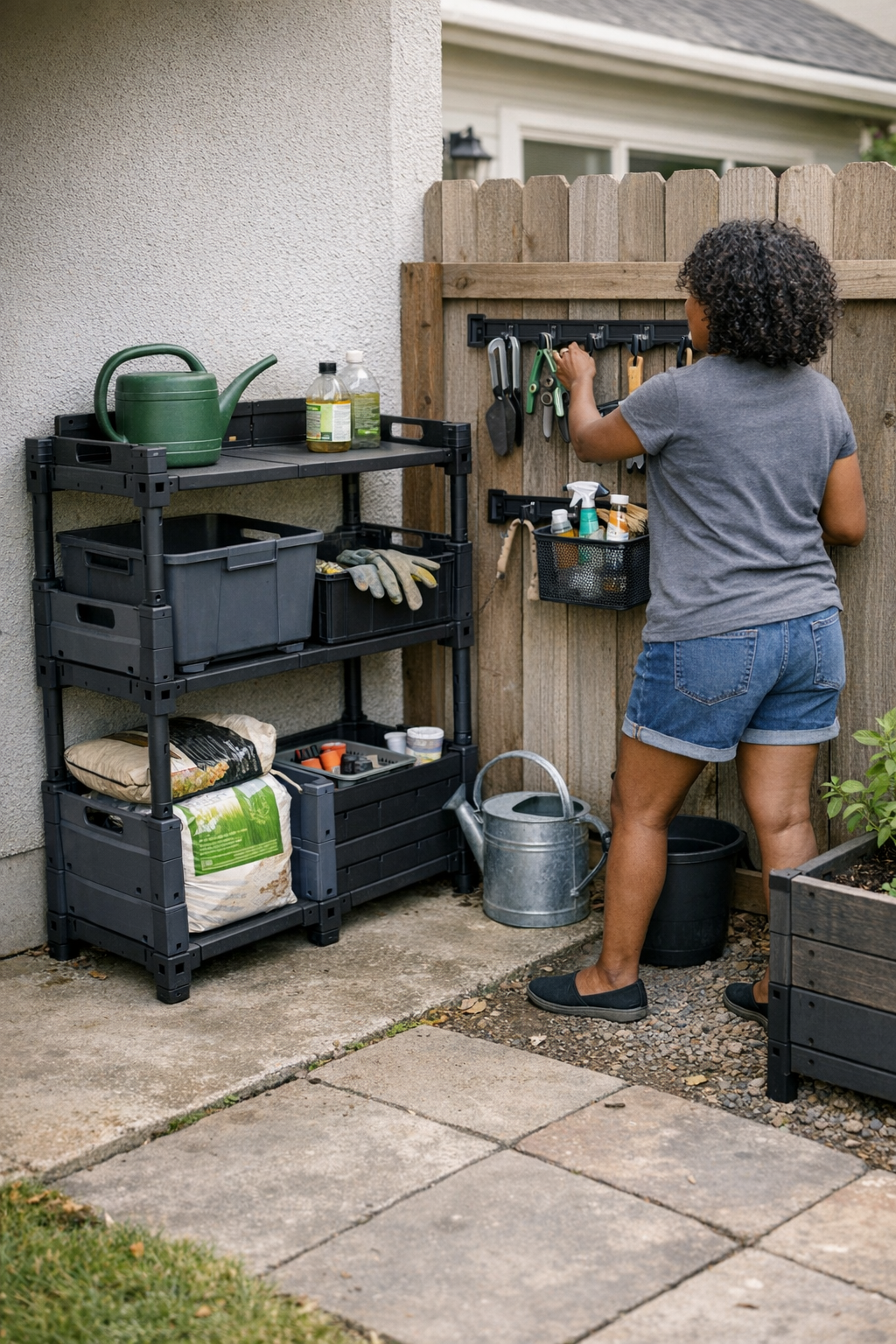
Outdoor storage reveals its real story only after you’ve wrestled with it for a few weeks. The first day, everything looks right: a clear path between the trash bins, boots lined up by the shed, nothing in the walkway. But give it some time—a few wet days, a weekend of sports gear, or a rush to beat the rain. Suddenly, that clear route is blocked by a half-tipped wheelbarrow, and the storage box intended for boots is now surrounded by the same muddy pile you meant to avoid. What’s in your way isn’t just clutter. It’s the invisible friction: the lid that jams when your hands are full, the awkwardly placed bin that demands you shuffle other things just to squeeze it back in. This is where “good enough” outdoor setups quietly unravel.
Where Clutter Creeps Back: Floor Pressure and Blocked Movement
The warning sign comes small but steady. Maybe it’s a pile of kids’ shoes outside the bin—because lifting the lid is one step too many when you’re on your way inside. Or it’s a garden rake left angled across the entry, blocking the door from opening fully. Each “drop it here for now” moment adds up, until you’re moving something out of the way every time you cross the yard. The more you notice yourself sidestepping bags or inching past makeshift stacks, the clearer it gets: your setup isn’t carrying its weight. The piles aren’t the problem; it’s the daily resistance to returning things that keeps the cycle spinning.
Floor Space That Disappears Fast
Small yards and utility strips don’t offer spare inches. Line the fence with bins or block the back gate with a “temporary” storage chest, and your paths vanish. What seemed clever on day one quickly becomes a blockade. Wall-mounted racks look like a fix, but unless each tool or ball actually fits where it’s hung—even when you’re muddy, rushed, or carrying groceries—the spillover hits the floor again. Doors that can’t swing open without first moving a hose reel, lids that demand a free hand—all of it quietly teaches you to pile things wherever is easiest, not necessarily where they belong.
Real Use: The Gap Between Looking Organized and Actually Working
Outdoor storage lives or dies in the busy hours between resets—not in the “after” shot, but in the churn. Imagine a garage-edge wall with hooks for long tools. The first week, everything finds a home. But quickly the system gets overwhelmed; there’s always one shovel too many, a stray glove never returning. Or picture the tall cabinet in the side yard, meant to tuck bikes and rakes neatly away. By the second week, with school pick-ups and projects, the cabinet doors hardly open—the bikes sit in front, the rakes lean against the outside, and every trip down the path is slowed by detours and sidesteps.
The Side Yard Trap
Nothing uncovers a setup’s weaknesses faster than a side yard forced to play double duty—as both storage and main walkway. That tall, narrow cabinet? It eats less floor on paper, but the doors are always hemmed in by something: a bike tipped sideways after a rushed morning, a mower half-parked in front, a plant that migrated just enough to jam the swing. Eventually, what started organized becomes a tightly wound obstacle course. Wheeling the recycling bin out now means shifting two stacks and nudging a forgotten soccer ball just to reopen the passage. The whole flow of using your own yard changes not for the better, but for the more awkward.
Shifting the Reset With Wall Systems
Everything changes the moment you stop relying on lids and cabinets for high-use items. Modular wall systems, open rails, and quick hooks fill the gap between theory and daily habit. Hang tools at arm’s reach—no opening or lifting required. Face gloves on a front rail, stack a single open bin for things that always cycle in and out. Even spacing—separating hooks by just a few inches—can mean the difference between a wall that collects clutter and one that actually empties pockets and hands on the way in. Slowly, the “just drop it here” mentality fades, replaced by a visible, reachable spot for everything. The best sign: resets don’t take a full afternoon, and the urge to pile fades because returning things actually feels easier than skipping the step.
Overflow Zones and the Trouble With Dead Corners
Every outdoor setup has at least one spot that absorbs overflow—a fenced nook that quietly turns into the dumping ground, or that triangle behind the grill where abandoned gear goes to linger. Even with well-built storage, these corners attract clutter if the main system jams up. The result? You circle through the same reshuffling routine: clear the floor, move the pile, open a path, block it again. It’s not a system; it’s a cycle of temporary fixes—and the proof is in how often you find yourself returning to the same dead corner with armfuls that don’t really belong.
When Mobility Turns Into Stagnation
Rolling cabinets and portable racks sound ideal—until they lock up from weight or the wheels snag against uneven stone. Intended flexibility can breed its own kind of gridlock: the instant a mobile unit is too heavy to shift, overflow comes back, now clustered in an even tighter spot. For mobility to actually help, the storage must still work everywhere it lands and be light enough to move even when loaded. If not, it quietly becomes yet another blockade hiding in plain sight.
Making Return Flow Effortless
The real payoff for any outdoor setup is obvious return flow after real use—not just clean lines, but easy resets when there’s actual mess. Ask yourself: how many steps does it take for each daily item to get put away? Does one simple move bring things back, or are you nudging bins, fighting lids, and tricking open cabinets crammed too full? The best quick fix: add open, easy-access storage at the highest-friction points. Wall racks within arm’s reach for daily tools, a single large bin by the door for quick-dump items, hooks or rails at the entry for gloves and bags. The more the setup matches honest use, the less chance stray piles have to sneak back in.
Honest Structure Makes Maintenance Nearly Invisible
Every item needs its spot in plain sight. Wall-mounted systems don’t just keep the walkways open—they shift the habit for everyone under your roof. Forget nagging or mental checklists: the visible structure makes out-of-place items obvious, so resets become second nature instead of a dreaded task. The result: less thinking, less shuffling, and a setup that can actually keep pace with the churn of an ordinary outdoor week.
Order That Outlasts the Weekend Sweep
The real test isn’t how neat a yard looks right after a deep clean—it’s what happens after five days of normal life. A setup that blocks paths, smothers corners, or demands daily reshuffling is just another layer of hassle. But a system that clarifies and simplifies where things go—especially as routines change, seasons shift, and hands stay full—keeps chaos from creeping back. Walls carry the turnover, open zones absorb the rush, and floors stay clearer longer. In the end, the win is less time spent reclaiming the same square footage, and more time moving through an outdoor space that actually works the way you hoped it would.