
Where Entryway Friction Really Begins
The warning signs rarely look dramatic. A pair of shoes sneak past the mat. Backpacks settle into a heap, inches from the door. Someone’s keys land on the same random shelf, then vanish—again. The friction isn’t sudden, but it builds, every time someone comes or goes. A few stray items turn the simplest route through the entry into a daily obstacle course. It’s not about whether you own a bench or a set of hooks—it’s about whether anything in your setup actually stops the flow of clutter before it scatters, or if every return just bounces the mess to another corner.
The Real Scene at the End of Any Day
The actual state of most entryways has nothing to do with those serene, catalog-ready photos. Shoes angle off in unpredictable directions. Bags cling precariously to hooks—until someone knocks two down at once. Keys migrate. The “return flow” in homes, garages, and workshops is less a gentle routine and more a multi-user collision—people, gear, pets, parcels, all hitting the same space at the same time. If the landing zone can’t absorb that impact, spillover is unavoidable. It leaks past bins and benches, hunting for any open real estate and little by little, the chaos keeps spreading.
When Storage Looks Right…Until It Doesn’t
It’s easy to trick yourself with more baskets or stacking yet another modular shelf. All that neatness evaporates at rush hour: one person wrangling groceries, another dragging in muddy boots, someone else trying to find the dog’s leash for the fourth time. Skinny shelves—empty, perfect—become impassable the instant stuff arrives. Even a wall of storage can fail if it crowds the aisle. You end up with everyone shuffling sideways, dodging stuff, waiting to put things down. It’s the quiet chaos of a layout that looks organized, but can’t keep up with how your household actually moves.
Where Storage Ends and the Mess Spills Out
Sometimes the “solution” becomes the slow clog. You squeeze a rolling cart into the corner, and now you’re shifting it several times a day just to get the door open. A tall cabinet keeps shoes hidden, but every morning you’re blindly reaching past one overloaded shelf for a missing bag. Baskets line the wall, lovely until they fill; after that, overflow spreads right onto the floor. These micro-annoyances are easy to ignore at first, but they shape your mood each time you pass through. An entryway that never truly clears itself quietly turns into something you sidestep or avoid resetting.
Four Rainy Days: A Drop Zone Stress Test
Imagine run after run through bad weather. The boot count doubles, jackets pile up, groceries wedge themselves against what used to be floor space. Your storage “zone” surrenders by lunch. By Wednesday, the pile has escaped its supposed containment—every crossing demands a sidestep, a lift, a hunt for keys under something you didn’t mean to set down. Tidying becomes a project. The original intent—easy reset, clearer movement—gets replaced by constant low-grade reshuffling, and the area is never just “ready.”
Turning a Bottleneck into a True Buffer
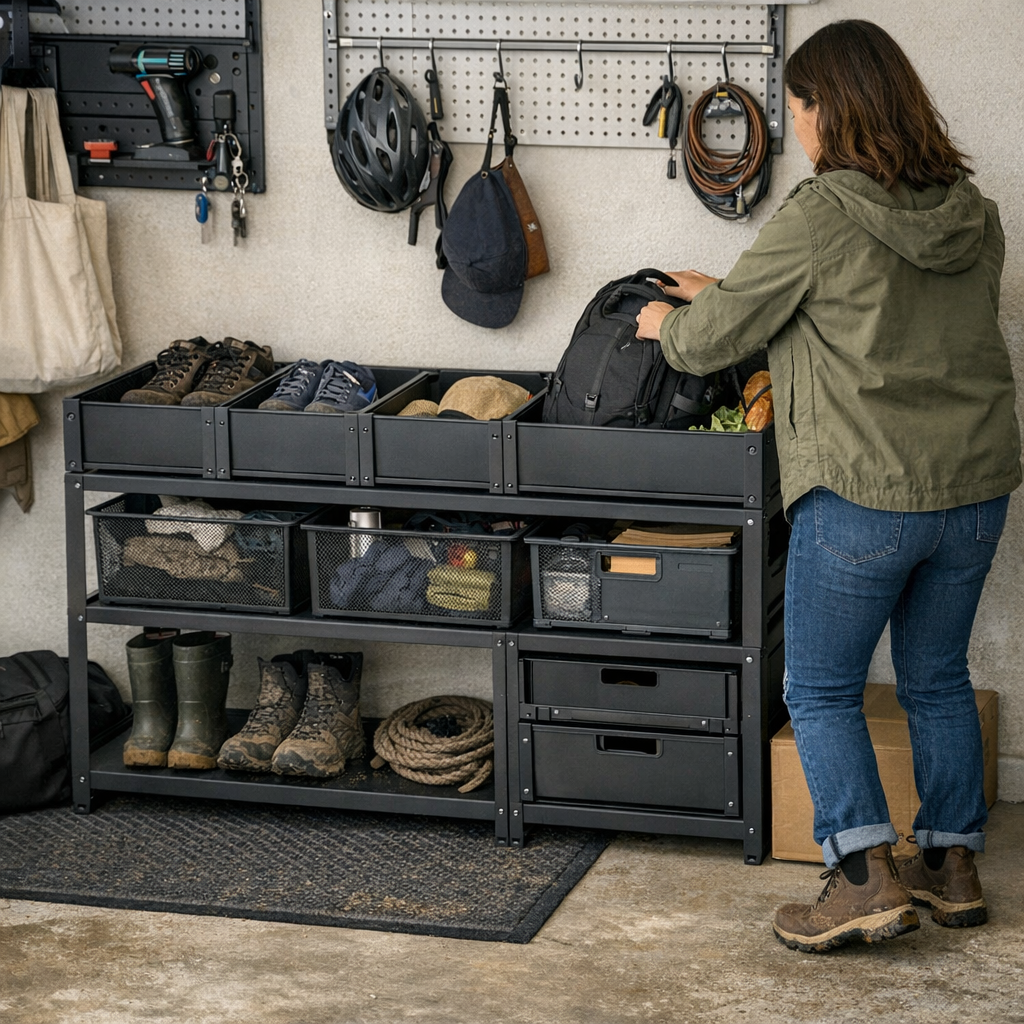
The shift isn’t about more storage. It’s about the shape of storage. Swapping a hooks-and-shelf setup for a single, wall-mounted surface with real depth (try 50cm, raised off the floor) does something most systems can’t: it offers a landing zone wide enough for messy days, deep enough for an arm’s load of everything, but still stays out of the walkway. Suddenly, boots, mail, gym bags and packages land onto one surface, without tumbling onto each other or rolling off the edge. The wider buffer lets two people pass through at once, no zigzag required. It absorbs the gear—so movement through the space finally feels free again.
Why Depth (Not Height) Wins for Real Loads
Most failures come from storage being too vertical, too shallow, or too precious: tall units eat up eye-level space, narrow bins can’t absorb an influx. If the zone’s footprint is at least 40–60cm deep, it takes the brunt of what you actually drop—packs, parcels, shoes—while the crucial crossing stays open. Depth doesn’t just add capacity. It prevents pileups from breaking across the walkway, so you don’t end up stepping around the very system meant to help you. Especially in tight entryways, depth solves more than stacking ever will.
How You Know It’s Finally Working
The test is simple. Wait for the evening rush. If gear and shoes hit the zone and stay contained, and you can walk a straight line without moving something out of your path, you’ve got a winner. The bigger signal: you survive a half-messy week without dragging carts aside or tripping over overflow. If you’re no longer forced into nightly resets, but the space is still accessible, the drop zone is finally doing what storage is supposed to—catching, not just storing, the mess of real life.
Everyday Friction—And Why Minute Tweaks Matter
No setup stays perfect. But small, repeatable changes keep your entry or garage useful, not just tidy on Sunday evening. Some pressure points to watch for in routine use:
- Spotting serial overflow. Is there always that one corner where debris collects—beside the cart you need to move, the shelf no one can reach, or atop a “temporary” pile? That’s your signal to rethink the landing zone.
- Identifying the block. The cart that’s never where it belongs, the basket no one uses because it’s half in the way, the unreachable hook—those add drag to your crossings, especially when you’re rushed.
- Testing lived-in capacity, not just looks. If the day’s real load—jacket, groceries, work gear—overwhelms the space, don’t add another bin. Re-examine how direct and deep your drop zone really is, and whether it matches the impact of a normal return.
A working drop zone is almost invisible: it performs in the background, freeing up movement without creating a new obstruction. If you’re aware of the setup because you’re wrestling with it, style isn’t the problem—the fit is.
Resets Are Won in the Details, Not in Perfection
What matters most isn’t flawless organization, but the speed and ease of sliding from chaos back to functional order. The right drop zone absorbs the shock of entry, lets you put things down without blocking everyone else, and shrinks the time needed for small resets. That’s what turns entryways, high-traffic garages, and backroom utility corners from frustration zones into legitimate buffers—ready for whatever comes through the door without demanding constant attention.
Find storage that follows your routines and fits the choreography of your space. The best entry solution isn’t always the one that looks tidy in a product shot—it’s the one that, day after day, quietly keeps you moving forward instead of slowing you down.