
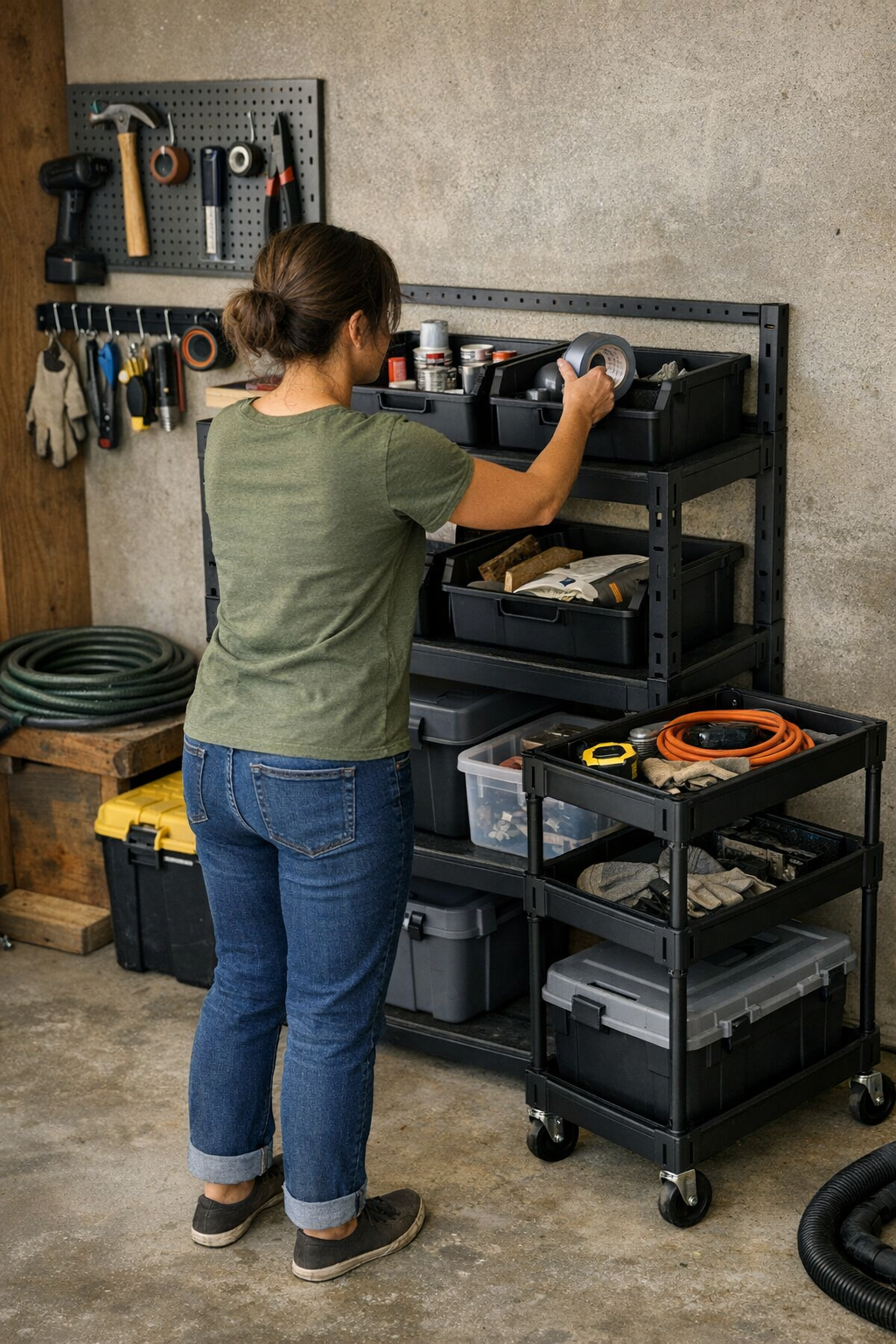
A garage, shed, or crowded backyard corner can look perfectly dialed in—hooks loaded, rails filled, bins lined up like a catalog photo—and still throw you off every time you try to actually get something done. The initial setup lures you in with false confidence: tools have a slot, nothing is underfoot, and best of all, every system claims it’ll flex to your workflow. But that “everything in its place” feeling never lasts long. The real test isn’t on setup day—it’s in the grind of a normal week, when setups get stressed, paths fill up, and routines hit friction you never planned for.
When “All-in” Storage Grinds Your Workflow
The impulse is universal—if there’s empty wall or floor, fill it. Mount another rack. Add a rolling cart. Hang another row of hooks. Pretty soon, every foot of space gets drafted into storage duty and things still feel organized—until you’re mid-project and need to return the drill, but the shelf is blocked by a bin you have to move first. Or you go for a screwdriver, only to play a five-second search game because the right one is hidden among tools you use once a year.
- Paths that started open fill with the awkward drift of carts and bins
- Grabbing a box of screws means tugging out three other containers first
- “Flexible” carts set in the perfect spot… until you need to squeeze past them every half-hour
What looks maximally organized is often maximally inconvenient when you’re in the middle of a normal work loop.
Access Erodes, Movement Slows
This breakdown is slow, but unmistakable. Suddenly, returning tools just means choreographing a series of nudges, slides, and shuffles. The rolling cart—supposed to be mobile—camped out for days because it has nowhere else to live. That “handy” back corner? It’s an overflow graveyard—not from laziness, but because there’s no painless way to put anything there, so things pile up instead. Wall hooks become a jumble, their promise of visibility and quick access replaced by a tangle of odd-angle clamps, rarely used hardware, and the things you actually need buried in between.
For most people, the friction shows up like this:
- Reshuffling bins one more time, just to finish a small task
- Walking an awkward loop around a cabinet corner—again—to put away a tool
- Giving up and leaving things out instead of forcing another round of rearrangement
It doesn’t feel like outright clutter. Instead, it’s constant interruption—a setup that organizes everything, but never quite lets your routine move freely.
Clearing the Logjam: Fewer, Focused Zones
The fix isn’t minimalism for its own sake—it’s finding the minimum number of storage zones that truly support how you use the space. In one real-world trial, three modular shelves and a rolling cart became just two shelves, with the cart pulled in only for big, messy projects.
- The previously blocked bottom shelf was open and ready to use every day
- Tool returns stopped feeling like a traffic puzzle
- That narrow corridor across the floor stayed wholly walkable—even at the week’s end
This isn’t about stripping down for the optics. It’s about matching the setup to the actual rhythm of grabbing, using, and returning your most-used gear—so resets happen fast, and regular movement stays smooth. The difference is clear: instead of fighting to get things back “in place,” the system falls away. That kind of frictionless reset never shows up in before-and-after snapshots, but it’s instantly felt during a real run of projects.
Warning Signs: When “Organized” Tips Into Overbuilt
How can you tell if you’ve crossed the line from plenty to too much? Look for these friction points:
- You pause, eyeing a shelf, anticipating a shuffle before you can put anything away
- Your hand automatically moves the same cart—over and over—just to grab basics
- Corners accumulate half-finished returns because you skipped the return entirely
- Walkways shrink a little more each cycle, feeling tighter by the week
When setups start creating these small hurdles, they’re making routines harder, not smoother. The best test isn’t a tidy shelf right after a cleanup, but the speed and ease of a reset at the messiest point between tasks.
Choosing Wall vs. Floor: How Access Eats Storage Space
Wall-mounted systems score points in theory—freeing up floor, “putting vertical space to work.” But overload the rail and every retrieval becomes a tangle: you unhook four tools to get the fifth. On the floor, big chests and carts give you instant stowaway spots—but in cramped aisles and busy shops, they swallow up movement space and park themselves right in your way. Leaner wall zones and one truly functional chest routinely beat a landscape of carts and tacked-on bins.
The Real Cost of “Just in Case” Add-Ons
We all justify the extra tray (for rare hardware), the bonus bin (for off-season stuff), or the wall hook ready “just in case.” Problem is, those add-ons guarantee fresh clutter. Soon enough, the question isn’t “where did I put that?” but “where can I even put this?” The workspace you perfected in the opening stretch quietly drifts back to blocked aisles, overflow corners, and a permanent game of storage Tetris.
Resetting Without the Strain: Clarity, Not Just Containment
What actually works isn’t maximizing storage—it’s minimizing the struggle. The strongest setups make it easy to return, grab, and reset—no matter how many projects cycle through in a week. Over time, friction shrinks: you move without steering carts, dodging corners, or playing musical chairs with bins. The gold standard is almost invisible: your storage disappears into the routine, barely noticed, because it never slows you down.
Real-World Tip: Build in a Buffer Zone
Every functional shop—big or small—needs a soft landing for projects in progress, sudden influxes, or stuff you’re not ready to put away yet. Reserve a single open shelf, a dedicated tray, or room for a small cart that isn’t always active—just fills up when needed. That buffer becomes controlled chaos, keeping your primary zones unblocked and your daily routine flowing. No more endless reshuffling; just one sweep and you’re back to clear movement.
“Perfect” Isn’t the Point: Function Outlasts First Impressions
The setup that wins isn’t the one that looks flawless in a photo. After days of busy, repetitive use, only the systems tuned to real work patterns survive without drifting into chaos. The difference isn’t in how packed your storage looks—but in how quickly you can reclaim order and keep tools in motion. In the end, an organized space shouldn’t get in the way. It should all but disappear behind the rhythm of your routine—leaving you free to get things done, again and again, without restarting from scratch.
Visit StackNest for practical storage systems that make real spaces easier to use.