
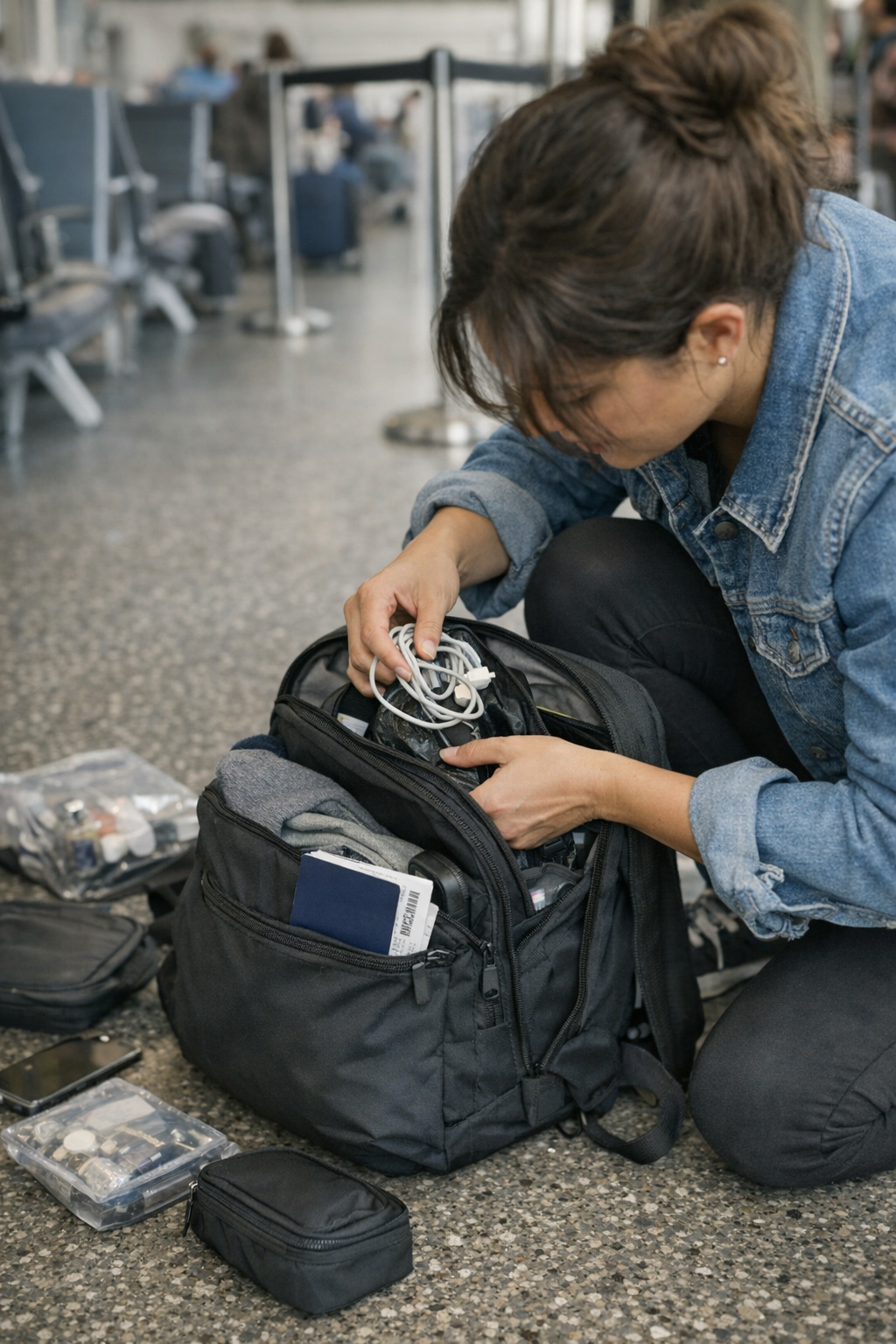
The carry-on setup that looks pristine at home often falls apart on the move. You start with pockets assigned, chargers in their pouches, every document stacked where it should be. But walk into a crowded airport, and your neat layout turns demanding. What took one motion in your bedroom takes three at a TSA checkpoint. Suddenly you’re blocking the line, fumbling for your boarding pass as cables spill from a pouch or your passport slips behind zippered layers. That gap—between looking organized and moving efficiently—shows up fast and gets more costly with every checkpoint and tray transfer.
When Visual Order Collapses Under Movement
The divide between tidy packing and real travel use becomes obvious by the first document check. It isn’t about how crisp your bag looks closed, but how often you’re slowed down by sticky zippers, overlapping pouches, or items sliding out of assigned places. Airport routines—security, boarding, seat entry—stress-test every claimed organization trick. That travel wallet you meant to streamline cards and cash? It chokes retrieval if you’re digging through a “system” just to show ID. Those neat layers you built at home quickly turn into barriers once you’re in motion and under pressure. You notice which setups actually spare you friction, and which turn every grab-and-go into a stop-and-unpack.
Most people don’t see this breakdown in the living room—but in airport loops: passport checks, rushed repacking after security, grabbing a charger mid-walk to a gate. Every reach exposes hidden inefficiencies—how your “order” either speeds the sequence or drags it out just when you need to move.
The Trap of Looks-Good-But-Feels-Slow
Category packing tricks travelers into feeling prepared. At home, pouches and color-coded pockets promise “everything in its place.” But in line, you end up opening three zippers and shifting stacks just to free a single pass. The signal: you’re doing more than one motion for every item, and reassembling the layers each time you rush. The friction only grows on tight layovers, where one buried item sets you two steps back.
Distinct pockets and compact wallets promise speed but often double the work when items overlap in real use. A merged document-and-card pouch, for example, means you’re showing one card and then digging again for your passport. The cost isn’t just hassle—it’s being the traveler fumbling while the line moves past. Even “minimalist” stacks get exposed: the neatly packed tech case that sits two zippers down, a charger lost below folded shirts, the passport exiled for main-compartment tidiness. Every efficiency at home can create its own slow lane in practice.
The Hidden Tax of Overlapping Pouch Systems
Impeccable pouch layouts and organizer stacks promise clarity but become labor on the fly. When cash slips under cords or headphones mix with chargers, every small overlap means a restless pause. What feels like a micro-delay at first becomes real time lost during transfers or tight connections. Add up three or four prolonged retrievals during a single trip—suddenly you’re minutes behind.
Real Scene: Cluttered Access at The Gate
Imagine the moment: you reach your gate, think you’re ready, and the agent asks for ID. Your fingers find the doc pouch, but your passport fights for space with a phone cable you re-stuffed after security, and your paper ticket catches on an out-of-place receipt. That two-second hold-up isn’t rare; multiply it by every control point and the initial “order” starts to feel like a slow trap.
Spotting the Repeated Friction Signs
If your bag triggers extra rummaging, it’s signaling a setup problem. The signals: answering the same “which pocket?” question twice, dropping small items while reaching for bigger ones, running a mental checklist every aisle-walk, and needing two hands when one should suffice. Each time you open more than one compartment for a single routine task, you’re facing design drag. These hiccups never stay isolated; they return each leg, accumulating as fatigue and making quick pivots more taxing throughout your trip.
Setting Up For Actual Single-Motion Retrieval
What cuts through this cycle? Relentless separation of essentials, guided by actual use—not just visual order. Give each high-use item its own dedicated, accessible pocket: passport in an outer zip, boarding pass in a slip slot, charger in a pocket that’s never blocked by toiletries. Stop assigning double duty to pouches or wallets meant for single-moment retrieval. Keep cards, cash, and non-essentials corralled where they won’t slow the moments that matter.
Small Shifts, Noticeably Less Drag
Success here isn’t about adding more compartments, but breaking old packing habits. If you find yourself fishing for a passport mid-line—next trip, move it to an external zip, isolated. Stash travel docs where you can grab them in one movement without unloading the bag. The payoff is immediate: you clear security in a single action, find what you need while walking, re-stash with no need to reassemble stacks. The repeated friction melts away. You’re no longer forced to empty half your bag for one small retrieval, nor do you fear the contents “exploding” out in an aisle seat. The travel sequence flows—ready, reach, move on.
Where Packing Theory Breaks: Scenes From Transit Reality
Security Tray Transfer—Revealing the Gaps
Security is the event where setups get unmasked. Clear pouches seem smart—until vital items are buried together. When pulling out a laptop requires shifting through both chargers and paperwork, everyone waits behind you. The more multi-compartment configurations you use, the steeper the learning curve after every repack.
Boarding Queue and Seat Entry—Access Under Pressure
Boarding is not the place for second guesses on pocket location. Grab your passport, slide out a boarding pass—simple, if the setup works. But if those live in separate organizers or behind travel pillows, you’re stalled, digging at the overhead bin, and re-stowing while anxious travelers shuffle behind you.
In-Flight Reach and Under-Seat Shuffling
Mid-flight, routine needs—like a charger or paperback—shouldn’t require a full bag inversion. If you’re bent sideways, knocking elbows while locating one item beneath a mess of pouches, the supposed neatness of your setup is costing you travel comfort and flow. Every reach that requires a silent re-pack triggers the realization: this layout needs to change.
How To Reset the Carry-On Flow Mid-Trip
Carry-on gear is inherently adaptable—but only if you listen to the signals. After a few travel cycles, travelers start isolating their repeat-use items: moving passports to the easiest-reach pocket, re-homing tech for quick grabs, banishing complex pouch stacks that never seem to work at speed. The breakthrough comes from removing overlap and refusing to double-stack essentials, not just buying new kits.
On longer trips—with more transfers—this approach pays in energy saved and fewer disruptions. Every time you make a setup change that removes two-step actions from your routine, you get back minutes and lose travel fatigue. The aim isn’t a tidier photo, but a bag that lets you move through each phase—check-in, tray loading, boarding, seat—without the need for resets.
Order That Moves: Why Real-World Carry-On Structure Wins
No travel setup survives unchanged if it doesn’t work live. If your carry-on’s neatness fades after the first access, or if you dread opening it mid-journey, that’s a real loss in time and comfort. When repeated interruptions—blocked pockets, misplaced boarding passes, awkward repacks—become routine, the “organized” look is meaningless. The best carry-on structure isn’t complicated or overbuilt: it singles out essentials for immediate, repeatable access, and prevents overlap where you need speed most.
Ready to improve your carry-on setup for repeat travel? Explore smarter, more usable organizers and tools at CarryOnSupply.