
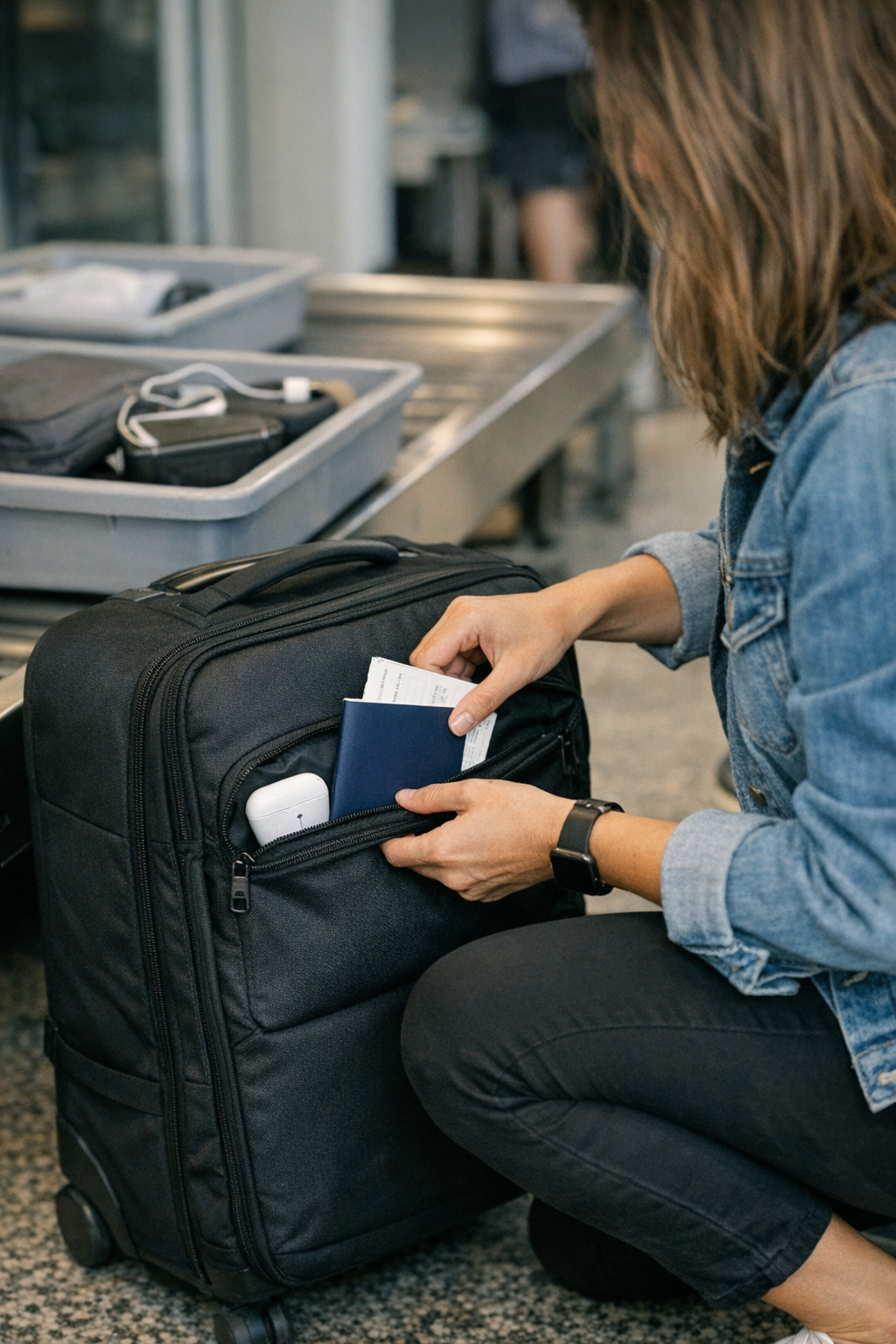
The gap between an organized carry-on at home and a workable carry-on mid-trip appears fast—usually at the worst time. At home, every charger, passport, and cable sits zipped in place, ready to go. At the first security line or document check, that sense of control dissolves: reach for your boarding pass, and suddenly you’re unzipping main compartments, pushing aside headphone pouches, flipping through stacked organizers. What looked efficient on your bedroom floor turns frustrating once airport routines expose each retrieval step, each clumsy shuffle, and every buried essential.
Why “Organized” Doesn’t Mean Easy—or Fast
A bag that looks orderly isn’t always faster or less stressful in real travel. The friction grows the moment you need something often—ID at security, headphones before a flight, a charger when your phone dies in line. You don’t just grab and go; you pause, unzip, disturb two other things, tug out a document wallet or pouch, and then force everything back in worse than you found it. Each supposed layer of “order” is another obstacle when the pressure is on.
Organization isn’t about first impressions. It’s about how many steps—or slowdowns—stand between you and that one thing you need again and again. Over-packed outer pockets explode with “just in case” gear, but slow you at checkpoints. A pouch system built for home visual clarity becomes a repacking job at every gate or aisle. What feels under control in quiet moments, crumbles under rushed, repeated use.
The Real Bottlenecks: Where Order Cracks Under Pressure
Some carry-on decisions almost guarantee trouble when actually moving through the airport:
- Security tray scramble: The power bank you filed under three layers now requires a full dig-out. That means emptying half your bag into a plastic bin, fumbling while the line pushes forward—only to restuff it all, messier, as agents glance at your delay.
- Gate document delay: The boarding agent calls for your pass—fast. If it’s hidden under an organizer or inside a main compartment pouch, you’re blocking the line, unzipping layers, juggling sleeves, while your system quickly gets out of sync.
- Seat entry slowdown: Squeezed between upright bags and aisle traffic, you realize your headphones or book are packed away for “tidiness,” buried just out of reach. Now you’re stopped, digging awkwardly with people behind you, already losing order before the flight has even started.
This is the cost of organization that ignores flow: Every retrieval adds interruption. Every repack worsens the next retrieval. Perfect order at home starts failing under churn in line, at trays, and especially at boarding when you can’t put the bag down or spread out.
How Setups Collapse: When Visual Order Fails Real Use
Picture a standard airport rush: Security moving fast; agent asks for ID; your phone hits red battery. The power bank and documents are neat under a layer of mesh pouches—“smart” at home, now all in the way. Each access means more unzipping, searching, restacking. Just one round—security and gate—and the bag is no longer organized. There’s no mess, just a cascade of micro-delays, and each pause compounds for the rest of the trip.
Most systems don’t fall apart in one big failure. They unravel with every repeated scramble for the same item, as tidy home logic gets replaced by real-world urgency. The friction isn’t visual—it’s the low-level drag of slow, interruptive access at each checkpoint.
Functional Organization: What Actually Survives Travel
Setups that hold up in airports have one clear trait: they prioritize the items you’ll need quickly and repeatedly—passport, boarding pass, main headphones, maybe a power bank—right at the bag’s edge in one reliable, reachable pocket or section. Anything you access rarely or only after arrival can sit deeper, unbothered by transit chaos.
This isn’t a cosmetic strategy; it’s structural. A single pocket reserved for “grab now” essentials massively cuts down lost time, mishandled gear, and post-checkpoint repacking. From curb to seat, your bag’s order survives each disruption because the stuff that needs to stay out of the way actually does.
How it Changes the Routine
Security lines speed up: Passport, boarding pass, and charger are literally right at hand—one motion per item, no “wait, where did I put…” You skip the multi-layer excavation, avoid the cable tangle, and don’t have to reset your setup post-checkpoint.
Boarding and seat entry stop stalling: Your headphones, ticket, and in-flight must-haves are in one layer, not mixed with “maybe later” stuff. You grab what you need without exposing socks or scattering toiletries across the aisle. Fast access, less chaos.
The Subtle Downsides of Over-Organizing
Too many organizers—nested pouches, elaborate tech kits, deep document wallets—tend to hide essentials under what feels like smart structure. Each “convenient” accessory meant to sort things at home becomes a puzzle to reassemble on the move. The more organizers between you and your go-to item, the more likely you are to delay others or have to fix your packing job two, three, four times before boarding even begins.
The takeaway: Layers of neatness become layers of resistance on travel days.
Practical Tips for True Travel-Ready Order
- Dedicate a single edge pocket to “next-use” essentials. Don’t let sunglasses or hand sanitizer sneak in with boarding pass, passport, and key electronics—keep that zone focused and always the same.
- Surface only what you’ll actually need in transit. Chargers and cables can go front only if you use them before arrival; stashing every wire up top just crowds the urgent stuff out.
- Group “once-per-trip” gear deeper. Backup cards, medication, and “if needed” extras live best where you won’t touch them during airport movement—they shouldn’t disrupt your travel flow.
- After each trip, check your own hang-ups. If you keep fixing the same pouch or re-stuffing the same pocket after every checkpoint, simplify again. A setup that worked on your bed may not survive three airport cycles without revision.
Measuring Real Improvement: Looking Beyond the Surface
A carry-on isn’t successful just because it looks clean post-packing. The real test comes in the grind of lines, security trays, repacking sprints, and those tight overhead-bin moments. The systems that survive these cycles require less unzipping, reshuffling, and recovery—not just once, but through every repeated interruption. These efficiencies signal a bag that’s not just “organized,” but fit for the actual conditions of modern travel.
If your current routine looks tidy at home and turns slow at every step—longer retrievals, awkward pocket maneuvers, messy correction mid-trip—it’s not just annoying. It’s a sign that your structure is optimized for stillness, not movement. Streamlining for quick-access and repeated use always beats adding the next clever pouch that turns routine urgency into another bottleneck.
A resilient travel setup isn’t about perfect order or maximal sorting; it’s about a bag that can take real pressure, recover fast, and reduce disruption each time you’re forced to dig, grab, or move. When you’re ready to adapt your system for actual airports—and real travel churn—functional tools and field-tested kits from CarryOnSupply can help cut the pointless drag from your next trip.