
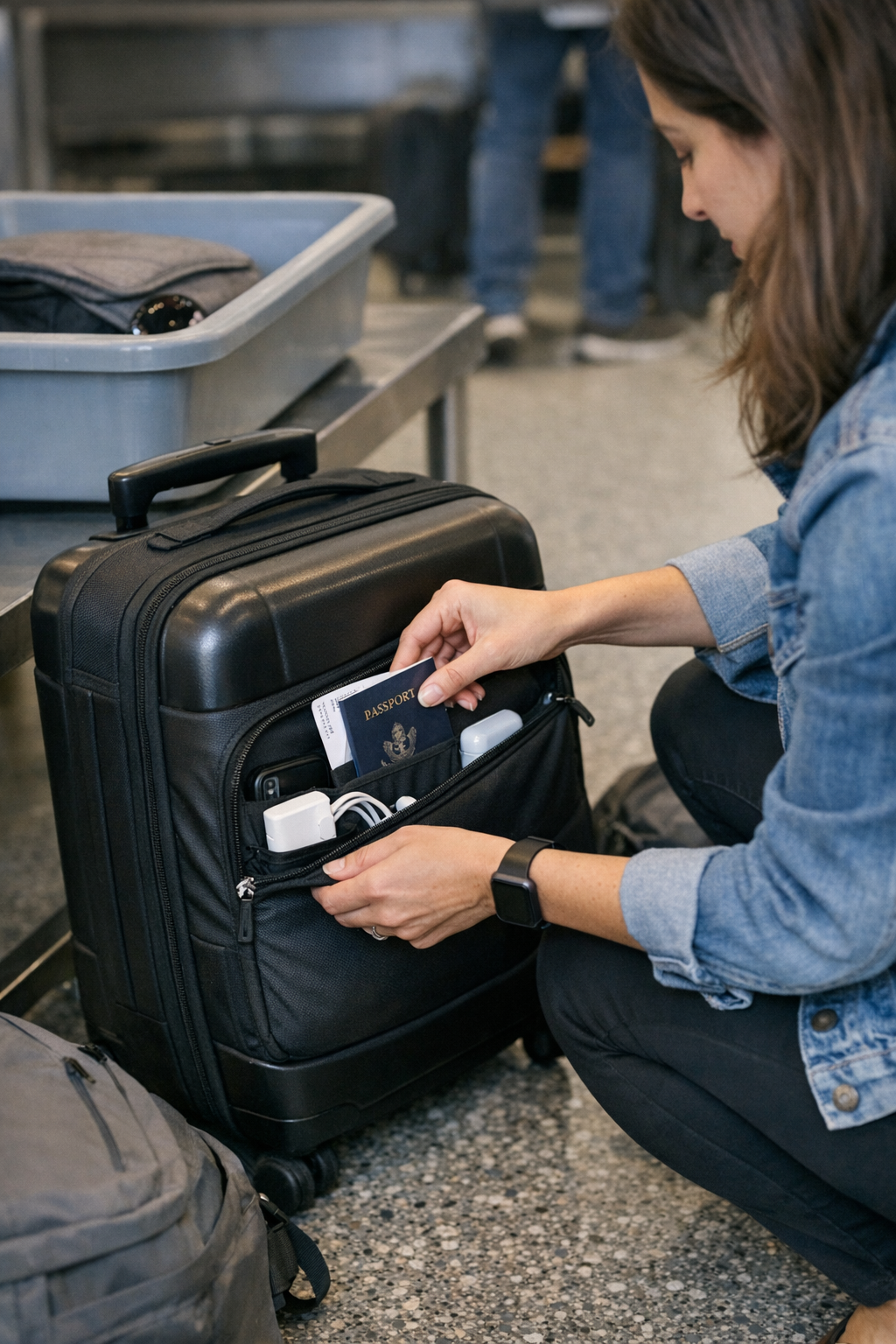
Looks can deceive in carry-on travel. A bag that seems perfectly organized at home—color-sorted cables, passport front and center, neat little pouches—rarely survives the first wave of airport reality. Under pressure, your “quick-access” pocket turns into a choke point. The passport you set on top slips under a charger pouch; your boarding pass slides behind tangled headphones; even the zipper fights you, catching on a misplaced pouch. You feel the slowdown as soon as your gate is called. Access that felt effortless on your living room floor now burns precious seconds at security and in the aisle, making what should be a streamlined routine a repeated frustration. If you’ve ever jabbed through an outer pocket, pawing at overlapping layers for a single document, you know how fast a tidy layout collapses inside a crowded terminal. This is the difference between bags that only look ready and bags that actually work—a difference CarryOnSupply is built to expose and solve.
Order That Doesn’t Hold Up Under Speed
Packing order never guarantees smooth airport movement. Real friction shows up in every transition: security checks, boarding lines, overhead-bin lifts, and seat scrambles. The tell isn’t mess, but slowing access. You reach for your passport, and instead of a quick pull, you unzip, shift pouches, fish beneath a charger, and repack everything with the line breathing down your neck. The more you move, the more your careful layout resists. Instead of reliable quick grabs, you get sudden stutters—fumbling during boarding, delays at checkpoints, items slipping further out of sync each time you open your bag. The cost: seconds lost at the worst moments, and a bag that interrupts your movement when you most need it to help.
Real Moments Where Organization Breaks Down
Security tray delays: In the scanning line, you unzip a “security” pouch expecting one thing, but find headphones tangled with power packs, and a toiletry kit blocking the reach. The layout that felt logical yesterday now jams at the exact moment the tray needs to move forward.
Boarding stress: As the line inches ahead, your passport hides behind two slim cases, forcing you to haul out every pouch, spread your tray of travel bits onto the boarding lane, and try to repack with a dozen eyes on you.
Seat entry interruptions: Squeezing into a window seat, you try to extract earbuds from the outer pocket but hit a wall of cable bundles and hard-to-grab gadgets. You pause, dig, and catch the aisle traffic, repacking items on your knees before you can sit down.
When Setups That Look Good Fail in Real Movement
Flat, color-coded layouts fail the second you start opening the bag for actual travel needs. Each new access moment—passport, charger, boarding pass—pushes pouches out of position, bunches zippers, and nudges essentials deeper. The thing you need twice in an hour slips behind gear you only touch once per trip. “Neat” turns into “nested,” and retrieval cost grows—a few seconds per interruption, magnified across gate changes, connections, or last-minute security requests.
Repeated Access, Repeated Interruption
The friction isn’t in what you pack—it’s the buried access path. First pack always feels controlled. True pressure comes after a few real transitions. Your urgent item, easy in theory, ends up trapped behind layers of less-used gear. Soon, pulling a passport means unzipping three sections or balancing your bag on a knee just to fish out a cable that’s migrated to the bottom. Every slight reshuffle multiplies, turning a one-motion retrieve into a multi-step scramble as your day stacks up transfers and checks.
Building a Carry-On Structure for Actual Use, Not Just Appearance
Function under travel strain comes down to one rule: High-frequency items must be within one honest, unstacked reach. The difference isn’t the number of pouches—it’s which pocket you trust for what you actually need in motion. Shifting essential documents and devices to a dedicated, shallow-access pocket makes the entire process direct. No more unzipping the main compartment at the gate, no more stacking organizers to get to your phone at security. A single, well-laid outer pocket turns scramble into flow: unzip, retrieve, done. When real travel disrupts order, only setups that protect immediate access keep working hour after hour.
Minimizing the Mid-Journey Repacking Cycle
This small structure shift—reserving the fastest access slot for only passport, boarding pass, and phone—drops the cycle of public repacking. Retrieval shrinks from minutes to seconds. At the gate, in boarding aisles, or at the security scanner, you open one zip, grab what you need, and move. Old routines of laying out every small pouch or re-layering tech organizers in the aisle disappear. The essentials remain forward, the friction recedes, and your setup no longer tutors you in airport repacking while other travelers rush past.
Practical Tweaks That Reduce Travel Slowdown
Keep outer-access lean. Every item labelled “essential” but used once per day slows the pocket you actually need fast. Cramming too many things into shallow pockets piles up overlap and snag risk; soon, the “quick” pocket is just another layer to dig through. Watch for signals: if you’re pausing at security or fumbling documents at the gate, it’s time to rotate items further back. The difference is immediate—true high-frequency tools stay in reach, low-frequency gear slides deep, and travel flow regains momentum.
The Shift from “Looks Packed Well” to “Works on the Move”
This isn’t about spotless visuals. A setup’s proof is in movement by your second or third flight—not the Instagram shot on a hotel bed. The real test is how retrieval speed holds up when the boarding lane clogs, or how your pocket works when you’re bending to slide a bag under the seat. Glitches still show up—pockets sometimes crowd or shift in turbulence—but the difference is measurable: you reach for most-used items and get them in a motion or two, not a messy repack. Consistency, not perfection, is what lowers travel friction in real time.
Consistent Access Means a Smoother Trip—Even When Things Speed Up
Truly efficient carry-on setups aren’t just mess-free—they cut out repeated, avoidable interruption. Move quick-grabs to a single, honest outer-access pocket, and your bag becomes an extension of your travel rhythm. Security checks, overhead lifts, boarding—suddenly, interruptions fade and your setup keeps pace. The cost of sticking with “tidy but buried” is clear: more digging, more slowdowns, and time lost fixing a bag instead of moving forward. It’s not about hitting perfection, but about making visible order deliver in the real, moving world of travel—especially when seconds count.
CarryOnSupply—see smarter carry-on tools for repeated real travel use.