
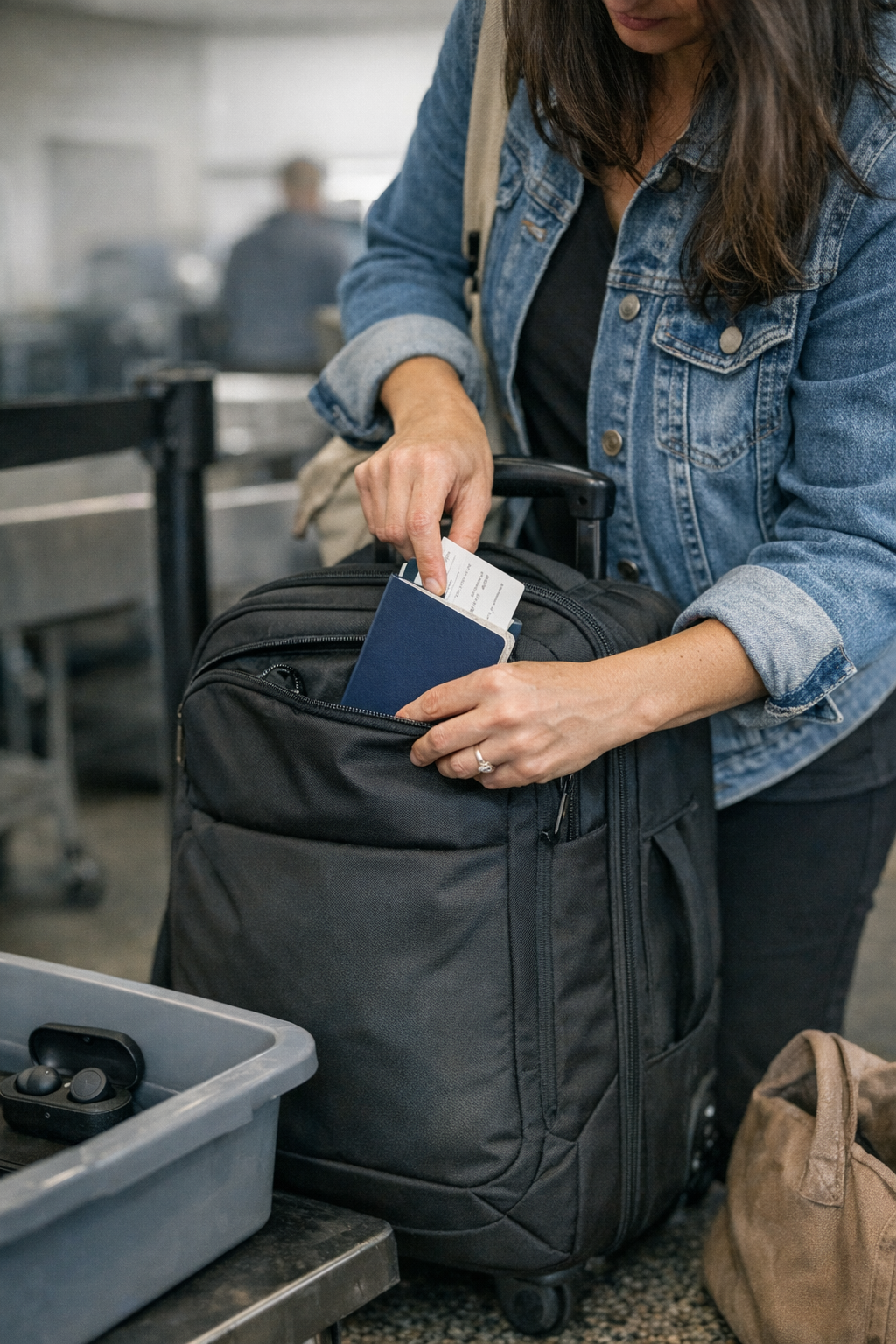
The biggest weakness in most “organized” carry-on bags isn’t visible until you’re actually moving: Standing in a slow security line, shouldering your bag while juggling a passport, or squeezed behind the person who’s already loading trays, you find that “order” breaks down fast. A bag that looks perfectly packed at home turns clumsy with every forced reach—one hand fishing beneath zipped pouches, a passport trapped under orderly layers, earbuds buried where you can’t get to them. The true test isn’t the tidy layout on your table; it’s the moment you need to grab something in real airport flow and your setup adds friction with every repeated move. This is where most travelers discover their perfectly arranged carry-on just became their biggest travel hassle.
When “Organized” Falls Apart: Friction in Real Transit
The most common travel mistake is believing packing order alone guarantees a smoother trip. You arrive at airport security, confident because your bag holds every item—each in its pouch, every pouch in its slot. Then reality checks in: your passport is under three other pouches, and your headphones require a full unpack just to drown out boarding announcements. Meanwhile, the line presses forward. The setup that felt streamlined in your living room now means you’re popping zippers, shifting stacks, and losing seconds at every interruption. Every extra reach interrupts your flow and signals to everyone behind you that you’re not quite ready for travel pace.
Travel friction builds by the minute—not just from pouches and zippers, but from forced, repeated rearrangement. What starts as a minor pause as you dig for documents grows bigger each time you need access, especially as crowds grow more impatient. If you’ve ever found yourself in mid-queue, holding up a line because your travel layout needs constant untangling, you’ve already seen how “order” can quietly work against you when the clock is ticking.
Layers vs. Access: Where Packing Logic Breaks Down
Many carry-on bags sell the promise of “complete organization”: document sleeves deep inside, neatly stacked packing cubes, everything zipped away tight. It feels secure—until you actually need to move fast. What makes sense in static packing falls apart under live airport pressure, where repeated access is the rule, not the exception.
Imagine you’re called for boarding or another document check. The sleeve holding your ID is “safe,” but accessing it means bending your bag in a cramped space, rooting around blind, yanking out a pouch, then re-layering awkwardly on your knee. The third or fourth time this shuffle happens—often before you’ve even reached your seat—the so-called organization feels like a trap. Your setup might protect every item, but at the cost of speed, confidence, and real usability.
Where the Friction Shows:
- Hidden sleeves demand repeated full unzips—forcing a reset for every small item
- Pouches stacked tightly together—pull one, two others shift, nothing returns perfectly
- Essentials vary in placement by segment—constantly reopening the main compartment for routine checks
Several retrievals in, “secure” packing turns into a string of micro-delays—each one piling up stress during boarding calls, gate changes, and seat entries. Travelers quickly learn that looking organized and staying accessible are not the same thing.
Repeated-Use Realities: Movement Exposes Weak Points
The biggest gap in many packing systems appears when travel stops being linear. Tight layovers, unexpected crowd surges, or those last-minute boarding zone calls—suddenly, your neat setup isn’t helping but holding you back. With one hand tied up by a bag, the other juggling a phone or tag, every inefficient reach becomes obvious and expensive.
Seconds lost hunting for routine items add up in ways you only notice when the stakes are high. The traveler who pauses at the x-ray tray for a buried document, or steps out of the aisle to reshuffle pouches after a bag check, is living the flaw of overdone order. These are not just minor delays—they risk missed boardings and heighten the pressure at every checkpoint. Real travel flow is broken not by messy packing, but by “neatness” that chokes access at critical moments.
Boarding and Seat Entry: Small Advantage, Big Relief
The difference jumps out when you compare opening an outer pocket and producing your ID in seconds to those wrestling deep-pouch setups. By the third or fourth document check, every extra zipper feels heavier—and each awkward reach increases the chance you’ll drop or misplace something vital. This isn’t a rare problem; it’s the default for most new “organized” layouts that never saw real-life, repeated access before being labeled travel-ready.
Small Changes, Big Difference: The Case for Quick-Access Zones
After too many trips repeating the “layered pouch” dance, switching to a carry-on with one consistently reachable outer pocket changed my entire travel sequence. Now, boarding passes, passports, and earbuds stay in a single, hipside zip—always retrievable with the bag upright, never demanding a full compartment repack. Access is instant, using one hand, and never disturbs the rest of the bag’s order.
Does this pocket look as sleek as the pre-trip flat lay shot? No. But the trade-off is a carry-on that finally matches the speed of airport movement. Suddenly, reaching for essentials isn’t a disruption—it’s routine. Every document check, boarding pass flash, or last-minute repack happens without losing your place in line or compromising everything else inside. In airports, that seamless quick-access zone proves more valuable than the illusion of perfect organization.
The Quiet Wins of Quick Access:
- Retrieving documents without opening the main bag (or disturbing its layout)
- Grabbing earbuds or comfort items mid-line, never disrupting the bag’s stack
- Sitting down in a narrow airplane seat fully prepared, already holding everything you’ll need for the first hour
- Reducing that subtle embarrassment of holding up impatient travelers behind you at key checkpoints
Accepting Visible Imperfection for Smoother Travel
It’s tempting to pack for a perfect photo: every pouch in line, every zipper closed, nothing left out. But repeated travel almost always breaks that visual order. If you sacrifice quick-access to keep your bag looking pristine, you invite needless friction at every gate, checkpoint, and seat entry. The real test is how the setup works after three, five, ten retrievals on a single trip—across miles and terminals, not just a flat surface.
The lesson lands quickly: order counts only when it survives real movement. A sharp-looking bag won’t matter if grabbing your passport, phone, or headphones pulls you out of the flow every time. Over repeated segments, functional access always saves more stress—and the best setups are the ones you barely have to think about, even after hours on the move.
Packing for Movement, Not Just for Show
Real carry-on utility depends on whether your bag supports you in the small, repeated travel moments: airport security, spontaneous gate changes, tight aisle shuffles, or the mid-flight hunt for a charger. A packing system that demands frequent full unzips or repacking will let you down far more quickly than one that trades a little visual neatness for reliable, one-move retrieval of your essentials.
Across dozens of flights, small changes—putting high-use items in consistent exterior pockets or switching to a carry-on with a dedicated quick-access area—delivered more relief than any stacking scheme. The best carry-on isn’t the prettiest on pause. It’s the one you trust to move with you, not against you, checkpoint after checkpoint.
Shop CarryOnSupply for practical travel solutions that work in real movement.