
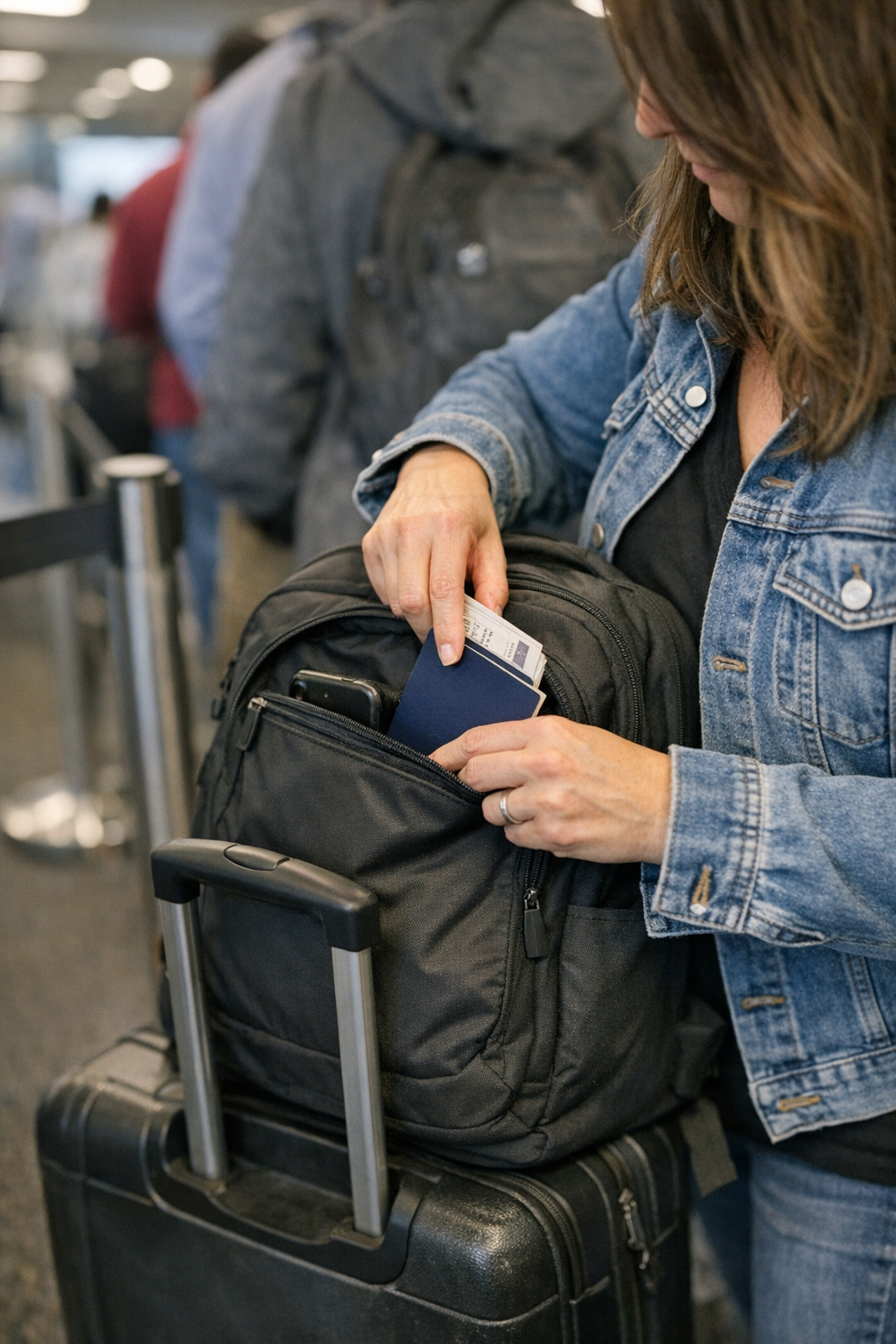
The true bottleneck of boarding rarely announces itself until it matters: your carry-on looks perfectly organized, but nothing is where you need it when the line starts to move. At home, every slot, pouch, and zipper creates the illusion of control. But once you step into the stuttering shuffle of an airport queue—bag on your shoulder, speaker blaring, people pressing forward—the cracks in your “system” show up as delays, shifting weight, blocked access, and small moments of friction that multiply with every step.
Packed to Impress—But Stalled at the Gate
The first real test of any carry-on isn’t how neat it looks fully packed. It’s how fast you can grab your essentials under pressure. Even one zippered layer too deep—passport hiding under a pouch, phone wedged behind a charger—means you have to pause, fish around, and break your flow. The boarding line compresses, elbows nudge, and what felt organized turns slippery when one quick reach becomes a mini-fumble. This is not a rare disaster; it’s the ordinary speed bump that repeats every time you fly, turning a smooth line into a stuttered advance.
This isn’t about losing items, but about how even a brief scramble for ID or ticket breaks your movement. Every unnecessary step—stopping, adjusting how your bag hangs, pulling it closer just to see inside—compounds the sense that your setup is slowing you down at exactly the wrong moments.
Nesting and Overlapping: When Organized Means Slower
The neatest-seeming layouts can turn on you mid-trip, because stacked “order” quickly becomes stacked barriers. At home, pouches nested into pockets and chargers wrapped tight inside toiletry bags look visually satisfying. At the airport, when your boarding pass is wedged beneath your headphones or your ID rests at the very bottom, each layer is one more obstacle on the way to what you actually need. Every document check or security bin highlights how slow this becomes in practice: unzipping, digging, repacking—none of which feel important until you’re in line, forced to repeat them with a dozen impatient travelers around you.
Overlapping zones—chargers pressed against passports, snacks overlapping wallet space—are the main culprit. You think you’ve packed cleanly, but now each retrieval starts a mini search-and-rescue, sometimes pulling out cords or letting a lip balm tumble onto the floor. The so-called “order” creates friction: boarding, searching at security, even reaching into the main compartment once you’re in your seat all reveal how fast those layers break down in use.
Real Boarding: Where Carry-On Layouts Succeed or Fail
There’s no hiding from the reality of the boarding line: you might be carrying a sleek spinner or an ergonomic backpack, but if crucial items require digging through overlapping pockets, you’ll stall. Picture this in motion—one arm full, carry-on angled in the aisle, fighting a stuck zipper while the line closes in. Visual neatness loses against functional access instantly. Does finding your boarding pass require shifting your weight, unshouldering your bag, or dragging the whole thing onto your knee for balance? If so, that “organized” look is undermining every step you take.
Outer pockets easily become a trap: they appear handy but mix too many one-off necessities. Stuff your boarding pass, a wallet, loose headphones, and lipstick in the same spot, and now the cable snags, the pass is blocked, and you’re left pulling out fragments or dropping something in the aisle. The illusion of fast access turns into a bottleneck where essential seconds are lost and the crowd keeps moving.
Practical Example: Rushing at the Jet Bridge
Imagine you’re up next for boarding, thumb still on your phone, scrambling to free up a hand for your ticket. You stuff the phone into an outer pouch and swing your bag around for a one-handed score—but when you reach in for your ticket, the charger cord comes with it, tangling your fingers. You can’t blame nerves; this is what happens when a setup doesn’t force clear separation for the high-frequency, in-transit items. The inconvenience repeats, not because you forgot, but because the pocket is doing too many jobs at once.
Why Dedicated Outer Access Matters
The easiest fix for in-transit slowdowns isn’t adding more pockets. It’s subtracting confusion by assigning a single, truly dedicated outer pocket for only your key travel items. Limit it to the essentials—passport, boarding pass, ID, maybe headphones. When nothing else shares that real estate, retrieval turns from guesswork to habit: it takes one reach, not two. There is no pause to verify, no risk of fishing up a snack instead of your wallet. The motion becomes automatic, and the zip-path feels as familiar as your own jacket pocket.
This single change isn’t about “convenience” in a vague way—it spares you from the repeated awkwardness at security trays, the mid-aisle stretch that slows seat entry, and the last-minute repack when an accidental spill dumps your essentials in public view. There’s no more accidental clutter at your feet, no document jam that leaves you standing with your bag half-open as others shuffle past.
Repeated Access: When Good Structure Pays Off
Try flying a full travel day—two boardings, a tight connection, and security checks—using a split-front zipper pocket for all high-frequency items. You’ll notice: the loop of double-checking, of hand-digging and “where did it go” disappears. It’s not a one-trick fix; by the time you get to your hotel, grabbing a document or headphones still takes a single move. That temporary pre-trip order holds up in the chaos—no need to mentally reset or reorganize just to keep pace.
Design for Movement, Not Just Looks
The most persistent failure is confusing tidy with fast. Compact packing isn’t enough—if the essentials aren’t immediately reachable, each leg of your trip exposes where things slow down:
- Document checks become a reflex, not a pause to scan every pocket.
- Seat entry loses its awkward shuffle—no swinging your bag around to find what’s buried deep.
- Security trays stop being frantic dump-and-scramble moments.
The “quick fix” of just adding another organizer rarely works. Every saved movement matters. Order that shrinks your speed isn’t order—it’s just a prettier form of interruption. The right structural change lets your carry-on help you move, rather than making every retrieval a hidden obstacle course.
Redesign One Zone, Reduce Repeat Headaches
The most manageable shift: dedicate one quick-access outer pocket exclusively to the core items that matter during the first and last fifteen minutes on the plane. Don’t let chargers, snacks, or toiletries steal space here. Reducing overlap is not about minimalism for its own sake—it’s the only way to cut the string of micro-interruptions that come from digging through unrelated accessories when time is tight. Nothing else should share space with your passport or boarding pass if it can wait until you’re seated.
Most carry-on routines break down not from lack of space or lack of gadgets, but from too many access points stacked on top of each other. If you need two hands, an empty seat, or a mini-inventory in your head just to pull a ticket, the structure is working against the reality of travel movement. Add less, rethink more—one simple pocket shift beats another layer of pouches every time.
The Difference Over a Real Trip
Back-to-back flights, tight connections, or airport routines built on repeated boarding checks put every choice under pressure. When your travel setup separates high-frequency items into a truly dedicated, low-overlap zone, your bag stops tripping you up and starts matching your speed. The awkward mid-aisle repack becomes rare, and the repeated, low-level stress of reorganizing fades out. Your focus returns to the trip, not the tug-of-war with your own luggage. The shift is visible only during actual motion—but that’s exactly when it counts most.
Discover practical carry-on upgrades at CarryOnSupply.