
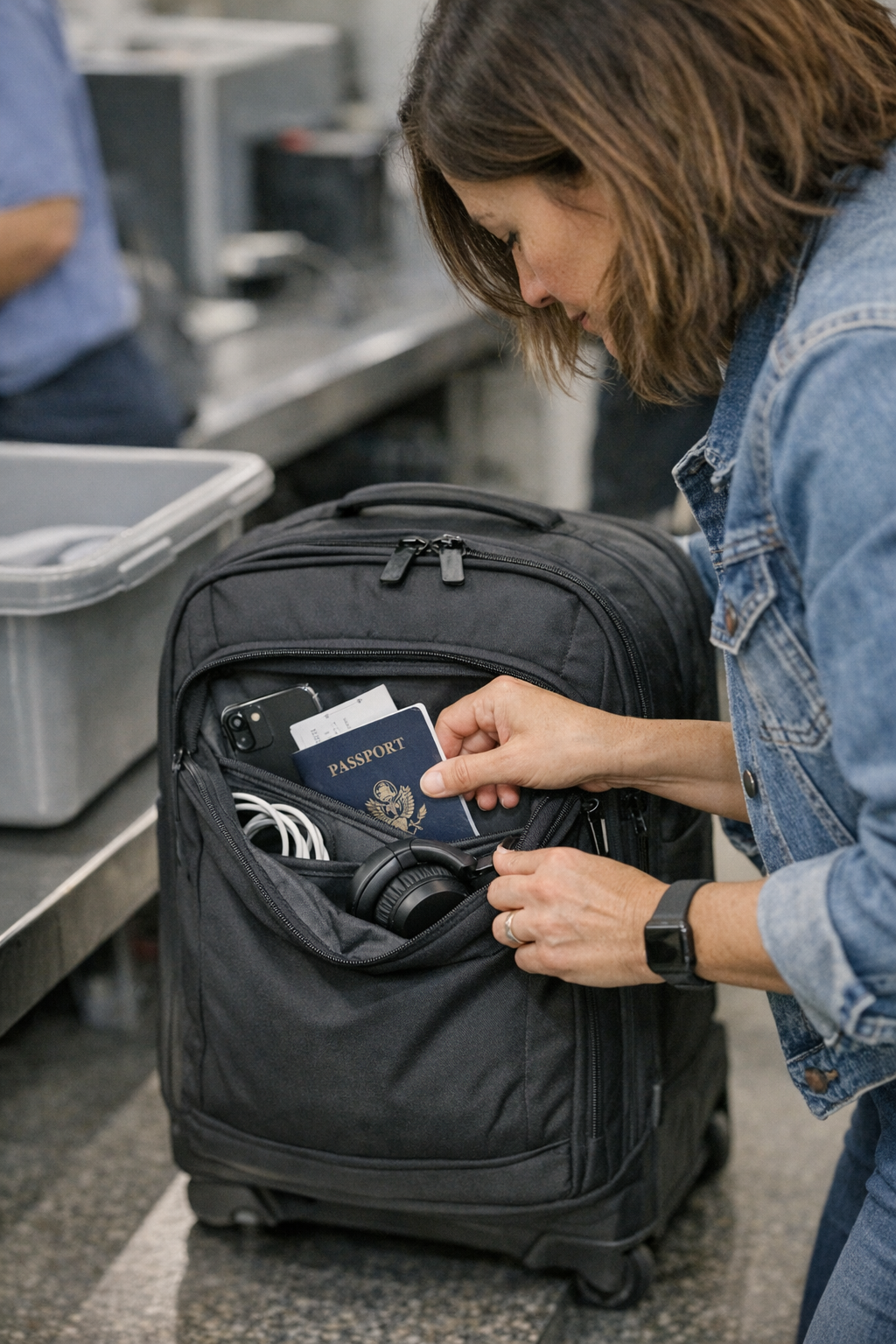
A carry-on that looks organized still breaks down the moment you need it most. That neat setup—pouches lined up, cables in order, passport visible—unravels at your first real checkpoint. It isn’t big chaos, but the second you’re digging past a pouch for your boarding pass with a security line behind you, the “well-packed” setup turns slow and clumsy. You might only need two things, but both are wedged behind something else. The main problem isn’t visual mess; it’s hidden friction. The bag you perfected on your kitchen table rarely stays that way once you’ve reached for your passport, fished out a charger after boarding, or tried to get your headphones without blocking the aisle. In real travel, organization fails quietly—by demanding two or three steps where there should be just one, by hiding the item you just put back a moment ago, by turning fast movement into hesitation.
Pocket Competition: Where Friction Starts
Friction in carry-on use is less about visible disorder and more about losing single-step access under pressure. The first reach might work. The third reach—the one where your hand pauses—exposes the flaw: passport under a mesh pouch, charger stuck behind toiletries, document sleeve migrating again after security. Bags shift in trays, compress in overhead bins, reorganize themselves during seat entry. Every squeeze, shuffle, and re-stack turns that “clean” configuration into an unpredictable sequence. The result isn’t dramatic mess—it’s a stacking of micro-delays, fumbled motions, and interrupted flow, especially when the right zipper path is suddenly blocked or the outer pocket feels overcrowded.
The subtle slowdown shows up fast when travel flow matters most. Pockets overlap, pouches press against each other, and zippers stick—not because they’re broken, but because your setup was built for packing, not repeated checkpoint access. Resetting feels constant: slide this pouch aside, dig for the buried passport, tug a charger cable that’s looped around something else. Nothing is “lost,” but everything takes longer than it should—stealing your mental focus and making you more visible in moments when you just want to get through quickly.
Home vs. Airport: Why Packing Logic Breaks Down
At home, the packing rules favor symmetry and contained categories—a tech pouch here, a tidy document holder there, toiletries stacked perfectly, each layer deliberate. It looks disciplined and prepped for anything. But travel doesn’t reward tidy layers; it punishes setups that force repeated digging. The first time you unzip your bag at the airport—one foot forward in the security line, arm awkwardly reaching from above—you often grab the wrong organizer or tip over a pouch, only to find your passport or boarding pass has migrated. Now what seemed efficient becomes a sequence: unzip, fumble, re-stack, repeat. Multiply that by every checkpoint: the time lost to correcting small packing errors adds up, and your supposed “system” becomes a quiet liability.
The Reality of Layered Organization
Visual order rarely equals functional speed in repeated use. Each checkpoint—document checks, bag searches, gate calls—tests whether your layout works under pressure. A setup that passes for order at a glance often fails fast in motion. What matters is whether you can grab essentials in one fluid reach, not whether every pouch has its category. If repeated access to primary items means moving or dislodging something each time, you’re trading away the only rhythm that matters in transit: smooth, fast retrieval without backtracking.
Checkpoint Slowdown: Small Delays, Compounded
Real burden isn’t a dramatic spill but a quiet, repeated drag: standing in a boarding queue, half-listening for your zone while wrestling with a zipper; reaching for headphones only to find them tangled around a charger in the main pocket; pausing at security as you try to slide a document sleeve out without exposing toiletries. Instead of quick, one-step retrievals, you build a ritual of shuffling and mental mapping. Each time, small delays pile up. You block the aisle, stall the security tray, and start to see the tradeoff—every time you go past three items for one, the order you created yesterday has already failed the day’s first real test.
It isn’t about losing your place; it’s about repeating pointless micro-motions until travel feels tiring before you reach your gate.
A Better Rhythm: Single-Zone, High-Frequency Access
The difference is obvious once you focus on a structure built for repeat movement, not just initial tidiness. The answer isn’t to add more pouches or separate everything—it’s to group all high-frequency essentials (passport, wallet, phone, chargers, glasses) into one stable, outer-access pocket. No more unzipping layers, digging through stacked organizers, or remembering where to repack after every tray check. All secondary items—change of clothes, backup cables, snacks—can stay deeper in the main compartment, untouched through most of the routine. You eliminate the need to shuffle the same few pieces multiple times in every sequence.
Less Shuffling, More Movement
The payoff is clear the first two times you use the setup in the wild. In security lines, documents pass from bag to tray and back in one motion. In the boarding aisle, headphones come out without knocking over pouches or re-layering the whole bag. Returning items is automatic—everything lands in the same place, no re-mapping, no reshuffling. You stop monitoring your own process. Instead of quietly resetting after each move, you experience continuous flow—multiple retrievals without friction or regret. By the third checkpoint, the travel drag is gone. The fact that you barely notice your setup is evidence the structure works.
The Invisible Difference: Look vs. Feel
A carry-on can look flawless zipped up and still betray you in real use. The mark of a better setup isn’t how the bag looks before departure, but how little it interrupts your movement after two hours of travel. The best structure stays invisible—everything you actually need is always a single reach away, no matter how much the bag gets jostled or compressed en route.
If you find yourself double-checking compartments, digging for the one thing you just used, or opening multiple sections after a short walk, the underlying structure is fighting your actual travel needs. Streamlining high-frequency items into a single, stable access zone isn’t just a trick—it’s a real test of travel resilience. Efficiency is built with fewer pouches for the things you grab every time, not by adding new containers to solve yesterday’s tangles.
Redesigning for Repeat Access
Designing your personal carry-on structure for repeat access doesn’t mean losing control or order—it means recognizing that repeated use matters more than initial symmetry. The “packed well” setup is only proven by how it performs: checkpoint to gate, aisle to seat, arrival to hotel. When every reach is quick and repeatable, when your hand always finds the right pocket, travel stops feeling like a cycle of minor corrections. That’s the turning point—when order and function finally meet, flight after flight.