
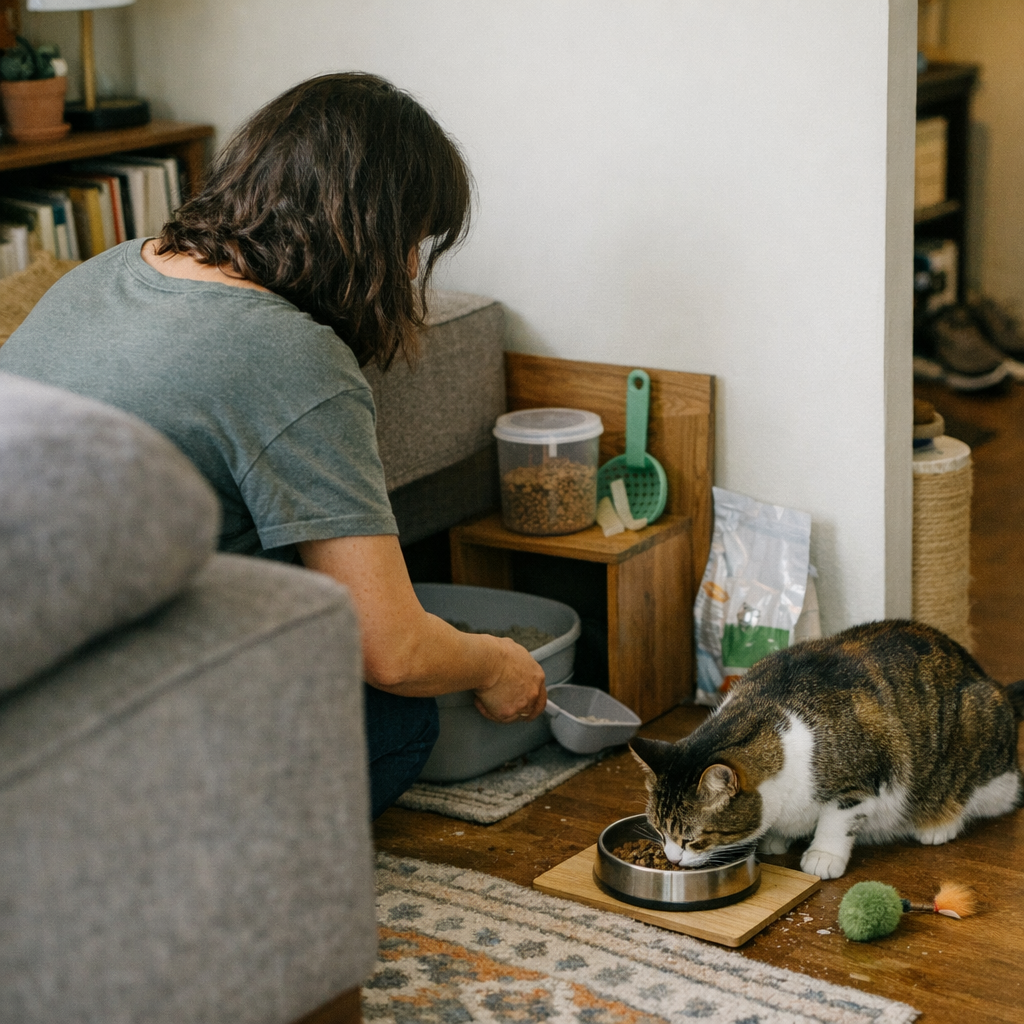
The real test for any indoor-cat setup shows up by the third day—not in how tidy the space looks, but in how the routine keeps fighting back. What runs smooth once can turn tedious fast: you refill water, but the counter is already streaked before breakfast is over; you swear the scoop had a home, but by midweek it’s gone wandering again. Routines slow, cleaning repeats, comfort setups start to sprawl, and the neat look you created on day one starts leaking messes and extra steps everywhere. That repeated drag is the StillWhisker world’s focus: not just looks, but setups that don’t crumble under real, repeated use.
Why the Real Mess Sticks Around
A space can look organized—bowls perfectly lined up, scoop tucked away—but if every refill or wipe-down makes you zigzag for supplies, you’re feeling friction that builds with every round. Mess appears wherever routines stall, not just after big cleaning sessions. The gap isn’t about decluttering; it’s about how each setup reacts when real habits test the limits.
In tight apartments, every extra walk to a distant faucet or a hidden scoop adds strain. Leave gear scattered for “easy access” and the whole corner starts to block itself: hand bumps bowl, mat won’t lie flat, or you end up nudging the cat’s food station every time you just want to pass through. The surface says organized, but daily resets get slower and less satisfying—making “clean” feel more like a performance than a condition you can count on.
The Hidden Costs of a “Clean” Setup
Out-of-sight storage promises relief: scoop in a top cupboard, toys stashed deep in a side bin. On the first day, the floors are clear and breathing room is real. But every longer detour breeds “I’ll wipe it later”—those little interruptions that become new sources of stray litter, crumbs, and grit. Messes start creeping outside their zones, building up in places meant to stay clean, with the “not quite done” feeling sinking in every day the right tool isn’t close enough. Tidiness starts to hide deferred work, not reduce it.
The Other End: When Everything Lives in One Spot
Stacking it all together? Now the friction flips. The scoop is reachable, but the setup crowds in, forcing you to move a toy to wipe the mat or shift bowls just to reach underneath. Every action is blocked by something else—meaning a two-second reset grows into a longer round of awkward reshuffling. Instead of feeling equipped, you find yourself stepping over curled mats and guessing which pile holds what you need next. Easy access becomes its own mess trap.
Where Setup Friction Sneaks In: Common Indoor Cat Scenarios
The real weak spots aren’t obvious on day one—they reveal themselves after a few cycles of feeding, scooping, refilling, and clearing space. Practical examples:
- Refilling water means carrying a heavy jug back and forth—one spill darkens the carpet edge, and you end up tiptoeing over slow-to-dry spots for days.
- The scoop drifts behind a leaning board, so now there’s a trail of grit right through the main walkway, while the litter area only gets cleaned when you finally go searching.
- Wiping surfaces gets postponed because the cloth or brush isn’t within reach, letting food dust and water tracks circle the bowls for hours.
- Supplies “temporarily” stacked aside for company leave small piles that block the morning reset and slow down the next round of cleaning.
- Mats or blankets for comfort take twice as long to put back—now you’re smoothing curled corners around other supplies, letting dust or stray litter cling until the next deep sweep.
- Cat stations drift into walking zones: bowls edge out, mats curl, and scoops stray just far enough that both people and cats now trip over the fallout.
None of these are disasters. But together, they’re the reason recycled mess and slow routines become the rule, not the exception. The difference between an “organized” space and one that actually feels easy only shows up when you’re back in the loop, doing it all over again.
Questions to Diagnose Setup Trouble
If your routine breaks down fast, the structure itself is likely the weak point—no matter how well you tidy up. Ask yourself:
- Are you moving things just to start cleaning, instead of actually cleaning? If you spend more effort on the setup shuffle than the job, chances are essential items are out of daily reach, leaving real messes to linger “for later.”
- Do you always have to nudge, juggle, or restack supplies to reach what matters? If every wipe, scoop, or reset comes with a mini dance, too much has crowded into too little space—or key clear space is gone.
- Is your sticking point too many steps, or too much congestion? Whichever repeats most is your main friction—spreading out and slowing movement, or clustering and blocking every reset.
The setup challenge isn’t about which cat gear you own, but where and how it fits into routines you repeat dozens of times a week. The best area isn’t the cleanest on camera—it’s the one that survives second and third rounds without forcing you into a loop of extra work or regret.
Practical Scene: Real Repeated-Use Friction
Picture a week in a cramped living room. The water fountain and litter tray share a corner behind the armchair—the only outlet forces them over a ragged strip of carpet. To refill water, you haul a jug past two obstacles and mop up drips from a greyed mat edge. By Wednesday, the bowl hasn’t been wiped in days; mentally, it drops down the to-do list because the trip itself feels like a bother.
Toys scatter across the floor, creeping under furniture without boundaries. Come Saturday morning, the scoop turns up behind a leaning board, with a band of litter grit claiming the main walkway. Now, try the other extreme: every supply within arm’s reach of the sofa. Feeding, scooping, wipes—nothing demands a trip. But by Friday, you’re picking up toys with every step, guest traffic means bowls and mats break ranks, and every corner is a new obstacle course. The room looks unchanged, but resets drag and both humans and cats sidestep low-level mess fatigue.
Smoother Reset: The “Route” Fix That Actually Works
Most breakthroughs don’t come from another bin or a new round of deep cleaning. They come from mapping daily moves and matching placement to flow. Locate what you use most right where your route takes you—feeding or cleaning shouldn’t require detours or shuffling through a pile just to finish one job.
This can mean putting the food bowl a foot closer to the water fountain—so wiping, refilling, and feeding happen in one pivot, not a room-crossing lap. Store the scoop in a slim cabinet near eye level, with just the daily basics—not the full supply spread. Extras that keep blocking movement or migrate into shared space probably need a new home or a less demanding spot. These are small, structural shifts—not photo-ready “after” shots, but changes that noticeably reduce repeated work.
When every reset doesn’t require tracking down supplies or fighting congestion, fewer messes linger past their moment. The biggest sign of improvement isn’t how the area looks at a glance, but how much less you have to keep fixing the same problem.
Worth Noting: Tiny Shifts, Big Difference
This kind of practical adjustment won’t erase all setup friction—some tension between comfort and cleanup is part of real life. But by shrinking routine obstacles and keeping quick resets available, you start to gain ground. Mess loses its grip, and the space feels less like a repeating project and more like part of daily life you don’t have to dodge. The point isn’t “perfect”—it’s fewer moments spent circling the same frustration, and more time with a setup that survives the week without falling apart.
Browse practical indoor-cat solutions at StillWhisker.