Blog

  • Why Lighting Accessories Make or Break Your Workspace Setup

    Most lighting setups seem “finished” the minute they’re installed—until real use exposes their limits. What drags a tidy surface back into chaos isn’t the bulb or brightness, but loose brackets, peeling cable guides, plugs knocked crooked, and “invisible” supports that quietly shift out of place. The true problem isn’t that light looks wrong, but that cables creep across your sightline, a lamp falls out of aim, and you end up working around a setup that was supposed to make things easier.

    When Looks Deceive: The Day-One Setup vs. Real Living

    You mount a low-profile under-cabinet strip, feed the cable through its track, and the kitchen suddenly looks resolved—clean lines, edges squared, shadow eliminated. But by the second week, after your daily coffee routine and a few rushed lunches, stress points start to show. The bracket that held firm now rattles when a cabinet door swings; a once-straight cable sags out of its channel after catching on a bag handle. Little by little, friction takes over the space.

    The lamp that started perfectly aimed has wandered off-target. You find yourself with just enough glare near your laptop to start using only half your desk. The area feels less usable, and every fix—re-tucking the cable, turning the light back—becomes an extra nuisance built into your day. Appearance holds, but function unravels with every bump, reach, and stretch.

    The True Test: How Accessories Shape Lighting That Lasts

    The weakest part of a lighting setup often isn’t what you see; it’s whatever holds things where you need them, every time. A flimsy bracket or cable sleeve might disappear into the background at first, but over weeks, these small pieces shape whether your routine flows or grinds. A support that can’t handle a sideways tug translates into cables migrating onto the counter or a task light never quite pointing where you want it.

    Where Failure Shows Up First: Everyday Pressure Points

    Weakness rarely screams at once. Instead, it’s the steady spiral—a bracket creaks every time you nudge the screen, a cable works loose after shifting the keyboard, a plug tilts after a rolling chair presses sideways. “Finished” slowly becomes “fragile.” What signals trouble:

    • Cables you’re always re-routing to keep out of sight or reach
    • Lamps slumping, refusing to hold position as you work or cook
    • Shadows appearing right at the prep or writing zone’s edge
    • Spaces you avoid because the light stops making the area usable

    Setups Under Real-World Pressure: Scenes from Everyday Spaces

    Ceiling Panels vs. Under-Cabinet Strips: Invisible but Not Equal

    A flush ceiling panel keeps mounts and wiring out of mind and out of the way—nothing to snag, nothing to disturb. When supports are buried and stable, this calm sticks around. Glare stays contained, and there aren’t loose cables threatening to catch on your ladder or dust mop. Move to an under-cabinet run, and every motion tells a different story.

    Under a busy kitchen shelf, a mounting point weakens with each door swing. Yesterday’s cable management loses grip, so cords droop just low enough to catch your jacket or brush against what you need. “Tidy” stops lasting beyond one hectic week, and clutter creeps in wherever hands, bags, or kitchen tools circulate.

    Desk Edges and Shared Tables: Small Failures, Big Impact

    Set a slim LED strip along a shared table or perch a lamp under a shelf, and day one impresses—unified line, clean perimeter. But elbows lean, bags slide, cords come and go. Cheap adhesive at desk edge pulls loose and curls away. A power cable slips forward until it hangs off the tabletop, the light bar bends just a little further every day. Function fails quietly—the last third of the workspace goes dim, and people sidestep to any spot that stays reliably lit. You catch yourself avoiding the “good” side, because it can’t stay good.

    Small Fixes, Real Payoff: When the Right Accessory Changes Everything

    Stability doesn’t demand a new fixture; it starts with a deliberate fix at the most abused spot. Replace a slumped adhesive bracket with a screw-on mount at the desk edge. The cable finally stops sliding off, the light bar stays in line, and the routine—write, grab, stretch—no longer ends in cable slip or light aim drift. Over a week, tinkering disappears and the surface quietly stays in order.

    One solid anchor at the right pressure point brings the whole setup back to reliable use—restoring edge light, protecting desk area, keeping glare out of your eyes, and letting the upgrade pay off beyond its appearance.

    Clutter, Glare, Instability: Knowing When to Rethink Your Setup

    Notice any fix you repeat—re-aiming a lamp, rescuing a fallen cable, tightening a bracket after every busy week. These are signals your setup doesn’t match reality. Adhesive that fails after every surface wipe, trays that let cables squirm loose, unstable clamps that float until they irritate. The “wear and tear” isn’t wear; it’s the wrong support for your actual pattern of touch and movement.

    Look for persistent friction: glare you can’t dodge, clutter building at a single pinch point, light always shifting out of place. That’s the moment for a targeted fix—a real mount, a clipped cable, a proper plug brace. Ignore it, and the daily battle with your lighting becomes just another source of slow, steady frustration.

    Tips From Real Use: What Lasts and How to Spot Weak Links Early

    • Anchor in high-contact zones. Desk edges, door zones, and busy shelves need hardware that won’t peel off or loosen with normal movement.
    • Organize cables by structure, not shortest path. Route along back edges or under lips where they’re protected, instead of letting them dangle where they get knocked loose with every motion.
    • Take time with your pressure points. Ten extra minutes spent mounting a bracket at a stressed spot means weeks where you’re not resetting the same cable or lamp every day.

    Why Living With Light—and Its Supports—Matters Most

    Task lights, panel runs, and accent bars rely on the quiet resilience of every support, channel, and bracket. The real difference between a lighting setup that fades into your routine and one that sabotages it: reliability that doesn’t draw attention to itself. The right accessory quietly endures repetition. The wrong one interrupts your flow day after day—and sets off the slow undoing of even the most beautiful result.

    The job isn’t done until your lighting still works the way you need it, after real use has tested every detail. Prioritize real support, deliberate anchors at high-stress points, and accessories that answer repeated contact—not just a polished first look.

    Find supports and accessories made for practical, repeated use at LightSupport.
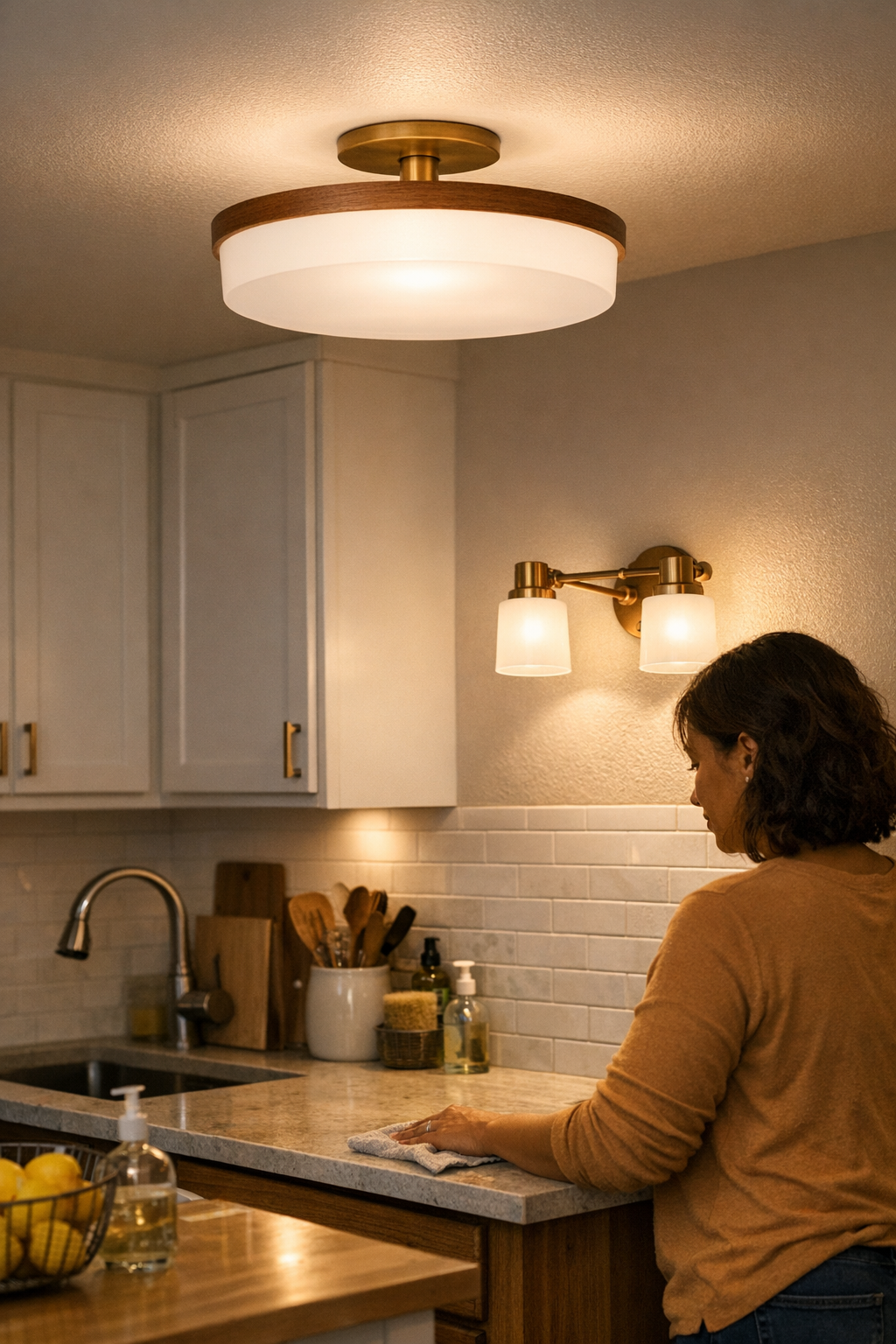
  • Why Ceiling Lighting Alone Slows Down Your Daily Cleanup Routine

    Everyday cleaning shouldn’t be a hunt for crumbs you can’t see. Yet, in most homes, basic overhead lighting creates glaring blind spots—surfaces “look” lit but force you to hunt in shadow for every last streak and crumb. If you’ve ever circled back to the same edge, leaning in just to catch what the main light misses, you’ve felt how badly the wrong setup steals time and turns quick cleanups into drawn-out, second-guessing routines. The repeated frustration isn’t just annoyance: it’s the cost of lighting that works in theory, not in use.

    Why Standard Ceiling Lights Miss the Mark in Real-World Cleanups

    The default option in most daily-use rooms is a single flush-mount ceiling light. On paper, the wattage covers everything. But stand anywhere but the exact center—scrubbing a counter, leaning over the sink, or shifting down a hallway—and the illusion breaks. The middle stays bright while edges fade, surfaces streak with shadow, and the very spots you touch disappear at odd angles.

    The constant scenario: center glare, edge neglect. A counter’s working edge sits in dullness even if its middle gleams. Hallways have a pool of light that fades as you near the door, turning movement into hesitation. Mirrors betray you from the side, lighting one cheek and leaving the other ghosted in the dark. The payoff: missed grime, repeated swiping, and movement that’s slower and less confident—room after room.

    Everyday Scenarios Where Lighting Friction Adds Up

    1. Countertop Cleanups and Missed Edges

    In the kitchen, you’re already tired, and you’re wiping down the counters at night. Shadows pool along the back edge and around the faucet. Leaning over to inspect your work, your head or elbow throws even darker shade. The overhead flush mount does little for the far side; you find yourself reaching and tilting, cleaning the same patch twice or more. Bit by bit, the cleanup drags, not because you missed a spot, but because your lighting did.

    2. Hallways That “Look Bright” But Feel Dull to Move Through

    You walk through a corridor lit by a central ceiling light. The floor ahead looks safe, but a step to the side and the wall loses definition. Turning the corner, a shoe rack or bag blend into shadowed edges. You end up either slowing your step or brushing the wall—never quite trusting your movement, even when, from a distance, the hallway “seems” lit well enough.

    3. The Bathroom Test: Surfaces That Stay Uneven

    In bathrooms, a single mid-room fixture dazzles the white sink center while leaving both mirror and faucet in patchy dimness. Grooming means shifting your angle to catch real detail, wiping means fighting both glare and shadow. Every motion turns into a recalculation—never just a single, confident pass.

    From Showroom Brightness to Real, Usable Illumination

    Apparent brightness from the threshold doesn’t guarantee usable light at eye level or work height. The true test: as you move through cleaning steps, does every surface reveal what’s left undone—or do you always have to adjust your angle, backtrack, or squint for confirmation? Overhead-only setups impress at first glance and fail during real routines, revealing the limits no catalog photo shows.

    Solving these blind spots doesn’t require an overhaul—just layering the right types of light where they close routine gaps:

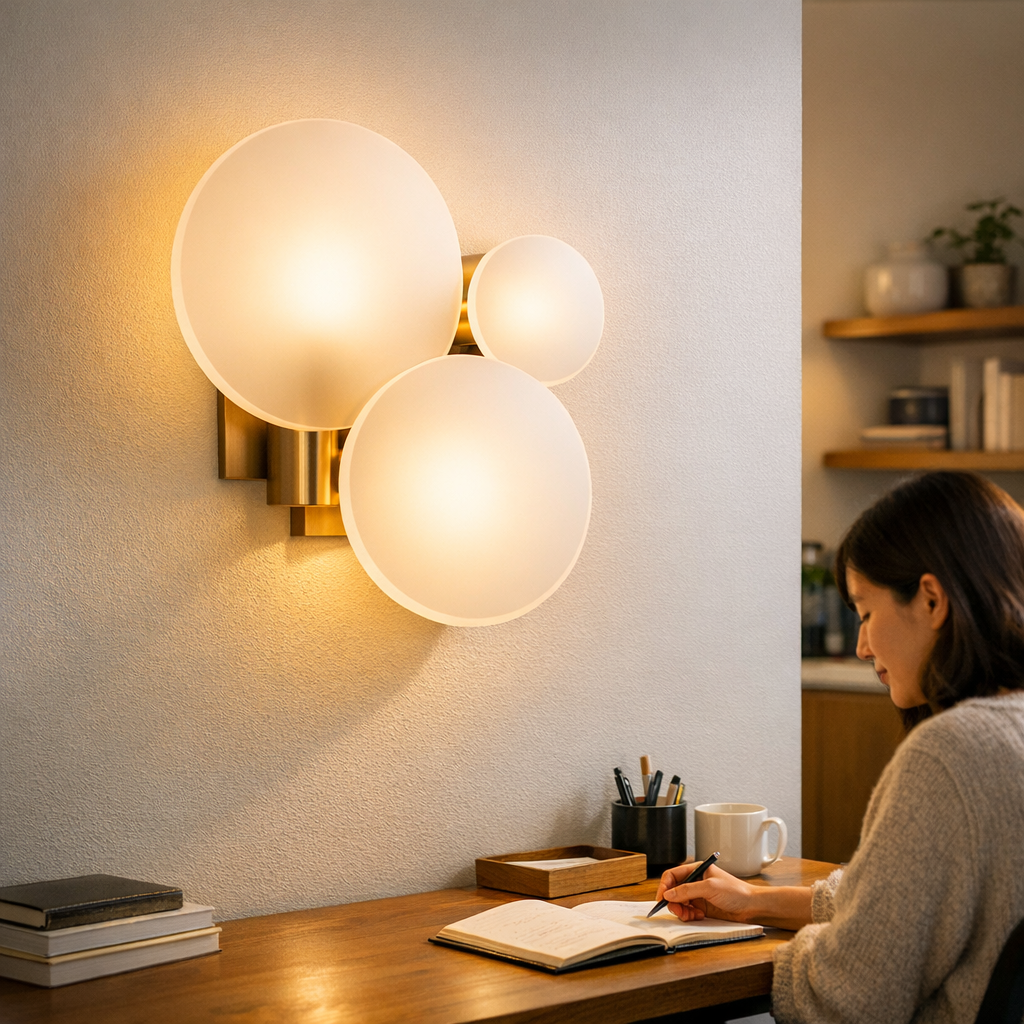
    • Wall sconces by worktops erase shadow lines where dirt collects and overheads can’t reach.
    • Under-cabinet strips, especially in kitchens or utility corners, push even, damp-safe light right down to the hands and backsplash—no missed crumbs, no long reach-around.
    • Square-diffused flush mounts overhead, paired with low-glare wall fixtures, fill the entire room with usable illumination, not just broad, unfocused glow.

    The Visible Shift: Faster Routines, Fewer Misses

    Upgrade a single dome light to a square flush-mount plus a shallow wall sconce at the critical counter, and you see the change where it matters: hands stop flattening along backsplashes, no more circling the faucet, no more hunting a better angle. Glare drops. Side shadows flatten out. That nervous pause—“Did I actually get it all?”—just vanishes.

    Routines tighten: kitchen, bath, or hallway, surfaces show dirt or water marks on the first pass; nobody’s looping around for another check. The goal isn’t decorative perfection—it’s clarity at every edge and comfort in fast, repeated movements, even if you’re hauling laundry or cleaning at an odd hour.

    Do Small Rooms and Tight Corners Still Benefit?

    In small, packed-in kitchens or cramped laundry alcoves, a single shadow means every mess is more obvious and movement is more awkward. Overhead-only setups amplify the annoyance: cleaning turns into squinting and triple-passing already-tight spaces. Targeted fixtures—under-cabinet bars, wall sconces placed at problem spots—erase these dark patches, turning dead corners into usable space without the constant mental second-guessing.

    Damp-Rated Lights: Reliable Illumination Where It Matters Most

    High-moisture zones like bathrooms and laundry rooms push ordinary fixtures past their limits. Steam, condensation, and humidity turn average lights hazy, and you’re left with uneven, unreliable spread—glare here, dim zone there. Damp-rated ceiling or wall fixtures keep output even and steady, no matter the weather or the routine. The upgrade isn’t glamour—it’s real-time confidence, less wiping blind, and one fewer source of nightly friction.

    Choosing Lighting that Supports the Routine, Not Interrupts It

    The best setup isn’t the prettiest—it’s the one that cuts through daily hassle. When ceiling and wall lights work together:

    • Work surfaces are fully visible from first wipe—no leaning, no circling, no double-checking in the dark.
    • Edges and corners finally stay found: even runs of cabinets, stair turns, and entry nooks reveal mess or trip hazards instantly.
    • Movement flows without stop-and-start: you move at your real pace—not the pace forced by “almost bright enough” lighting.
    • Cleanups shrink down to their real size. Most of all, the routine itself gets quieter, because light isn’t something you have to work around anymore.

    In spaces defined by movement and detail, lighting that bridges the gap between “looks bright” and “actually clear” isn’t a design extra—it’s the difference between a routine that drags and one that just works.

    http://www.lighthelper.myshopify.com

  • Why Fixed Liners in Entryway Storage Complicate Cleaning Over Time

    Why “Organized” Entryways Don’t Stay That Way

    Day one, your entryway looks under control: shoes slotted under a bench, bags tucked inside neat storage, maybe a new liner or two. But by day three, the gap between organized appearance and actual routine blows wide open. Shoes multiply and drift into the walking path, bags teeter and spread at the bench, and that “easy-clean” setup now hides tracked-in grit, pet hair, and muddy streaks just below the surface. What looked manageable at first—especially in a high-traffic or family entry—gets quickly undermined by the logistics of real daily use. Resetting order isn’t just about tidiness but about friction: how much work it actually takes to reclaim usable space while traffic keeps flowing in and out.

    How Fixed Liners Create Hidden Cleaning Headaches

    On install day, a fixed liner in your bench or storage zone feels like a game changer: everything crisply in place, covering exposed edges, ready for real life. But give it a week of shoes coming and going—soccer cleats after rain, lunch bags that leak, dropped coats, the pattern of a dog’s fur swirl underfoot—and a hidden mess builds up fast. Fixed liners don’t move; neither does the dirt they absorb. Every time you stretch to vacuum under a bin or try to catch crumbs stuck deep in the seam, you realize there’s no straightforward way to reset the area. Cleaning turns into a contortion routine around obstacles, not a simple refresh. The bench edge becomes a collection zone for damp socks, shoes edge outward, and each pass worsens the embedded mess under your so-called “clean line.”

    The struggle isn’t laziness—it’s structural. Fixed liners block full access. You wipe and vacuum what you can reach, but dust and grit pool at the seams, just beyond your stretch. After a weekend with bad weather, hitting “reset” means emptying the whole setup just to address a mess that’s hidden by default. Most postpone it, and the cycle of ignored dirt and clutter gets locked in.

    When Daily Drops Turn a Reset Into a Project

    Look closer after a busy week: kids’ shoes angle wider until the row blocks the path, backpacks slide halfway off the bench, umbrellas drip by the cabinet. Fixed liners absorb the fallout, holding onto every granule and darkening into a layer of residue just out of sight. The visual order is lost at the edges: you start stepping around piles instead of through a clear zone. Each time you mean to “fix it later,” the mess compounds, requiring a full disassembly when you finally run out of runway. The threshold zone is no longer a reset point—it’s a semi-permanent traffic jam.

    Removable Liners: The Fast Track to Clean Slates

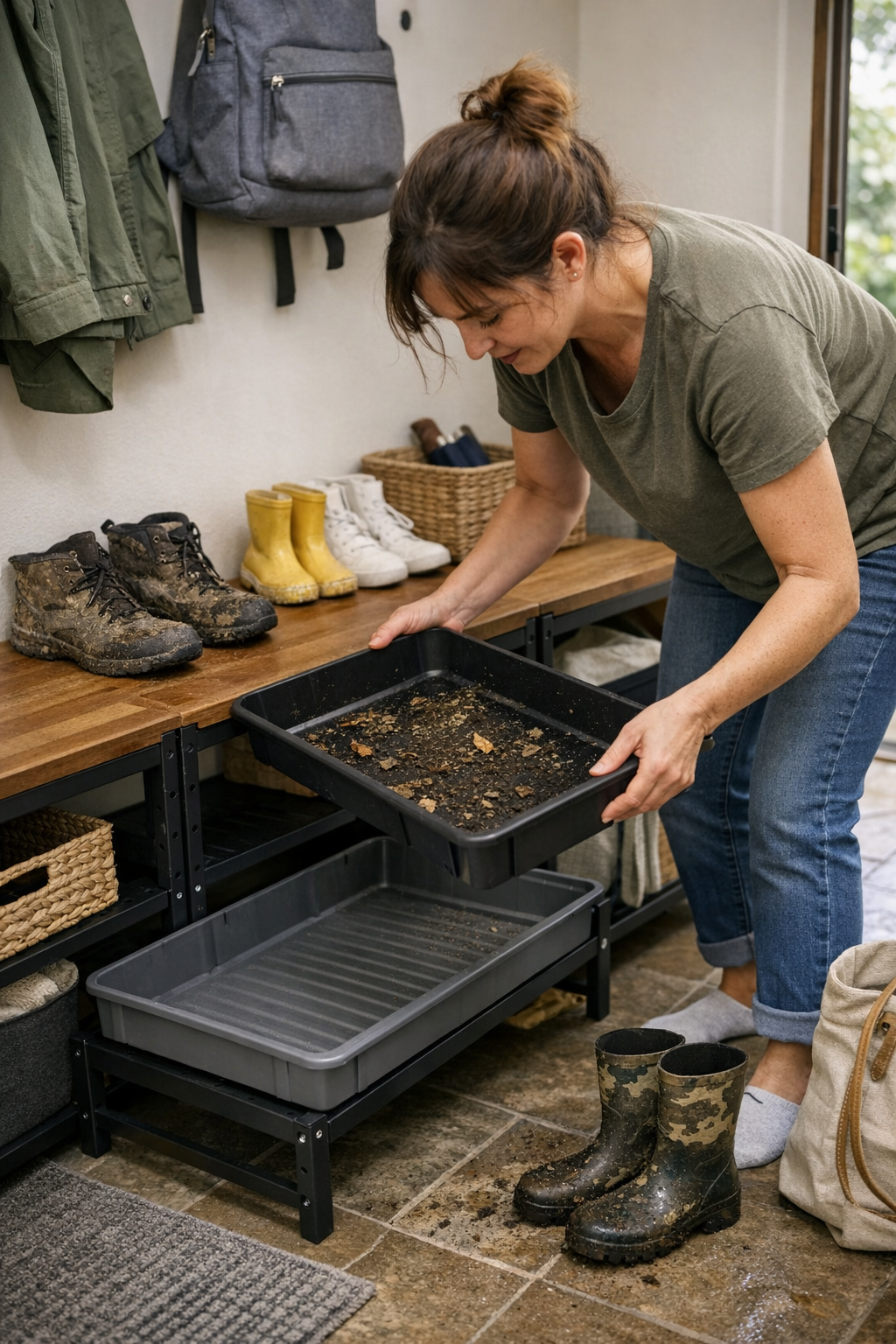
    The moment you swap in a removable tray or bin, you notice the difference isn’t about looks but speed of reset. Now, when soil or fur builds up, instead of wrestling with corners, you lift the tray or liner straight out, shake it off outside, and—if needed—quick rinse, back in. Suddenly, returning the entry to baseline becomes a two-minute break, not a looming project. Shoes can spread, traffic can spike, but the real bottleneck—awkward access—vanishes. Even one well-placed removable underlayer blocks the buildup cycle a fixed liner traps, keeping maintenance a reflex, not a chore.

    Repeated Use Beats Perfect Setups

    Display models and picture-perfect entry setups sell a promise: every shoe lined up, baskets flush, edges sharp. But once your routine kicks in—kids, pets, work gear, weekend mud—it’s the ease of reset that decides whether the area works. Removable liners match the churn of actual life. Shoe rows snake wider day by day, but cleanup doesn’t stall: snap out, shake, slot it back. No tools, no tilting heavy bins just to chase after one pebble. Restoring order becomes part of moving through the door, not an extra job left lurking until you can dedicate a whole afternoon. Reset speed and surface access become your real defense against permanent mess.

    Maintenance Gaps: Why the Wrong Setup Slows Everything Down

    Every threshold zone has a weak link—usually the spots you avoid cleaning because the setup gets in the way. Fixed liners form pockets where crumbs, leaves, and hair drift just out of reach, left to collect until the inevitable heavy reset. As shoes splay into the doorway and dropped gear claims the bench, surface cleaning barely touches what’s buried below or behind. Small inefficiencies—shuffling bags, stepping around blockers—mount up. With every skipped reset, the line between “transition space” and “overflow pile” gets harder to redraw. Real order isn’t about a one-time display but about how little effort it takes to return things to functional.

    The tell is what happens on week two: after a few storms, a couple rounds of visitors, and routine gear flow, does cleaning take seconds—or does it require moving everything and fighting the built-in barriers? Removable underlayers adapt; fixed liners make every reset harder.

    Making Fast Resets Part of the Routine

    The reality of a busy entryway is relentless: the surface cleans rarely keep up, and complicated setups just encourage delays. The only reset that actually happens regularly is the one built for shortest path—grab, lift, dump, return. Placing an extra removable tray under the outdoor boot row means you can catch heavy mud days without breaking your stride. Keeping a spare liner lets you swap when the first gets soaked—no waiting or scrubbing, just a quick exchange that keeps the space usable. With pets, a ribbed tray makes the bulk of fur a one-shake task. These aren’t tech upgrades; they’re structural concessions to how transition spaces are bombarded daily. The difference: reset doesn’t stall, and the zone stays part of the working routine instead of becoming background clutter.

    Choosing What Holds Up to Real Traffic

    If your entry sees steady flow—weather, gear, paws, and backpacks mixing at all hours—the choice between fixed and removable is really about reset friction, not just storage volume. Fixed liners deliver surface order on day one, then shift baseline maintenance into a spiral of delays and avoided chores. Removable bases break the buildup loop, restoring quick, full access so your home’s entry never has to become a permanent work zone.

    Ultimately, transition-space storage isn’t about perfection—it’s about whether you can return to clean in two steps, not ten. When reset is easy, order survives rain, soccer cleats, pet hair, and weekday rushes—making the threshold a passage, not a pileup point.

    http://www.betweenry.myshopify.com

  • Optimize Sports Gear Storage with Large Underbed Bins for Faster Retrieval

    Storing sports gear almost always looks “good enough”—until the second week of real use. You think the floor baskets or hallway hooks will hold it together, but what actually shows up is a pattern of interruptions: the missing left shoe behind a stack, the shin guard caught under a backpack, the stumble at the door as you sift through piles for gear that’s drifted away from its home. The problem isn’t just visual clutter—it’s how a weak retrieval path keeps hijacking your routine, turning what should be quick grab-and-go into repeated delays. Most setups break down not from one big mess but from five small frictions in a row.

    When “Organized” Still Slows You Down

    Shelves and baskets promise fast access at first, but gear’s natural drift takes over. Shoes stretch outside their zone. Glove pairs break up—one hiding behind a box or another family’s coat. Balls roll into corners you never intended to use, and so the “system” dissolves back into a full-room hunt. Every “reset” means rummaging through more layers, not less.

    Hooks get overloaded, baskets crowd out the walkway, and the routine grinds down: not because you don’t put things away, but because things refuse to stay sorted after just a few days of real activity. Each round gets a little slower, a little less predictable, until sorting feels pointless and retrieval always means retracing steps.

    Why Underbed Storage Changes the Routine

    A shift to underbed bins forces a real reset point, both physically and visually. Instead of open shelves absorbing new overflow and baskets turning into mini junk drawers, the bin creates a hidden but predictable zone: every piece goes back under one bed. Retrieval is single-location—either it’s there or it’s not. There’s no chase through three rooms or six drop baskets.

    That shift clears the floor for movement (and stops you tripping on a lost cleat), but the bigger win is time— you can check, reload, or return gear with one motion, not five. Still, this setup isn’t magic. If the bin fails in structure—flimsy, poorly sized—it simply hides the friction instead of removing it.

    The Common Pitfalls of Underbed Bins

    The wrong bin can sabotage the whole routine. Too shallow, and you end up shoving, folding, and compacting gear until it’s just a hidden tangle. Too deep, and the bin swallows smaller pieces—another version of the lost-item loop, only now less visible. A lid that doesn’t close means daily friction as pieces escape, and a featureless bin risks turning everything into a horizontal jumble. Instead of vertical stacks, you’re left with an endless sideways dig every time someone needs their sock or band. You still dig; now it’s just under a bed.

    Overflow Corners and the Case for Two Bins

    Overflow happens fastest with growing gear or shared family use. The “one big bin” approach invites cramming: socks vanishing under pads, balls wedged in corners, the lid always half-open as categories bleed into one another. Two bins cut the density: one for shoes and pads, the other for balls and small loose gear. Instead of emptying a giant jumble to find one mouthguard, you make one short check—and nothing rolls across the floor in the process. Dividing items also makes resets lighter and lets each bin take on a specific role, not a catch-all burden.

    Zone Dividers: Small Fix, Big Upgrade

    Internal structure inside the bin is what makes the routine stick. Even just a removable divider or soft section keeps items in place—shoes one side, pads and bands the other—so you don’t end up shaking out an unplanned mix each trip. After practice, everyone knows which pocket or section gets their gear. The scramble disappears: a five-second glance and grab replaces the ten-minute dump-and-search.

    The benefit isn’t perfection—it’s speed and fewer misses. Now you see immediately what’s missing (and what’s overdue a wash), without sitting down to upend a muddy heap. Kids can self-sort, duplicates don’t pile up, and practice starts with fewer “where is it?” moments.

    The Real Test: Can You Retrieve in Two Moves or Less?

    Storage setups reveal their value when you’re in a hurry. Can you pull and open—a single sequence—and get what you need, or do you still have to fish around for the last piece? Deep, undivided bins make it easy for pieces to vanish, especially if multiple people share the space. If categories mix, the reset cycle slows: you start seeing mix-ups, lost items, and a new round of shuffling just to cover basics.

    This isn’t just a “deep bin problem.” Oversized bins that don’t fit the underbed footprint can’t pull out cleanly. If you have to shift other furniture or lift half the bin to see inside, you lose the very gains the system should give. The right setup removes roadblocks—not just visually, but for your actual routine.

    What Works in Tight Spaces

    Rooms with low bed clearance or awkward legs typically don’t fit a one-size bin. Flexible, soft-sided options or using two slimmer, paired bins lets you split the space, avoid overfilling, and easily slide bins out even in the tightest setup. This stops bins turning into overflow zones out of necessity and keeps each return simple—no more dragging a heavy, half-stuck container out just to grab one item.

    Keeping Things Clear—Literally and Structurally

    Clear bins—or those with small windows—let you verify what’s inside immediately, breaking the “out of sight, out of mind” problem. Dividers (even color-coded, for kids) make the return flow automatic, not a guess. Instead of wondering where something was left, you see what’s missing before it becomes a crisis.

    One real-rule to prevent headaches: Dry everything fully before stashing—one damp sock in a sealed bin keeps the whole zone smelling bad for weeks, and washable liners only help so much.

    The Real Gain: Flow, Not Just Appearance

    Visual “order” can be a setup that looks good for a day but fails under pressure. The actual upgrade? A reset routine that resists breakdown over busy, unpredictable weeks. When a storage solution—divided, clear, sized to fit your room—lets you reset quickly, keeps stuff in predictable zones, and stops overflow from spreading, the space finally works with you instead of against you.

    A setup that survives five back-to-back practices and a muddy, rainwashed all-gear return is what proves itself—because any system can look calm in a photo, but daily friction is what tells you when it’s time for a change.

    Explore functional underbed storage and more at Gridry.

  • How Protecting Walkways Transforms Outdoor Storage Efficiency

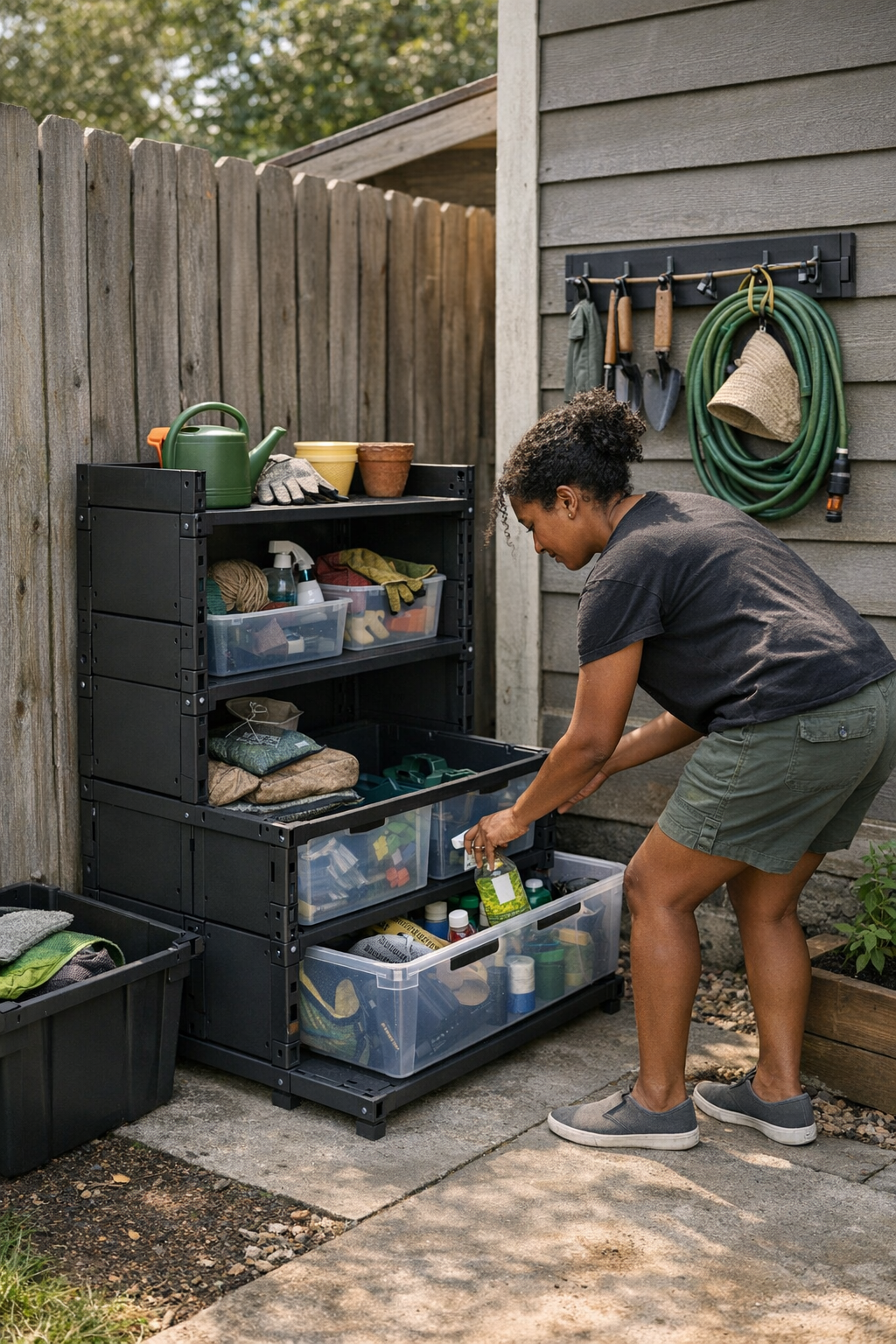
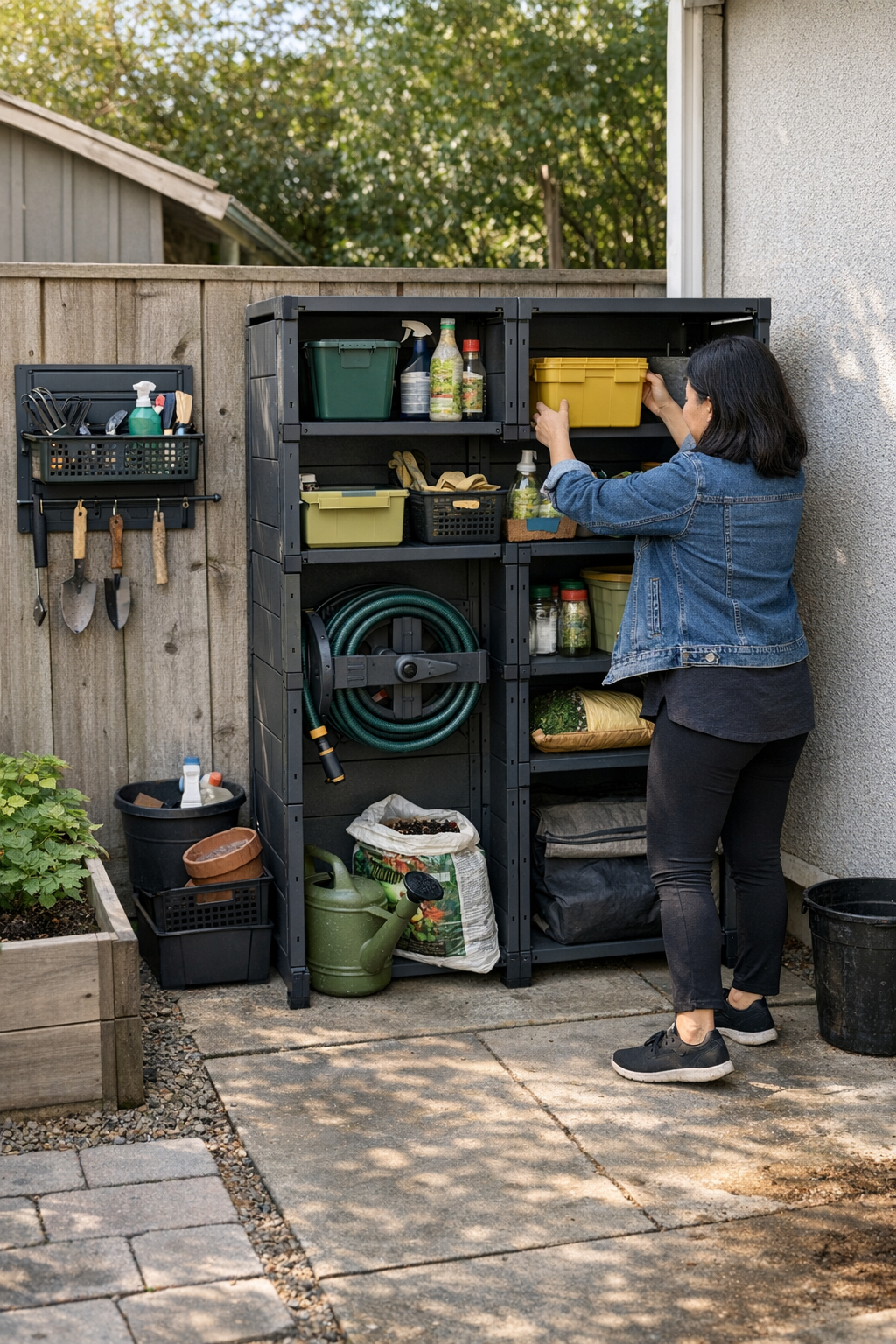
    Out in the yard, every storage decision shows up in how you move—not just how the space looks. Most outdoor storage setups start with hope: you install a trim shed, a tidy wall rack, or modular bins along the side fence, and for a moment, the disorder recedes. But then real life floods back in—garden work, trash runs, a weekend of bikes and bins—and the walk zone collapses. The route that felt “clear” on day one now demands a shoulder twist, a shuffle, or a full stop just to dodge a rake, a rogue pair of boots, or a storage unit edging too far into your path. The layout still reads as organized, but every pass through the area pulls you deeper into a slow-motion obstacle course. Eventually, the friction isn’t dramatic—it’s a buildup of hesitation, one minor interruption at a time.

    Why Footpath Space Is the First Thing to Guard

    The real trap of outdoor storage is the invisible squeeze: the path that looks wide enough until real use crowds it. All it takes is a shed edge, a freestanding shelf, or a rolling tote pushing eight inches into the walkway. Nobody grumbles at first, but soon retrieving the garden fork means skirting a hose, nudging past an awkward stack, or negotiating space with someone hauling bags behind you. What should be a one-step handoff becomes a sequence: slide this over, shift that back, step aside. It’s the same in side-yard strips and patio edges—tiny encroachments that, over several busy days, turn free movement into a slow dance of sidestepping and apologizing.

    The moment routines get even a little hectic, storage starts to leak into the path. You cut across the garage threshold during a project, drop gear in the first open spot, and by the end of the week, you’re unlocking a silent contest between what belongs in storage and what’s simply in the way. The “open” walkway dissolves into new clutter hotspots, faster than you’d expect.

    How “Organized” Storage Becomes a Bottleneck

    Even the cleanest-looking modular wall or perfectly matched bins can create trouble when they overreach the real boundaries of movement. Picture a fence lined with storage that looks streamlined—but pushes the circulation path just out of line. On a regular week, the cracks appear quickly: carry mulch sacks, steer the trash can, pass a second person with a shovel. That slim extra foot taken by storage means the main route kinks at a critical moment, so returns get messy. The rake you always reach for leans out to catch your sleeve. The wall holds your tools, but now the entry fills with scatter—seed packets, pruners, gloves—none of it in its place because the route is too tight to keep clear through daily use.

    Movement gets blocked not by lack of storage, but by the footprint that isn’t quite honest about how much passage it needs. The space looks fine on paper, but in reality the flow chokes off, and with every interrupted trip, frustrations multiply. By midweek, your “system” demands too much from anyone just trying to return a single item without causing a pileup.

    Stacking, Shifting, and the Sluggish Reset

    The stubborn giveaway of a broken setup is the quiet decay into pointless reshuffling: pausing to slide a hose so you can park the mower, wedging a bin sideways just to close the gate, or stacking gear in a clear spot thinking you’ll shift it later—which, let’s be honest, drags on for days. Wall space gets filled, but not helpfully; one awkward corner keeps pulling in overflow, becoming a “temporary” holding spot that never empties out. Even when the yard starts organized, returning things becomes fraught with minor negotiations, until suddenly reset isn’t a quick end-of-day habit but a dreaded overhaul.

    The Turning Point: Guarding Pathways Harder Than Storage Volume

    Everything changes when you treat the footpath as untouchable. Not more “decor,” not a wider cabinet, but a hard line: storage ends here. The best setups cut storage units to fit the true movement zone—wall systems pulled flush, rolling racks that can clear the line when activity ramps up, nothing crossing the path, not even “just for now.” That single rule keeps corners from becoming magnets for overflow and lets movement snap back to instinct. In real terms, this means no sidesteps with arms full, no hunting for clear floor, no losing energy to awkward shuffle routines. The storage becomes background, not a recurring part of the job.

    Even after a high-traffic weekend, the mood flips: you walk through hands-full, reset goes fast, and nobody ends up muttering about sorting out the side yard again. The difference isn’t pretty on a checklist—it’s a path that stays free without reminders, so the gear returns itself almost as quickly as it leaves.

    Visible Signs a Setup Is Working Against You

    • You have to move or tip something every time you want to step through the “clear” route.
    • Stray tools, boots, bags, or garden supplies show up in the main walk zone after each use—even though storage is “not full.”
    • Putting away one item forces you to reshuffle others or leave things half-stored just to clear space.
    • Corners accumulate extra gear for days—never truly reset, always waiting for a “later” that rarely comes.
    • Everything looks put away, but moving through the area feels slower with each passing week.

    Small Tweaks That Clear the Path for Good

    Protect the path first—even if it means scaling back storage units or narrowing a wall organizer by a few inches. In reality, a slightly smaller system that keeps every foot of walkway usable pays off daily, while spacious units that block movement will always create work. During planning, tape the path boundary and never let a unit cross it. Position rolling carts or bins so they can slip into dead space, not the main lane. After every busy stretch, walk the path: do your feet move straight through, or do you find little piles waiting for later? Adjust, clear, repeat—the goal is to make the uninterrupted walk automatic, not an exception you have to fight for.

    The easiest benchmark: if you can walk the route in the middle of the busiest week, arms full and focus elsewhere, without thinking about what you’ll have to move next, the storage is pulling its weight. That’s the difference between looking organized and living organized, and it’s where real outdoor setups finally start to hold up.

    For more practical ideas on making outdoor storage function better, visit TidyYard.

  • Why Your Organized Cabinets Fail During Real Daily Use and How to Fix It

    The Neat Setup That Doesn’t Last

    Anyone who’s ever lined up a set of cabinets or snapped together a modular shelf knows the momentary satisfaction of a picture-perfect setup. For a day or two, every bin and tray sits in the right spot. But as routines kick in, friction pops up fast—cart wheels catch, tools float from assigned spots, narrow pathways become obstacle courses, and corners meant for “overflow just for now” turn into permanent dumping grounds. The truth is, setups that look finished on Saturday crumble by Wednesday under the pressure of real use.

    When “Storage” Only Looks Organized

    The real test isn’t more space—it’s smoother movement. There’s a quiet difference between stashing things away and building a setup that keeps pace with you. Cabinets and racks promise order on install day, but repeatedly shifting carts just to clear an aisle, sliding a door around a bin you didn’t plan for, or lifting three trays to reach one screw—that’s where cracks appear. Day by day, these micro-obstacles slow you down and pull energy out of every routine. Organized storage that interrupts your flow is just another form of clutter.

    Seven Days In: The Real Scene

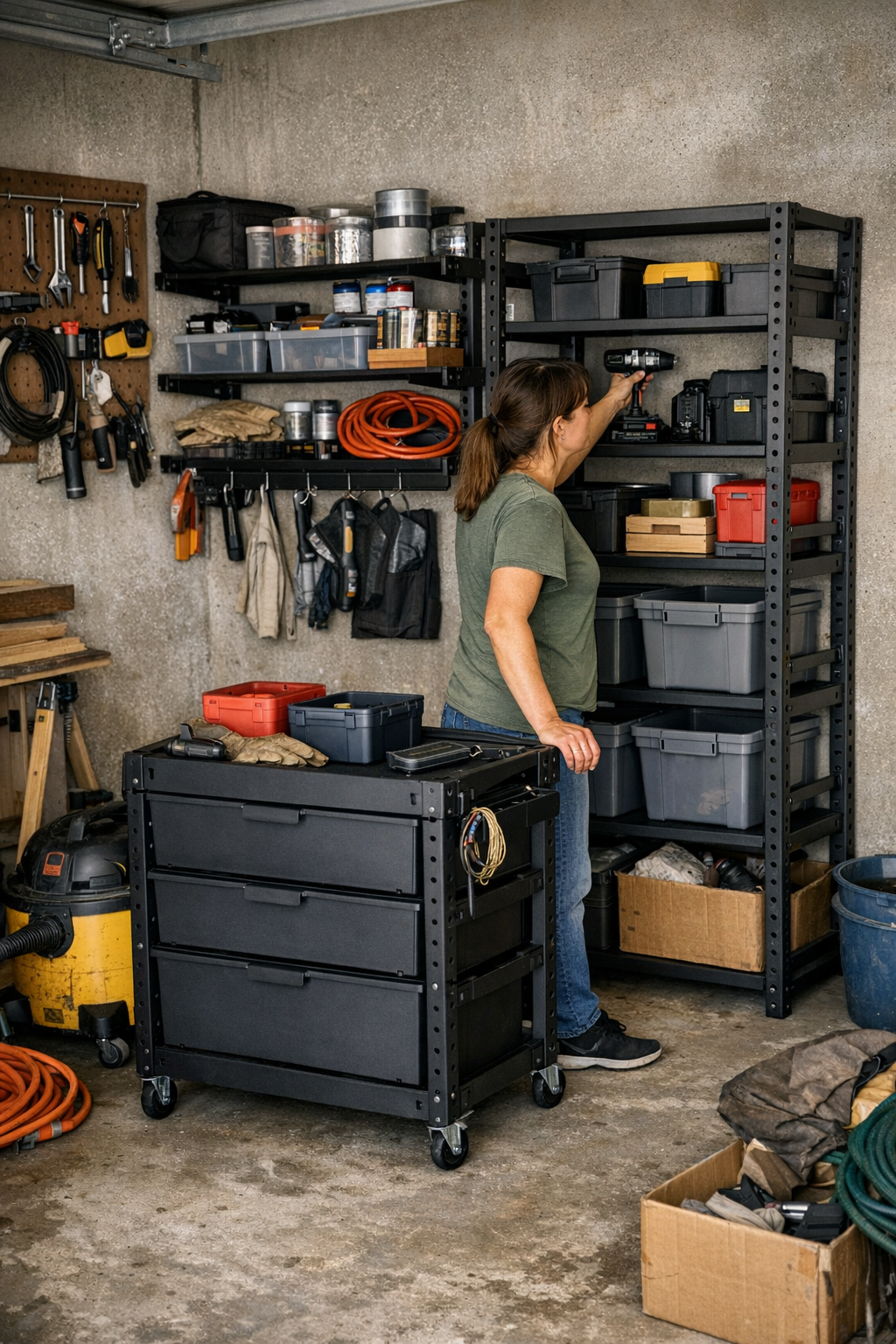
    Picture your garage or utility shed after a week of everyday projects. The shelf that started spotless now hosts “temporary” piles—garden gloves over toolboxes, a bag of fertilizer wedged behind painting supplies. The rolling cart looks parked and perfect, but every time you bring in the mower you’re forced to shuffle it back and forth just to pass. Need a box of screws? You’ll be restacking bins again, because the “logical order” from day one never survives five hurried returns.

    Tools start living on the workbench because the wall-mounted rack forces you to thread past protruding hooks or other bins just to hang them up. The one awkward corner—too small for real storage—collects everything with no home until it becomes a mini-landfill. No single moment is dramatic, yet each missed return, each detour or workaround, chips away at the tidy illusion.

    Where Setup Friction Sneaks In

    If you recognize these signs, the system is underperforming:

    • Paths that shrink as carts, bins, or doors jut into the aisle
    • Stacks or piles left “for the weekend” that quietly settle in
    • Flat surfaces buried under tools in limbo between use and put-away
    • Drawers and cabinets swinging open more often than closed, because it’s a hassle to use them
    • Feeling boxed in—moving sideways instead of striding through the space
    • Return routines getting longer, not sharper, week by week

    These triggers reveal a system that stores, but doesn’t serve. Setup pressure exposes where theory falls short of lived reality.

    Looks Organized…but Blocks You All Week

    Walk through any setup that’s supposed to be “done.” Row after row of cabinets may look sharp but force you to inch along a narrow chute, especially when both sides eat up the aisle. Stacking trays sound smart until “retrieving one” becomes solving a small puzzle. Wall racks—great in the blueprint—often end up as logjams, demanding an awkward reach every time. With each day of real use, pathways close in, piles emerge, and minor hassles quietly turn into the new routine. Visual order can mask a setup that’s actively slowing you down.

    Small Layout Tweaks, Big Everyday Payoff

    Most real fixes are about inches, not overhauls. One simple shift—moving adjustable, open-access shelves to a single wall—freed enough aisle width that carts could park without trapping you in. Suddenly, bins went back in place without shifting neighboring trays. Redesigning for open movement (not maximum storage) pried those lost inches back and made everyday resets snappier. Who needs another cabinet if you unclog the path you already use?

    Take stock after a week of normal churn: Is your main route still open? Can you reset tools fast? Or does every return risk triggering a pile-up “just for now”? Minor changes—grouping high-use items in arm’s reach, repositioning carts closer to the door, leaving one wall spare—create setups that bend to your real routine, not just your layout plan.

    Return Flow Is the Real Barometer

    The best setups almost disappear during use—you move, grab, and return without breaking stride. If you catch yourself detouring, ducking around corners, or mentally putting off the reset (“I’ll put this away later”), the system is leaking. Test yourself: Late in the week, walk your most common paths. Where do you detour, reach, or get jammed up? Adjust one element—a shelf height, a cart position, a bin location—and watch the space open up. Sustainable order comes from how easy it is to maintain, not from a quick install-day snapshot.

    Build Storage Around Routine, Not Just Floor Plan

    The right solution depends as much on habits as on square footage. Wall-mounted organizers are gold in tight corners—if nothing nearby blocks the approach. Open shelves beat deep cabinets if you’re always rotating large gear. There’s no single answer, but setups that follow your rhythms—not just the room’s geometry—hold up week after week. Pay attention to where you pause, pile up, or hesitate: that’s where friction quietly builds.

    What Actually Works, Week After Week

    The true mark of a solid system is not how much it stores or how “finished” it looks, but whether it holds together under routine pressure. Most of the time, improvement means making common zones easier to reach and resets simpler—not adding more places for overflow to hide. Smooth-functioning setups reveal themselves in how little you think about them—and how rarely things start piling up for “later.” Clarity and movement outlast neatness every time.

    Find modular storage systems, cabinets, mobile units, and workshop organization that actually work under real-world conditions at StackNest.

  • Choosing Shelf Dividers That Keep Deep Closet Shelves Organized Over Time

    The deep shelf in your closet promises more space—but in real life, it rarely lives up to that hope for long. At first, bigger shelves seem like the answer. You line up fresh dividers, maybe set some bins, and pile in your sweaters, sheets, or off-season clothes. But a few weeks later, you’re right back to frustrated digging. Stacks slump and spread, categories dissolve, and the simple act of grabbing a t-shirt can send an entire row sliding forward. The real challenge isn’t finding “storage solutions”—it’s creating a setup that actually keeps up with the chaos of daily living, rushed mornings, and the constant coming and going of real stuff, not showroom props.

    The Trouble With Deep Shelves: Space That Hides More Than It Helps

    On paper, deep shelves mean you never run out of room. In practice, they encourage overpacking and forgetting. Every extra inch lets piles stretch—and that’s when clothes start spilling over or drifting backward into the darkness. Need the towels you stuffed in the back? Prepare to unstack half the shelf to reach them. Reach for a single pullover and three more come along for the ride. If you’ve ever found a month-old sweater hidden behind a wobbly row, you know how quickly generous space turns into a black hole.

    Most deep shelf layouts ignore how we actually use our closets. Even with dividers, the wrong setup crowds things so you’re constantly shifting stacks, chasing runaway piles, or straightening after every “just one thing.” What started as a fix becomes a recurring annoyance—and most products only half-solve the problem.

    Why Most Shelf Dividers Stall (Or Fail) in the Real World

    Try a few types and the differences reveal themselves within a week. Acrylic dividers make the shelf look neat, but if you stuff soft sweaters next to those hard edges, the stacks turn curved, and grabbing one piece often bumps the rest out of shape. Wire frames flex—great for jumbled towels or bags—but their give means jeans or heavier piles sag and spill, and the boundaries you set start to blur. Bins group things nicely for the first day, but become clutter collectors with hidden socks, tangled scarves, or forgotten accessories buried below. You trade visible clutter for invisible overflow.

    Over a typical month, here’s what happens: categories merge, stacks tip or blend, and what used to be “grab and go” now means digging, restacking, and quietly cursing that one divider that shifts every other day. Routines slow down. You spend more time resetting the shelf than actually using it. Daily storage is constant friction, not the streamlined experience you hoped for.

    The Real-Life Test: Where Dividers Work (And Don’t)

    Imagine you’re late, reaching for that one shirt behind a high pile. The acrylic divider keeps its line, but as you tug, the whole stack wobbles—now you’re smoothing everything just to close the door again. With wire dividers, the rows look fine on Sunday, but by Friday, T-shirts and jeans have drifted over the lines, and you’re mushing piles together “just for today.” Bins organize on day one, but by day three you’re hauling down entire boxes to find a single pair of gloves, making the closet feel more like a puzzle than a tool. Each fix handles one issue but brings a new wrinkle into play.

    Small Changes That Make a Real Difference

    Big improvement doesn’t necessarily require a total overhaul—or another long afternoon spent reorganizing. Sometimes, switching from three narrow dividers to just two wider, sturdier ones makes your stacks resist sideways drift. A well-notched, grippy acrylic divider planted two inches behind the front edge creates easier grab zones—folded shirts stay upright and you can scan what’s there without re-stacking. Spacing is crucial: cramming too many dividers blocks access, but too few let things lean and blend.

    One practical shift: Instead of packing in dividers, aim for about 18-inch zones. This forces you to limit each section to what actually fits, keeps piles stable, and means resets after a hectic morning are as simple as nudging things back into place—rather than re-doing an entire system.

    Bins: When They Work, When They Don’t

    Bins seem like the ultimate shortcut—they tidy up stray items in one move. But unless the bin fits the shelf’s depth and your actual items, problems show up quickly. Small things sink out of sight or slide under larger pieces, and over time, the “grouped” system turns into a hidden jumble. Bins help manage seasonal gear, but for everyday essentials, they can make things harder to see and slower to grab—especially when you need something at the bottom or back. Instead of solving clutter, the wrong bin just changes where the mess collects.

    Wire Dividers: Flexible Friends With Short Memories

    Wire dividers flex for bulky or odd-shaped items—think floppy duffel bags, extra linens—but that very flexibility is their downfall for anything heavy or stacked tall. A few days in, heavy jeans start to bow the wires, sections blend, and your quickly folded “separate” piles become indistinct. Wire is forgiving, but not strong enough to hold the line where you need reliable zones most.

    How Anchoring and Spacing Beat Shelf Drift

    Whether you choose acrylic, wire, or another style, the key is how securely each piece stays put under daily stress. Locking, slip-resistant bases anchor dividers so you’re not finding them halfway down the shelf by Friday. Consistent spacing—enough that clothes breathe, but not so much they tip—keeps the system from unraveling into “miscellaneous” by the end of the week. And even the best divider can’t defeat overstuffing; once you try to force in “just one more,” lines disappear and disorder creeps in again.

    Routine tip: After restocking laundry or switching out seasons, take ten seconds to check divider positions—and resist cramming in extras “just until next time.” That short pause keeps everything aligned longer and prevents the slow slide back to chaos.

    Looks Organized? Or Feels Organized?

    There’s a difference between a shelf that looks sorted after setup and one that makes sense in the thick of your week. It might photograph well on Sunday night, but if by Wednesday you’re straightening stacks or repacking bins, the system isn’t working for your real routine. Functional storage means each section stays tidy with quick, imperfect resets—no shuffling, no silent collapse when you grab that last T-shirt before work.

    The point isn’t showroom perfection. It’s lasting clarity—visible categories, fewer disrupted stacks, and a closet you can trust when you’re in a hurry. You know it’s working when you can grab what you need and return it without fuss. Anchored dividers, thoughtful spacing, and realistic limits help your shelf support life as it actually happens, not how you wish it would go.

    Solve the deep-shelf shuffle for good—see daily-use storage options at ClosetWorks.

  • Choosing the Right Jig Saw Blade for Flawless Laminated Board Cuts

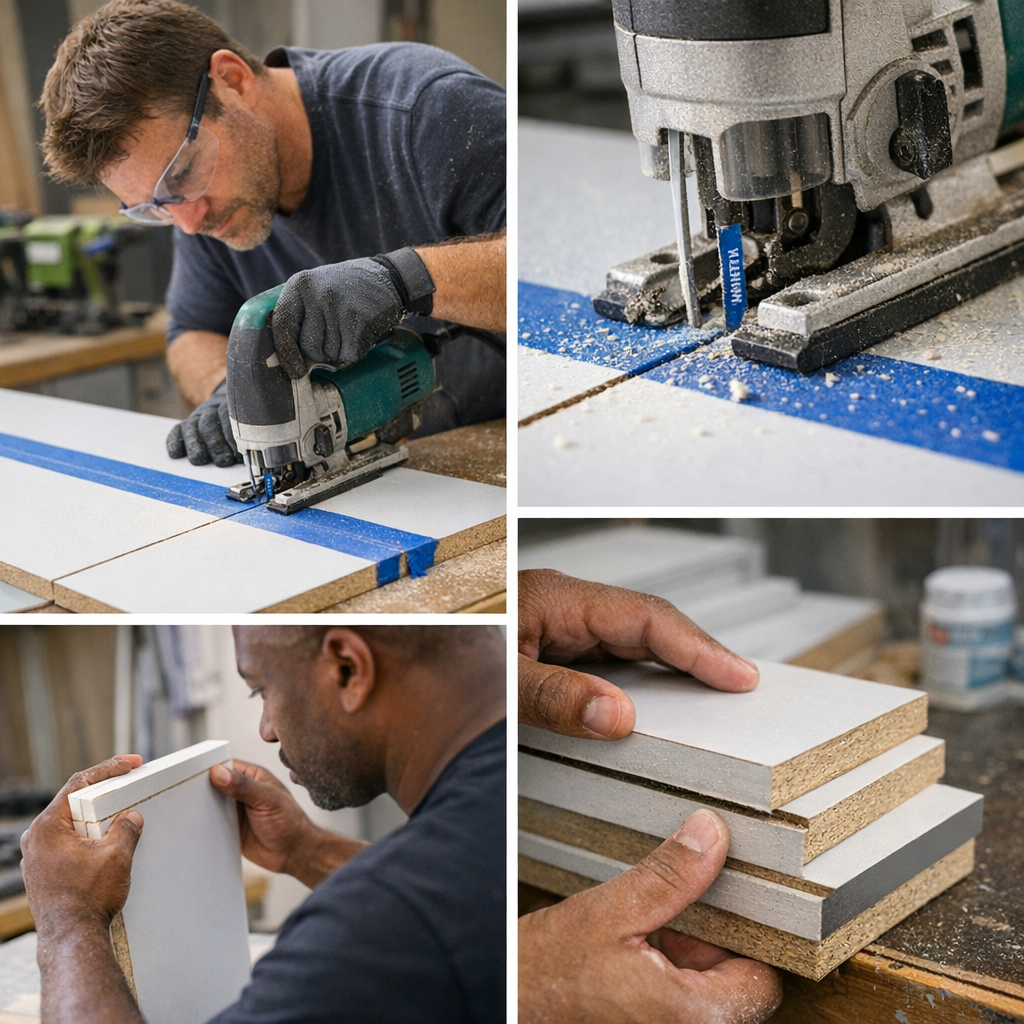
    The first few cuts almost lull you into confidence. You clamp down a sheet of melamine, snap your go-to jigsaw blade into place, and the cut feels smooth. The edge looks decent—no glaring chips, no tear-out. You lay out a second panel for shelves or closet inserts, and again the kerf seems tidy. The trap is right there: the belief that your “standard” wood blade is all you need. But that easy start rarely holds. Soon enough, the flaws creep in—invisible at first, then impossible to ignore as the project drags on, panel after panel.

    Misleading Beginnings—When Trouble Starts

    Anyone shaping a batch of laminated boards knows the pattern. The first cut feels fine, maybe the second. But by the third, the shallow confidence wears off. Small chips appear along the laminate face. Corners look uneven, and the cuts stop lining up flush. A project that started clean is now a patchwork of sanding, manual alignment, and masking mistakes. That “good enough” blade quickly becomes the root of a pile of small, time-sapping headaches—glue lines that flake apart, edges that no longer match, and visible flaws along what should be a crisp finish.

    Why Standard Wood Blades Fall Short

    It’s easy to think any blade labeled “fine finish” will handle sheet goods—after all, wood is wood, right? But if you’ve ever watched a jigsaw hesitate or snag through melamine, you know better. A general-purpose wood blade, even when sharp, bites too aggressively into hard laminate. Instead of slicing, it chews: you feel the jigsaw fighting your hands, teeth rattling and wandering. The cutline gets ragged, vibration travels up your arm, and you’re forced to steer harder just to keep a straight path. Each pass sounds harsher, sometimes even burning or melting plastic at the edge. Suddenly, you need to spend extra minutes sanding or stash the panel somewhere the damage won’t show.

    Switch to a purpose-built laminate blade—think upward-facing teeth, 10+ teeth per inch, marked for sheet goods—and those flaws fade fast. The blade slides through the face layer, not under it. The jigsaw hums at a steady pitch. You finish a board and move right to the next, not bogged down by cleanup. The difference is in the feel: less resistance, more consistent control, and a near-complete end to edge crumbling. It isn’t a miracle, but it’s a very real shift in the quality of every cut.

    The Stack Test—Where Consistency Falls Apart

    Where blade choice matters isn’t in that first satisfying slice—it’s in repeatability. Imagine trimming a run of eight white melamine panels for a home office build: the difference really shows on cuts four, five, and six. With a standard wood blade, heat builds, the teeth dull, and you’re fighting to keep the jigsaw straight. Each successive board has a little more chip-out than the last. Stack the finished pieces and edge alignment goes off—the tight, square shelf corner you had in mind shifts into a gap you’ll be filling with caulk or wood putty later.

    All of this chips away at more than just the results. Fatigue sets in. Hands tense up against vibration, wrists absorb the jigsaw’s kickback, and concentration drifts after wrestling through uneven resistance. By the end of even a short batch, you end up chasing blade errors across every downstream task—filing, gluing, compensating for inconsistent kerf, or re-marking panels that should have just fit in the first place.

    The Mid-Project Blade Swap

    No one wants to stop mid-job, reach for the blade case, or break their stride. But if you’re honest, there’s always a moment—usually after the third disappointing cut—where you know a change would save you far more time in the long run. Replacing a worn general blade with a dedicated T-shank laminate blade (10 TPI or higher, reverse-tooth if possible) isn’t just a fix. It’s a reset. Suddenly, cuts regain that first-pass quality, the jigsaw follows the line, and the edge holds up even after you’ve run a dozen boards. Post-cut sanding turns into a two-swipe routine, not a major production. And you get clear, predictable results the whole way through—no need for confidence checks after every panel.

    Field trick to keep in your pocket: For especially slick or high-gloss laminates, lay down a strip of painter’s tape over your cut line. You’ll see chip-out drop even more. Blade and tape together, you can hold edge fraying under a millimeter—enough to avoid fillers or paint touch-up, even on show faces.

    Recognizing Cut Quality—And When to Intervene

    Laminates rarely scream disaster after a single cut. But when you find yourself reaching for the sanding block after every board, or nudging corners to fake a flush fit, stop blaming the tool or the board. The culprit is almost always the blade. If cut speed slows, vibration ticks upward, or edge damage shows—even in the slightest—treat it as your end-of-blade warning sign. These moments are clues: blade fatigue creeps in slow, then ruins three panels in a row before you catch it. Changing blades or bits isn’t wasted time—it’s prevention, trading thirty seconds now for hours saved correcting flaws later.

    The lesson holds for drilling, sanding, even driving screws into particleboard: when results start slipping, don’t just push through with more force or faith. Trust your senses. If an accessory feels off, intervene before the mistake repeats across your entire batch.

    Consistency Beats Perfection

    What proves a tool setup isn’t the beauty of a single cut—it’s what happens when you work through the eighth, the tenth, or your tired, last panel of the day. Repeatable, controlled results stack up into real progress. The right jig saw blade, made for laminates, keeps projects moving predictably. Clean edges mean fewer repairs later. Less vibration means energy in your hands, not lost to the tool. Instead of wrestling for every good board, you’re lining up panels that fit, simply and reliably. No magic, just the difference between fighting your material or letting your tools help you win.

    Small changes—like swapping blades before issues build—don’t just upgrade your cut lines. They improve every phase of the job, from first layout to final install. When cut quality matters, switch early. You’ll spend less time fixing, more time building, and every panel will prove the payoff in your hands—not just in the sales pitch.

    Visit Gumboll for tools, accessories, and upgrades for the jobsite and workshop.

  • Creating a Seamless Pet-Care Routine That Minimizes Daily Friction

    You can feel when a pet-care routine starts dragging—even when the space looks organized. It’s not about dramatic messes or skipped meals. The real problem is the small, regular breakdowns: reaching for a refill bottle and bumping into clutter, finding the bowl an inch out of place after every meal, or going for a towel post-walk and realizing it’s back in the laundry. What begins as an occasional inconvenience turns into daily friction, turning basic care into repeat detours and workarounds. Over time, these small gaps drain speed, reset your habits, and make even a “tidy” setup feel off-balance. This is the difference between a pet space that seems calm and one that actually reduces effort—an everyday gap that CalmPetSupply aims to bridge.

    Early Signs of Routine Breakdown

    The routines that look calm on the surface can pile on extra work when basic details are off. If you’re hunting for the food scoop every morning or pausing to mop up crumbs because the bowl never stays put, these are early warnings. It’s often one item: a lid left on the wrong bin, a towel that migrated to the bedroom, a refill bottle shuffled behind canned food. The result isn’t just what you see—scattered supplies, a bowl askew—but the invisible buildup of extra steps and interruptions that cut into even the best-kept routine.

    Why Small Frictions Repeat

    When every item—bowl, towel, brush, refill bottle—is always in its place, pet care almost vanishes into the flow of your day. But the smallest mismatch—storage that blocks itself, a towel knocked off its hook, a brush set “just anywhere”—creates friction that keeps returning. Repeatedly digging for cleaning supplies, shifting baskets aside to get to food, or pausing to search for the right brush turns what should be automatic into a set of minor hurdles. These aren’t one-time annoyances. They’re issues that multiply because routines depend on repeated, reliable access—one missing link slows everything.

    Real Scenes: When “Easy” Routines Falter

    The gap between what looks good and what works becomes obvious after a few days of normal use:

    • After an evening walk, you reach for the towel by the door but it’s vanished; grabbing a bath towel or some paper towels eats up time, and later you’re mopping up damp footprints you meant to catch the first time.
    • The water refill bottle sits “somewhere nearby”—today it’s wedged behind a pile of treats and catnip. You stretch to fish it out, lose the rhythm of your reset, and forget to refresh the water until it’s already past time.
    • It’s cleanup time and the dustpan is in its cabinet—behind a gauntlet of cleaning sprays. Every extra shuffle costs a minute, which stacks up meal after meal.
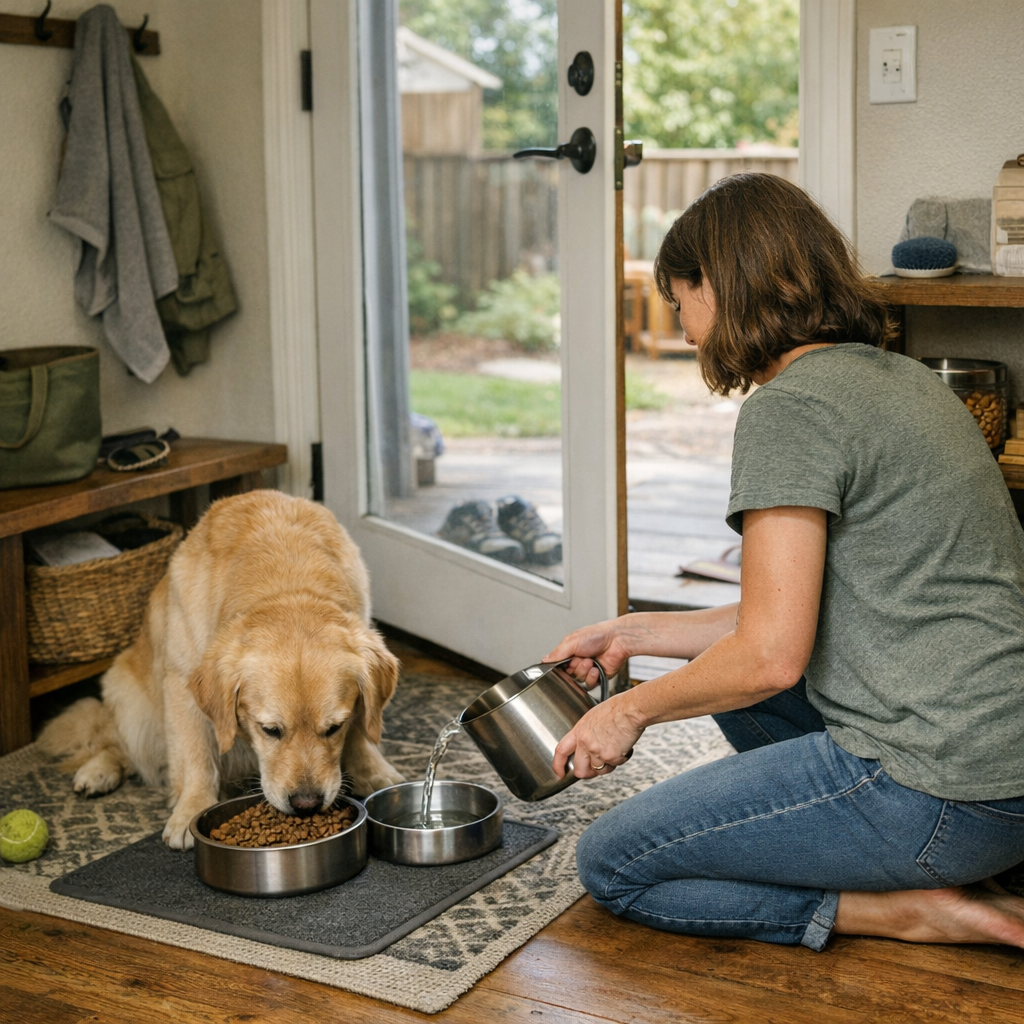
    • Feeding seems fine until the bowl slides off its mat; every meal leaves invisible traces, so the mat needs a real wipe-down at tomorrow’s breakfast, not just a quick pass.
    • Grooming tools store nicely in a caddy, but when you pull out the brush, the comb is missing. Pause, backtrack, lose momentum—mid-routine resets sneak into the core of your day.
    • Pet beds and toys drift into walkways or creak across the hall at night. What’s tidy at noon turns into late-night stumbles or wake-up clutter. You nudge things back—only to find them creeping out again next evening.

    The Hidden Cost: Extra Steps and Energy Drain

    These small snags turn into real energy drains. What should be a 30-second stop to refill water or tidy up now requires juggling supplies, detouring for a missing item, or improvising with whatever’s closest. The mess returns quickly—feeding areas get cluttered, towels backup in the laundry, and little spills reappear before you’ve caught up. Even if you organize on Sunday, if one part of the flow stays awkward or out of step, you’re back to delays and reset drags by Wednesday. Every extra grab, reach, or backtrack adds up noticeably over just a few days.

    Looking Tidy vs. Working Smoothly

    It’s easy to mistake a clean, neatly stored pet area for a system that actually works. But if you’re routinely shifting supplies, clearing the same corner for a storage bin, or hunting for a missing wipe-down cloth, the appearance of order masks the reality of effort. Real functionality isn’t about visible neatness; it’s about not having to think twice, not needing extra steps, and fewer moments where the routine falls apart after the first day or two.

    Finding Calm by Fixing Basics

    Lasting improvement always comes from fixing the core setup, not adding more storage or gear. The difference shows up fast:

    • Set the water bottle in a visible, always-reachable spot—refills never get skipped and you stop double-checking.
    • Swap to a weighted or deeper bowl so it doesn’t shift; crumbs and spills drop, and the mat’s actually clean when you check next time.
    • Keep the towel hooked right by the main door—no scramble after walks, fewer muddy streaks sneaking inside.
    • Move the dustpan out of cleaning clutter; quick resets after meals or brushing become standard, not extra.

    The result isn’t just less mess—it’s a routine that stays self-resetting. No more last-second searches, no more missing items, and no slow creep of clutter or missed resets. The system fades into the background and basic care regains its reliable, low-effort flow. Getting the setup right for your real daily routine doesn’t just make things look better; it makes them work better, every time.

    See practical setups and routine-ready solutions at CalmPetSupply.

  • How Structured Play Reduces Restless Pacing and Clutter in Cat Owners’ Homes

    Everyone with an indoor cat knows this sequence: you set out a few chase toys, aiming for a clear, contained play zone. By midweek, the promise of simple entertainment sours. Toys aren’t just everywhere—they wedge behind chair legs, disappear under the radiator, and interrupt even the smallest routine. Suddenly, reaching for the water bowl means kicking aside yesterday’s crinkle mouse; a quick sweep turns into crawling after a hard plastic bead under the sofa. What should be a low-friction setup becomes a cycle of annoyance, dragging both your flow and your cat’s mood off-balance. Any claim of “tidy play area” fades as the mess keeps sliding into your usable space—without warning, your living room turns into a field of minor rescue operations. StillWhisker owners know: it’s not the toys you see so much as the interruptions you feel.

    How Hidden Messes Undermine Everyday Calm

    Most indoor cat routines trick you with a sense of order at first. It seems like you’re set—a stash of fuzzy balls near the wall, the walkway mostly open. But inevitably, the loose setup leaks. Chase toys migrate and vanish into cracks, while you tiptoe around stray wands or lose precious seconds fishing for objects just to refill a bowl. The problem rarely announces itself; friction shows up in stacked minutes, repeated pauses, and a growing sense that every shared-area reset uncovers another tiny blockade.

    A common spiral: Three successful play sessions in, and now one ball’s stuck under the couch, a feather wand is half-wrapped around a dining chair, and a bead disappears into a radiator gap. You’re promoted from play partner to low-level janitor, forced into “toy retriever” duty as part of every evening routine.

    Cleanup That’s Never Really Over

    The mess isn’t epic, but it’s relentless. Each out-of-place toy means one more slow-down: a water refill interrupted, a quick surface wipe delayed until after the latest scavenger hunt, one more thing to shift before even starting cleanup. These aren’t deep messes, just constant nicks against daily flow. Rooms that looked clear in the morning become minefields by evening, and the “simple” reset keeps expanding from minutes to lingering frustration.

    The Real Impact on Cat Behavior—and Your Routine

    This isn’t just an owner’s hassle. When chase toys scatter, your cat shifts from play to restless patrol. Instead of post-chase calm, you get pacing, vocalizing, and nosing under doors. The visible clutter cues repeat expectation—a rolling loop of “what now?” energy. There’s no clear routine to signal play is over, so your cat lingers, unsettled. At the same time, your own routines stutter: vacuuming derailed by plastic, attempts at rest broken by a cat circling for something lost.

    Noisy Even When the Room Looks Tidy

    Even after you sweep, the quiet isn’t real. Your cat returns to the corners, eyes darting for new targets, newfound obstacles, or another spark of action to fill the gap. What looks like a tidy space still triggers tension—yours and theirs. Each time your cat paws at a hidden toy or starts pacing after play, you feel the absence of a genuine reset. It’s not just about visible clutter, but about the repeated disruptions that drain time and energy long after cleanup is “done.”

    Surface Neatness Versus Real Reset

    It’s easy to mistake a neat corner for a functional play setup. But repetition exposes the difference: what feels organized at 8 a.m. has already split open by noon. Three toys out in the morning morph into a scatter through the house by night. Cleanup isn’t a single scoop—it’s crawling after vanished pieces and reshuffling furniture just to restore order. Each sweep is less about general tidiness, more about battling a pattern of tiny, repeating setbacks that never resolve on their own. The false sense of “ok for now” becomes tomorrow’s source of annoyance.

    Interrupting the Restless Loop With Structure

    The fix isn’t just more storage or fewer toys—it’s rewiring the post-chase experience. StillWhisker setups favor anchored play: after high-energy chase, a single semi-fixed toy absorbs the restlessness, concentrating that last burst in one predictable spot. Instead of chasing resolution through scattered objects, your cat gets closure; you get a clear reset. The ripple is immediate: your routines pick up pace, the room stays open, and your cat’s energy settles faster—especially when space is tight or cleanup windows are short.

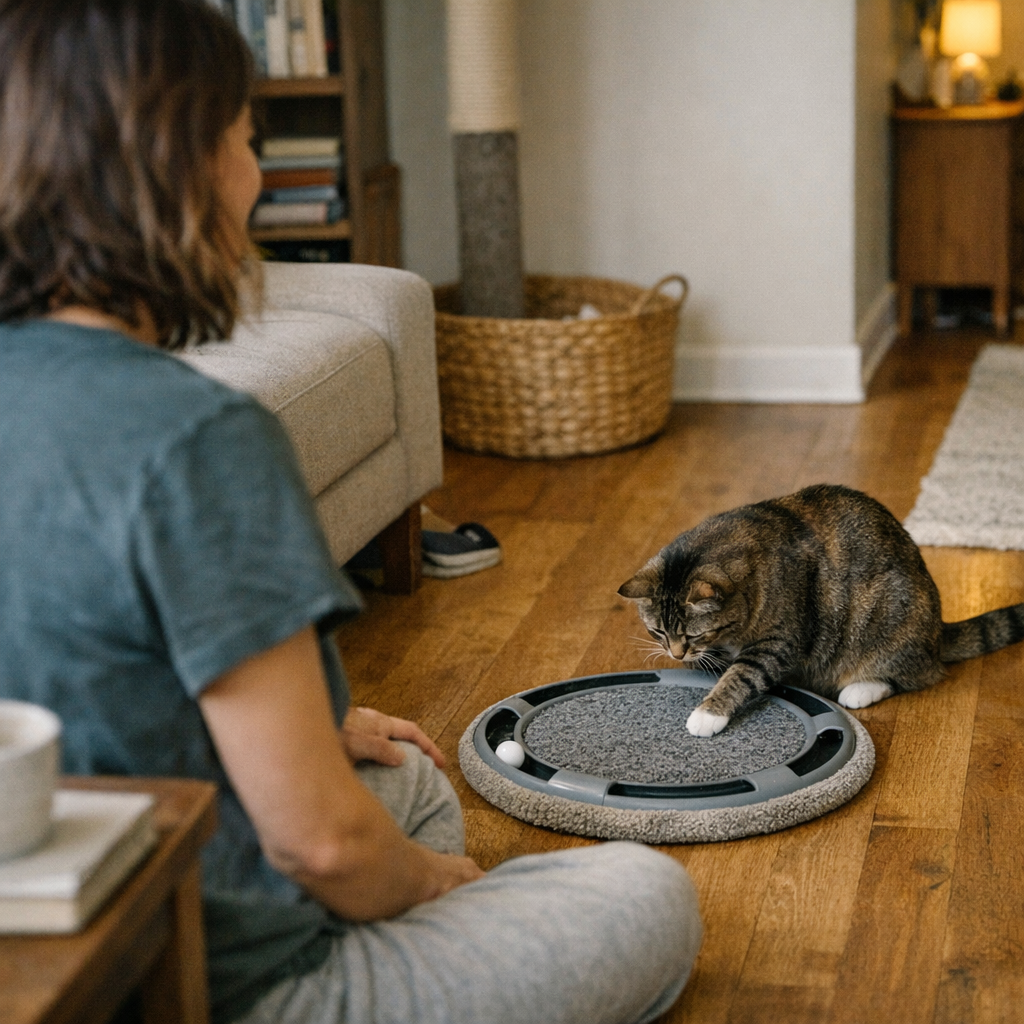
    In practice: When you swap four loose toys for an anchored mat with a built-in rolling track, the end of play points to one specific location. Your cat finishes strong, and you reset in one step: slide mat, check for strays, move on. The lingering “unfinished” tension fades, and both of you stop circling the space for what comes next.

    Containment Makes Reset Predictable

    The biggest shift in real use is reset time. No nightly battles with the broom, no hunting for a missing bead before bed. One contained zone means you move toys back once—not in pieces, not at random hours. Your main floor route stays clear, shared spaces stop accumulating friction, and those stray meows signifying extra, unresolved energy drop off. The real gain is in what you stop repeating—reset shrinks to a routine instead of a lurking project.

    Location Matters as Much as the Toy

    Position is as potent as any new toy. Anchor the wind-down activity where both you and your cat naturally move—just off the main walkway, at the soft boundary of a living area, or tucked beside a sofa. The right spot keeps play visible and the rest of the space undisturbed; your movement recovers speed, and repeated detours evaporate. Over time, your cat’s post-play behavior becomes focused, your own motion gets easier, and sprawling interruptions give way to smoother transitions between play and everything else.

    When Structure Slides: Signals to Watch For

    Even strong setups weaken under fatigue or neglect. Watch for:

    • Loose toys creeping back to corners or under hard-to-reach places.
    • Renewed late-night pacing, door-staring, or low, repetitive meows from your cat.
    • Reset times quietly ballooning—a supposed “quick pickup” becomes a five-minute search after dinner or before bed.
    • Shared areas demanding mini cleanups before you can just walk through the doorway.

    These are the flags: structure is slipping, and the cycle needs a reset. The rhythm—chase, wind-down, contained reset—brings the friction back down with minimal changes.

    Getting Repeated Use Right: Small Adjustments, Big Differences

    Perfect is rare. Indoor cat life is always moving, for you and them. The fix is almost never an overhaul—just targeted swaps and minor shifts. Anchoring a post-chase toy, cutting the number of open-ended objects, and placing the “final stop” where it fits both cat access and your cleanup route, transforms the home from a series of micro-aggravations to a pattern that fits real, repeatable routines. Sometimes that means swapping a rolling bead for a circular track; sometimes, trading a scatter of mice for a mat that won’t migrate. The missed toy under the chair may still resurface, but you won’t have to stop everything to deal with it daily.

    Recognizing the Difference Between “Looks Better” and “Actually Works”

    Tidy isn’t the measure. The real question is how quickly any setup returns to normal during repeated use, especially when no one has time or patience for heroics. The most reliable signal comes midweek, not after the deep clean: is the evening routine still being interrupted? Are you losing time to low-grade “toy rescue”? If not, structure is holding. Play that moves smoothly from high energy to organized wind-down—anchored to the right spot, reset in seconds—means the system isn’t just neater; it’s genuinely easier to live with, cycle after cycle.

    Practical improvement looks like:

    • A predictably managed chase-to-calm flow.
    • Anchored play clearing the mental load of constant pickup.
    • Containment placed in the natural movement path—no more circles around scattered objects.
    • Cleanup that’s routine—not random, not effortful, not another slowing surprise.

    This isn’t about designer home style. It’s the practical recovery of time and comfort, so both cat and human routines become easier—not messier—with each repeated reset.

    Find more structure-focused setups for real repeated use at StillWhisker.