Blog

  • Choosing the Right Reciprocating Saw Blades for Mixed Material Cuts

    If you’ve ever burned an afternoon forcing a reciprocating saw through a messy tangle of wood, nails, PVC, and metal brackets, you already know: using the wrong blade isn’t just slower—it’s an invitation to ruined cuts, wasted materials, and a forearm cramp before lunch. Real job sites rarely hand you clean, single-material runs. A neat line can turn ugly in an instant—one hidden screw, a quick hit of electrical conduit, and suddenly the saw stalls or veers off course. You can almost predict it: the ragged ends, the numbing vibration, and the steady drag that piles up minute by minute. The store wall might make all blades look similar, but when you’re deep in a remodel or an urgent patch, the wrong match is the kind of mistake you only make once—or pay for twice in repairs.

    Where It Goes Wrong: Mixed-Material Strain on Saws

    Blades claim “multi-material” or “demolition” on the packaging, but the streets are different. Out in the dust and sweat, you’re breaking through wood studs, biting into drywall, skimming plastic, then suddenly crunching into buried hardware. Every layer means new resistance, new friction. Blades made for a single material throw off more than just noise—expect handle rattle, heat where it shouldn’t be, and seams that will haunt you on final inspection. Not just chips and splinters—sometimes full-on blade deflection, chewed drywall, and the slow, creeping calamity of a cut gone sideways.

    The “universal” blade, it turns out, is often only universal in making more work. It splinters or staggers at transitions, riding up over metals, bogging down in plastics, wandering off your pencil line. What looks like a five-minute fix balloons into rework, wasted stock, and fatigue in your grip long before quitting time arrives.

    It’s the Details—Not the Packaging—That Separate Blades

    Line up any hardware display and it’s easy to be fooled: flat blades, bright labels, assurances of “versatility.” In the real world, the difference reveals itself in seconds. A high-quality bi-metal blade rated for “wood with nails” glides through a stubborn stud—even when a nail interrupts your path. No vile chattering, no scorched dust cloud, no forced blade stop. But swap in a course-toothed wood blade, and the minute you clip metal, every vibration in the handle spikes, the cut staggers, and you’re left easing the tool back onto your mark while the job grinds to a halt.

    In-Job Friction You’ll Know by Heart

    The retrofit run: Routing wire behind drywall, you’re up against pine, calcified gypsum, maybe steel corner bead. The right blade slides through with one controlled stroke—even a hit of aluminum only slows, never stalls. The wrong blade catches, wobbles, and the exit wound is jagged: nothing a round of filler can hide. Now you’re fixing as you go, not finishing.

    Emergency patch turns marathon: You gamble on a “universal” blade through spotty framing, old fasteners, and mismatched woods. The result? Saw chatter, pauses to unclog teeth, seams that force extra planing—or worse, a finish you have to sand for half an hour just to blend. Your sweat soaks in before you’re even done with the first pass.

    What Really Improves With the Right Blade?

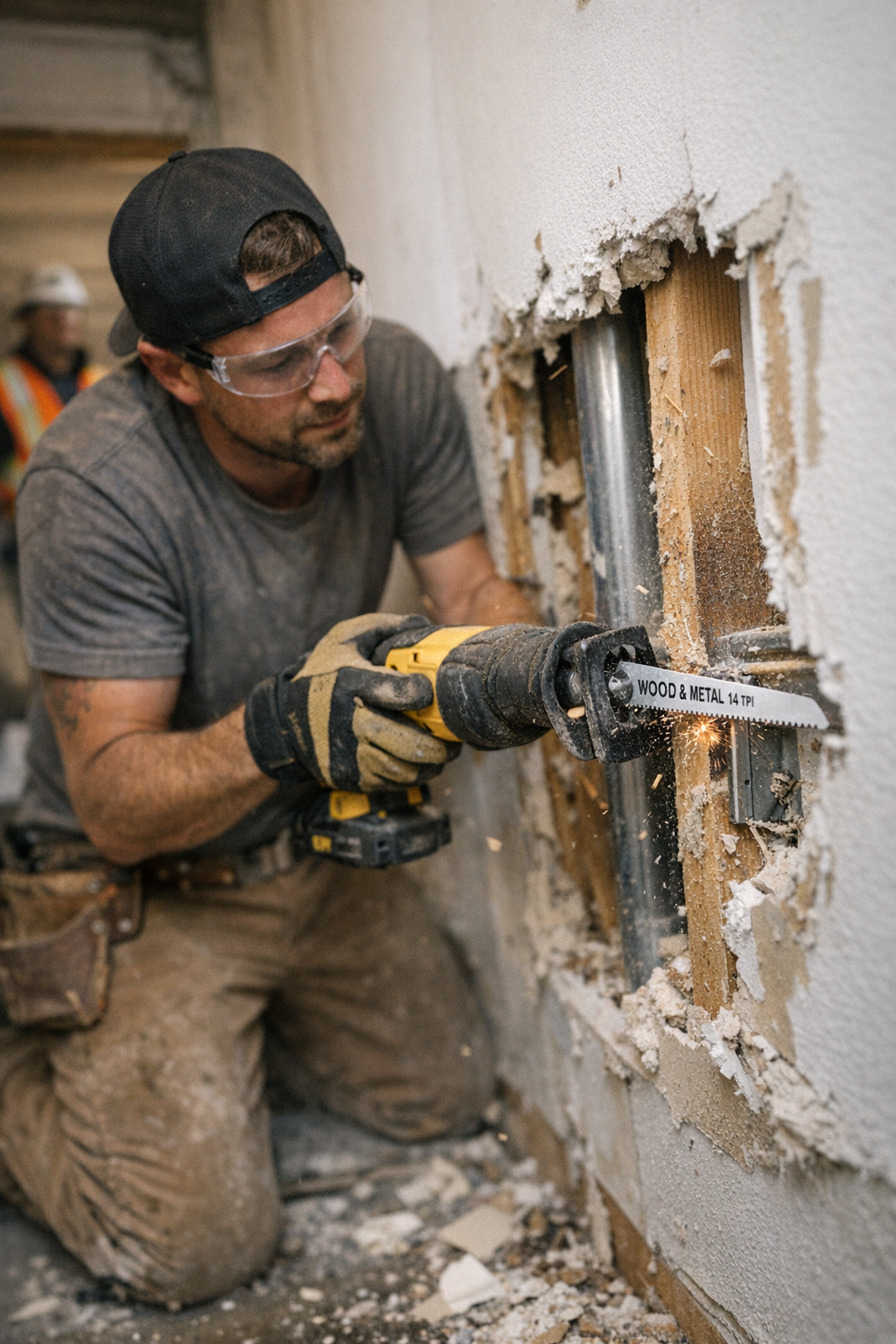
    Most crews earning their scars settle on a sweet spot: a moderate-tooth bi-metal blade—around 14 TPI—specced for “wood with nails” and “light metal.” The difference is vivid from the first stroke. Instead of hiccups every time you hit a screw, the saw just hums through. Your pencil line actually survives transitions, not just the easy lumber. Cleanup shrinks from endless sanding (ten-foot boards knocked down to fluff) to a couple of clean passes with a block. Sheet alignment lines up tight, so you spend the next hour assembling, not improvising repairs to crooked panels.

    Control improves hour by hour: No more yanking or riding the trigger, no desperate wrist work to steer the saw back on track. With the right blade, you’re steady through surprises—less fatigue means steadier hands by afternoon, and more eyes on layout instead of fighting vibration. Material loss dips, scrap piles shrink, and at the end of the day, the cut list is shorter because your first passes actually count.

    When Your Blade is Telling You Something—Listen

    A blade rarely fails without warning. Feel for sudden extra buzz as you sink from wood into metal, or if the saw just starts fighting the material harder than usual. Notice a faint burnt smell, or see blackened streaks in the dust? That’s the heat rising—teeth dull, the blade binding, and the finish suffering in real time. Ragged seams, smoke on layer changes, or the tool suddenly tracking off mark are red flags. Don’t stubborn through “just this last cut.” A two-minute blade swap can save an hour—especially if the alternative is tearing out a warped or burnt piece you’d hoped to keep.

    Universal Blades: Quick, But Not Quality

    Sure, universal blades are tempting when you’re flying blind or racing the clock. But they rarely cut clean—expect more chipping in soft woods, seam tearout, vibration in the hand that builds across the day. You can feel quality slipping: seams that never sit flush, finishing work that never seems to end, and wrists that ache before coffee wears off. Across dozens of cuts, that shortcut only stretches the job.

    Adapt or Accumulate Mistakes—That’s the Real Choice

    Mixed-material work is unpredictable—that’s the point. The best results go to those who spot trouble early: is the blade kicking more? Do seams roughen as you move through a new fastener? Pros don’t wait for disaster—they swap blades before small hiccups pile up. Your first few cuts are the signal. Miss it, and you can spend all afternoon sanding patched seams and hiding imperfections. Catch it, and you keep the job moving—less waste, fewer wrist breaks, a finished face that actually passes a close-up inspection.

    Shop blades, tools, and gear designed for real jobsite challenges at Gumboll.
  • Why Modular Wall Systems Transform Outdoor Storage Efficiency

    Outdoor clutter rarely explodes all at once—it seeps in, one mislaid shovel or lopsided bin at a time. You organize your side yard or garage edge, snap the lids shut, and stand back with relief. But give it three weeks: a rake abandoned outside the chest, a bin jammed half-open near the gate, a narrow route made tighter by something that never quite finds its way back. Even with a picture-perfect setup, the wrong system turns routine cleanup into a slow-motion obstacle course.

    Why Even Neat Setups Collapse Under Real Use

    The confidence of installing a fresh rack or shiny new bin fades quickly once daily life gets rolling. At first, you’re careful: tools get returned, gear tucked away. Then one rushed morning, the hand trowel lands on the floor instead of inside the chest. Later, the mower wedges awkwardly beside a bulky bin you swore would stay out of the path. Each retrieval means another shuffle—the subtle start of storage that resists, rather than supports, your routine.

    These tiny detours don’t seem urgent at first. But when you’re bending over to pull items from behind a trunk or inching sideways past an overflowing tub, efficiency evaporates. By the middle of summer, all those small interruptions form a single grind: your storage looks passable, but moving through it is work.

    How Floor Storage Puts Your Routine in Reverse

    Picture your most-used outdoor corner—a side-yard strip lined with standing bins, or a patio edge with a deck chest. It holds everything, so it must be working, right? Until the next weekend when the kids’ boots collect near the threshold, the coiled hose stays slouched in the walkway, and you step over a garden fork blocking a bin you can’t quite reach without moving something else.

    This is how a “solution” thickens into a new set of problems: Returning the trimmer means sliding a bin out with your foot. Hanging up a rake is delayed by a stray tarp atop the chest. Corners gather random piles because actually accessing the main trunk feels tedious. Organizing by type or squeezing in extra bins just creates more surfaces for the next overflow—and the movement path you need is choked by the very system meant to organize it.

    What Changes When the Walls Carry the Load

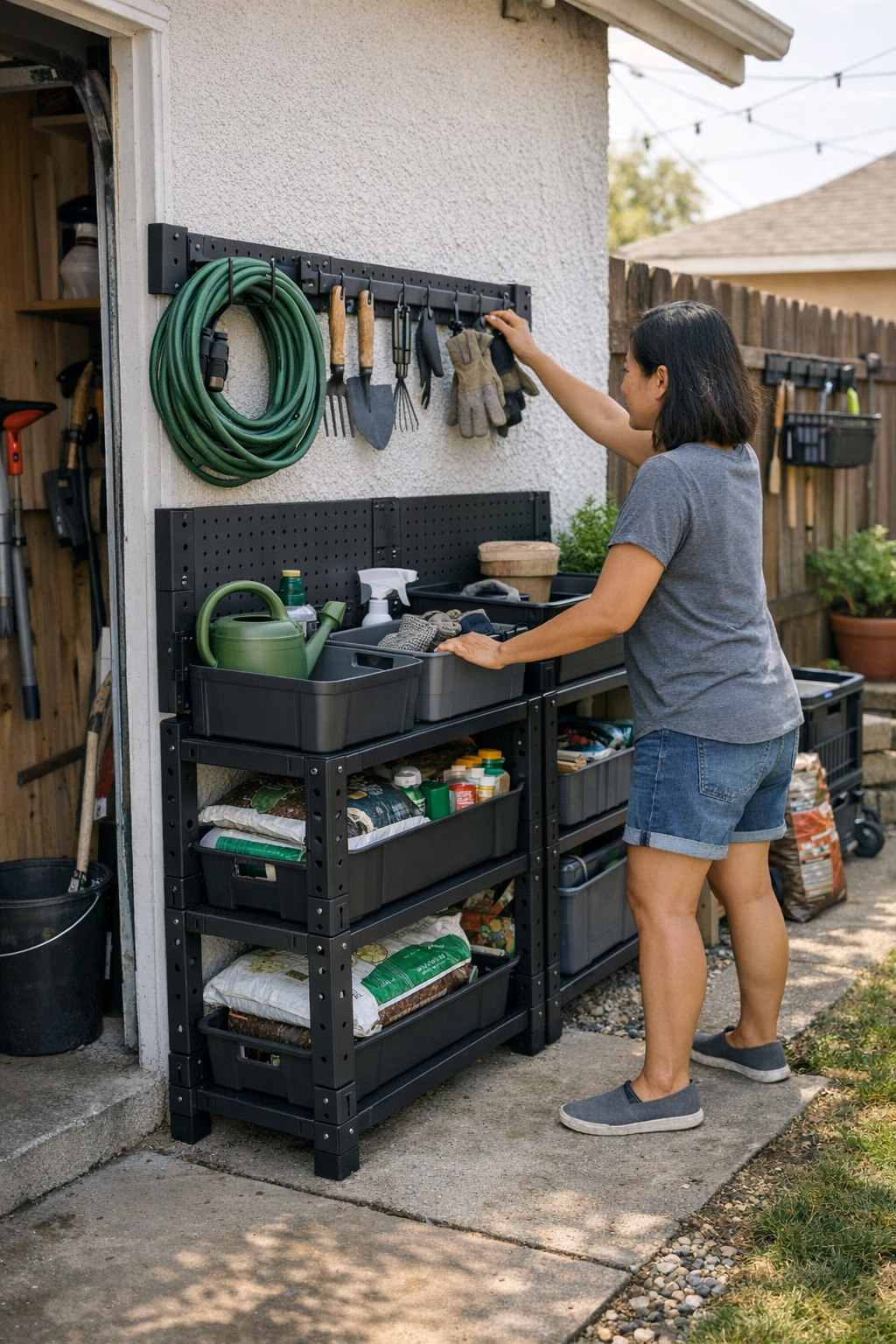
    Now swap that bin cluster for a chest-high wall rail along your fence or garage edge. Hooks and mounts stage every daily tool—broom, shovel, clippers—exactly where your arm expects them. The ground isn’t just visible, it’s clear. No lid-lifting, no pile-shifting, no side-stepping around a chest angled too close to the walking line.

    • Returning clippers? Two steps up, done. No bending or skirting past obstacles.
    • Broom missing? It’s right there—not buried, not displaced, not interfering with anything else.

    This isn’t about overloading the fence—it’s about transforming the essential movement zone. The wall system pulls gear off the floor, so returns become a smooth, natural reach, not a ritual of moving things just to get through. What looks like a small layout shift actually unlocks “reset power”—gear returns are frictionless, and movement through the area stays wide open, not rerouted by overflow.

    Small Shift, Huge Return: An Everyday Test

    It’s one thing to imagine: here’s what happens after the change. Swapping a bulky deck chest for a wall-mounted rail instantly opened up nearly a foot of cramped side-yard space. The difference landed on the first busy Saturday—clutter stopped sneaking back into the walkway, and routine gear returns required zero step-over or reshuffle. No more fishing for stuck handles mid-task, no more closing the lid atop a tangle of misplaced stuff.

    Over a month, the improvement held. Bikes came and went; spades back on hooks after use; footpaths stayed passable. Overflow didn’t drift into corners. The new boundary was physical, not wishful—movement and storage started reinforcing each other instead of generating friction with every reset.

    Spotting (and Fixing) Return Friction in Your Setup

    The best outdoor storage is invisible when rushed, not just tidy when staged. So ask yourself:

    • Does putting away a rake trap a bucket behind a flipped bin?
    • Are you shifting containers every time you reopen the main path?
    • Is there a corner that magnetically collects piles despite “systems”?
    • Is your normal return slowed or derailed by one awkward holdout?

    If yes, it’s the system’s routine, not just its order, that’s failing. Labels and categories don’t rescue a layout that keeps the ground busy and the core route in flux. Even color-coded bins mean nothing if you’re caught untangling the same traffic jams after every project.

    Wall Real Estate Beats Floor Real Estate—Every Time

    Ground you don’t have to cross is value you feel instantly. Open floor space means fewer stumbles, cleaner lines, and a real path even in high season. A wall rail or rack lets every tool move separately—no shifting the domino row if you need something in the middle.

    And unlike “discipline-dependent” systems, this method doesn’t falter the first time you skip a perfect reset. Good wall setups hold the line, quietly shaping your returns and routines for weeks—while floor bins, however pretty, turn into storage speedbumps as soon as life speeds up.

    Practical Tip: Walk the Reset—Don’t Just Map It

    Before calling your setup done, physically act out your busiest reset. Grab the usual mess: shovel, bucket, rake, boots. Set them down, put them back, retrace your steps. Does the system slow you or make you adjust to it? If you’re looping or hopping over obstacles, keep refining. The best setup is the one you barely notice once real life resumes.

    The True Goal: Storage That Disappears Into Your Routine

    Functional outdoor organization isn’t hidden, it’s harmonious: the side yard, the fence line, the garage threshold—all work together, not against your daily paths. The right setup earns its keep by keeping movement clear and reset simple, no matter how many times you use the area. When your path stays open—and storage quietly stays aligned—you stop fighting the corner, and your space starts making sense for how you actually live outside.

    Visit TidyYard for practical outdoor storage solutions.

  • How Smart Carry-On Packing Speeds Up Airport Exits Every Time

    What slows down carry-on travelers isn’t usually baggage weight—it’s design friction, especially when time or movement matters most. Zip a bag perfectly before the trip and everything looks in order. But as soon as you start moving—security lines, sudden gate changes, crowded boarding—small delays pile up. Instead of a confident pass through security, you’re stuck wrangling tangled zippers, shifting out-of-place pouches, and searching for boarding documents lost under layers. The bag that seemed so “ready” in your hotel room can unravel the moment you’re forced into repeated access.

    When “Organized” Isn’t Fast: The Trap of Visual Tidy-Up

    It’s easy to mistake neat packing for good travel flow. At security, you reach for your ID, only to realize it’s pinned under power cords and snack packs. A single document pull turns into full-bag shuffling with stressed eyes behind you. That organized grid of pouches means nothing if it scatters on the first tray, or if you spend every checkpoint re-stacking items that should’ve been instantly accessible.

    Well-packed doesn’t always mean well-designed for movement. Most carry-on plans work until you need speed: pulling out a passport at a gate, checking a ticket in a crowd, or grabbing tech before the tray hits the belt. The weakness isn’t cosmetic—it’s in how many steps it takes to extract a single item.

    The Subtle Slowdown: Micro-Delays Add Up

    Every time you fumble for a boarding pass buried under travel gear, you’re feeling a flaw in your carry-on’s logic. The problem isn’t obvious after the first quick search—it builds up with each terminal and checkpoint. After a layover, you find yourself hesitating, double-checking pockets, and shuffling items around every time you need something small. Multiply that by four or five “quick” retrievals, and the lost moments break your flow, forcing you to reset your bag mid-journey instead of breezing through.

    Security Trays: Where Packing Choices Are Exposed

    The airport security tray exposes the difference between quick-access setups and slow, “tidy” ones. If your passport or laptop hides behind pouch layers and secondary zippers, each check becomes a minor project. Remove an item, rearrange, fight the zipper, and repack—there’s a visible strain as the line moves. The cost isn’t a dramatic scene; it’s in the repeated small slowdowns and the uncomfortable sense you’re falling out of step with everyone else.

    Gate Waiting and Boarding Lines: Retrieval Under Pressure

    Boarding lines highlight the weakness of “nested” packing. When travel documents or headphones are stuffed beneath other layers, you can end up digging around while others press forward. With every extra unzip or accidental spill, your packing starts working against you. The crowd feels tighter, your motions get more frantic, and what started as “plenty of time” shrinks to “hurry up.” That slowness is not an illusion—it’s the result of setup habits built for appearance, not movement.

    Overlapping Compartments: The Hidden Projectors of Delay

    Stacking multiple pouches or stuffing everything into layered zones seems efficient, but these overlaps become friction points. The impact is subtle but constant: every reach for a document means disturbing tech cables, snacks, or unrelated gear. You’re not just accessing—you’re clearing obstacles. The bag looks sorted, but its structure interrupts you again and again at each checkpoint and boarding squeeze. Each disturbance adds mental drag, turning every “quick step” into an avoidable slowdown.

    One-Step vs. Multi-Step Retrieval: The Deciding Factor

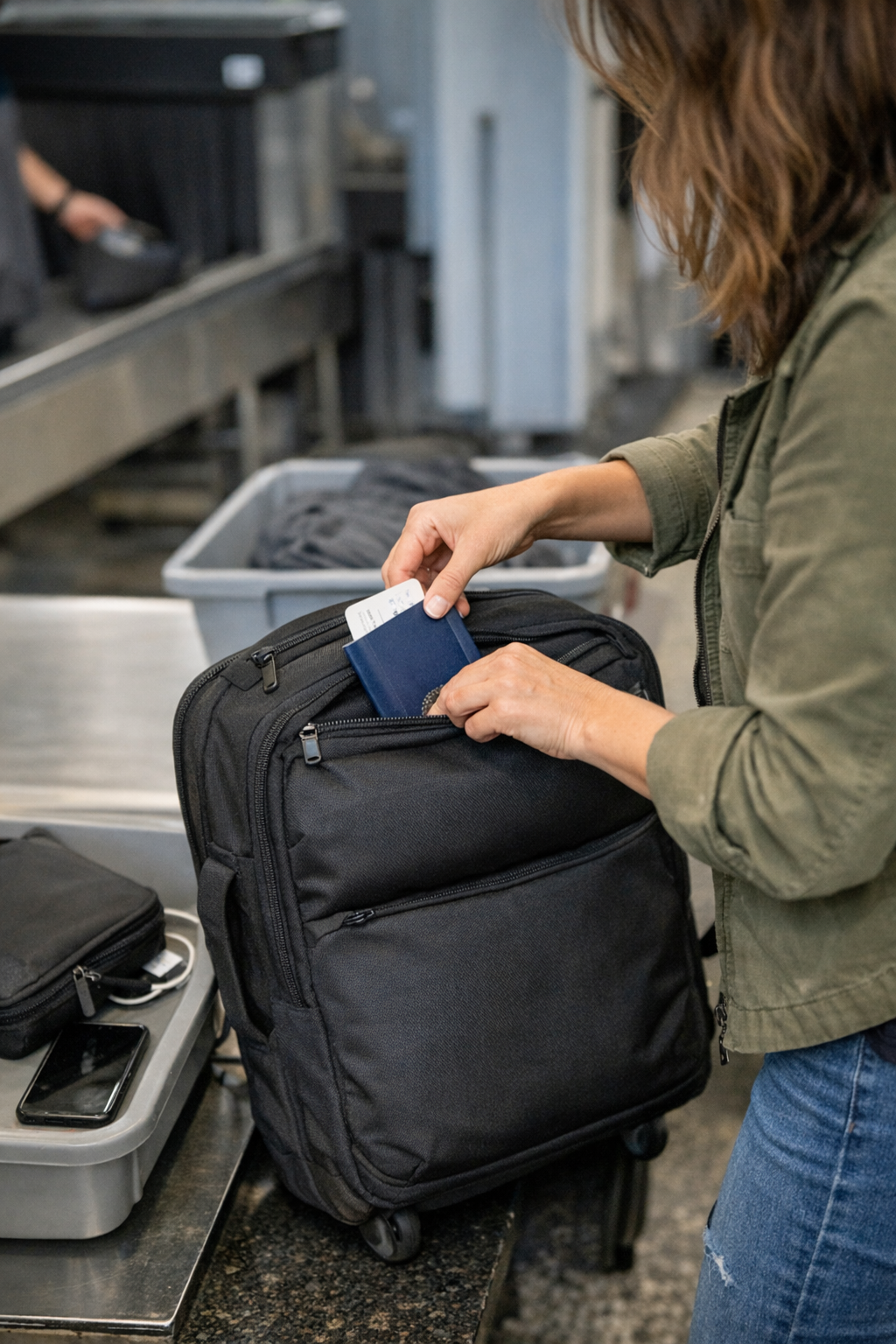
    The real shift happens when travelers dedicate a one-step route to their essential items. A single, immediately reachable outer pocket makes passports, boarding passes, or key tech easy to grab—no digging, no detours. This isn’t about adding more pouches; it’s about separating high-frequency items from anything you won’t touch until arrival. When you can unzip, retrieve, and reclose a pocket in one motion, your bag stops being a bottleneck. Routine checkpoints go faster. Repacking is minimal. You spend less time reconstructing your bag and more time actually moving through the airport sequence.

    The improvement sneaks up: after only one or two trips, you stop asking, “Where did I put that?” and simply act. No more reflexes wasted on re-organizing. The tension in line fades, because you trust the setup and the order holds under pressure.

    Real Repeated Use: Where Tidy Structure Crumbles

    Carry-on systems reveal themselves over repeated use, not on the first run. The pristine “order” of your first segment unravels after the third security check or boarding hold-up. Fatigue creeps in, crowds thicken, and a well-laid row of pockets ends up jumbled. Repeated adjustments aren’t just annoying—they underline that visual order can’t substitute for access during present-moment travel. Rushed repacking, tiny misplaced items, or a buried pouch all become headaches that multiply over the course of a single day’s travel.

    Carry-On Access in Tight Spaces: Aisles and Overhead Bins

    Nothing exposes setup faults faster than trying to get your earbuds or wallet while blocking the plane aisle. One zipper stall turns into holding up boarding; grabbing from a shared pouch tips the whole bag. The inconvenience isn’t just lost seconds—it’s the uneasy attention of others, the awkward angle of lifting a bag from the bin, or fumbling for a hidden compartment under pressure. As trips stack up, these aren’t isolated blips; they’re recurring signals that your system isn’t handling real movement well.

    Reducing Friction: Design for Movement, Not Just Storage

    Reducing travel friction means building your carry-on setup around transit, not only storage. The most consistent fix is a truly separated, external pocket or document slot just for high-frequency items—travel documents, IDs, phone, headphones. Assigning each critical item its own direct-access space (and refusing to stack unrelated gear within) streamlines every phase: security, gate boarding, seat entry, and hotel arrival. No split-second search under pressure. No accidental mixing of snacks, chargers, and passports. Each motion is simpler, faster, and doesn’t require a mental repacking reset after use.

    This isn’t about shrinking your packing list or adding organizer after organizer. It’s control by subtraction: fewer access layers, no overlap, and a setup that flexes for movement—not just for looks. Every time you move, the bag delivers exactly what you need in the order that you need it—minimizing those familiar, friction-filled moments with each trip segment.

    The Practical Payoff: A Bag That Moves With You

    Switching to a purpose-built, quick-access outer system reveals its value within a single airport run. Documents pulled without unlayering, zippers running without jams, and every repack needing just a single motion. Even as schedules change or crowds grow, your setup holds. The real gain isn’t a still-life of “perfect order.” It’s not losing your rhythm—resetting from each access without breaking stride, keeping your head in the journey instead of in the bag.

    The best proof: momentum. Travel routines repeat, but the delays don’t have to. By making smarter setup choices, you skip the mistakes—micro-repacking, buried pouches, traffic-jam zippers—and build a carry-on that actually supports in-motion travel, not just storage on a bed.

    Visit CarryOnSupply for practical travel tools designed for real carry-on movement.

  • Small Daily Resets That Keep Your Pet Care Routine Running Smoothly

    How Small Details Shape the Success of Daily Pet Care

    Every daily pet routine depends on tiny resets most owners barely notice—until they start going wrong. The cracks don’t show with a single missed wipe-down or a brush dropped wherever. But as days stack up, the fallout becomes hard to ignore: food bowls with hardened crust, towels nowhere near the porch after a late walk, water dishes empty when you’re already in a rush, grooming tools lost under stray laundry. What begins as a passable setup quickly turns into a slow drag on every care habit, each missed step multiplying hassle while the area outwardly looks “fine.” The difference isn’t in dramatic mess, but in those silent moments where the system you thought was simple quietly stops working. This is the practical world behind every CalmPetSupply setup—where ordinary feeding, quick cleanup tools, and visible storage make or break the flow.

    The Cascade of Missed Resets

    Reach for a pet bowl in the morning and you might find a ring of dried food that could’ve been wiped away last night. Look for the brush after a quick groom, and it’s wedged behind toys or mail instead of a known shelf. With each “I’ll do it later,” seconds turn into sidetracks: bowl rims collect buildup, water top-ups require an extra trip to find the refill bottle, grooming supplies drift deeper into the closet, and basic tools disappear from where you actually need them. After a week, routines that looked smooth on paper now include regular detours, with slowdowns settling in around every corner.

    Real-Life Roadblocks in Daily Routines

    It’s easy for a pet-care setup to look organized but create its own snags. You wrap up an evening walk and reach for a towel—only to find it missing from its hook, leaving you juggling a damp leash and tracking water into the room. A nighttime water refill gets derailed when the bottle’s already empty, forcing you to break focus and hunt for a backup. These routines don’t fall apart all at once. Routine friction builds in tiny ways: a bowl stacked just out of reach, a tool buried under clutter, or a necessary item stranded in the wrong room. Over time, what should be quick turns into a series of half-finished handoffs and chores that start bleeding together until even basic care feels unwieldy.

    The Invisible Drift: Tidy Enough, Still Not Easy

    An area that looks “cleaned up” can keep letting you down in real use. You might gather everything to one side of the room, only for the brush or towel to wander off again three routines later. Toys find their way back into high-traffic paths. Food bowls end the day half-full, left to dry out and get crusty by bedtime. Beneath the appearance of order, weak links keep resetting your efforts: a refill bin just far enough away to be skipped, a towel never dry or nearby, a grooming tool that’s always missing when needed. These small breaks mean the routine demands repeat corrections instead of quietly helping you move through care without a second thought.

    Effortless Routines Start at the End of Each Task

    A reliable pet-care flow happens when resets are built in right as the task ends, not as a forgotten afterthought. Hanging up the towel the instant you finish the wipe. Topping off bowls or water as you set them back. Stashing brushes or nail clippers in one open bin by the main traffic zone rather than anywhere with an open space. The effect is immediate: one dedicated hook on the porch keeps the leash from migrating indoors, while a simple caddy by the litter box means no backtracking for wipes. Even the smallest improvement—a drawer just for treats, a matching towel next to the door—might not seem like much, but in practice, it deletes a headache before the problem even appears.

    What Happens When Resets Slip?

    Skip one reset and the slowdown isn’t obvious—wait three or four routines, and the accumulation turns invisible mess into avoidable time loss. Miss a single nighttime bowl wipe and that sticky crust becomes a project in the morning. Delay a water refill and suddenly you’re interrupting your day for a task that should have taken seconds. Items without a real home spread out—forcing repeated shuffling of toys, hunting for towels, or navigating around leftovers that block actual cleaning. Pet care turns from a contained routine to a drawn-out string of interruptions, easy to put off and even easier to let pile up until the whole area feels off-balance.

    Practical Fixes for Everyday Care

    What actually works isn’t piling on new organizers or going for spotless. It’s establishing real signals and placements where your routine breaks down. Put a towel hook where you always exit, even if it only holds one towel. Keep the water station along your natural path, not tucked away. Make the grooming bin easy to open and always returned to the same spot. These are the setups that solve tomorrow’s scramble before it starts—with one brush consistently right where it’s needed, one leash never drifting, and resets so frictionless they blend into the end of your habit rather than becoming their own task.

    Conclusion: Keeping Routines Ready

    Pet-care routines rarely fail in one big moment. They unravel through every small reset skipped, every tool not returned, and every refill delayed “until next time.” The only routines that keep pace are the ones with built-in, nearly automatic resets: a wipe always within reach, a storage spot that never changes, a towel that actually dries by the door. Line up your setup for this kind of follow-through, and you make staying on track nearly effortless—while each shortcut costs you with real, repeated inconvenience. The right basics, placed where the friction happens, keep daily care simple and ready.

    See everyday solutions at CalmPetSupply.

  • How Wall Lighting Transforms Evening Rooms Beyond Ceiling Fixtures

    The first sign your ceiling light isn’t enough isn’t darkness—it’s the small, daily friction that starts piling up. Edges of tables go dim. Corners and shelves fade into uncertainty. You reach for something on the counter and miss. The room looked “done” when you installed that bright, clean overhead fixture, but within a couple evenings, the setup feels unresolved: conversation zones half-lit, faces unevenly shadowed, and surfaces that never catch enough light along their edges. This isn’t just about needing more lumens or replacing the fixture; it’s the inescapable blind spots of top-down lighting, especially after living with it through the real rhythms of your evening routines.

    When Overhead Lighting Falls Short—And Why It Keeps Happening

    It sneaks up the second you settle in. A group meal exposes the short reach of the ceiling light; people at the far end eat in partial shadow. Later, you’re stretching to see what’s on a shelf, or you realize you’re always turning your chair to dodge a glare band. Beneath the neat appearance—no cables visible, floors completely clear—surface-level “brightness” gives way to an unsettling flatness. Visual edges blur. Shared zones become awkwardly generalized. After a few cycles of bumping into these same problems, the frustration is hard to write off as a fluke.

    The Problem Isn’t Just Brightness—It’s Vertical Surface Blind Spots

    One major flaw: most ceiling fixtures ignore vertical surfaces almost entirely. They flood the floor and catch the center of the table, but wall edges and shelving sit in a dull gray. Bookshelves become shadow banks. Artwork disappears before night’s half over. Suddenly, you’re hauling in desk lamps or flicking on every under-cabinet light just to make corners usable. Even high-rated fixtures “underperform” in the spaces where daily work and storage actually happen. For every task, it’s coping—moving gadgets, squinting at margins, compensating instead of just using the space.

    Wall Lighting: Giving Shape Back to the Edges

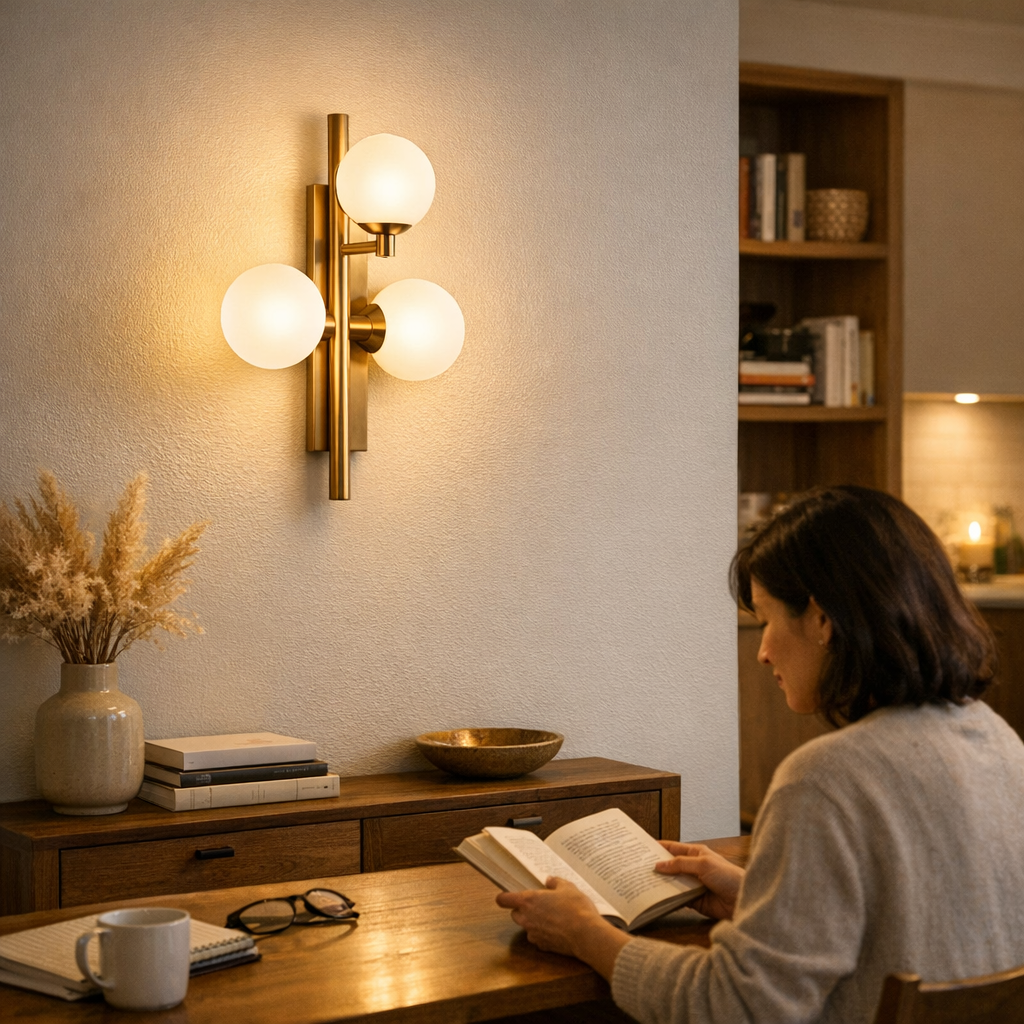
    This is where wall-mounted lighting stops being a “nice to have” and starts feeling essential. Sending light horizontally, wall fixtures reclaim corners, show where shelves begin and end, and make edge storage as usable as the room’s center. The difference is obvious in any space where routines cluster away from the ceiling’s brightest circle: bookcases, workstations, dining nooks, even hallway seats. Suddenly, the silhouettes at the far end of the table become faces. The spine labels on the shelf are legible without a hand lamp. Details lost to dim edges come back into play.

    Trouble Starts with Placement, Not Just the Fixture

    Real improvement depends almost entirely on where you put the light. Mount a fixture too high, and its beam floats above where you actually use the space. Squeeze it into a distant corner, and the center stays flat while edges still vanish. Eye-level glare lines can make a newly installed lamp more disruptive than dark. Most irritating: a room that reads “finished” but requires you to constantly adjust—reposition a reading chair, shield your eyes, or shift the lamp for each activity. The only installations that actually solve these problems do the opposite: target where real routines need coverage, not just where it looks symmetrical or stylish.

    How Standalone Lamps and DIY Fixes Stack Up—And Fall Short

    Plenty of people patch their way around flat overhead light with desk lamps, clamp-on spots, and runs of LED tape. On paper, it should work. In reality: cable clutter sprawls. Outlets fill. Lamp bases migrate weekly across crowded counters. One bad tug on a cord, and the whole setup unravels. The room never feels fully “clear”—you’re dodging plugs to reach a drawer, or rerouting a lamp just to avoid a puddle of glare on your notepad. Every adjustment reminds you: the light still isn’t where you need it, and the support hardware keeps interrupting instead of disappearing into the background.

    Installing Wall Lights Where (and How) They Actually Help

    The shift comes when you prioritize daily use over decoration. Wall fixtures become assets when placed for activity, not appearance. For example: mounting a slim lamp two feet above a desk, away from corners that generate glare, but low enough to illuminate the upper shelves, transforms repeated tasks. Cables, when managed tightly along the base or trim, vanish into the room’s outline instead of drawing the eye or catching a foot. Gradually, your routine changes—less hunting for plug-in points, fewer awkward lamps crowding the table, cleaner lines of sight right where work, reading, or conversation happens.

    Best Heights and Spacing for Shared and Work Zones

    Most multipurpose rooms benefit from wall fixture centers between 48–60 inches from the floor. This isn’t just a number—it’s the zone that hits seated faces, catches table and desk edges, and keeps shelving visible while standing. To avoid “bright spots” that don’t help where you need them, space fixtures for overlapping coverage in activity areas—not just along walkways. If your counters, corners, or shared work surfaces still look dull or leave shadow stripes, check your spacing and mounting height: too close or too high, and you’re back to ceiling-light problems, just relocated.

    How to Spot—and Solve—the Most Common Setup Flaws

    The most common mistake? Seeing bright circles beneath the new lights, but still tripping over dim edges or missing the start of a shelf. This usually means fixtures are bunched together, mounted too high, or trained on walls where nothing happens. Test your room at dusk. Where does your attention snag—what spots force your eyes or your body to shift? That’s where a light is missing or misplaced. Prioritize mounting along actual use points: reading chairs, counter runs, group desk edges. Ignore broad rules. Instead, let daily behavior dictate where support is needed—your eyes (and routines) will tell you more than a tape measure ever could.

    Wall Lights Aren’t One-Size-Fits-All—But They’re Core, Not Optional

    Don’t expect wall lighting to replace focused task lamps for fine work—those narrow beams still have a job. But as a foundation, wall lights change a room from a patchwork of coping strategies to a usable, organized space. They deliver depth and edge clarity, making every shelf or work zone visible without extra gadgets cluttering the view. The transformation isn’t always severe on day one, but after a week of working, reading, or socializing without moving lamps around or losing tools to shadows, the improvement is inarguable.

    Why “Clean Looking” Isn’t Always “Easy Living”

    Rooms styled for cable invisibility and empty floors often end up hiding the real cost: last-minute desk lamps, glare dodging, constant cable rearrangement, and a setup that never fully works across all surfaces. Installing wall fixtures doesn’t just add light—it solves for repeat friction. By placing lighting where actual support or visibility is needed, you systematically remove the need for clunky end-run solutions. Bit by bit, visible and usable zones appear where once there were only bright centers and murky edges. Surface-level “clean” no longer means daily compromise.

    Flat edges, lingering shadow bands, and underlit shelving signal a setup that works visually but not practically. Lasting improvement comes from matching lighting to everyday routines—and choosing mounts, cable paths, and fixture alignments purposefully. When wall lighting answers real habits, its help shows up dozens of times a day—and the space finally feels ready for every use, not just inspection.

    Find more practical lighting and support solutions at LightSupport

  • How Changing Your Dog’s Leash Unclip Spot Improves Daily Routine Flow

    The real after-walk pause isn’t about manners—it’s about the logjam. Whether you’re returning from a walk with bags on one arm, leash in the other, and keys wedged between your fingers, that calm sit or stand by the door stops feeling like structure and starts acting like a blockade. The first few days, unclipping right at the threshold seems efficient. But week after week, what was a brief, tidy checkpoint quietly becomes the spot where your routine breaks down: shoes still on, hands juggling, critical dog gear just out of reach, and a dog left glancing for a next step that never lands. The entryway stays clear, but the flow of home life snags here—again and again. This is the kind of overlooked daily friction DogPile is built to diagnose—where practical setup, not just discipline, makes the real difference.

    When Calm Turns into a Bottleneck

    On paper, that door-side pause looks organized. Your dog’s waiting; you’re unclipping; the process seems controlled. But reality pushes in: one hand on the leash, the other arm loaded with bags and keys, and now you’re fumbling because the water bowl or wipes are nowhere within reach. That moment of order cracks fast the second you realize you have to stretch or backtrack for the next step. Instead of a move into home mode, you get a standoff: you, the dog, the door, frozen in place as your workflow stalls.

    No leash yanks or barking—just a jammed entry zone where you need the space to act. Typical signals pile up:

    • You’re half in, half out, stuck balancing on the mat, unable to step free until all hands are empty.
    • Your dog waits for something more, hovering uncertain while you dig for a towel or drop a bag to find keys.
    • Trying to grab one item blocks access to another, so nothing gets put away smoothly.

    After a dozen cycles, this silent hold eats up your mornings and clutters your evenings. Every post-walk reset feels bogged down, and the transition to “home” never quite clicks—you remain mentally outside, even while standing halfway in.

    The Lingering Effect of Entryway Pauses

    It’s easy to mistake this routine as good practice; the dog is calm, after all. But repetition reveals what first felt orderly soon forces both of you to wait pointlessly for some secondary “go” cue. The hidden cost? Routine momentum grinds out, second by second, cue by cue.

    • Shoes stay on, trapping dirt at the door and stacking clutter in the space you’re about to need.
    • The water bowl sits empty while your dog paces, waiting for relief that never arrives at the right step.
    • Bags and gear pile up at the choke point, blocking easy access to both dog space and human space.
    • Transitions swell into a string of half-completed tasks, never really letting you move on.

    Looking tidy doesn’t guarantee living ease. You notice the drag only after the rhythm is broken by too many friction points, and what felt managed proves itself unworkable under real, repeated use.

    Real-World Friction: Where Small Holds Up Big

    This isn’t chaos—but it’s a mounting stack of micro-holds. Maybe you kneel to unclip and realize you still have damp grocery bags on your wrist. Maybe you step inside and reach reflexively for a towel, only to find it’s still drying in the hallway. Keys hang off your finger; the wipes are at the far end of the bench; your phone buzzes from your jacket in a heap by the leash. Meanwhile, your dog stands in limbo, taught to wait but never actually released into comfort or food. The artificial “pause” becomes a friction point you both start to hesitate around, especially at the end of a long week of broken transitions.

    The Subtle Crunch as Schedules Tighten

    The trouble compounds on days when you’re squeezed for time: you rush in, mentally juggling your next call or meal prep, but get stuck anyway—shoes still on, bowl empty, bags clustered, dog stuck by the door. The “official” pause point eats up precious minutes without ever earning its keep. By Wednesday or Thursday, the sense that your system is sabotaging you—not helping you—becomes unmistakable.

    What Actually Helps: Moving the Unclip Deeper

    The most practical reset? Shift the leash-off spot away from the threshold and into the next real action zone. Unclip not by the doormat, but beside where the day actually continues—dog bed, feeding corner, or water station. It doesn’t require a major overhaul; just restructure the “release” to align with your actual next step.

    • Set down the water bowl where you plan to stop, fill it, then unclip—so the dog flows straight to what matters.
    • Kick shoes off as you walk in, before hands are needed elsewhere, and before gear blocks movement.
    • Drop bags in a spot that keeps them out of the path—not at the narrow door—while the leash is still in range to control the dog for another few steps.
    • Stash cleanup items where you pass naturally, so you’re set up for quick use, not a delayed scramble back to the door.

    This single adjustment erases the “threshold freeze.” Home becomes a sequence, not a stutter. The silent waiting game at the door disappears, replaced by a smoother, less interrupted handoff into daily life.

    How Threshold Pauses Become Cracks in Your Routine

    Boundaries work—up to a point. Dogs cue off repetition. When you teach “leash off at the door,” you train a checkpoint that holds everyone there, regardless of what’s practical. The longer you use it, the more it becomes an anchor point that needs another cue to resolve. It’s not calming; it’s a pause that outlives its usefulness and traps you in a cycle neither of you actually enjoy.

    • You repeat a dozen versions of “okay, go ahead” just to get both feet inside.
    • Meanwhile, gear oscillates between human and dog zones, never finding a home until after extra effort or laps in and out of the entry zone.
    • The rest of the layout can look organized, yet this stuck point quietly sabotages you day after day.

    Even a clear floor doesn’t equal a solved routine. When the one sticky spot at the door keeps holding things up, the consequence stretches into every other part of the home’s flow, growing more obvious the longer it’s left unaddressed.

    The Difference Between Looking Organized and Living Organized

    Setups that seem orderly on first glance can reveal their limits in use. Shoe bins, leash hooks, or gear baskets by the door help—but if they force you to double back, shuffle hands, or block easy dog access, the neat look quickly proves hollow. Organization should oil the routine, not stall it midstream.

    • That convenient leash hook may actually encourage resets at the wrong spot, forcing you to retrace steps before you can settle in.
    • The “waiting spot” for your dog can create more standoffs if it’s not paired with what happens next—water, food, or comfort.
    • Splitting pause points means you check (and re-check) both dog and human essentials against each other, slowing the day every single time.

    The proof is in the feel of the routine’s reset. Shift the action to the dog’s destination, and both sides—dog and owner—get relief from repeated, low-level stall-outs. The home starts working with you, not against you.

    Small Change, Noticeable Improvement

    This isn’t about buying your way out of friction. One targeted tweak—moving the unclipping or cleanup moment to where the next task naturally starts—breaks the stutter without creating new hassle or clutter. For most routines, that’s as simple as leading the dog to their bowl, bed, or rest corner before you drop the leash, or rearranging one towel or bag zone to catch you on the way in, not after the pause. Over the next week, you’ll spot fewer repeated calls, walk back less often for missed wipes, and dodge the low-level irritation of a “door moment” that never quite ends—even if the space itself looks unchanged.

    Putting the Fix to Work: A Day-in, Day-out Perspective

    The proof comes through the ordinary mess: a muddy walk, arms full of groceries, shoes dripping on the mat. When the gear is staged a single zone further in, your home routine unjams and neither you nor your dog waste time in the entryway—reset flows into the rest of the day without dry runs, repeated cues, or the nagging sense you’re fighting the space you just organized. The door doesn’t need to be a checkpoint if the rest of the setup is finally working with your real, repeated use.

    See more setup

  • How Accessible Hidden Desk Storage Enhances Workflow Efficiency

    Hidden storage under your desk promises a clutter-free surface, but the real test comes after a week of back-to-back work. Drawers, cable trays, and neatly routed wires might deliver a spotless first impression—but day after day, tiny obstacles creep in. You reach for a notebook and wonder if bending for the hidden drawer is actually worth the pause. A tidy cable box means every device swap becomes a knuckle-crunch under the table. What looks organized from across the room can still trip you up in the middle of your real, repeated routine.

    Clean on the surface, awkward in the routine

    The subtle drag of hidden storage doesn’t show up in a single moment—it builds through daily repetition. You end your day by clearing the desktop, stashing pens and notebooks into an under-desk drawer. By Tuesday, the motions already slow you down. Instead of an easy reach, you’re shifting your chair at an angle just to slide a notebook away. The cable you meant to box returns to the surface, “for a minute” that blurs into half a day. The setup is technically sorted, but if putting things away means detour and effort, order becomes its own interruption.

    Clutter doesn’t return all at once; it leaks in sideways. One item left beside the keyboard, a phone charger snaking out from under the monitor arm—little signals that your storage system is fighting your habits, not working with them. If every tidy-up costs energy or breaks your working flow, surfaces start to collect “temporary” piles right where you need to move fast. The desk still looks sharp, but the day-to-day reset gets heavier with each round.

    Hidden doesn’t always mean handy: When tidiness interrupts flow

    The promise of perfect cable management and invisible drawers is real—until those systems begin to slow you down. Maybe your pen tray sits just out of reach under the far edge, or a cable box hides everything out back. Every time you switch from typing to handwriting, it’s a sideways chair slide and a pause. Plugging in a device means feeling for the charger blind under the desk and bumping into a drawer unit. The more you “optimize” for concealment, the more you risk turning every routine move into a multi-step reset.

    Tidiness that interrupts movement costs you more than a messy desk. A tray within reach—even if it’s visible—sees actual use; a hidden drawer that disrupts your posture or movement falls out of your daily routine fast. Over a week, these repeated micro-adjustments undermine your workflow. The mental barrier to resetting grows, and by Friday, hidden storage becomes a source of small but persistent friction instead of a solution.

    Where desk setup choices quietly add—or remove—everyday friction

    Desk friction hides in ordinary motions: scooting back to open a drawer, fiddling with a cable route, leaning for a stapler because it lives half a desk away. The warning signs show mid-session—a stalled reach for a notebook, a cable you stop bothering to hide, or the steady migration of “temporary” objects onto your main work surface. These aren’t dramatic interruptions, but they chip away at the logic of the entire setup.

    Reset speed makes or breaks desk performance. When a drawer, tray, or cable path matches your working range, putting things away stops being a chore. There’s no pause, no “should I bother?” calculation—resetting the space takes one motion, not an extra effort. Overly hidden solutions, by contrast, act like slow leaks in your system. The result? Surface clutter quietly returns, and little inefficiencies stack up in the background, making organization harder with every cycle.

    Micro-scenes: Real moments where friction shows

    • Quick notebook swap: Ending a meeting, you need to jot a note—but the notebook is trapped in a low drawer. Do you squeeze a knee and reach down, or just leave it next to your keyboard for “later”?
    • Laptop charger dance: That charger routed into a deep cable tray looks neat until you swap devices twice a day. Suddenly, you’re crawling under the desk to untangle and re-plug wires you thought you’d organized for good.
    • Drawer as obstacle: An under-desk drawer unit tames loose supplies, but if it fills your knee space or blocks your feet, you start shifting your chair off-center—resulting in more surface sprawl and less posture comfort, hour by hour.

    What changed when accessibility became the priority

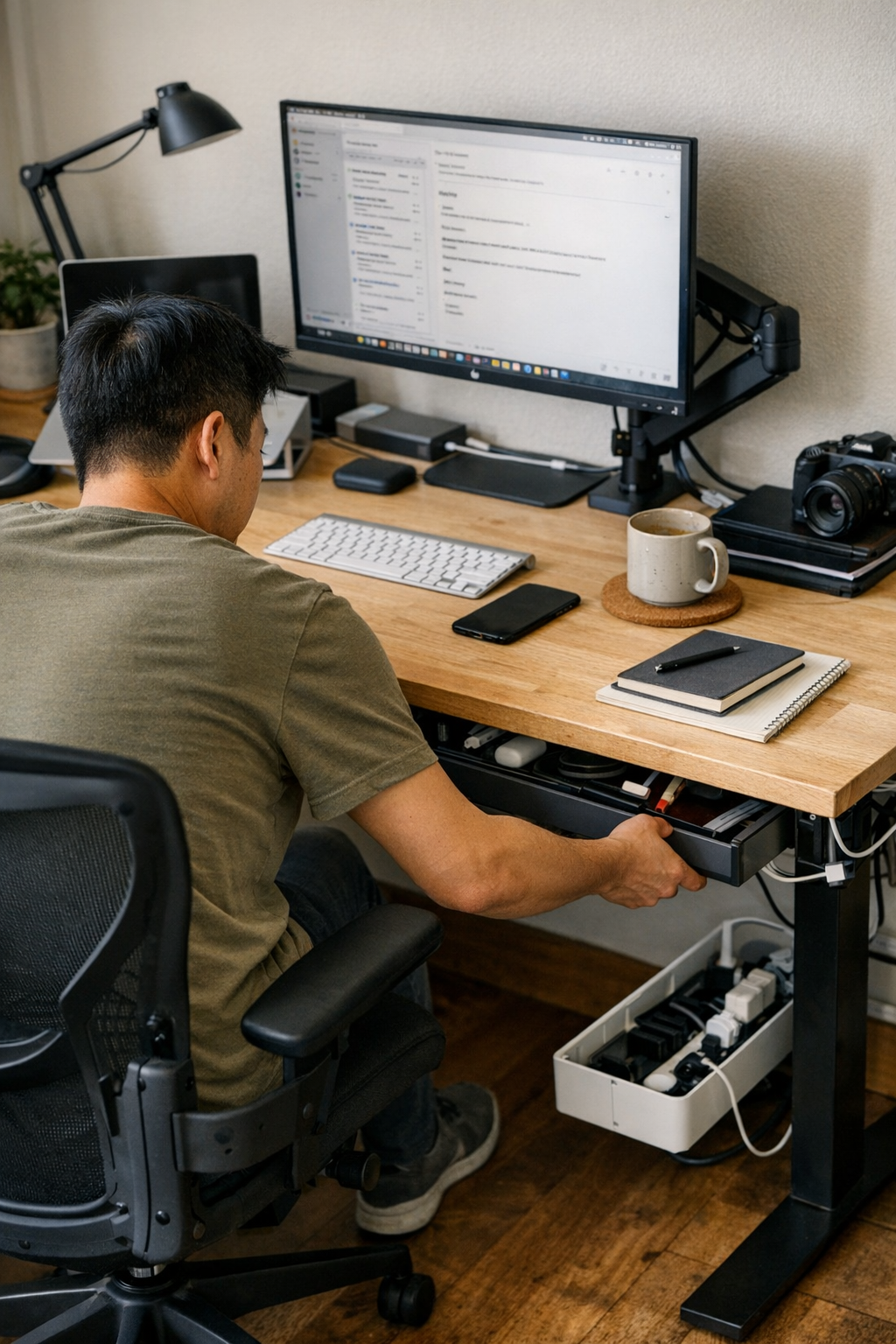
    A month of wrestling with hidden but awkward storage forced a reset. High-use items moved up to an accessible drawer, right within my seated reach. Cables I touch daily run along the front edge—visible, but out of the way—not buried behind a panel. Now, I can swap devices, stash supplies, or clear space in a single line of movement, no chair dancing, no pause. The routine of tidying disappears into use: every stow happens in rhythm, not as a separate to-do, and nothing gums up the middle of a busy stretch.

    The difference is practical, not just visual. When reset friction drops to zero, the desk actually stays organized without demanding extra effort or discipline. There’s no excuse-making about where the charger goes or why notebooks pile up; routines restore themselves because the steps match your flow. The workspace doesn’t just look neater—it runs with less drag, every single day.

    Questions that uncover hidden friction in your workspace

    Do small pauses keep popping up during resets?

    If “putting things away” means scooting your chair, ducking under the surface, or shifting posture, friction is there—even if it hides in routine. As real workloads pile up, these delays multiply and weigh down momentum.

    How deeply should cables actually be hidden?

    Total concealment might look right, but when fast cable swaps mean fishing for wires under the desk, the solution backfires. Instead, leave high-use cables reachable—organized, but in your real touch zone—so device changes don’t interrupt your rhythm.

    Are most-used items one motion away—or blocked by setup logic?

    If core tools end up buried behind or below your main seat line, you’ll create unofficial piles closer at hand—undoing order little by little. The best storage supports “one sweep” actions for the things you touch every session.

    Making hidden storage truly work: Small improvements, big impact

    Minimal surfaces mean nothing if every clean-up slows you down. The real standard is reset speed: how instantly you can stash, grab, or swap without straying from your seat’s natural arc. Effective hidden storage sits just inside your movement, not far outside of it, making day-to-day order easy instead of an end-of-week project.

    Test your setup: bring high-frequency items up a level, route your main charger along a reachable edge, or re-home that “essential” drawer to match your seated range. The right choices shift your workflow from stop-and-reset to nearly automatic order—a desk that remains clear because it works with your cycle, not against it.

    Hidden storage earns its place when it removes friction, not just clutter. The goal isn’t a showroom surface—it’s a setup that keeps pace with the way you actually work, making repeated resets simple, fast, and forgettable.

    Explore the full WorkBasic collection

  • Why Defining Your Storage System Before Buying Organizers Matters

    The urge to finally “get organized” in a garage, workshop, or shed always starts out hopeful: a Saturday trip down the organizer aisle, ready to conquer clutter for good. You buy the matching bins, sturdy racks, and stackable trays, load them onto every shelf and pegboard, and for a brief moment, it looks like real progress. But then you try to use the space—the real way you use it. That’s when things start to slide. The order looks convincing, but friction creeps in: bins block each other, wall racks swallow what you need, a rolling cart lodges itself in your main route for the third time this week. The space seems sorted but everyday tasks get messier, not simpler. Practical setups rarely need more containers—they need better flow.

    How “Organized” Can Still Mean Awkward—And Why It Keeps Happening

    It’s easy to feel done once everything looks uniform. But looks don’t fix the underlying problems. A stack of trays might line up on the bench, but by midweek you’re digging through the wrong one to find your favorite screwdriver. Hooks meant for tools turn into tangled parking for garden hoses, always at the wrong height. The rolling cart’s wheels jam in the only walkway that actually gets used, so you push it aside, rerouting yourself around obstacles you only created last weekend.

    This is the everyday cycle: a space that photographs neatly, but disrupts your routine. The problems never show up at setup. They show up later—on the third time you twist through a blocked path or move stacks just to access what’s hiding at the back. Everything technically fits, but nothing moves smoothly. You end up shoving containers an inch this way, a box that way, trying to make the arrangement adapt to your habits, instead of the other way around.

    Real Routine Interrupts: How Setup Creates Unexpected Barriers

    Working in smaller areas makes these gaps painfully clear. You mount a pegboard and sort bins by category, but soon you’re playing Tetris: always shifting something to get what you really need. The most-used tray ends up four feet away because it looked better there, not because you ever grab it from that angle. Unused wall space turns into a dumping ground for random cords, while the floor’s corners gather overflow—a bag of nuts and bolts, a grime-streaked tarp. These slowdowns are subtle, but constant—especially with dirty hands, a time crunch, or a chilly garage where one extra step is one too many.

    The friction is cumulative. In the evening, cleanup turns into awkward shuffling: stacking mismatched bins that don’t nest, sliding gloves onto any open surface, piling odds and ends onto a cart you have to relocate for the third time. Week after week, what started as order quietly morphs into constant mini-resets that steal your time and block smooth movement.

    Why Looking the Part Doesn’t Make a Space Work

    The visual payoff of a coordinated setup disappears the first time you need to unhook three things to access one. Trays that nestle perfectly together are a headache once you realize the items you use most are buried or blocked. Every reach-around or awkward maneuver is a reminder: organizers chosen for the sake of looking “tidy” often get in the way of real, repeated use.

    There’s a real cost here. Bad wall layout means tools drip onto the floor, oversized racks gobble up working space, and neglected corners fill with overflow that slows every task. The more you shuffle and shift, the less satisfying the “system” becomes—if it even counts as a system at all.

    The Hidden Gaps Routine Always Exposes

    The weaknesses surface during rushed mornings, sudden weather, or whenever your hands are full. That narrow storage path in the shed? Always blocked by a rolling cart you have to drag aside just to access drawers. Baskets tucked under benches? Great until you need one fast, crouching and re-sorting in an awkward huddle. What works in a catalog photo collapses under repeated, real-life cycles—the ones you didn’t plan for, but repeat every week.

    Shift Your Mindset: Design the System, Not Just the Storage

    The real fix doesn’t come from more containers. It comes from stepping back and mapping how you actually use the space. Walk the whole area. Where do your hands land first? Which path does your body naturally take? Where is movement always interrupted, and which stretch of wall or bench inevitably collects overflow?

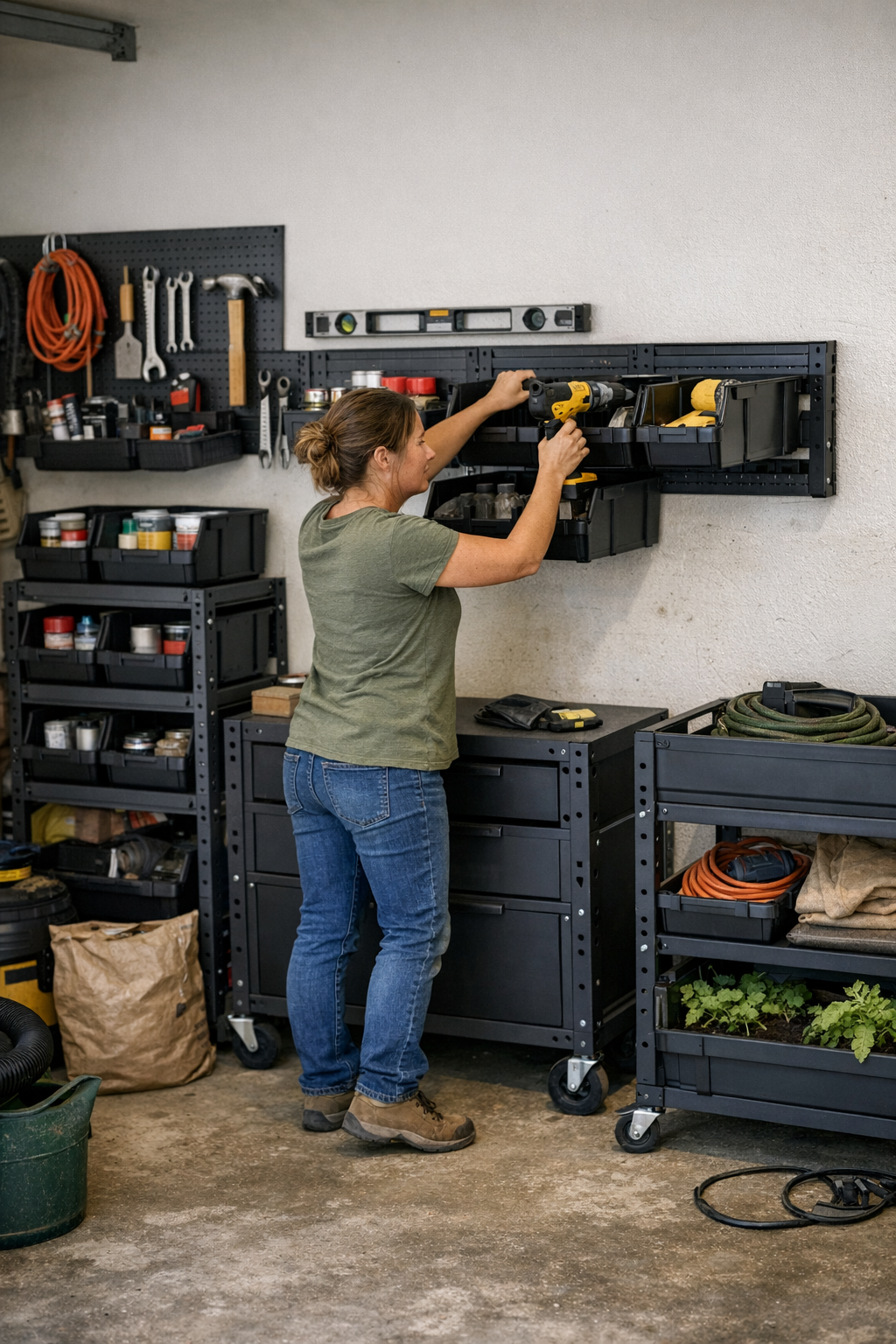
    Building a system means prioritizing effortless reach and uncluttered movement. That could mean a wall rail at standing height, holding trays that slide out without blocking anything else. Or modular panels that shift as your needs evolve—freeing you from a fixed rack that always pinches the same high-traffic spot. Instead of containers dictating your routine, the system adapts to you. The right layout clears paths, zones, and corners that would otherwise turn into storage purgatory.

    Practical Upgrades: What “System-First” Actually Changes

    When each organizer is chosen to slot into a bigger blueprint, the difference is immediately obvious. Tools you use weekly have their own tray, at a height you can reach in one motion—no reshuffling required. The wall system keeps overflow off the floor and finally kills the pile in that always-messy corner. End-of-week reset stops feeling like an all-day battle; each tool and glove lands where it belongs without friction, so you can actually finish and move on.

    It doesn’t look like a showroom. It feels like work goes faster and cleanup finally snaps into place. Nothing’s perfect, but the endless shuffling stops, replaced by a setup that lightens the load instead of building new obstacles.

    Spotting a Layout That Still Needs Work

    Does a cart block your walkway every time you open a cabinet? Does wall space look busy but nothing’s actually in reach? Do bins stack to awkward heights, or do categories keep bleeding together as you tidy?

    These are the tells: when the “organization” keeps breaking down into weekly rituals of restacking, redirecting, and re-sorting, the underlying system just isn’t right. Only when you can move through the space cleanly, grab what you need instantly, and return things without inventing new routines, do you know the setup is working with you—not against you.

    Turning Intentions Into Lasting Improvements

    If you want a space that stays organized, stop letting organizers dictate the plan. Start with movement, daily reach, and the ability to reset quickly—choose solutions that serve those needs. Usually that means fewer containers, smarter wall systems, and layouts that don’t require acrobatics to keep in shape.

    Organization stops being a battle the moment your setup feels frictionless—when trays draw out, carts park clear, and bins return to their spots without a second thought. That’s the shift: a workshop, garage, or shed that stores what matters, supports your real habits, and finally makes the whole project worth the effort.

    Shop StackNest for smarter workspace systems

  • Placing a Vacuum Dock Near Entryways Boosts Daily Cleanup Habits

    You know an entryway’s real limits the instant things start going wrong: one muddy dog loop, a rain-soaked backpack, or the first cascade of grit after soccer practice—suddenly the “clean zone” collapses. Not because of lack of storage, but because the one tool that could erase the mess is out of reach. A vacuum or broom stored even just a room away turns every small cleanup into a delay, and that delay—day after day—means shoes grind sand deeper, benches hide pet hair, and a so-called landing zone fills up with debris waiting to be dealt with “some other time.”

    The Entryway Battle: Mess Arrives Sooner Than You Think

    Most of your home’s dirt and clutter doesn’t sneak in—it gets dropped the moment someone walks through the door. Shoes leave a chalky trail while bags and wet jackets collect on whatever bench stands closest. That “reset” feeling after cleaning fades fast; within hours, you’re back to stepping over sand, tracking grit, and nudging a bent row of shoes out of the traffic lane. The issue isn’t the quantity of storage, but the practical distance between dirt and the tool that reverses it. Stash the vacuum behind a closet, and even small reset moments vanish. You feel the friction each time: pause to fetch the broom, or let the debris linger and grow. The entryway is never still long enough for one good clean to last.

    One Room Too Far: When Access Delays Action

    If a cleaning tool isn’t within reach of the drop zone, it might as well be off-limits. Shoes don’t get a quick brush-off; wet leaves get ignored rather than swept away; that easy, “just a minute” vacuum pass becomes something you put off until the buildup is visible. The routine argues against interruption—nobody, in the middle of returning home or heading out, wants to detour to a back cabinet just for a spot fix. By the time you do, debris has found all the seams: under the bench, behind the cabinet, right at the edge of the mats. Entryways don’t reward good intentions. They only respond to what’s actually within arm’s reach during the rush in and out.

    Clutter Drift: When Clean Zones Slip to Chaos

    Even the best storage setups—custom benches, nested cabinets, carefully measured cubbies—lose against daily drift if they don’t keep a cleanup tool in play. Here’s what happens in real homes:

    • Shoes line up tight, but as crumbs and sand collect, the row spreads and loses its order. The mess underneath quietly expands the zone.
    • Bags and gear land neatly on a bench, but edges collect pet hair, dried leaves, and loose grit. The once-clear surface turns into overflow storage and sheds debris onto the floor below.
    • The narrow gap between wall and cabinet becomes an unintentional holding area for every bit of dirt that goes unaddressed because no one wants to fetch the vacuum for “just a little pile.”

    Once the cleaning tool is out of sight, the drift accelerates. Delay becomes habit. Shoes, bags, and daily clutter push further into living space, all because the reset isn’t immediate.

    Back-to-Back Arrivals: Entryways Under Pressure

    Entryway order isn’t a single event—it’s tested every time someone walks through, especially in homes with overlapping routines. One person dumps muddy boots as the next piles in with a dripping backpack. Protective mats reach their limit fast, and anything left, like sand or wet grit, migrates under benches or into tight corners. If instant cleanup isn’t an option, the next arrival just steps around yesterday’s mess, compounding it. Over a weekend or even a single rainy day, that line between “organized” and “overrun” gets razor-thin.

    The Docking Difference: Moving Cleanup into Reach

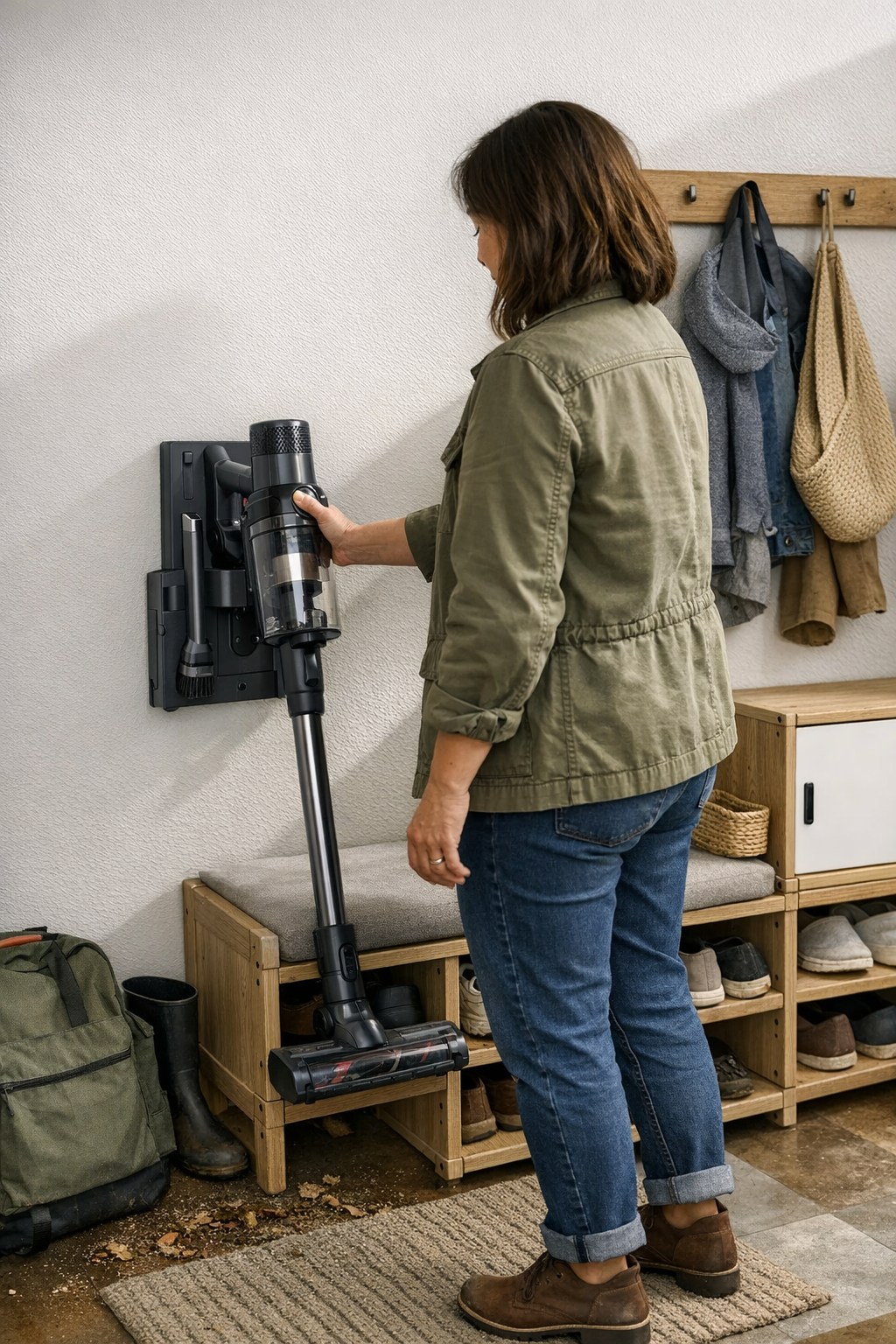
    Wall-mounting the vacuum dock right by the entry zone—no doors to open, no closets to dig through—changes the reset from project to habit. It isn’t about storage volume, but about proximity. Drop your bag, slip off your shoes, and in the same movement, a quick 90-second sweep catches what would have stayed hidden for a week. New messes don’t get time to settle and multiply. Instead, you catch sand, grit, and leaves before they become part of your daily scenery—and before “cleaning day” feels inevitable.

    Real-World Placement: Offsetting for Utility and Movement

    Placement shifts the whole dynamic. Mount a compact vacuum on the wall adjacent to the bench or main drop zone—not dead in the path, but not hidden around a corner. The goal: close enough for true convenience, far enough to avoid blocking the flow. This solves two real frictions at once:

    • Resets happen in stride, without making you re-route or reach awkwardly.
    • Paths stay open, eliminating the cluttered feeling of a storage “stage” that’s been overfilled or misplaced.

    The space stops being a showroom and starts working as a utility zone tuned to your actual exit-and-return pattern. Not always prettier, but less frustrating—the difference between starting the day organized and playing catch-up with clutter every evening.

    How Immediate Cleanups Change the Entire Routine

    With a docked vacuum visible and ready, spot cleaning becomes instinctive. You sweep before problems pile up, not as a rescue mission days later. Each micro-reset as people switch shoes, drop keys, or switch bags means dirt barely gets a chance to settle. As a result:

    • Shoe cubbies stay cleaner, not instantly filled with sand or pebbles after a single walk.
    • Benches stop becoming backlogs for crumbs, leaf fragments, and pet hair that used to spread via stray bags and gear.
    • Flow stays workable—there are fewer days where everything needs to be dumped and reset from scratch and fewer awkward bottlenecks trying to get out the door.

    The improvement isn’t about perfection, but about shrinking mess before it becomes a cycle.

    Tip: Use a Compact, Rechargeable Dock

    Only a slim, cord-free vacuum dock survives the real test: daily demand in tight, high-traffic entryways. Mount it at standing height, just next to but never blocking the bench. The best setup is always “in reach, out of the way”—present enough to become part of your return and departure routine, but never so prominent that movement gets pinched or pathways tighten and clog after a few arrivals.

    The Line Between Looking Organized and Staying Organized

    Style or storage alone cannot hold the line if resets require effort or detours. Entryways that only look neat on the first day slip quickly once real use resumes. Storage and gear that join the natural traffic pattern—visible, reachable, and offset for movement—eliminate the silent drift toward chaos. When the vacuum dock lives in the zone, resets shrink to seconds and mess never has a chance to become structural.

    Those tiny, repeated frictions—one extra step, one more thing to move, a single delay between seeing dirt and lifting it—add up to whether your entryway works for you or quietly works against you every single day. The right transition-space setup turns the difference into daily routine, not wishful “later.”

    Practical transition-space storage for entryways and daily drop zones is at Betweenry.

  • How a Single Basket Transforms Cat Care and Keeps Counters Clear

    The counter looks under control after a Sunday reset—bare, supplies stowed, nothing in the way. But by Wednesday, the refill bag is rubbing elbows with the coffee maker, the grooming brush has drifted to food prep territory, and the kibble scoop hides behind a bowl. Even neat setups quietly turn into an obstacle course: one errant spoon, one pouch in the blind spot, and breakfast runs straight into a reshuffling tangle you didn’t plan on. With every reset, the same silent pattern returns—cat-life tools spreading into every open space, stalling your morning, and erasing any sense that “tidy” means easy upkeep.

    Invisible Build-Up: The Counter Clutter Loop

    A tidy setup at a glance doesn’t mean it will stay workable midweek. You fill water, grab treats, brush fur, and keep parking each tool “just for now”—creating small blockades for next time. By Wednesday night, the scoop’s vanished behind wipes, treat packets edge under the placemat, and grooming tools wedge near the sink. The buildup isn’t just visual; it grinds down every routine—reaching for a can opener only to bump a sticky brush, nudging a toppling refill bag, or trying to fish a litter scoop out from a wonky gap behind the stove. Every step gets a little slower, every fix a little less satisfying, and the friction quietly returns just when you need the area to go on autopilot.

    Flat Surfaces: A Magnet for Micro-Mess

    Cleared counters look like order but double as magnets for mess within two days of real use. Most setups cluster feeding, care, and cleaning tools along the flattest, most available stretch. After reset, everything lines up. But within hours, feeding scoops overlap with half-used bags, a water additive bottle inches into the wrong zone, and by Thursday, a supposedly quick breakfast demands five minutes of shuffling around misplaced items. The warning sign? When a treat pouch starts sliding under the mat’s edge or a brush edges too close to prep space. Flat surfaces attract “temporary” drop-offs until the real fix—one big counter sweep—gets delayed again and again.

    The mess doesn’t show up with catastrophe. Instead, it leaks in: a toy under the dish rack, feeding tools trailing behind prep spaces, and slow creep as regular routines overflow into the same free space. Every delay—refilling, wiping, hunting for a lost scoop—signals a structure problem, not just a tidiness lapse.

    Routine Friction: When Function Doesn’t Follow Form

    Clutter changes daily rhythm fast. Suddenly, you’re sidestepping wipes to fill a water bowl, relocating a stray brush before you can prep food, or trying to clean up breakfast only to find yesterday’s toy jammed against the litter scoop. What looked like order after reset becomes a pattern of detours and repeat-mess. Instead of your setup supporting you, you’re working around its blind spots—and the backup builds with every feed, refill, and “just leave this here” moment.

    This tension stays background but real, making each task slightly slower and more frustrating. Cat care areas don’t just look less pleasant—they take more time, more movement, and sometimes more mess, quietly working against the feeling that your space fits your routine.

    The Open Basket: Turning Chaos into Containment

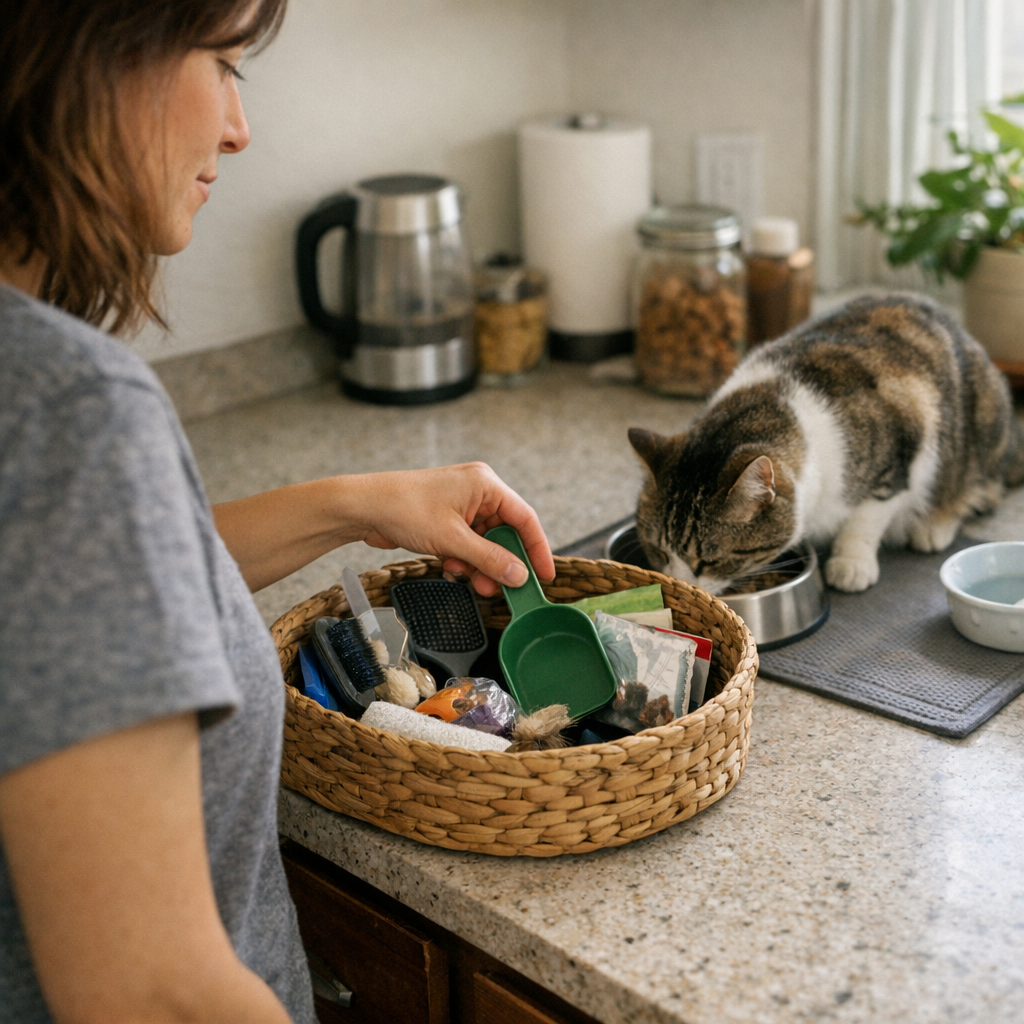
    One open, heavy basket near your cat care setup changes the problem. Rather than micro-clutter spreading across the counter, the basket corrals the high-turnover tools: treat pouches, feeding scoops, water additive, the lint roller, the timer for water refresh. Each used item lands in the same zone, not scattered through prep, coffee, and sink areas. The routine changes—mealtime ends, scoop gets dropped in, brush returns straight in after a quick use, refill pouches drop into a single spot. When it’s time to actually reset, one glance tells you everything: nothing’s hidden behind, everything’s out and visible, and the cleanup at the end of the day doesn’t spiral.

    What Happens Without the Basket? Daily Memory Leaks

    Drop the basket, and every routine leaves an invisible trail. After a few rounds, you’re searching for the scoop (it’s under the kettle again), chasing a treat pouch that rolled behind something, picking a brush up from the floor because a quick cat paw sent it flying. Tidy looks fade as each use secretly undoes the last reset. The weak point? Every object that’s not anchored returns as a friction point—until the only solution is starting over from scratch.

    Choosing the Right Basket: Function Over Flair

    The best basket is practical, not pretty—shallow but with weight. If it’s too light, your cat can shove it onto the floor with one swipe; too deep, and daily tools disappear into the pile. It should be easy to grab from, hard to accidentally tip, and visible at a glance so you never wonder if an essential’s gone missing. Test for real use: does a wet scoop drop straight in, or does it tip the basket? Can you find the brush without digging? Does it absorb clutter or just add another thing to trip over?

    Location matters. If the basket lands right in your cat’s main sprint zone, it’s just another thing to scatter—or for a playful swipe to send rolling. Move it close enough to your care area to stay useful, but out of the lane of cat traffic and kitchen chaos. Actually run through your routine with it in place and see if it survives the first day’s cycle.

    Only the Essentials: Defeating Overflow Before It Starts

    Most basket systems fail by trying to pack in everything “just in case.” Extra medicine droppers, back-up bags, spare collars, and dried out sprays do nothing but clog up fast grabs. The more you stuff in, the more every reset adds time and guesswork, as low-turnover supplies pile on top of true essentials. The easy fix: keep only the things you use in a single day’s cycle in the basket. If you’re staring at three types of water additive or digging under an old pill container for a treat, something’s ready to rotate out. Overflow turns “organized” into another routine roadblock.

    Hands pausing mid-grab are the early-warning system—if you stop to sort, you’ve lost the supposed speed advantage. Reset is about quick, repeatable flow, not storage for every possible need.

    The Pitfall of Multiple Containers

    Trying to separate feeding, litter, grooming, and toys into different bins feels organized but usually multiplies steps. Each extra container adds a round trip, a new spot to check, and stacks of “sorted” things that in practice just fragment the clean-up and make quick resets more complicated. For most setups, a single, visible, open absorber is faster, more honest, and tougher for real-life clutter to defeat than a set of neat, semi-empty containers that still slow you down.

    Signs Your Maintenance System Is (Finally) Working For You

    • Reset takes one minute, not five. The scoop, brush, and wipes are all right where you expect—not scattered or stuck behind appliances.
    • Nothing blocks human or cat movement. Chaos gets absorbed in the basket; tools no longer detour into meal-prep zones, walkways, or risky ledges.
    • Cleanup tools land where they’re supposed to. No hunting for a missing brush or scoop—they’re always in reach when needed, not halfway across the room.
    • Overflow is obvious, not sneaky. As soon as things outgrow the basket, it signals a cull—no more slow creep or stealthy pileup.
    • Essentials stay in real rotation. At a glance, you can spot what’s low, what needs replacing, or what’s overdue for a reset—no more lost tools or extra purchases because something slipped past your mental list.

    Real Changes, Not Just Visual Improvement

    Looking tidy isn’t the same as moving smoothly through routines. A good basket system does more than clear visual mess—it keeps feeding, cleaning, and reset cycles easy, even after the fifth run of the day. When clutter creeps back in—basket overflow, or too many “just in case” extras slowing grabs—a quick purge restores speed. The system should be flexible enough to absorb disruptions but firm enough to keep basics visible. The payoff? Less wasted motion, fewer forgotten tools, and a setup that’s actually use-ready, not just good-looking after a reset.

    Resetting Your Indoor Cat Life—One Reach at a Time

    A basket isn’t magic, but it anchors your routines. Routine friction drops, resets stop ballooning, and your home keeps pace with every daily cycle—without making you repeat the same old cleanup work.

    Explore the StillWhisker world for practical indoor-cat-life upgrades.