
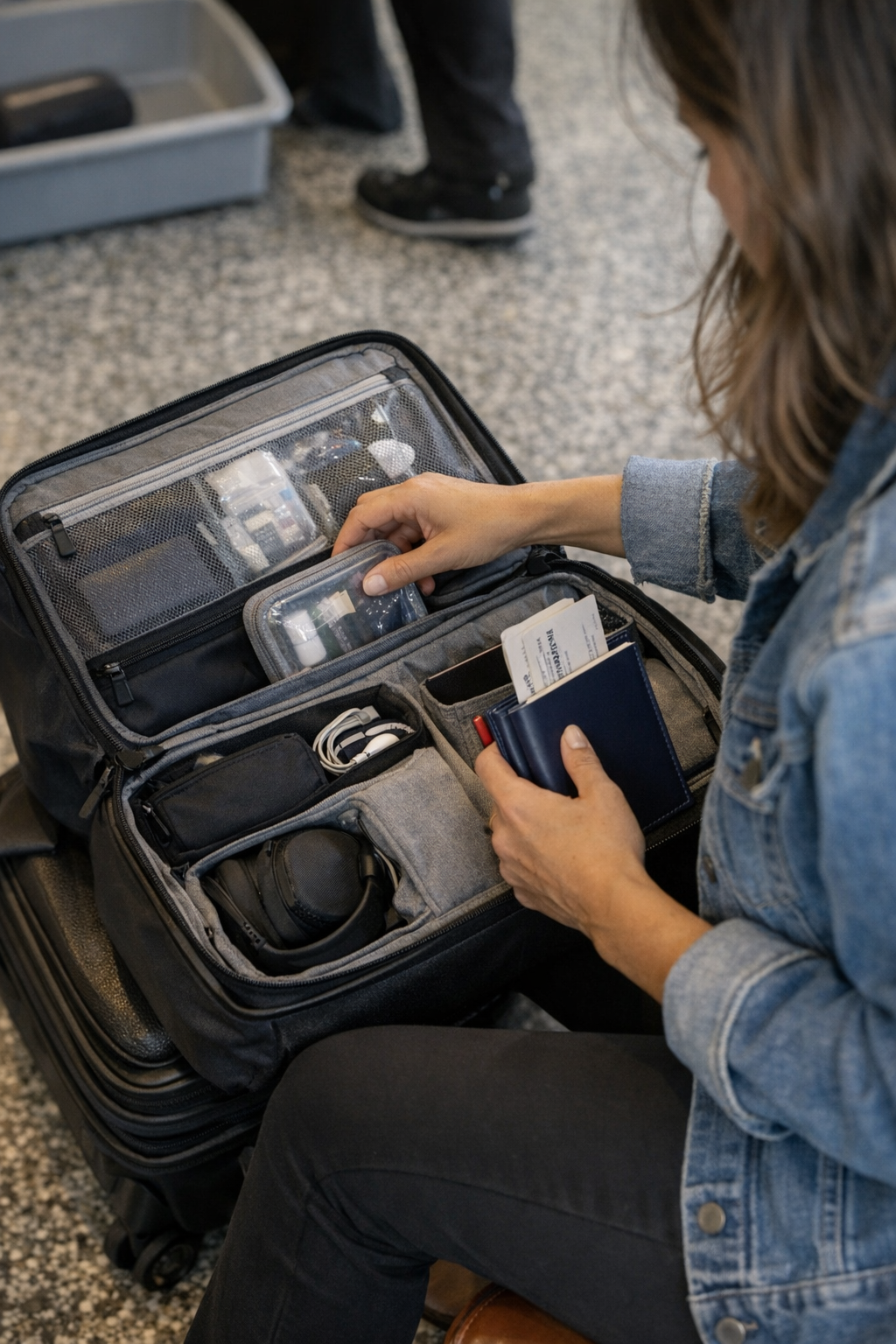
Your carry-on can look perfectly organized—zippers closed, pouches in order—until the first airport shuffle turns that tidy setup into a source of second-guessing and slowdowns. Clean lines at the hotel don’t survive the reality of security checks, boarding queues, and repeated access demands. What appears efficient at rest becomes a frustration machine in motion: organization by category (“all documents here, all tech there”) quickly unravels the moment your real routine asks for something in a different sequence—leaving you hesitating at zippers, digging through layers, and losing time with every unexpected reach.
When “Organized” Isn’t Enough: Travel Routines That Break Down the System
Most travel setups fail quietly, not suddenly. On your first gate transfer, the bag operates as planned—boarding pass right up front, passport in place. But as soon as you’ve gone through a security check or reached for a snack in-flight, items shift. Now, needed documents are buried under the headphones you last grabbed, or your passport has migrated below your toiletry kit, out of instant reach.
Every small interruption—like tracing your hand past three chargers to find your ID, or pausing to check if the right pouch holds your immigration form—feels minor in isolation. But string these interruptions together, and your entire journey gets peppered with slowdowns: waiting for your tray at security because your wallet disappeared into the bag’s base, unzipping the same outer pocket again in the boarding line, feeling that creeping frustration as your setup fails to keep up with movement.
The Real Cost of Subtle Mis-Grouping
Packing that looks organized fails when it doesn’t match your actual travel flow. You hesitate before unzipping—main compartment or side pouch? Do you need to slide out the tech organizer or reach through your sweatshirt first? Suddenly, every retrieval is a gamble, turning easy movement into micro-delays that stack up fast. The entire benefit of so-called “tidy packing” disappears the moment you can’t pull what you need in a single, confident motion.
Grouping by Use Moments: How the Flow Changes
Swapping category-based packing for a use-moment structure changes the whole carry-on dynamic. Instead of “tech here, snacks there,” your system links each pocket or pouch to a travel phase—screening, boarding, in-flight, arrival—regardless of category. Items needed at security go together. Boarding essentials don’t share space with in-flight gear. Every section is loaded for a real step in your routine, not just for visual symmetry.
This isn’t an abstract improvement—it’s visible in the quickest, most repetitive movements:
- At security: ID, passport, and scan-required items are grouped in an outer-access pouch. You avoid holding up the tray line to hunt for documents hiding beneath your laptop sleeve.
- During boarding: Boarding pass and seat details come out fast, not tangled with snacks or a phone charger. The line moves past you instead of bunching up while you repack on the spot.
- In-flight: Anything you’ll actually use—pen, headphones, cable—is within touch range, so even in a cramped seat you’re not elbow-deep in gear you don’t need yet.
- On arrival: Customs forms and landing documents are already separated; you coast through the immigration counter while others repack in a panic.
Recognizing Friction: Where Delays Creep In
These aren’t dramatic failures. It’s the hand-slip before you commit to a zipper. The awkward pause at the tray, debating which pouch hid your passport. The routine of rebuilding your setup before each checkpoint because one rushed reach-in wrecked the order. Or, worse, the sideways stance in the aisle, bag unzipped and every pouch half-open, blocking the flow while you pull out a single form.
This is the real tax of poor carry-on structure: routine interruptions stealing attention, time, and movement. Ignore it, and by your third transfer, “orderly packing” is just a memory. Your energy goes into fixing the system rather than flowing with it.
Real-World Scenes: Why Use-Moment Packing Sticks
What does this difference actually look like across routine travel?
Security: One Zipper, No Shuffle
You reach security, unclip one section, and every needed item lands in the tray at once—ID, boarding pass, loose electronics, all grouped. No public sorting, no holding up the belt. You move on fast while others paw through pockets, exposing half their bag just for one passport.
Boarding: Seamless Swaps, Less Holding Up the Line
The gate agent is ready? You grab your pass and ID in one motion from the outside slot, not buried two layers deep. The bag stays upright, you’re not blocking the scanner with open flaps and loose contents. Everything goes back as a unit, not in panic.
In-Flight: Predictable Access, Even When Cramped
With your carry-on stuffed under the seat, you don’t need to pull it up for every pen or cable. Your in-flight group—audio, charger, pen—sits together near the zipper path you can reach blind. No sidelong motion waking your neighbor, no gear avalanche across your lap just to find a single item.
Arrival: No Repacking at the Counter
Customs line? You open the arrival pouch: form, passport, receipts—already separated from snacks and headphones. You’re not the traveler folding over their bag on the counter, repacking spilled items one-handed while juggling documents in the other. Clearing the terminal is a handoff, not a gear shuffle.
Resetting the Structure: The Hidden Discipline
Even the right setup can fall apart fast if you skip the “reset.” Putting each item back into its use-moment group after every phase is the upkeep most travelers ignore. Stuff a passport into the first open pouch—even once—and the friction returns. One lax transition multiplies the hassle at every checkpoint that follows. The discipline is small but stubborn: one zipper, one repack, each time—saves hours across trip after trip.
The Visible Difference: Less Correction, More Flow
You’ll spot the payoff fast: using your bag stops feeling like constant recovery mode. Correction spirals—where you regularly pause to re-sort or backtrack—drop sharply. Slowdowns at touchy points like security or boarding become the rare exception. You find your mind is on your route, not on babying your setup. The outer look—magazine-level tidy or not—matters much less than the internal logic that lets your travel move with you, not against you.
Is this system flawless? Airport crowds still force moments of mess. Random checks can break your rhythm. But less interruption means you get on with your trip, not with fighting your own gear. Sacrificing some picture-perfect order for real-world access pays off where it matters: in the actual movement, not the visual.
Packing for Movement, Not Just Appearance
Organized cables, lined-up pens, well-folded snacks—these can look great, but they don’t always deliver in the clutch. A setup mapped to your travel sequence is messier outside but frictionless in real use: a pouch for each “move,” a pocket mapped to every checkpoint, a setup that works for life in motion—not a packing photo shoot.
If you want a carry-on routine that works beyond the hotel mirror, watch where your current setup makes you pause or double-check. Assign a section for each travel moment, keep items grouped by what happens next, and let your carry-on catch up to how airport days actually move.
See practical tools for real carry-on routines at CarryOnSupply