
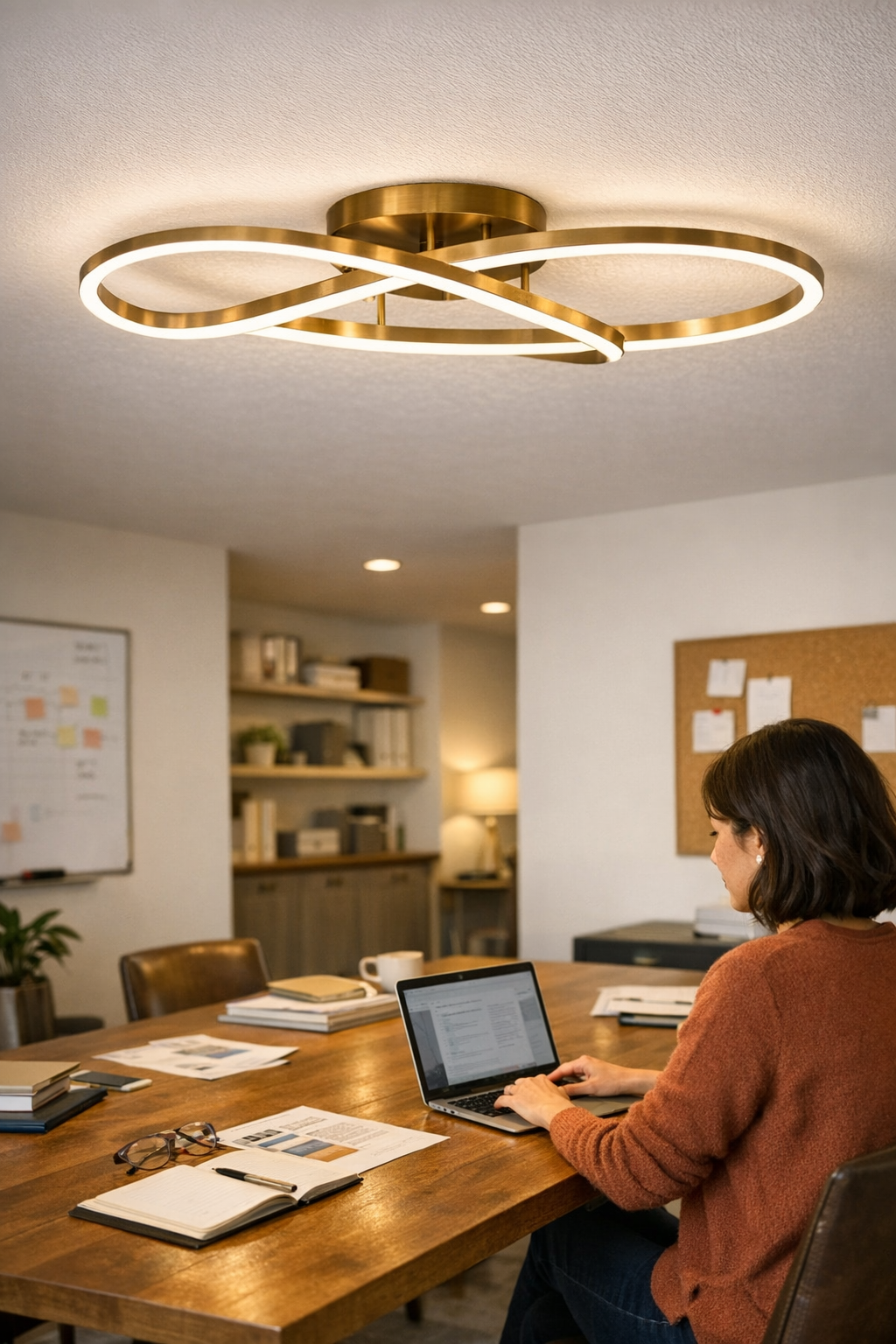
Linear vs. panel ceiling lights: the biggest difference usually surfaces after you move past the first week—once work spreads out, cables migrate, and the smooth, symmetrical fixture overhead can’t keep up with the room’s real rhythms. That panel, so clean in pictures, leaves one side of the counter in shadow and the corners unclaimed as people gravitate toward the center for survival brightness. Meanwhile, the urge to haul in extension cords, prop up extra lamps, or nudge your chair to dodge glare starts to feel inevitable, no matter how sleek the original plan looked.
Where Looks Slip and Friction Creeps In
The appeal of a flush-mount panel or slim overhead rectangle is all about eliminating the mess of cables and forgetting the chaos of scattered plug-ins. But after a few normal days—papers sprawled, laptops charging, team discussions—the flaws show up as lived-in inconvenience. It isn’t that the fixture is broken; it’s that the simplest ceiling setup ignores where light fades out. The “clean” look overhead can unravel at ground level: distant desk edges sink into shadow, group work clusters in hotspots, extension cords snake between seats, and those side-table lamps you thought were gone creep back to fill the gap. The fixture may hang straight and tidy, but the everyday lighting pattern is full of blind spots.
When Surface Lighting Falls Short in Real Life
A centered ceiling panel makes for a tidy diagram but rarely aligns with the action below. Picture the daily routine: the main table runs the length of the room, but the brightest beam falls onto the walking path or halfway across someone’s notes. People at the far edge lean forward, shift chairs, or play musical seats for a temporary lighting upgrade. The result? The room doesn’t stay clean for long. Personal lamps reappear, wires resurface, and the initial effort at order is chipped away by workarounds and clutter hiding in plain sight.
Shift to a linear fixture, lined up directly over the working zone, and the equation changes. Run it lengthwise, not just centered, and shadows along the far edge disappear. Task coverage follows the table, not the ceiling pattern. The difference isn’t just light distribution—it’s eliminating the cycle: no one fighting for a “good spot,” fewer random fixes, and less eye strain by the end of the day.
Spotting the Trouble Before It Settles In
The “wrong fit” rarely jumps out at installation. It’s the subtle daily workarounds—documents drifting into dimness, arms stretched to shield screens from reflection, cables sneaking back for emergency side lighting. The room looks handled at a glance but feels unfinished the moment you’re chasing usable light or tidying up somebody else’s extension cord.
Small Changes, Big Difference: Aligning Light to Routine
One overlooked fix: match the fixture to the active zone, not the architectural symmetry. In a recent office reset, replacing a centered panel with a continuous 2.4-meter linear above the main table snapped the lingering shadow from the table edge into full visibility. The old tide of personal lamps vanished, and cable creep stopped. Was it flawless? Not completely; a faint dim strip near the doorway lingered. But the “make do” improvisation everyone tolerated simply faded out, replaced by a layout that held up against real use patterns.
Lighting should move with people, with habits, with the shifting nature of the surface—not just fill a checklist or land in the ceiling’s geometric center.
Uneven Coverage and the Return of Clutter
Even a top-spec fixture fails if it’s undersized, dropped in the aesthetic sweet spot, or simply not built for the real way people use the room. Too-short linears or panels that only bless the center leave new busy zones in the dim. More users multiply the problem—edges darken, corners get cold, and the scramble for power and useful visibility restarts. The tension doesn’t come from installation but from the drag of adding “patch” after patch—extra lamps, creative cable trails—until the setup feels more complicated than what it replaced.
Why the “Clean Look” Isn’t Always the Best Use
A recessed fixture wins on cable control, but if it can’t visibly light the actual surface in play, the workaround cycle resumes. That first impression of polish breaks down by week two as the routine outpaces the overhead plan. Spot the mismatch before the extensions and table lamps multiply—otherwise, “clean” turns into “constantly corrected.”
Reducing Cable Chaos Before It Starts
Cable creep is relentless in shared or shifting workspaces. The moment someone can’t see clearly, their own fix—an extra lamp, a new extension—finds its way in. Soon, cords tie up walkways and clutter the floor. The way out: select fixtures with built-in cable guidance or keep installation tight overhead, directly above the main surface. Wire management up and out of the way blocks the chronic extension-cord drift and preserves the look (and safety) longer than any quick rearrangement.
The best “clean” is the one that doesn’t unravel the moment the routine gets busy again.
Recognizing and Addressing the Good-Enough Illusion
It’s easy to be lulled by how finished a room looks right after setup. But when the floor is retaped with cords after a few weeks, or you’re shifting lamps yet again, “good enough” shows its limits. An overhead panel can function for balanced, square rooms or small focused tasks—but in longer, group-oriented, or single-axis surfaces, linear fixtures step up with coverage where people actually work and move. The difference is felt not in the installation, but in having less to fix every week.
Quick Tips for Fixing Daily Lighting Strain
- Inspect the real working zone, not just the middle: Sit or stand where the activities actually happen. Can you see every inch of your task surface, or does shadow block the edge?
- Spot cable creep early: If new power strips or extension cords appear by week four, your overhead approach is missing a stretch of usable space.
- Don’t accept “almost right” fixture placement: Sometimes moving a linear, choosing a longer fitting, or carefully rotating the light makes the whole surface workable—no major overhaul needed.
Final Note: Match Lighting to Use, Not Just Appearance
Lighting setups that survive the first month often reveal what actually matters—how much improvisation is still needed. If you keep finding temporary solutions accumulating underfoot or at the far end of a table, it’s time to question whether the lights fit the true repeat pattern. For project tables, shared desks, or daily-use surfaces, aim for fixtures and supports that manage cables and give real, even coverage, even if it means bending symmetry or revising that tidy-looking plan. Everyday usability always outlasts a first impression.